We wish you Happy Holidays & a joyful New Year!

Compare rubber-based and acrylic adhesives for labels. Understand their adhesion strength, temperature resistance, durability, and applications to choose the right adhesive for your business.
November 19, 2026
John Doe
A label that looks perfect when it leaves the production line can become a costly problem once it reaches the warehouse, distribution centre, or retail shelf. Corners start lifting, adhesive edges become sticky, or printed information becomes difficult to read. For manufacturers and packaging businesses, these problems can lead to rejected products, rework, and unnecessary production costs.
In many cases, the problem isn't the label material or printing quality. It's the adhesive holding everything together.
Choosing between rubber-based and acrylic adhesive is an important decision for any business that depends on reliable product labelling. Both adhesive types have their advantages, but they perform differently depending on the application surface, temperature, storage conditions, and expected product life.
So, which one should you choose?
In this guide, we'll compare rubber-based vs. acrylic adhesive, explain their key differences, and explore where each performs best. We'll also look at practical considerations that label manufacturers, packaging companies, and procurement teams should evaluate before placing a bulk order.
At FormersPaper, we understand that choosing the right label involves more than selecting a face material. The adhesive, liner, printing requirements, and application environment all influence the final result.
Before comparing their performance, it's important to understand what makes these two adhesive technologies different.
Rubber-based and acrylic adhesives are commonly used in pressure-sensitive labels. These adhesives allow labels to stick to surfaces when pressure is applied, without requiring additional heat or water during application.
However, their chemical composition affects how quickly they bond, how they perform under different temperatures, and how well they maintain adhesion over time.
Let's look at each type.
Rubber-based adhesive is made using natural or synthetic rubber polymers combined with sticky resins known as tackifiers. These resins help the adhesive develop a strong initial bond when it comes into contact with a surface.
One of its biggest advantages is its quick gripping ability. Once applied, it can provide strong initial tack without requiring a long waiting period to develop adhesion.
Many rubber-based label adhesives are supplied in hot melt formulations. During manufacturing, the adhesive is heated until it flows and can be applied to the label material.
Main advantages of rubber-based adhesives include:
However, rubber-based adhesives also have limitations. Some formulations can lose performance when exposed to prolonged heat, UV light, or ageing. They may also soften, discolour, or develop adhesive ooze under unsuitable storage conditions.
Acrylic-based adhesive uses synthetic acrylic polymers to create a pressure-sensitive bond. It is widely used in applications where labels need to remain attached for extended periods.
Unlike many rubber-based formulations, acrylic adhesives generally offer better resistance to sunlight, oxidation, and ageing.
Many conventional acrylic label adhesives are water-based emulsions. During manufacturing, the adhesive is coated onto the label material and dried through a controlled heating process.
Acrylic adhesives may develop their full bonding strength gradually. Depending on the formulation and application conditions, this can take approximately 24 to 72 hours.
Main advantages of acrylic adhesives include:
However, acrylic adhesives also have limitations. Their initial tack may be lower than that of rubber-based alternatives, and some formulations require a minimum application temperature. Special adhesive grades may also be necessary for difficult surfaces such as polyethylene and polypropylene.
For B2B buyers, understanding the practical differences between these adhesives is more useful than simply comparing their chemical compositions.
The right choice depends on how the label will be applied, where the finished product will be stored, and how long the label needs to remain in place.
Here's a side-by-side comparison.
1. Initial Tack
2. Bond Development
3. Heat Resistance
4. UV Resistance
5. Ageing Resistance
6. Cold Application
7. Rough Surface Compatibility
8. Low-Energy Plastic Compatibility
9. Clear Label Applications
10. Cost
Note: These are general performance characteristics. Actual results vary according to adhesive formulation, label construction, application conditions, and manufacturer specifications.
Initial tack describes how quickly an adhesive grabs a surface after contact. It is particularly important in high-speed labelling operations where products move continuously along production lines.
Rubber-based adhesives generally offer stronger initial tack. This makes them useful for applications where labels need to stick immediately, including cartons, packaging materials, and certain plastic containers.
Acrylic adhesives may take longer to develop their full bond. However, they can provide reliable long-term adhesion once properly applied.
Temperature affects adhesive performance at two different stages: application and product storage.
Rubber-based adhesives often perform well when labels need to be applied to cold surfaces. However, some standard grades may soften when exposed to prolonged high temperatures.
Acrylic adhesives generally provide better resistance to heat and temperature-related ageing.
For businesses handling frozen products, refrigerated packaging, or goods stored in hot warehouses, selecting an adhesive grade designed for the actual temperature range is essential.
Labels used in food packaging, beverage containers, and industrial environments may come into contact with moisture, condensation, cleaning agents, or chemicals.
Acrylic adhesives generally offer better resistance to environmental ageing and many chemicals, although performance depends on the specific formulation.
Rubber-based adhesives can work well in many standard packaging environments, but prolonged exposure to moisture and certain chemicals may affect their bonding performance.
For demanding applications, always request product-specific resistance information from your label supplier.
Sunlight can gradually affect both label materials and adhesives.
Rubber-based adhesives are generally more vulnerable to UV exposure and oxidation. Over time, some formulations may become yellow or lose their original bonding properties.
Acrylic adhesives typically offer better resistance to sunlight and ageing, making them a suitable choice for products displayed outdoors or stored for extended periods.
This is particularly important for transparent labels, where adhesive discoloration can affect the overall appearance of the product.
Not every business needs a permanent label. Some applications require labels that can be removed without damaging the product surface.
Both rubber-based and acrylic adhesives are available in permanent and removable formulations.
The amount of residue left behind depends on the adhesive grade, application surface, bonding time, and removal conditions.
If your business requires removable labels, request samples of the specific adhesive grade rather than assuming that one adhesive family will always be easier to remove.
Rubber-based adhesives are often a more economical choice for general-purpose applications, especially when immediate bonding is important.
Acrylic adhesives may have a higher initial material cost in some applications, but their durability can make them a better investment for products requiring longer shelf life or greater environmental resistance.
For procurement teams, the best comparison should include the total cost of labelling, not just the adhesive price. Label failures, rejected packaging, production downtime, and replacement costs can quickly affect the overall budget.
Rubber-based adhesives are commonly selected for applications that require quick bonding and strong initial tack.
Rubber-based adhesives can be suitable for:
Acrylic adhesives are often preferred when long-term performance and environmental resistance are important purchasing considerations.
Acrylic adhesives are commonly used for:
Hot melt adhesive is often mentioned alongside rubber-based adhesive, but the two terms do not mean the same thing.
Hot melt describes the method used to apply an adhesive. The material is heated until it becomes fluid, coated onto the label material, and allowed to cool.
Many hot melt pressure-sensitive adhesives use rubber-based polymers. However, acrylic adhesives are also available in hot melt formulations.
This distinction matters when comparing adhesive specifications from different suppliers.
When requesting a quotation, don't simply ask whether a label uses hot melt or acrylic adhesive. Ask about the adhesive chemistry, application method, and performance specifications.
FormersPaper also covers this subject in more detail in its guide to permanent hot melt vs. permanent water-based acrylic adhesive.
When evaluating label adhesives, three technical measurements deserve particular attention: tack, peel strength, and shear resistance.
Understanding these measurements helps purchasing teams compare adhesive specifications more accurately.
Tack measures how quickly an adhesive forms an initial bond when it comes into contact with a surface.
It is especially important for high-speed labelling lines where labels must stick immediately after application.
Rubber-based adhesives generally perform well in this area.
Peel strength measures the force required to remove a label from a surface.
It helps determine how securely a label remains attached when someone tries to lift or peel it away.
Shear resistance measures an adhesive's ability to withstand forces that try to make a bonded label slide across a surface.
This is particularly important for labels exposed to weight, pressure, heat, or prolonged storage.
A rubber-based adhesive may offer excellent initial tack, while an acrylic formulation may provide better long-term performance under certain conditions.
For this reason, B2B buyers should review all three measurements rather than selecting an adhesive based on a single specification.
Even a high-quality adhesive may fail if it is not compatible with the packaging surface.
The material receiving the label plays a major role in determining how well the adhesive bonds.
Here are some common examples.
PE and PP are low-surface-energy plastics. Their smooth surfaces can make adhesive bonding more challenging.
Rubber-based adhesives often provide good initial adhesion to these materials. Specially formulated acrylic adhesives can also work well.
Glass and metal generally provide suitable surfaces for many acrylic adhesive formulations.
These materials are commonly used in beverage, cosmetic, chemical, and industrial packaging.
PET is widely used for bottles, containers, and product packaging.
Acrylic adhesives are often suitable for PET labels, particularly where long-term appearance and durability matter.
Plasticised PVC can create adhesive compatibility challenges because plasticisers may migrate into the adhesive layer over time.
Acrylic adhesives may offer better resistance to this issue in certain applications, but testing is still necessary.
Thermal paper requires special attention because it reacts to heat.
The adhesive, face material, printing method, and application conditions should be evaluated together to avoid printing or converting problems.
At FormersPaper, label materials include paper, thermal paper, PP, PE, and PET. This allows businesses to discuss different material and adhesive combinations based on their packaging requirements.
Different industries have different labelling requirements. A shipping label does not need the same performance characteristics as a pharmaceutical label or an outdoor industrial identification label.
Let's look at some common B2B applications.
Food and beverage labels may be exposed to refrigeration, condensation, moisture, and changing storage temperatures.
Rubber-based adhesives can be useful for certain cold and fast-moving packaging applications. Acrylic adhesives may be preferable when long-term durability and resistance to environmental ageing are priorities.
The adhesive must also meet the applicable regulatory requirements for the intended packaging construction.
Pharmaceutical labels need to remain readable and securely attached throughout storage, transportation, and handling.
Acrylic adhesives can be suitable for long-term product identification and labels exposed to changing environmental conditions.
However, the correct choice depends on the packaging surface, storage conditions, and regulatory requirements.
Industrial labels often face heat, friction, moisture, chemicals, and outdoor exposure.
Acrylic adhesives are frequently considered for applications requiring long-term durability and environmental resistance.
For demanding industrial surfaces, specialised adhesive formulations and application testing are essential.
Shipping and warehouse labels need to stick quickly and remain readable throughout transportation.
Rubber-based adhesives can be a practical choice for cartons, corrugated packaging, and general-purpose shipping labels.
The right grade should also account for storage temperature, carton surface, and transportation conditions.
Retail packaging places importance on both appearance and adhesion.
Acrylic adhesives are often suitable for clear labels and products requiring long shelf life, while rubber-based adhesives may work well for general-purpose packaging.
The final decision should consider the packaging material, display environment, and expected product life.
Chemical containers and outdoor products may be exposed to sunlight, moisture, temperature changes, and chemical contact.
Acrylic adhesives are often preferred for their resistance to ageing and UV exposure.
However, chemical compatibility must be checked for the complete label construction rather than the adhesive alone.
Selecting an adhesive is not simply a matter of comparing two product categories. Businesses should evaluate the complete application before approving a label for bulk production.
Here are six important factors to consider.
Start by identifying the material on which the label will be applied.
Is it glass, metal, cardboard, PET, PE, or PP? Is the surface smooth, rough, curved, or textured?
Different surfaces interact with adhesives differently. Sharing accurate substrate information with your supplier helps narrow down suitable options.
Consider both the temperature during label application and the temperature the finished product will experience later.
For example, labels applied in refrigerated environments may require different adhesive properties from labels used on products stored in hot warehouses.
Labels used outdoors need to withstand sunlight, moisture, and temperature changes.
Acrylic adhesives are generally better suited to applications requiring long-term UV and ageing resistance.
For indoor packaging, the requirements may be less demanding.
Consider how long the label needs to remain attached.
A shipping label may only need to survive transportation, while a product identification label may need to remain readable and securely attached for several years.
The required bond strength should match the intended product life.
Warehouse temperature, humidity, refrigeration, and transportation conditions can all affect adhesive performance.
If products travel internationally, consider the environmental conditions they may encounter during shipping and storage.
For large-scale manufacturers, even small differences in label performance can affect overall production costs.
Compare adhesive pricing alongside application speed, label failure rates, printer performance, and replacement requirements.
The most economical adhesive is the one that delivers reliable results throughout the intended application.
If you're still unsure which adhesive to select, use the following practical guidelines.
Consider rubber-based adhesive when:
Consider acrylic adhesive when:
Before approving an adhesive for a large order, request sample labels and test them under actual operating conditions.
A small trial can help identify problems before they affect an entire production batch.
Choosing the wrong adhesive can lead to unnecessary costs, production delays, and customer complaints.
Here are some mistakes businesses should avoid.
A reliable label supplier should help you evaluate these factors before confirming the final specification.
Adhesive selection also affects printing and converting performance.
One common problem is adhesive ooze, which occurs when the adhesive gradually moves beyond the edges of a die-cut label.
This can create sticky edges that collect dust, affect label feeding, and leave residue on printer rollers or other equipment.
Some softer rubber-based hot melt formulations are more prone to edge ooze under warm conditions. Acrylic formulations often provide cleaner converting performance, although results depend on the adhesive grade and manufacturing process.
If your business regularly uses A4 label sheets or thermal transfer rolls, ask your supplier about adhesive coating consistency, slitting quality, and edge performance.
You can also read FormersPaper's guide on how to prevent sticky edges on A4 labels.
For food manufacturers and packaging companies, adhesive selection involves more than bonding performance.
The complete label construction must meet the relevant regulatory requirements for its intended use.
For example, in the United States, FDA regulation 21 CFR 175.105 addresses adhesives used in food packaging under specified conditions, including certain indirect food-contact applications.
However, this does not mean every rubber-based or acrylic adhesive is automatically approved for food packaging.
Buyers should ask suppliers for documentation covering the specific adhesive formulation and label construction. They should also confirm whether the adhesive is suitable for the intended packaging application.
Never rely on the adhesive family name alone when evaluating food packaging compliance.
Before finalising your next label order, go through these four steps.
Step 1: Identify the packaging surface.
Confirm whether your label will be applied to paper, cardboard, glass, metal, PET, PE, or PP.
Step 2: Check the temperature requirements.
Consider the application temperature, transportation conditions, and final storage environment.
Step 3: Determine the expected label life.
Short-term shipping labels may have different requirements from long-term product identification labels.
Step 4: Test the complete label construction.
Apply sample labels to actual packaging and evaluate their performance before approving bulk production.
Following these steps will help your procurement and production teams make a more informed adhesive selection.
Technical specifications are useful, but they cannot replace practical testing.
Before approving a new adhesive, conduct trials using the actual label material, packaging surface, and application conditions.
A basic testing process can include:
For more detailed testing, buyers can ask about recognised methods such as ASTM D3330 for peel adhesion, ASTM D3654 for shear adhesion, and ASTM D2979 for tack.
FINAT test methods are also commonly used in the pressure-sensitive label industry.
The important point is to evaluate the actual application rather than relying entirely on laboratory figures.
When comparing rubber-based and acrylic adhesives, you're not just selecting a type of glue. You're choosing a complete label construction that includes the face material, adhesive coating, and release liner.
Working directly with a manufacturer can make this process easier because material selection, coating, printing, and converting requirements can be discussed together.
FormersPaper is a label manufacturer with five factories across China, the UK, and Indonesia, supported by more than 600 machines.
Its manufacturing operations include coating, laminating, printing, and converting, allowing businesses to discuss different label specifications under one roof.
FormersPaper offers label materials including:
This range allows businesses to explore different face materials and adhesive combinations according to their production requirements.
FormersPaper operates with ISO 9001:2015 and ISO 14001:2015 certifications, supporting its quality management and environmental management systems.
For B2B buyers, working with a manufacturer that handles multiple stages of production can help simplify sourcing discussions and maintain better control over label specifications.
Whether your business needs rubber-based adhesive for quick bonding or acrylic adhesive for long-term performance, FormersPaper can help you discuss suitable label options.
Still deciding between rubber-based and acrylic adhesive?
Rather than making a bulk purchasing decision based on general specifications, request samples and evaluate how the labels perform on your actual packaging.
To help FormersPaper understand your requirements, share the following details:
The team can discuss suitable material and adhesive options, along with minimum order quantities and production lead times during the quotation process.
Explore the FormersPaper labels and stickers range or contact the team to discuss your requirements and request samples.
There is no single winner when comparing rubber-based and acrylic adhesives. Both have an important role in pressure-sensitive labelling, and the right option depends on the job.
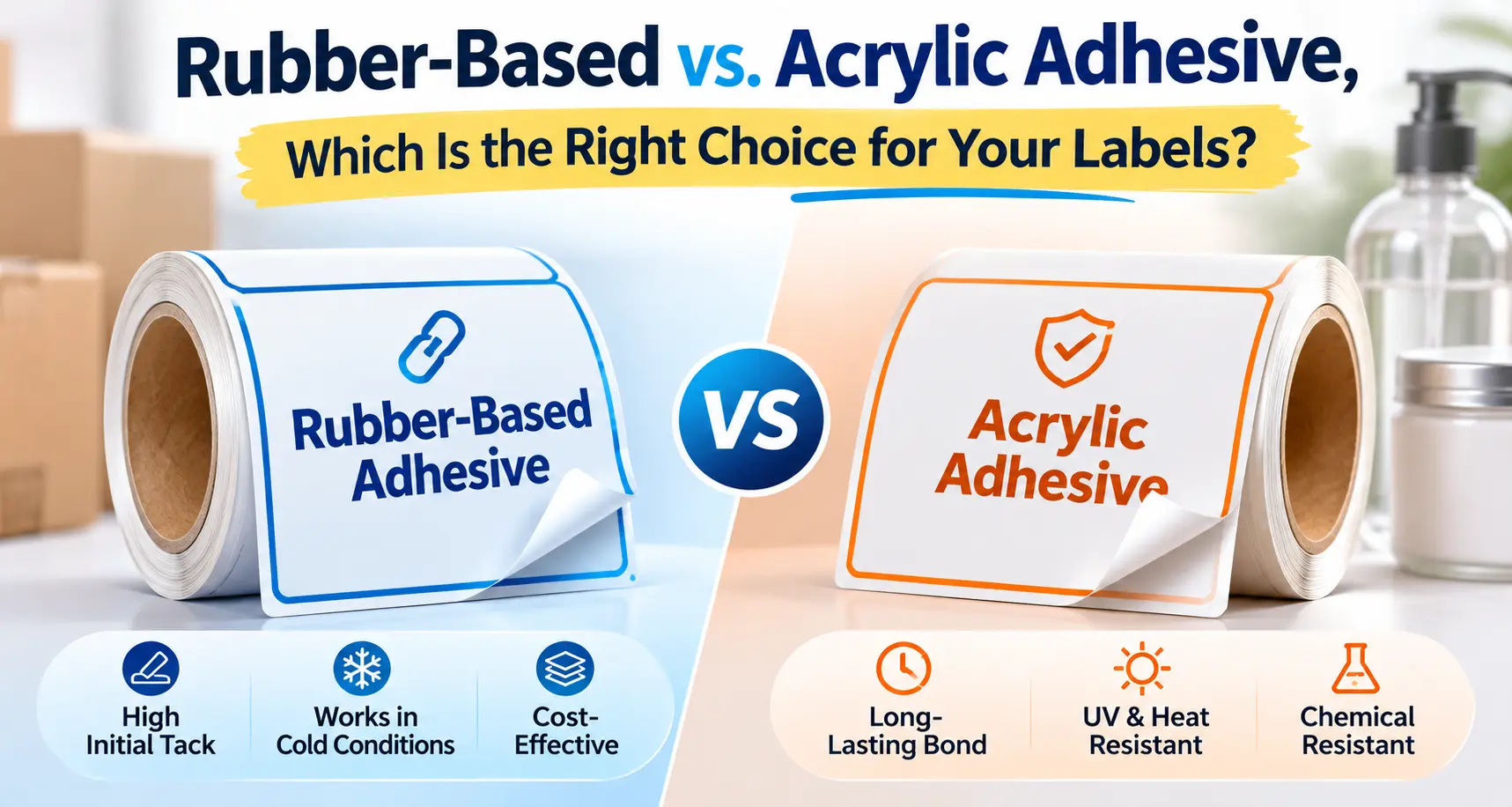
Rubber-based adhesives are generally a good choice when quick initial bonding, cold application, and cost-effective performance are important.
Acrylic adhesives are often better suited to applications requiring long-term adhesion, heat resistance, UV stability, and resistance to ageing.
For manufacturers and packaging businesses, the decision should always come down to the actual application. Consider the packaging surface, temperature range, storage environment, expected label life, and printing requirements before selecting an adhesive.
If you're planning a new label order or experiencing adhesive-related problems with your existing labels, FormersPaper can help you explore suitable material and adhesive combinations.
Get in touch with FormersPaper to discuss your label specifications and find an adhesive solution that works for your production requirements.
Neither adhesive is better for every application. Rubber-based adhesives generally provide stronger initial tack and work well in many cold or rough-surface applications. Acrylic adhesives are often preferred for long-term durability, heat resistance, and UV exposure.
Generally, yes. Acrylic adhesives offer better resistance to UV exposure, oxidation, and ageing than many standard rubber-based formulations. However, the complete label construction must also be suitable for outdoor conditions.
Yes. Many rubber-based adhesives provide good initial adhesion to plastics such as polyethylene (PE) and polypropylene (PP). However, performance depends on the specific plastic, surface condition, and adhesive formulation.
Acrylic adhesives generally offer better heat resistance than standard rubber-based adhesives. However, buyers should always check the service temperature range of the specific adhesive grade.
For many long-term applications, acrylic adhesives offer better resistance to UV exposure, oxidation, and ageing. Rubber-based adhesives can still provide excellent performance in applications where quick bonding is the main requirement.
Rubber-based adhesives are often more economical for general-purpose applications. However, acrylic adhesives may offer better overall value when long-term durability and environmental resistance are important.
Yes. Both adhesive technologies are available for different label materials. The correct combination depends on the face material, application surface, and intended operating conditions.
Many acrylic pressure-sensitive adhesives take approximately 24 to 72 hours to reach their ultimate bonding strength. The actual time depends on the adhesive formulation, application temperature, and surface material.
Hot melt describes an adhesive application method in which the material is heated before coating. Acrylic describes the adhesive chemistry. Many hot melt adhesives use rubber-based polymers, but acrylic adhesives are also available in hot melt formulations.
Start by identifying the packaging surface, application temperature, storage conditions, and required label life. Then request samples and test them under actual production conditions before placing a bulk order.


Formers Paper is a leading manufacturer for a comprehensive range of sustainable paper & packaging products serving customers globally.
Shenzhen Formers Paper Co. Ltd, No.92 Zhugushi Road, Wulian community, Longgang District, Shenzhen, China