We wish you Happy Holidays & a joyful New Year!

Compare removable water-based acrylic and solvent-based adhesives, including technical specifications, performance, benefits, and industrial applications for B2B buyers.
October 21, 2026
John Doe
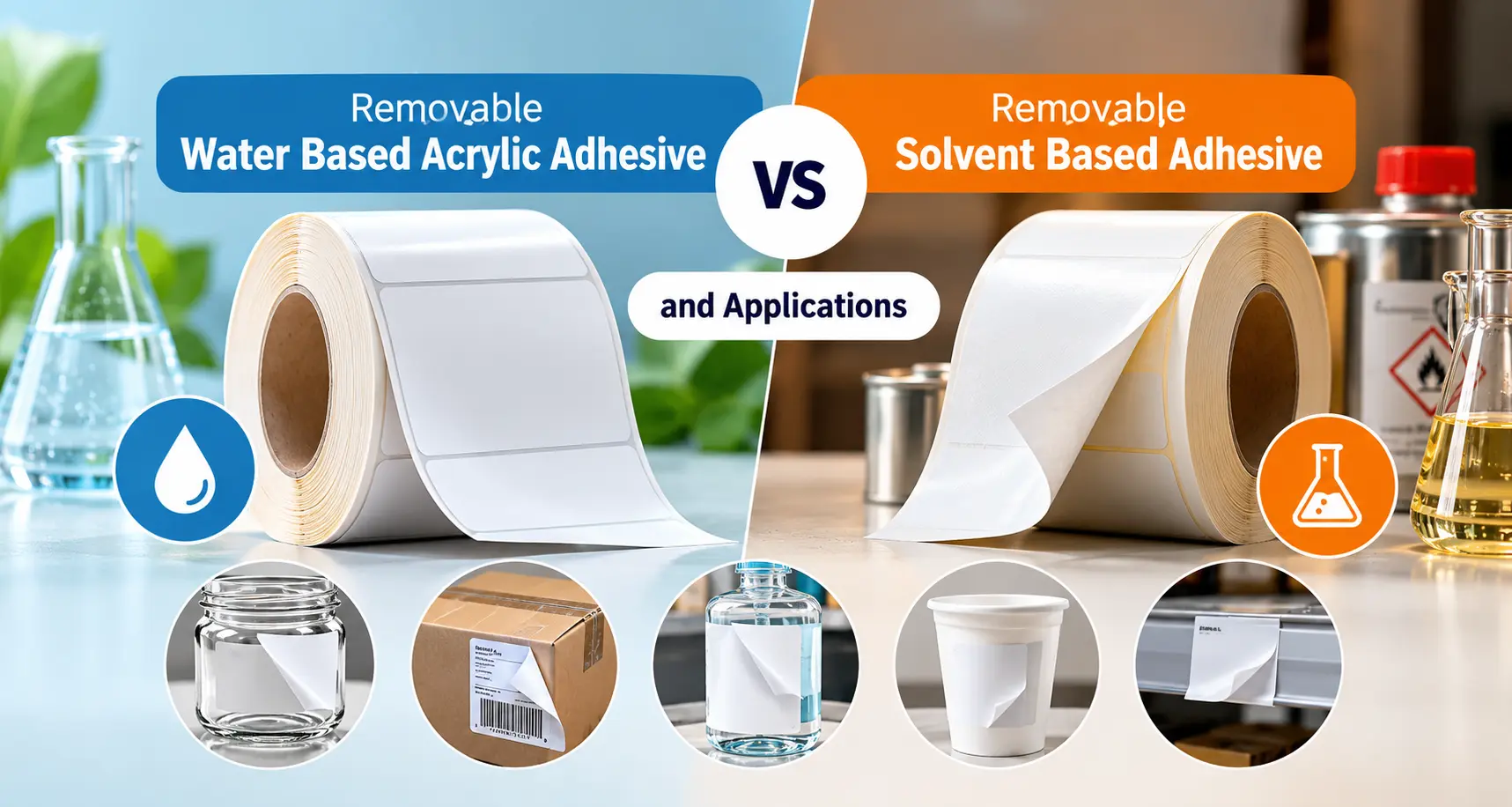
Selecting the right adhesive is an important decision for businesses involved in label manufacturing, packaging, printing, and industrial production. The adhesive must provide reliable bonding during storage, handling, and transportation while allowing clean removal whenever required.
For example, a packaging manufacturer may need removable labels that can be peeled off cartons without damaging the packaging surface. A retail business may require promotional stickers that can be removed without leaving sticky residue, while a warehouse may need temporary labels that remain attached throughout inventory handling and storage.
These requirements make adhesive selection more important than simply choosing a product with strong bonding properties.
Two commonly used options in removable labelling applications are water-based acrylic adhesives and solvent-based adhesives. Both offer different performance characteristics, manufacturing requirements, and application benefits.
Water-based acrylic adhesives are generally preferred for applications where lower odour, reduced VOC emissions, and compatibility with paper-based materials are important. Solvent-based adhesives are often considered when faster drying, higher initial tack, or specific bonding performance on challenging surfaces is required.
However, neither option is suitable for every application. Factors such as substrate compatibility, adhesion strength, removal performance, temperature resistance, moisture exposure, and production requirements should guide the selection process.
In this guide, we will compare removable water-based acrylic adhesives with removable solvent-based adhesives, explain their technical differences, explore their industrial applications, and discuss the important factors B2B buyers should evaluate before purchasing.
The right adhesive depends on the material, production process, and conditions in which the label or sticker will be used.
Here is a quick overview:
To understand which option is right for your business, let's first look at how removable adhesives work.
Removable adhesives are designed to hold labels, stickers, and other materials securely during use while allowing them to be removed without causing significant surface damage or leaving unwanted adhesive residue.
Unlike permanent adhesives, which are designed for long-term bonding, removable adhesives provide controlled adhesion.
They are commonly used in product labelling, packaging, retail promotions, warehouse identification, temporary surface protection, and other industrial applications.
The removability of an adhesive depends on several factors:
One important consideration is adhesion build-up. In some applications, the bonding strength of an adhesive can increase over time due to prolonged contact, temperature changes, and other environmental conditions.
As a result, a label that peels off easily after 24 hours may become more difficult to remove after 30 or 60 days.
For businesses using temporary labels, testing removability over the expected application period is essential.
For manufacturers and commercial buyers, adhesive performance directly affects product quality, operational efficiency, and customer experience.
The right removable adhesive can help businesses:
Choosing an appropriate adhesive is therefore both a technical and commercial decision.
Water-based acrylic adhesives use water as the primary carrier for acrylic polymer particles.
During manufacturing, the adhesive is applied to the label material through a coating process. The coated material then passes through a drying system, where water evaporates and the acrylic particles come together to form an adhesive layer.
This technology is widely used in paper labels, packaging materials, stickers, and other applications where controlled adhesion and lower VOC emissions are important.
1. Lower VOC Emissions
Water-based adhesive systems generally release fewer volatile organic compounds (VOCs) than conventional solvent-based systems. This can help manufacturers reduce VOC-related emissions during production.
2. Lower Odour
These adhesives typically produce less noticeable odour during coating and processing, making them suitable for manufacturing environments where odour control is important.
3. Easy Equipment Cleaning
Water-based formulations can often be cleaned from coating equipment using water, subject to the manufacturer's cleaning recommendations.
4. Suitable for Paper-Based Materials
They are commonly used in paper labels, carton labels, and other porous substrates where the adhesive can develop suitable bonding performance.
5. Reduced Fire Risk During Handling
Since water is the primary carrier, water-based adhesive systems generally present a lower flammability risk than solvent-based alternatives. However, standard industrial safety practices are still necessary.
Despite their advantages, water-based adhesives also have certain limitations:
Manufacturers should consider these limitations when evaluating water-based adhesives for specific production requirements.
Solvent-based adhesives use organic solvents to dissolve or carry the adhesive polymer. During the coating process, the solvent evaporates, leaving behind a thin adhesive layer on the label material.
These adhesives are commonly considered for applications requiring faster drying, higher initial tack, or specific bonding performance on challenging surfaces.
Their suitability depends on the formulation, substrate, and operating conditions.
1. Faster Drying
Solvent-based adhesives generally dry faster because many organic solvents evaporate more quickly than water. This can support higher coating-line speeds, depending on equipment and process conditions.
2. High Initial Tack
Many solvent-based formulations provide strong initial adhesion, helping labels bond quickly after application.
3. Performance on Difficult Surfaces
Certain solvent-based formulations are designed to bond effectively with low-surface-energy materials, including specific polyethylene (PE) and polypropylene (PP) surfaces.
4. Suitability for Challenging Environmental Conditions
Some solvent-based formulations offer good resistance to moisture, temperature variations, and demanding operating environments.
5. Industrial Processing Flexibility
They can be suitable for production environments where quick drying and specific bonding characteristics are required.
Solvent-based systems also come with certain operational considerations:
For B2B buyers, these factors should be included when evaluating the overall cost and suitability of solvent-based adhesives.
Although both adhesive technologies can be used in removable labelling applications, their manufacturing processes and performance characteristics are different.
The following points highlight the major factors businesses should consider when selecting an adhesive:
1. Carrier
2. Drying Time
3. Initial Tack
4. VOC Emissions
5. Odour
6. Fire Risk
7. Equipment Cleaning
8. Moisture Resistance
9. Plastic Compatibility
10. Environmental Considerations
Actual adhesive performance depends on its formulation, coating weight, substrate, and application conditions. These comparisons provide a general starting point. Always review the manufacturer's technical data and conduct application-specific testing before selecting an adhesive.
Adhesion strength is one of the most important factors when selecting a removable adhesive.
A label must remain attached during handling, storage, and transportation. At the same time, it should be removable without damaging the underlying material.
Water-based acrylic adhesives can provide suitable bonding on many paper and carton surfaces. Solvent-based adhesives may offer higher initial tack and can perform better on certain smooth or difficult-to-bond surfaces.
However, stronger adhesion does not automatically mean better performance in removable applications.
The objective is to achieve the required holding power without making removal difficult.
For temporary labelling applications, clean removal is just as important as initial bonding.
Both water-based and solvent-based acrylic adhesives can be formulated for removable applications. Their removal performance depends on adhesive chemistry, coating thickness, surface properties, and duration of application.
Businesses should evaluate whether the adhesive:
Drying time can have a direct impact on manufacturing productivity.
Water-based adhesives require water evaporation during processing, which may increase drying requirements depending on the coating line.
Solvent-based adhesives often dry faster, making them suitable for certain high-speed production environments.
However, production efficiency should not be measured by drying time alone. Businesses should also consider energy consumption, ventilation requirements, equipment configuration, and overall operating costs.
Labels may be exposed to different environmental conditions during storage, transportation, and application.
These include:
Certain solvent-based formulations are suitable for demanding environmental conditions. However, some water-based formulations also offer good performance when specifically developed for the application.
The most reliable approach is to test the selected adhesive under the actual conditions in which the label will be used.
Water-based removable adhesives are commonly used in applications where paper compatibility, lower VOC emissions, and controlled removability are important.
Warehouses use labels for carton identification, inventory tracking, storage locations, pallets, and shipping operations.
In applications involving reusable cartons and paper-based surfaces, removable water-based acrylic adhesives can be a suitable option.
They help businesses apply temporary identification labels while allowing easier removal when cartons or storage containers need to be reused.
However, dusty surfaces, cold loading areas, and prolonged storage periods should be considered before selecting the adhesive.
Packaging manufacturers often require removable labels for temporary product information, promotional campaigns, and packaging identification.
Water-based acrylic adhesives can be suitable for paper-based packaging materials where the label needs to remain attached during handling but should be removed later.
Retail businesses regularly use promotional stickers, price labels, discount labels, and product information labels.
Removable adhesives help retailers update pricing and promotional information without leaving unwanted adhesive residue.
The adhesive should be selected according to the packaging material, particularly when labels are applied to coated cartons or glossy surfaces.
Restaurants, commercial kitchens, and hospitality businesses use labels to identify food containers, storage areas, and ingredients.
Removable labels can simplify routine identification and cleaning operations.
Water-based adhesive systems may be suitable for certain dry paper-based labelling applications. However, labels exposed to refrigeration, moisture, washing, or oily surfaces require specific adhesive testing.
For food-contact applications, businesses should also verify the relevant regulatory requirements and obtain appropriate supplier documentation.
Water-based acrylic adhesives are also used in different paper labelling and specialty tape applications.
They can be considered for products requiring controlled adhesion, lower odour, and compatibility with paper-based substrates.
Solvent-based adhesives are often selected for applications that require specific bonding characteristics, faster processing, or performance under challenging environmental conditions.
Manufacturing facilities use industrial labels for equipment identification, product tracking, inventory management, and operational instructions.
Certain industrial surfaces can be difficult to bond with conventional adhesives. Solvent-based formulations may offer suitable adhesion where higher initial tack or specialised surface compatibility is required.
Automotive manufacturers use labels and adhesive materials on components, packaging, and equipment.
Applications may involve plastic components, coated surfaces, and materials exposed to temperature variations.
The adhesive must be selected according to the specific surface, application temperature, and required removal performance.
Electronics manufacturing involves different plastic, metal, and coated surfaces.
Labels used for product identification, temporary marking, and component tracking must remain secure throughout handling and manufacturing processes.
Certain solvent-based acrylic formulations can be suitable for these applications, provided they meet the required bonding and removal specifications.
Temporary protective films are used to protect surfaces from scratches, dust, and handling damage during manufacturing, storage, and transportation.
The adhesive must provide sufficient holding strength while allowing the film to be removed without damaging the protected surface.
Solvent-based removable adhesives can be considered for applications where specific environmental resistance and bonding properties are required.
Cold-chain operations require labels that can withstand refrigeration, moisture, and temperature fluctuations.
These conditions can affect adhesive performance, particularly when labels are applied at low temperatures.
Some solvent-based adhesive formulations offer good performance in cold environments. However, businesses should verify application temperature, service temperature, and removability through product-specific testing.
The application surface often plays a major role in determining which adhesive will perform better.
Before selecting an adhesive, businesses should consider the physical and chemical properties of the substrate.
Paper and cardboard are porous materials that allow adhesive interaction with their surface.
Water-based acrylic adhesives are commonly considered for these applications, particularly for removable carton and packaging labels.
However, surface coatings, paper quality, and fibre strength can affect removal performance.
Materials such as polyethylene and polypropylene have relatively low surface energy, which can make bonding more challenging.
Certain solvent-based formulations may offer better compatibility with these materials. However, specialised water-based formulations may also be suitable.
Testing is essential before selecting an adhesive for plastic labels.
Glass and metal provide smooth, non-porous surfaces.
For these materials, surface cleanliness and initial tack are important considerations.
Oil, dust, moisture, and surface treatments can influence bonding performance.
Rough or contaminated surfaces can prevent proper adhesive contact.
In warehouse and industrial environments, dust and surface irregularities may reduce bonding performance.
The surface should be cleaned wherever possible, and the adhesive should be tested under actual operating conditions.
Environmental conditions can influence both adhesive application and long-term performance.
High humidity may slow the drying of water-based adhesives, while cold temperatures can affect the flexibility and bonding behaviour of different adhesive formulations.
Heat may also accelerate adhesion build-up in certain applications.
For businesses supplying labels across international markets, these conditions deserve particular attention.
For example, labels used in cold Canadian storage facilities may face different requirements from labels transported in hot trucks across parts of the USA or Mexico.
A reliable adhesive selection process should consider the complete journey of the product, from application and storage to transportation and final removal.
Environmental and workplace safety requirements are important considerations when purchasing industrial adhesives.
VOC regulations differ by country and, in some cases, by state or province. Businesses exporting products or sourcing materials internationally should verify the requirements applicable to their manufacturing location and target market.
Water-based adhesive systems generally have lower VOC emissions than conventional solvent-based alternatives. However, the exact VOC content depends on the complete formulation.
Before purchasing, request the following documents from your supplier:
FormersPaper reports certifications and management standards including ISO 9001:2015, ISO 14001:2015, and RoHS on its company information. Buyers should verify the scope and applicability of relevant documentation for the specific product being purchased.
For international procurement, it is important to confirm that the selected product meets the applicable market requirements rather than relying only on general certification claims.
Selecting an adhesive should involve more than comparing product prices or choosing the option with the highest bonding strength.
For procurement managers and manufacturers, the decision should be based on the complete application requirement.
Start by identifying the surface where the label or adhesive material will be applied.
Common substrates include:
Different surfaces have different bonding characteristics. An adhesive that works well on cardboard may not provide the same performance on smooth plastic or metal.
Consider how securely the label needs to remain attached.
For removable applications, the objective is to achieve sufficient holding power without creating problems during removal.
Ask your supplier for technical data on initial tack, peel adhesion, and holding power.
Evaluate the conditions the product will experience during its lifecycle.
For example:
These details help manufacturers identify an adhesive formulation that matches the actual working conditions.
Adhesive selection also affects manufacturing operations.
Consider drying time, coating-line speed, energy requirements, equipment compatibility, and cleaning procedures.
A faster-drying adhesive may improve production speed, but its overall suitability should be evaluated alongside safety and operating costs.
Businesses supplying products to international markets must consider the environmental and safety requirements applicable to their products and manufacturing processes.
Request relevant VOC information, SDS documents, and compliance documentation before finalising a supplier.
The purchase price of an adhesive is only one part of its overall cost.
Procurement teams should also consider:
A slightly more expensive adhesive may offer better overall value if it reduces production issues and improves finished-product quality.
For B2B buyers, selecting a removable adhesive requires more than understanding whether it is water-based or solvent-based.
The technical specifications determine how the adhesive will perform during application, storage, transportation, and removal.
Before placing a bulk order, procurement managers and label manufacturers should review the following specifications with their adhesive suppliers.
Peel adhesion measures the force required to remove an adhesive-backed material from a surface.
For removable labels, the adhesive should provide enough bonding strength to keep the label in place while allowing easy removal when required.
Ask suppliers for peel adhesion test results and the testing conditions used.
Initial tack refers to how quickly an adhesive bonds with a surface after application.
This specification is particularly important for high-speed labelling operations, automated packaging lines, and applications where labels need to stick immediately.
Shear resistance measures how well an adhesive withstands forces acting parallel to the bonded surface.
It helps determine whether labels will remain in place during storage, handling, and transportation.
Check the recommended application and service temperature ranges of the adhesive.
This is especially important for businesses dealing with refrigerated products, cold-chain logistics, outdoor packaging, and temperature-sensitive materials.
If labels will be exposed to moisture, refrigeration, or humid environments, review the adhesive's resistance to these conditions.
The selected adhesive should maintain the required bonding performance throughout the intended application period.
For removable applications, evaluate how easily the label can be removed and whether it leaves adhesive residue.
Ask your supplier for test results covering different removal intervals, particularly when labels need to remain attached for several weeks or months.
Coating weight influences adhesive performance, material consumption, and overall product consistency.
Manufacturers should confirm that the coating weight is appropriate for the selected face material, substrate, and end-use application.
Businesses operating in regulated markets should review VOC information, Safety Data Sheets (SDS), and other applicable compliance documents.
This is particularly important when comparing water-based and solvent-based adhesive systems.
Adhesive selection plays an important role in the overall label manufacturing process.
The right adhesive does not just determine how well a label sticks or removes; it can also influence coating efficiency, drying requirements, printing operations, converting performance, and production costs.
For label manufacturers and converting companies, even small differences in adhesive behaviour can affect production speed and finished-product quality.
Here are some important areas where adhesive selection makes a difference.
The adhesive carrier directly affects the drying process.
Water-based adhesives require water evaporation, which may increase drying time or require additional oven capacity depending on the formulation and coating conditions.
Solvent-based adhesives generally dry faster because many organic solvents evaporate more quickly.
Manufacturers should evaluate drying requirements alongside coating-line speed to maintain consistent production output.
Uniform adhesive application is essential for producing high-quality labels.
Inconsistent coating can result in uneven bonding, poor label removal, adhesive transfer, and product quality issues.
The adhesive formulation, coating equipment, viscosity, and operating conditions should work together to maintain consistent coating performance.
The selected adhesive should be compatible with the complete label manufacturing process.
Businesses should evaluate its performance during:
For roll-based labels, adhesive transfer and build-up on machine components should also be monitored.
Adhesive selection can influence equipment cleaning and maintenance requirements.
Water-based systems may allow easier cleaning with water, subject to the manufacturer's recommendations.
Solvent-based systems require suitable cleaning procedures and appropriate handling of cleaning solvents.
Choosing an adhesive compatible with the existing production setup can help reduce unnecessary maintenance and downtime.
Coating weight, adhesive formulation, drying energy, production speed, and material waste all contribute to manufacturing costs.
A lower-priced adhesive may not necessarily offer the best value if it requires additional processing time or results in higher rejection rates.
Manufacturers should evaluate the complete production cost rather than comparing adhesive purchase prices alone.
The final performance of a label depends on the combined quality of its face material, adhesive, coating, and converting process.
An unsuitable adhesive can lead to:
Selecting an adhesive that matches the product requirements helps manufacturers maintain consistent quality and meet customer expectations.
For businesses handling large orders, consistent adhesive quality and reliable material supply are equally important.
Manufacturers should work with suppliers who can provide technical support, product specifications, samples, and consistent material quality across production batches.
Manufacturing Insight: The best adhesive is not necessarily the one with the highest bonding strength or fastest drying time. It is the one that delivers the required performance while working efficiently with your existing coating, printing, and converting processes.
Before finalising an adhesive for large-scale production, manufacturers should conduct application-specific testing.
A laboratory result may not always reflect how the adhesive will perform on actual packaging materials or industrial surfaces.
Here is a practical testing process for procurement and quality-control teams.
Use the same surface material on which the final label will be applied.
For example, if your business uses corrugated cartons, test the adhesive on those cartons instead of relying only on standard laboratory test plates.
Apply the labels using the intended application method, whether manual or machine-based.
Maintain consistent application pressure and conditions across all samples.
Check whether the label attaches properly and remains in place after application.
Observe any lifting, curling, or bonding issues.
Evaluate removal after:
If the intended application period is longer, extend the test accordingly.
During removal, examine whether the adhesive leaves residue, damages the surface, or causes the label material to tear.
Record the results for each adhesive sample.
Test samples under the expected temperature and humidity conditions.
For cold-chain or outdoor applications, include the relevant exposure conditions in the testing process.
If the labels are supplied in rolls, evaluate printing quality, dispensing, cutting, and adhesive transfer or build-up on machine components.
This is particularly important for high-volume label converting and printing operations.
A structured testing process helps procurement teams make decisions based on actual performance rather than assumptions.
Even when businesses understand adhesive specifications, a few common purchasing mistakes can affect product performance and increase operating costs.
A lower-priced adhesive may not provide the required bonding or removal performance.
If labels damage packaging or leave residue, businesses may face additional labour, replacement, and rework costs.
Not every removable adhesive works equally well on paper, plastic, glass, and metal.
Always check compatibility with the actual substrate.
A label may perform well immediately after application but become difficult to remove over time.
Evaluate adhesive performance at different intervals.
Temperature, humidity, moisture, and storage conditions can affect bonding performance.
These factors should be included in product evaluation.
For businesses operating across different regions, failing to review VOC information, SDS documents, and applicable compliance requirements can create unnecessary operational challenges.
Even adhesives within the same category can have different performance characteristics.
Formulation, coating weight, label material, and manufacturing process all influence the final result.
Procurement teams should clearly mention the required adhesive type, substrate, removability expectations, environmental conditions, and relevant technical specifications in purchase orders.
This helps reduce confusion between suppliers and manufacturers.
For businesses sourcing labels and adhesive-based products, choosing the right manufacturing partner is just as important as selecting the right adhesive.
FormersPaper offers labels, stickers, and paper rolls for different commercial and industrial applications.
FormersPaper follows a vertically integrated manufacturing model that includes in-house coating, laminating, printing, and converting operations.
The company also reports:
These manufacturing capabilities are relevant to B2B buyers because label performance depends on more than adhesive selection alone.
The face material, adhesive coating, liner or linerless construction, printing process, and converting quality all contribute to the finished product.
FormersPaper's product range includes:
For businesses looking for customised label solutions, discussing the intended application and material requirements with the manufacturer can help identify suitable product options.
You can explore FormersPaper's label and sticker product range or contact our team to discuss your business requirements.
Selecting between removable water-based acrylic adhesive and removable solvent-based adhesive requires a clear understanding of your product, substrate, manufacturing process, and end-use conditions.
Water-based acrylic adhesives are a practical option for many paper-based labelling and packaging applications where lower odour, reduced VOC emissions, and controlled removability are important.
Solvent-based adhesives can be a suitable choice for applications requiring faster drying, higher initial tack, or specific performance on challenging surfaces.
However, neither option should be selected based on general comparisons alone. Actual adhesive performance depends on the formulation, application surface, environmental exposure, and required removal period.
For B2B buyers, the best approach is to evaluate technical specifications, test samples under real operating conditions, and compare the total cost of ownership before making a purchasing decision.
Looking for the right label solution for your business? Connect with FormersPaper to discuss your substrate, application requirements, production volume, and label specifications. Its team can help you explore suitable label and material options for your business needs.
The primary difference is the carrier used in the adhesive formulation.
Water-based adhesives use water to carry acrylic polymer particles, whereas solvent-based adhesives use organic solvents.
Water-based systems generally offer lower VOC emissions and odour, while solvent-based systems often provide faster drying and higher initial tack.
Neither adhesive type is universally better.
Water-based acrylic adhesives are often suitable for paper labels and carton applications where lower VOC emissions are important.
Solvent-based adhesives may be more appropriate for certain plastic surfaces, faster production processes, and challenging environmental conditions.
The right choice depends on the specific application and performance requirements.
Both water-based and solvent-based acrylic adhesives can be formulated for clean removal.
However, residue depends on adhesive formulation, application surface, coating weight, temperature, and duration of use.
Testing on the actual substrate is recommended before bulk production.
Yes, certain water-based acrylic formulations can be used on plastic surfaces.
However, performance depends on the type of plastic and its surface energy.
Materials such as polyethylene and polypropylene can be more challenging to bond, so manufacturers should request samples and conduct compatibility testing.
The answer depends on the adhesive formulation and the temperature range involved.
Some solvent-based formulations offer good temperature resistance, but specialised water-based formulations may also be suitable for certain applications.
Always check the manufacturer's technical specifications.
Water-based adhesives generally have lower VOC emissions than conventional solvent-based adhesives.
They can also reduce solvent-related handling and fire risks.
However, their overall environmental impact depends on the complete formulation, manufacturing process, energy consumption, and applicable environmental requirements.
Start by identifying your substrate, required bonding strength, removal period, environmental conditions, and production requirements.
Then compare technical specifications, request samples, and conduct application-specific testing before placing a bulk order.
Important specifications include peel adhesion, initial tack, shear resistance, temperature resistance, moisture resistance, removability, coating weight, and VOC content.
Always review the product's Technical Data Sheet and Safety Data Sheet before purchasing.
Adhesive selection can influence coating-line speed, drying requirements, printing compatibility, converting efficiency, equipment maintenance, and material consumption.
Choosing an adhesive that matches the production process can help manufacturers maintain consistent product quality and control operating costs.
For industrial purchasing, ask for:


Formers Paper is a leading manufacturer for a comprehensive range of sustainable paper & packaging products serving customers globally.
Shenzhen Formers Paper Co. Ltd, No.92 Zhugushi Road, Wulian community, Longgang District, Shenzhen, China