We wish you Happy Holidays & a joyful New Year!

8-color vs standard custom label printing compared: color accuracy, cost, and consistency, so you know which press fits your labels.
August 24, 2026
John Doe
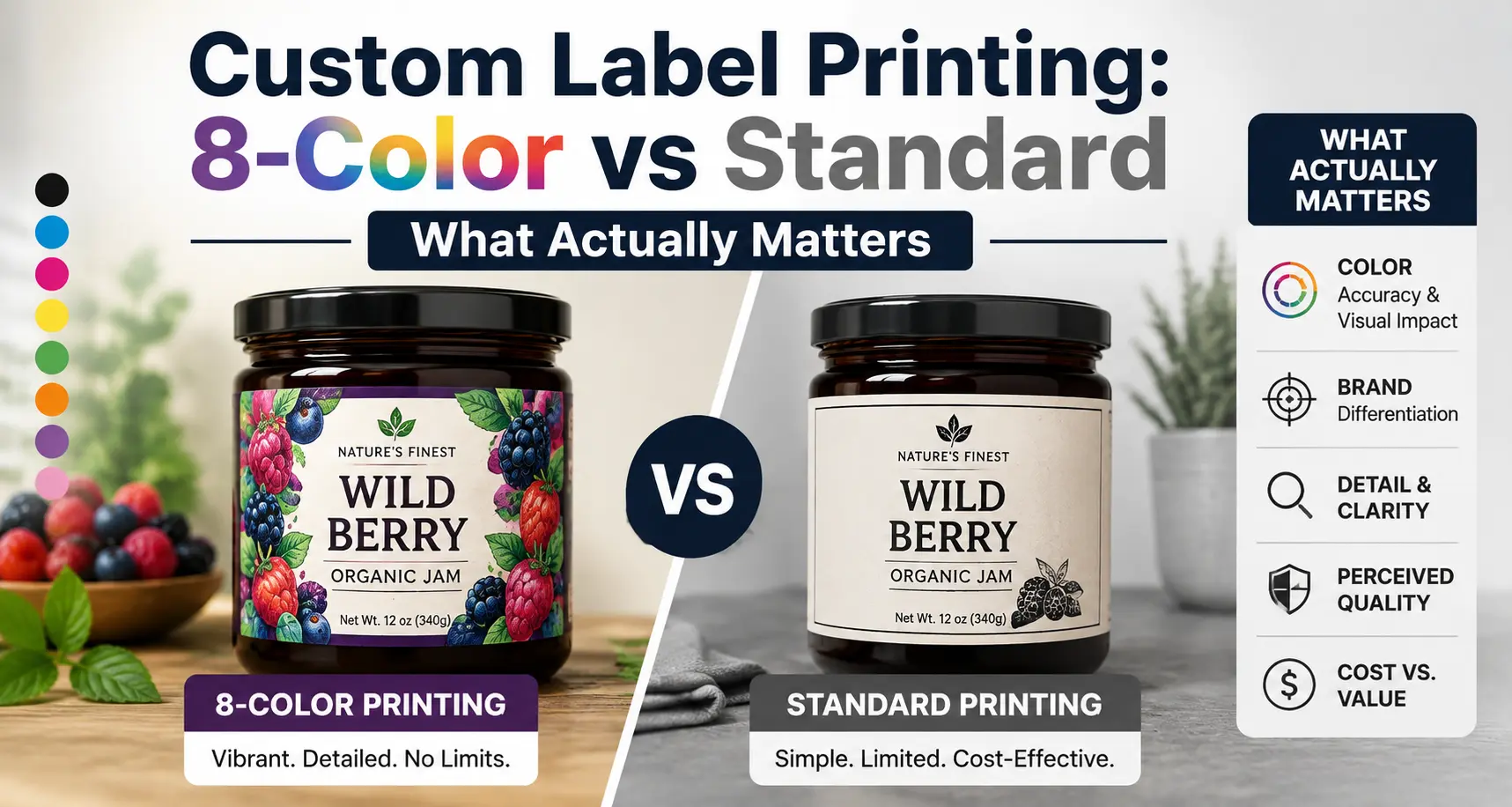
Pick up two products off a shelf. Same size, same shape, same price. One label looks sharp, bright, and expensive. The other looks flat and a little washed out. You did not read a single word yet, and you already trust one product more than the other. That is the entire business case for custom label printing in one sentence.
Most buyers already know they need something better than a blank sticker pulled off a stationery shelf. What they do not always know is how much the printing method itself changes the outcome once the job leaves the press. Two labels can share the same material and the same design file and still look nothing alike in the end. The difference usually comes down to one decision: a basic four-color run, or a press built around extended, richer color.
This guide breaks down exactly what changes between the two paths of product label priniting, what stays the same, and how to decide which one fits your business. We built it for B2B buyers across the United States, Canada, Mexico, the Caribbean, and China who are sourcing labels at volume, not for a single small batch. Along the way, you will see how FormersPaper approaches high quality custom label printing as a vertically integrated, certified manufacturer, not a reseller repackaging someone else's stock.
Key Takeaways
Custom label printing is the process of producing labels built around your exact product, brand, and application, instead of pulling a generic option off a shelf. It covers everything from size and shape to material, adhesive strength, finish, and the number of ink colors used on press.
A business ordering custom printed labels usually needs more than a name and a barcode. Food and beverage brands need ingredient panels and expiry dates that stay legible for months. Retailers need printed labels that survive handling, shipping, and store lighting without fading. Warehouses need barcode labels that scan correctly the first time, every time. This kind of order solves all of these problems by matching the finished product to the job it actually has to do.
At its core, this kind of order is a manufacturing decision, not just a design decision. The substrate, the adhesive, and the press itself all work together to determine how the finished piece performs once it leaves the factory. This is where the real difference between a basic four-color run and high quality custom label printing starts to show up.
This basic label format is pre-set in common sizes, common materials, and a limited color range. It is fast to produce, simple to reorder, and inexpensive per unit. For internal use, shipping, warehouse tags, or basic pricing, this basic format usually does the job just fine.
A custom approach works differently. Every part of the label is built around your product, not the other way around. Size, shape, adhesive, finish, and color depth are all chosen to match the application. This matters most when a label has to do more than identify a product. It has to represent the brand, survive real-world handling, and meet industry rules for content and safety.
Many businesses use both formats. A warehouse might run basic stock tags for internal control while ordering custom labels & sticker printing for anything customer-facing. The real question is not which option is better. It is which option matches the job the label has to do.
A basic press typically relies on four ink colors, known as CMYK: cyan, magenta, yellow, and black. These four inks combine to create most of the colors you see on a simple label. This works well for basic text, simple logos, and functional applications where color accuracy is not critical.
An 8-color press adds extra ink stations, expanding the range of tones that print directly instead of being simulated by blending just four inks. The result is a wider color gamut, sharper detail, and colors that sit much closer to the exact brand shade a designer originally chose. This is often called extended gamut or wide gamut printing in the industry, and it changes what color label printing can actually look like once it reaches the shelf.
For a B2B buyer, the difference is not just visual. Extended color capability at this level reduces the guesswork in color matching, shortens the number of proofing rounds needed to approve a design, and keeps colors more consistent from one production run to the next. That consistency becomes critical once a brand is printing across multiple factories or multiple product lines at once, and it is exactly why buyers researching product label priniting online tend to ask about ink stations before anything else.
FormersPaper supports printing with capability of up to 8 colors, giving B2B buyers a real option beyond a basic four-color run without needing to switch label prinitng companies for premium jobs.
Choosing between a basic run and an extended-color press comes down to a handful of practical factors. Here is what changes, and what does not.
Color Accuracy: A basic press blends four inks to approximate most colors. An 8-color press prints more shades directly, which keeps brand colors closer to the exact tone a design team intended. This is the heart of color label printing as a category.
Detail and Gradient Quality: Fine gradients, soft shadows, and subtle color transitions can look banded or flat on a basic press. Custom printed labels made on an extended-color press handle these transitions more smoothly.
Consistency Across Batches: A basic press can drift slightly between runs. Extended color stations reduce that drift, which matters most for brands ordering repeat batches over months or years.
Cost Per Unit: A basic label usually costs less per unit, especially at high volume with simple designs. The extended-color option carries a modest premium, which is offset by fewer reprints and stronger shelf performance.
Best Fit: A basic run suits internal use, shipping, and simple product identification. High quality custom label printing suits retail packaging, premium products, and any label where color is part of the sale.
What Stays the Same: Material choice, adhesive strength, durability, and certification standards do not depend on the number of ink colors used. A business can order water-resistant, oil-resistant, or scratch-proof labels on either a basic press or an extended-color press, depending on the application.
Retailers, food brands, logistics companies, and manufacturers across North America and China all face the same core challenge. Products move fast, shelves are competitive, and a label that looks slightly off can quietly cost sales before a customer even picks up the product.
For businesses shipping across the United States, Canada, Mexico, and the Caribbean, product label priniting also has to handle real logistical stress. Labels travel through humid warehouses, cold storage, long-haul trucking, and retail shelves under bright lighting. A label that fades, peels, or shifts tone from batch to batch creates problems that go beyond appearance. It can slow down barcode scanning, confuse compliance checks, or damage a brand's shelf presence across an entire region.
This is exactly why more businesses are moving away from generic label prinitng companies and toward manufacturers who control the full production process. A supplier who only resells finished stock cannot guarantee the same batch-to-batch accuracy that a vertically integrated manufacturer can offer. When a company controls its own coating, printing, and converting lines, product label priniting becomes far more predictable, order after order, and this is why more procurement teams now shortlist suppliers based on factory control rather than price alone.
FormersPaper works directly with B2B buyers across China, the USA, Canada, Mexico, and the Caribbean, supplying labels at scale for retail, food service, healthcare, warehousing, and logistics clients who need consistent quality no matter which region receives the order.
Custom label printing technology has changed a great deal over the past decade, moving from simple flat printing toward more advanced ink systems, better substrates, and tighter color controls. FormersPaper has built its label production around this shift, running a fully vertically integrated model that covers coating, laminating, printing, and converting in-house.
This matters because custom label printing technology is only as good as the factory behind it. A press with 8-color capability means little if the substrate underneath it is inconsistent, or if the facility cannot hold the same specification across a large order. FormersPaper runs five manufacturing factories with over 600 pieces of advanced production equipment across China, the UK, and Indonesia, giving the company the scale to support both a basic run and higher-end printing without sacrificing consistency.
An in-house research and development team backs this production model, holding more than 100 patents that help solve custom requests instead of turning them away. For a B2B buyer, this means custom labels & sticker printing at FormersPaper is not limited to a narrow catalog of pre-approved templates. Non-standard sizes, specialty adhesives, and application-specific finishes can be engineered to match the exact product a client is bringing to market, and this same engineering mindset carries through to every order of custom labels & sticker printing the company ships.
Labels show up everywhere once you start looking for them, and different industries lean on different strengths of the process.
Retail brands depend on color label printing to stand out on a crowded shelf. Consistent, accurate color across every SKU helps a product line look intentional rather than mismatched, which is why so many retailers now request color label printing by name instead of settling for a basic run.
Ingredient lists, allergen warnings, and expiry dates need to stay sharp and legible through refrigeration, condensation, and handling. This category lets food brands combine compliance information with strong shelf branding on Food Labeling Systems that hold up under real conditions.
Medical and pharmaceutical products need labels that print small text clearly and hold up under sterilization, refrigeration, or repeated handling. These labels give healthcare buyers control over exactly how that information appears, and many facilities now specify product label priniting requirements down to the point size.
Barcode accuracy matters more than color here, but durability still counts. A basic run often handles this job well, since labels need to survive scanning, handling, and transport without peeling or fading.
Guest checks, receipts, and security-sensitive documents often combine simple printed text with custom labels & Business Forms & Docket Books for branded elements, tamper-evident features, or promotional stickers.
Across every one of these industries, the underlying question is the same. Does this label need to simply identify a product, or does it need to sell it, protect it, and represent the brand at the same time? That answer decides which path is the right call.
A ranked comparison only gets a buyer halfway. Choosing among the many label prinitng companies actually competing for a contract takes a more specific checklist.
1. Confirm They Actually Manufacture: Some label prinitng companies market themselves as manufacturers while reselling stock printed elsewhere. Ask directly whether the supplier runs its own printing, coating, and converting lines, or if it outsources parts of the process.
2. Ask About Color Capability in Writing: Premium color means little without a number behind it. Ask any supplier offering color label printing whether they run a 4-color, 6-color, or full 8-color press, and request a sample to compare directly against your design file.
3. Request Certifications by Name: Do not accept fully certified as an answer. Ask for specific certificate names such as ISO 9001:2015, ISO 14001:2015, RoHS, or FSC, along with the issuing body.
4. Test Real Samples on Real Applications: A label that looks great in a sales deck can behave differently once it hits your actual product, your actual environment, and your actual application speed. Order test samples of custom printed labels before committing to a bulk run.
5. Check Regional Supply Consistency: If your business ships across the USA, Canada, Mexico, the Caribbean, or China, confirm the supplier can keep color label printing and product label priniting specifications identical across every region instead of drifting between local production runs.
6. Confirm Turnaround and Capacity: Ask about lead times, minimum order quantities, and production capacity before your busiest season arrives, not during it.
Buyers who work through this checklist consistently end up with a printing partner that performs the same way on order one hundred as it did on order one, instead of gambling on unproven label prinitng companies.
Anyone can claim premium quality. A certificate means an outside body checked the claim and signed off on it. FormersPaper's manufacturing facilities hold the following certifications:
These certifications apply across FormersPaper's full production range, including labels, sticker printing, paper rolls, and business forms. For B2B buyers sourcing product label priniting at scale, this means the same documented standards follow every order, whether it ships to a distribution center in Texas or a retail chain in Mexico City.
Even the best press cannot save a label that is stored badly before use. A few habits protect printed labels from the moment they leave the factory:
A well-made label from a trusted manufacturer can hold its color and adhesion for years when stored correctly. Basic labels and 8-color prints both benefit from the same careful handling, since a label left in a hot warehouse corner cannot perform well no matter how strong the original print quality was.
Businesses shopping for labels usually want the same four things: real production control, proof of certification, flexible specifications, and supply they can count on across every region they operate in.
FormersPaper delivers on all four. The company controls its own coating, printing, and converting process across five factories and more than 600 pieces of production equipment. Its printing capability extends up to 8 colors, giving buyers a genuine option beyond a basic run whenever a project calls for stronger color label printing accuracy. Certifications including ISO 9001:2015, ISO 14001:2015, ISO/IEC 27001, OHSAS 18001, FSC, RoHS, and BPI back every claim with a real, checkable document.
What sets FormersPaper apart is reach combined with control. With manufacturing facilities across China, the UK, and Indonesia, and direct supply lines into the USA, Canada, Mexico, and the Caribbean, the company supports B2B buyers who need the same custom printed labels specification to show up correctly no matter which country receives the shipment. Few label prinitng companies can offer that same combination of scale, certification, and regional reach, which is exactly why FormersPaper positions itself for high quality custom label printing rather than competing on price alone.
Ready to compare FormersPaper's custom label printing against your current supplier? Contact FormersPaper for samples, specifications, and a factory-direct quote on custom labels & sticker printing.
The choice between a basic run and an 8-color option is not about picking the more expensive path by default. It is about matching the printing method to what the label actually needs to do. A shipping label headed for a warehouse shelf does not need the same color depth as a premium skincare product headed for a retail shelf.
What does not change, regardless of which option a business chooses, is the importance of working with a manufacturer that controls its own custom label printing technology, holds real certifications, and can prove consistency across every batch. Custom label printing done right protects a brand's reputation just as much as it protects the product underneath the label.
Before your next bulk order, run your shortlist of label prinitng companies through the same checklist covered in this guide. Ask for real samples, real certificate names, and real answers about who actually manufactures the product label priniting your business depends on. Compare standard labels against extended-color options side by side, and let the application decide, not habit.
A basic label uses common sizes, materials, and a basic four-color process for simple, functional applications. Custom label printing builds every element, including size, material, adhesive, and color depth, around your specific product and brand needs.
An 8-color press adds extra ink stations, expanding the color range beyond what four inks can blend. This produces sharper detail, richer tones, and closer brand color accuracy compared to a basic run.
It typically carries a modest premium per label, but the cost is often offset by fewer reprints, more accurate color matching, and stronger shelf performance for products that depend on visual appeal.
Yes. FormersPaper offers printing with capability of up to 8 colors, along with simpler, functional label formats for basic applications.
Look for ISO 9001:2015 for quality management, ISO 14001:2015 for environmental management, RoHS for hazardous substance restrictions, and FSC for responsible sourcing. FormersPaper holds all of these, along with ISO/IEC 27001, OHSAS 18001, and BPI certification.
Yes. FormersPaper maintains manufacturing facilities and supply lines that serve all five regions directly, helping B2B buyers keep specifications consistent no matter where a shipment is headed.
Retail, food and beverage, healthcare, warehousing, logistics, finance, and hospitality all rely on this category, though each industry prioritizes different features such as color label printing accuracy, durability, or compliance-ready text.
Ask directly whether they run their own coating, printing, and converting lines, and request a facility overview or certification documents. A genuine manufacturer answers without hesitation, while other label prinitng companies tend to change the subject.


Formers Paper is a leading manufacturer for a comprehensive range of sustainable paper & packaging products serving customers globally.
Shenzhen Formers Paper Co. Ltd, No.92 Zhugushi Road, Wulian community, Longgang District, Shenzhen, China