We wish you Happy Holidays & a joyful New Year!

Choosing a barcode label supplier? FormersPaper, a leading manufacturer, shares key factors for retail & logistics-material quality, adhesion & pricing.
August 12, 2026
John Doe
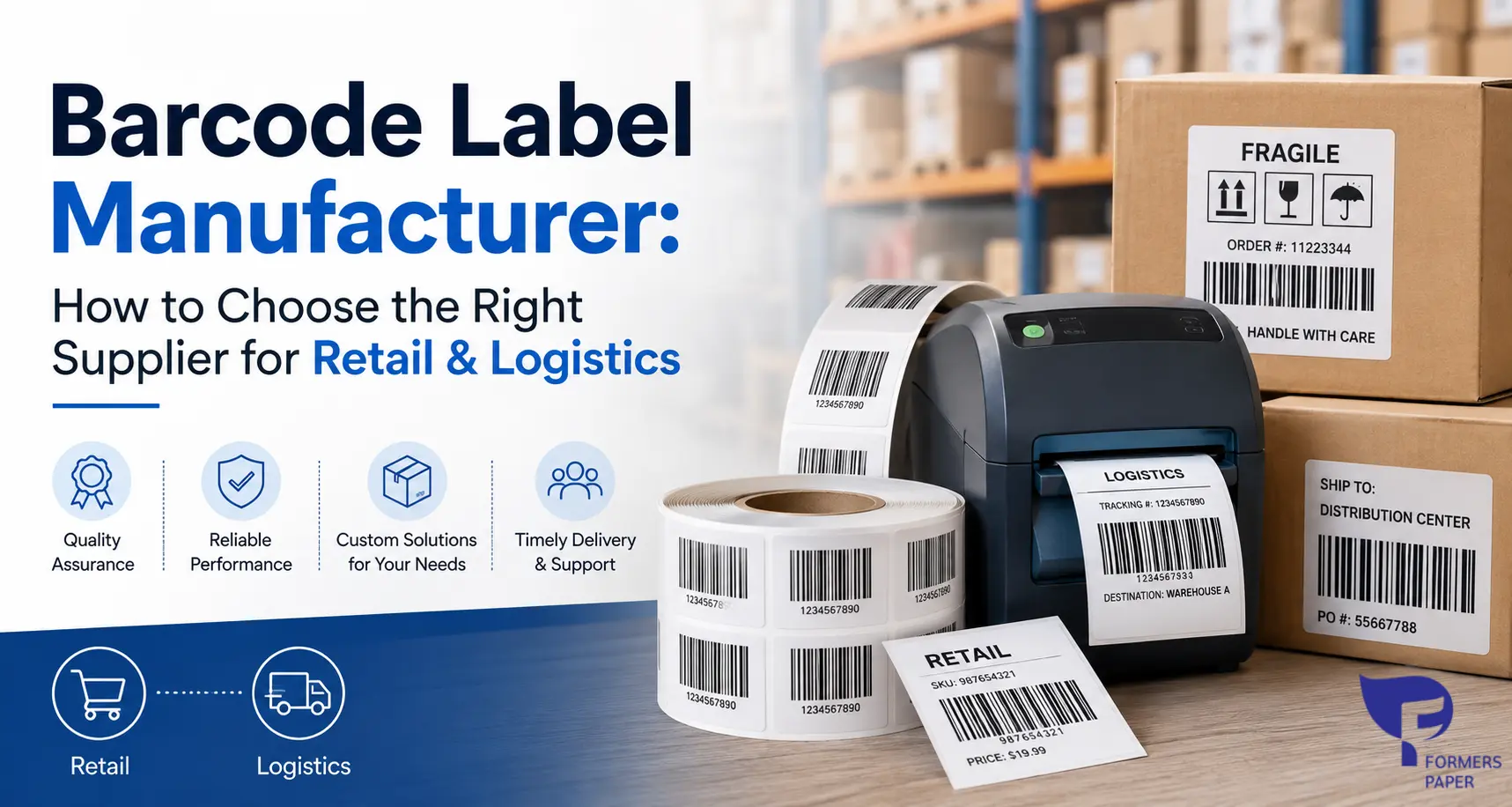
A bad label can slow down your entire team, which is why picking the right barcode label manufacturer matters so much. Think about the last time a barcode did not scan at checkout. The cashier had to key in the code by hand. The line got longer. Now multiply that by a warehouse moving thousands of cartons a day, and you can see why the right barcode label manufacturer matters so much. A weak label costs you time, money, and trust with your own customers.
If you run a retail chain, a distribution centre, or a logistics network, you already know that barcodes are not optional. They are the backbone of how you track stock, ship orders, and keep your shelves full. But not every barcode label manufacturer builds labels that hold up in your world. Some labels smear in the rain. Some peel off a cold box. Some simply will not scan the first time, which forces your staff to try again and again.
FormersPaper has manufactured paper and packaging products for more than 30+ years, supplying businesses across global markets with label stock built for real-world conditions. As a vertically integrated barcode label manufacturer, FormersPaper controls coating, laminating, printing, and converting in-house, which means fewer handoffs, tighter quality control, and a more consistent barcode label roll every time you reorder. This guide walks you through what to look for, what to avoid, and how to choose barcode label roll manufacturers that will not let your supply chain down.
Read More: Why FormersPaper is a Trusted Manufacturer of Paperang Thermal Rolls
Every barcode on your shelf or your shipping carton has one job: scan clean every time. When it does not, the cost adds up fast. A missed scan means a manual entry. A manual entry means a data error. A data error means your inventory count is wrong, and now your team is chasing a mistake instead of doing real work.
Retail and logistics businesses feel this pain the most, because they scan more labels in a single day than almost any other industry. A barcode label manufacturer that understands these two worlds builds labels that survive rough handling, changing temperatures, and constant scanning without breaking down.
This is also where cost sneaks up on buyers. A cheap label from an unreliable barcode label manufacturer might save you a few cents per roll, but if it causes even a small rise in scan failures, you pay for it in labor hours, delayed shipments, and frustrated staff. Choosing the right partner helps you avoid that trap altogether.
Choosing the right labeling partner directly impacts your scan rates, operational efficiency, and inventory accuracy across retail and logistics workflows.
Reliable barcode label roll manufacturers protect your scan rates, your inventory accuracy, and your bottom line by eliminating costly checkout delays and manual entry errors. High-quality production ensures seamless operations across your entire supply chain network.
Material choice (paper, polyester, or BOPP), top coating selection, back barrier protection, and adhesive type should match your specific environment, not just your budget. Selecting durable stock guarantees labels withstand rough handling, temperature swings, moisture, and long-term storage conditions effectively.
Direct thermal and thermal transfer printing serve different operational needs. Knowing the difference before you order helps you choose between budget-friendly short-term tags or long-lasting, smudge-proof labels designed for harsh warehouse conditions.
Retail and logistics businesses have distinct label priorities, and a good supplier should understand both. Retail focuses on clean appearance and fast scanning, while logistics demands extreme durability and weather resistance.
FormersPaper is a vertically integrated barcode labels manufacturer with certified, global production, built to support buyers across the USA, Canada, Mexico, the Caribbean, and China with reliable quality control.
Read More: How Thermochromic Labels Improve Food Safety in the Food Service Industry
A barcode label manufacturer does not just print a black-and-white pattern on a sticker. It builds the entire label system, starting with the base material and ending with a roll that performs consistently inside your printer, on your product, and in your storage conditions.
A proper barcode label roll includes:
When any one of these elements is off, your printer jams, your scan rate drops, or your label falls off before it reaches its destination. This is exactly why choosing the right barcode label manufacturer is not a small decision. It affects everything downstream.
Read More: Food-Safe Dissolvable Labels: The Smart Sourcing Methods for Food Brands
Not every barcode label is built the same way, and the differences matter more than most buyers expect. A good barcode labels manufacturer should walk you through each option instead of pushing a single default product.
Paper labels are the most affordable option and work well for short-term, indoor use. Retail shelf tags, price stickers, and short-life shipping labels usually use paper stock. They are budget-friendly, but they wear down faster under moisture, heat, or heavy handling.
Synthetic labels, made from polyester (PET) or BOPP film, resist water, chemicals, and tearing far better than paper. Warehouses, cold storage, and outdoor logistics applications lean on synthetic stock because it holds up through rough handling and temperature swings. Serious barcode label roll manufacturers should offer both paper and synthetic options, since one size never fits every application.
The top coating is the protective shield applied over the face stock, and selecting the right top coat is essential for maintaining scan clarity in targeted environments:
Read More: Airline Luggage Tags Manufacturer with RFID & Non-RFID Solutions
While top coatings protect the print side, a specialized back barrier is critical for overall roll stability and performance:
The adhesive on a label matters just as much as the material itself.
Direct thermal labels use heat-sensitive coating instead of ink or ribbon. The printer applies heat directly to the label, and the image appears instantly. This method is fast and low-cost, which makes it a favourite for shipping labels and receipts. The tradeoff is that direct thermal prints can fade over time when exposed to heat or direct sunlight.
Thermal transfer labels use a ribbon to transfer ink onto the label surface, producing a sharper, longer-lasting print. This method resists fading, scratching, and chemical exposure far better than direct thermal, which is why warehouses and industrial operations often choose thermal transfer for labels that need to last.
A dependable barcode label manufacturer should be able to supply stock for both printing methods, along with guidance on which one fits your specific application.
Retail businesses run on speed and accuracy at the checkout counter. A single unreadable barcode can slow down a line, frustrate a customer, or force a cashier to search for a product manually.
Here is what retail buyers should look for in barcode label manufacturers:
Multi-location retail chains face an added challenge: every store needs the exact same label quality. A single specification from a top barcode label manufacturer can roll out across every location, so your checkout process stays consistent whether you are running a single shopfront or a national chain.
Read More: PFAS-Free Baking Paper Manufacturer: A Complete Guide to Choosing the Right Supplier
Logistics and warehouse operations push labels harder than almost any other setting. Pallets get stacked, boxes get rained on, and forklifts brush past racks all day long. A label built for a quiet retail counter will not survive this environment.
Here is what logistics and warehouse buyers should look for in barcode label manufacturers:
A dependable barcode labels manufacturer understands that a single failed pallet label can delay an entire shipment. That is why material choice, adhesive strength, and print durability all matter more in logistics than almost anywhere else.
How FormersPaper Manufactures Barcode Label Rolls
Not every supplier that sells barcode labels actually makes them. Many are traders who buy finished stock from someone else and resell it under their own name. FormersPaper is different. As one of the leading barcode label roll manufacturers, FormersPaper controls the full production process, from raw material to finished roll.
Production starts with choosing the right base paper or film for the application, whether that means a cost-effective paper stock for retail tags or a durable synthetic film for warehouse pallets.
FormersPaper applies targeted top coatings suited for direct thermal or thermal transfer printing, engineered back barriers to block moisture and adhesive bleed, along with an adhesive formulation matched to the exact application surface (cardboard, plastic, glass, or metal).
Labels are printed, slit, and converted into rolls sized to fit your specific printer and application, from small handheld scanners to industrial print-and-apply systems.
Before any barcode label roll ships, FormersPaper tests for adhesive strength, top coat durability, back barrier integrity, print clarity, and roll consistency, so every batch performs the same way as the last one.
This level of in-house control is what separates genuine barcode label manufacturers from resellers. Fewer handoffs mean fewer surprises and a more consistent product every time you place an order.
Before you sign with any supplier, run through this checklist.
Buyers searching for barcode labels suppliers or comparing several barcode label manufacturers should weigh long-term reliability just as heavily as the price on the quote. A cheaper roll that fails scan tests costs more in the long run than a slightly higher-priced roll that performs every time.
A barcode label touches your inventory data, your customer experience, and sometimes your regulatory requirements. That makes supplier certifications worth checking carefully, not just taking on faith.
FormersPaper holds a range of internationally recognized certifications across its facilities, including:
Before choosing any barcode labels suppliers, ask for current documentation on each of these areas. A supplier that hesitates to share certificates is a supplier worth reconsidering.
This distinction matters more than most buyers realize when comparing barcode label manufacturers.
When you are comparing barcode labels suppliers, always ask directly: do you manufacture this product, or do you resell it? The answer changes how much control that supplier actually has over the quality you receive.
Choosing a supplier for barcode labels means looking past the price tag alone. With FormersPaper, B2B buyers get:
This combination is exactly why so many buyers end up comparing their current supplier against FormersPaper's vertically integrated model.
Many B2B buyers are not sourcing labels for a single warehouse or a single storefront. They are supplying a regional chain, a national distributor, or a growing logistics network, and that changes what a supplier needs to offer.
FormersPaper operates production facilities across China, the UK, and Indonesia, giving the company the reach to support B2B accounts across multiple regions without forcing every customer through a single bottleneck factory. For retail and logistics buyers across the USA, Canada, Mexico, and the Caribbean, this global footprint means more consistent supply, fewer shipping delays, and a barcode label manufacturer that already understands cross-border sourcing.
As a top barcode label manufacturer in China, FormersPaper combines large-scale production capacity with the quality systems international buyers expect. Businesses searching for a top barcode label manufacturer in China often need a partner who can produce at volume while still meeting the certifications and consistency standards required by retail and logistics operations abroad. FormersPaper's production scale, backed by five facilities and more than 600 pieces of equipment, is built to answer exactly that need. For buyers evaluating a top barcode label manufacturer in China against regional suppliers, the deciding factor often comes down to whether that manufacturer can guarantee the same quality on every shipment, no matter which market it is heading to. FormersPaper applies the same testing standards across every facility, so a buyer in Mexico gets the same barcode label roll quality as a buyer in Canada or the Caribbean, with a top barcode label manufacturer in China behind the entire supply chain.
This matters even more for growing brands. A regional retail chain or logistics provider expanding into a new market should not have to requalify a new supplier every time it opens in a new country. Working with established barcode labels suppliers that already operate internationally removes that friction.
Even experienced buyers make avoidable mistakes when sourcing labels for the first time or switching suppliers. Here are the most common ones.
Avoiding these mistakes starts with choosing the right barcode labels suppliers from day one, rather than fixing problems after they show up on the receiving dock.
Barcode labels look simple, but the supplier behind them affects your inventory accuracy, your checkout speed, and your shipping reliability every single day. Choosing the right barcode label suppliers is not just a purchasing decision. It is an operational one.
Before you commit to a supplier, look past the quoted price. Check the certifications. Ask about the manufacturing process. Request real samples and test them under your own conditions. Genuine barcode label manufacturers will welcome every one of these questions, because a company that actually makes its own product already knows it can perform.
FormersPaper combines more than three decades of manufacturing experience with vertically integrated production, certified quality systems, and international facilities built to support retail and logistics buyers across the USA, Canada, Mexico, the Caribbean, and beyond. Whether you need a dependable barcode label roll for a single shopfront or a full labelling program across a national distribution network, FormersPaper's team can match the right specification to your operation.
Contact FormersPaper today to discuss your barcode labelling requirements, request samples, and explore a manufacturing partnership built to support your retail or logistics business in the long term.
Barcode label roll manufacturers produce the label stock itself, including the base material, adhesive, and coating, supplied as blank or pre-printed rolls that customers print variable barcode data onto using their own printers.
Top coatings protect the printed barcode from moisture, chemicals, UV light, and abrasion. Back barriers prevent adhesive migration into the face stock and stop moisture from penetrating the underside, maintaining roll stability and preventing printer jams.
Direct thermal labels use heat-sensitive coating and need no ribbon, making them fast and low-cost but prone to fading over time. Thermal transfer labels use a ribbon to create a longer-lasting, more durable print, better suited for warehouse and industrial use.
Paper labels work well for short-term, indoor use like retail price tags. Synthetic labels, made from polyester or BOPP, hold up better against moisture, chemicals, and rough handling, making them a better fit for logistics and warehouse applications.
Look for quality and environmental certifications such as ISO 9001, ISO 14001, ISO/IEC 27001, OHSAS 18001, RoHS, FSC, and BPI. A trustworthy manufacturer will provide documentation for each one without hesitation.
A manufacturer controls the full production process, which means tighter quality control and more consistent results. A reseller sells finished stock made by someone else, which limits their ability to fix quality issues quickly.
Yes, if the manufacturer operates international production facilities. FormersPaper supports B2B buyers across the USA, Canada, Mexico, and the Caribbean through production facilities in China, the UK, and Indonesia.
Retail buyers should prioritize high-contrast printing, reliable adhesion, consistent roll quality, and fast turnaround for new product lines.
Logistics buyers should prioritize durability, moisture resistance, strong adhesion to cardboard and plastic, and bulk supply reliability to avoid running out of labels mid-shift.
Contact the FormersPaper team with your required label size, material, adhesive type, and estimated order volume. The team can recommend the right specification and provide samples and a quotation.


Formers Paper is a leading manufacturer for a comprehensive range of sustainable paper & packaging products serving customers globally.
Shenzhen Formers Paper Co. Ltd, No.92 Zhugushi Road, Wulian community, Longgang District, Shenzhen, China