We wish you Happy Holidays & a joyful New Year!

Looking for a reliable PFAS-free baking paper manufacturer? Discover key factors to consider, quality standards, and tips for choosing the right supplier for safe, sustainable baking paper.
July 29, 2026
John Doe
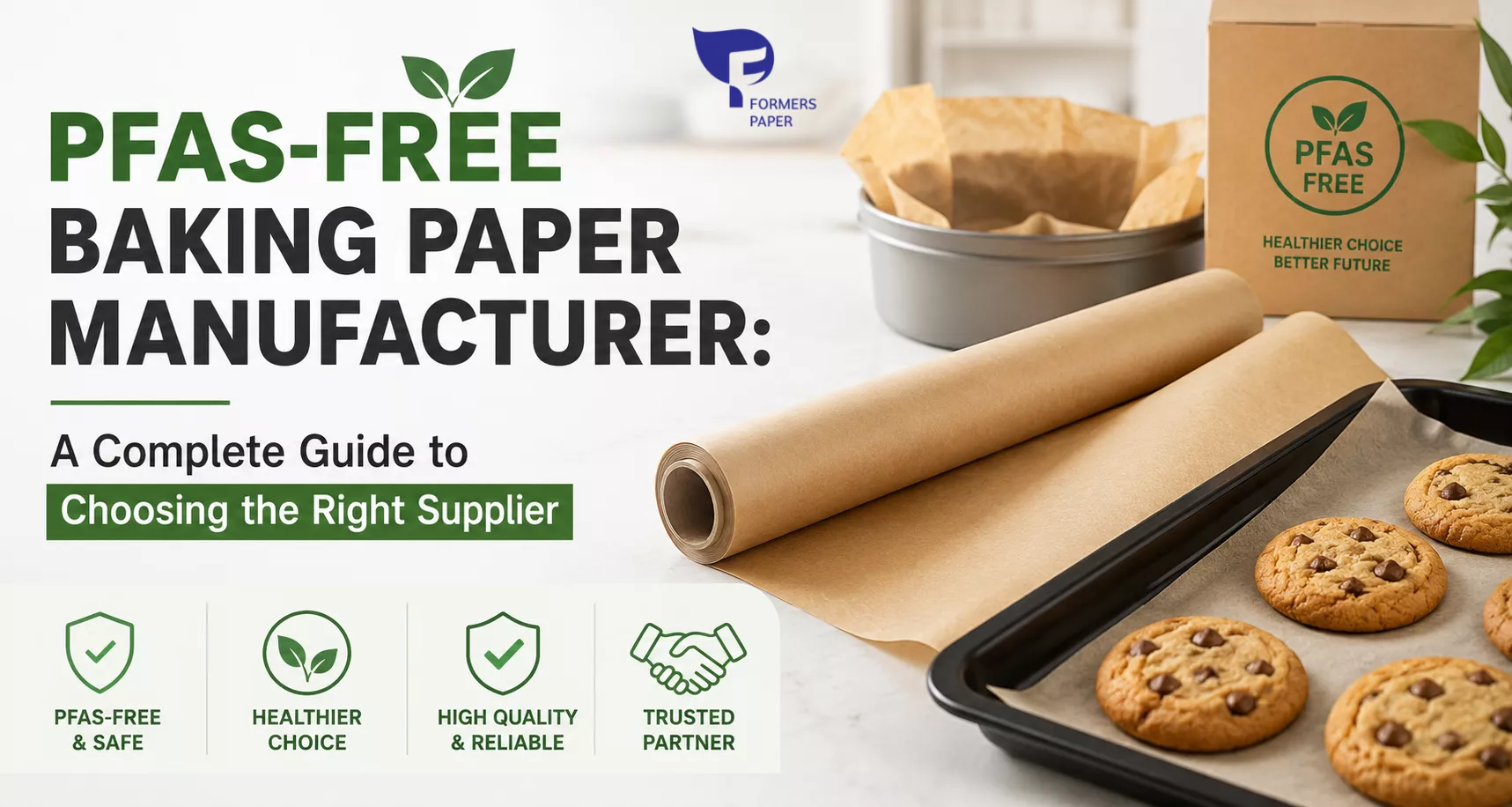
Every commercial bakery, food processor, catering business, and food packaging operation depends on consistency. From clean tray release and reliable non-stick performance to food-contact compliance and dependable supply, the quality of your baking paper can directly affect your production process.
That is why choosing the right baking paper manufacturer is more than comparing prices. The right supplier helps you maintain consistent baking performance, reduce production disruptions, meet food safety expectations, and secure a reliable supply of PFAS-free, food-grade paper products. The wrong supplier can lead to sticking, tearing, scorching, inconsistent quality, production delays, and unnecessary waste.
For more than 30+ years, FormersPaper has been manufacturing paper and packaging products for customers across global markets. As a vertically integrated manufacturer, we control key stages of production, including coating, laminating, printing, and converting. This gives our customers greater consistency, better quality control, and the flexibility to source products according to their exact application requirements.
Whether you are looking for wholesale baking paper, silicone-coated baking paper, 100% PFAS-free silicone-coated baking paper, Baking Base Paper, or customized food-grade paper solutions, this guide explains what to look for when selecting a reliable manufacturing partner.
Baking paper is not simply ordinary paper used inside an oven. It is a food-contact material designed to withstand heat, grease, moisture, and repeated handling while providing a reliable non-stick surface. It is used directly with food, often at high temperatures, which means material quality and manufacturing consistency are critical.
A poor-quality sheet may:
A professionally manufactured baking paper should perform consistently throughout the baking process.
This is where the expertise of the baking paper manufacturer becomes important. The quality of the finished product depends on raw material selection, base paper quality, coating uniformity, curing, quality control, and testing.
At FormersPaper, our manufacturing approach is designed to provide reliable performance across commercial and industrial applications. We manufacture 100% PFAS-free, food-grade silicone-coated baking paper for bakeries, food processors, commercial kitchens, packaging companies, and other professional users.
The quality of baking paper starts long before it reaches the oven. It begins with the materials used during production.
High-quality food-contact paper commonly begins with carefully selected virgin wood pulp.
Virgin pulp provides a cleaner and more consistent fiber structure compared with many recycled alternatives. This helps manufacturers achieve more predictable thickness, strength, flexibility, and surface quality.
For buyers sourcing food-grade products, the quality and origin of the base material are important considerations. A reliable manufacturer should be able to provide clear information about the materials used in production and the specifications of the finished paper.
The non-stick performance of baking paper comes primarily from its silicone coating.
Unlike traditional greaseproof papers that historically relied on fluorinated chemicals, high-quality baking paper uses PFAS-free, food-grade silicone formulations.
FormersPaper manufactures both single-sided and double-sided silicone-coated baking paper, allowing customers to select the configuration that best suits their application.
Single-sided paper may be suitable for tray lining and standard baking applications, while double-sided coated paper can provide additional flexibility for wrapping and other food-contact uses.
Baking products often contain butter, oils, fats, sauces, and moisture. Without suitable resistance, these materials can penetrate the paper and affect its strength and performance.
A well-manufactured baking paper maintains its structural integrity during use while helping protect trays, surfaces, and packaged food products.
For buyers sourcing large quantities of wholesale baking paper, grease and moisture resistance should be evaluated alongside heat resistance and non-stick performance.
When evaluating a supplier, it is important to understand whether the company actually manufactures its products or simply resells materials produced elsewhere.
A genuine manufacturer has greater control over the production process, quality specifications, and product development.
At FormersPaper, our manufacturing process includes several key stages.
The process begins with the preparation and refining of the paper pulp. Moisture levels, fiber consistency, and impurities are controlled to create a stable base for sheet formation.
The prepared pulp is processed through industrial paper machinery to form the base paper sheet.
During this stage, manufacturers control key specifications such as:
Consistency at this stage is essential because variations in the base paper can affect the final coated product.
Depending on the product specification, the paper may undergo parchmentizing to improve density, surface smoothness, and grease resistance. This process can improve the paper's performance before the silicone coating is applied.
Food-grade, PFAS-free silicone is applied to the paper through controlled coating equipment. Coating consistency is critical. If the coating is uneven, certain areas may become more vulnerable to sticking or reduced performance.
Professional baking paper manufacturers monitor key variables such as:
The coated paper is then cured under controlled conditions to ensure that the silicone properly bonds with the paper surface. Proper curing is essential for achieving stable non-stick performance and preventing unwanted coating transfer during use.
Before finished products are packed and shipped, they undergo quality checks based on the required product specifications.
Testing may include:
For buyers purchasing wholesale baking paper, requesting product specifications and relevant documentation is an important part of supplier evaluation.
Commercial baking paper needs to perform reliably at elevated temperatures.
FormersPaper's silicone-coated baking paper is engineered to withstand temperatures of up to 230°C, making it suitable for a wide range of commercial baking and food preparation applications.
However, buyers should always confirm the exact temperature specification of the product they are purchasing and match it to their application requirements.
A consistent silicone coating helps prevent food from sticking to the paper.
This is particularly important for:
Reliable non-stick performance can help reduce product damage, minimize waste, and improve production efficiency.
For products containing oils, fats, and moisture, resistance is essential. High-quality baking paper should maintain its structure during use while helping prevent grease and moisture from passing through to trays, surfaces, or packaging.
With global regulations tightening around perfluoroalkyl and polyfluoroalkyl substances, ensuring your baking paper is 100% PFAS-free is essential for consumer safety, brand protection, and legal compliance in international markets.
The paper must also be strong enough to withstand handling, folding, loading, and removal.
Depending on the application, FormersPaper's silicone-coated baking paper can be suitable for repeated use within a baking session, helping commercial kitchens and food operations improve material efficiency.
GSM, or grams per square meter, is one of the most important specifications when sourcing baking paper.
Generally, lighter paper may offer greater flexibility and cost efficiency, while heavier paper can provide additional strength and durability.
FormersPaper offers food-grade PFAS-free baking paper across multiple GSM options:
Suitable for applications where flexibility and material efficiency are priorities.
A popular option for everyday commercial baking applications, offering a balance between strength, performance, and cost.
Designed for applications requiring greater durability, repeated handling, or demanding production environments.
Our baking paper can be supplied in:
This allows customers to source baking paper according to their specific production requirements rather than adapting their operations to a limited product range.
Food-contact materials require a high level of quality control and documentation.
When evaluating any baking paper manufacturer, buyers should request relevant certification documentation rather than relying only on claims made in marketing materials.
FormersPaper's facilities hold a range of internationally recognized certifications, including:
PFAS-Free Compliance: Chemical testing verification confirming the absence of fluorinated compounds (PFAS/PFOS/PFOA) for safe food contact.
ISO 9001:2015- Demonstrates a structured Quality Management System designed to support consistent processes and quality control.
ISO 14001:2015 - Relates to environmental management and helps demonstrate a structured approach to managing environmental impact.
ISO/IEC 27001- Provides a framework for information security management, which is particularly relevant for international customers and supply chain partners.
OHSAS 18001- Relates to occupational health and safety management systems.
FSC Certification- Supports responsible sourcing of paper materials from responsibly managed forest sources.
RoHS Compliance- Restricts certain hazardous substances in applicable products and manufacturing processes.
BPI Certification- Supports recognized compostability requirements for applicable products.
When comparing food grade paper suppliers, always request current documentation and verify certification details where necessary.
Commercial bakeries require consistent baking paper for high-volume production of:
At this scale, even small inconsistencies can affect an entire production run. Reliable supply and consistent specifications are essential.
Food processors may use baking and grease-resistant paper for food preparation, wrapping, and packaging applications.
These customers often require:
Professional kitchens use baking paper for tray lining, food preparation, wrapping, and high-temperature cooking applications.
Catering companies benefit from practical, reliable baking paper that can support large-scale food preparation while helping maintain hygiene and reduce cleaning requirements.
Retail brands may require customized sheet sizes, roll formats, packaging, printing, and private-label solutions.
Working with a manufacturer that offers multiple capabilities under one roof can simplify the sourcing process.
Some businesses do not require finished silicone-coated baking paper. Instead, they source Baking Base Paper for their own downstream coating, converting, or finishing processes.
For these buyers, the quality of the base paper is critical.
Important specifications may include:
FormersPaper can support buyers looking for both finished baking paper and base paper solutions depending on their manufacturing requirements.
One of the most important questions to ask any potential supplier is:
Do you actually manufacture the product yourself?
Some companies operating in the paper industry are traders or distributors that purchase finished stock from third-party manufacturers.
This can create challenges when buyers experience:
A vertically integrated manufacturer has greater control over production.
FormersPaper manages key manufacturing capabilities in-house, including:
This allows us to maintain greater control over product quality and specifications.
With more than 30 years of manufacturing experience, five production facilities, more than 600 pieces of production machinery, and approximately 3 million square feet of manufacturing and warehouse space across China, the UK, and Indonesia, FormersPaper is equipped to support both large-scale production and customized requirements.
Our in-house R&D capabilities and more than 100 patents across our product range also support continuous product development and manufacturing innovation.
For buyers sourcing wholesale baking paper, this manufacturing infrastructure can provide the combination of scale, flexibility, and quality control required for long-term supply partnerships.
Before choosing a supplier, ask the following questions:
This helps determine whether you are dealing directly with the manufacturer or a reseller.
Request relevant certification documentation and verify it where necessary.
Confirm which GSM grades are genuinely available at production scale.
Ask for the specification in writing and request supporting test documentation where required.
Always test samples under your own production conditions before placing a large order.
Ask about production capacity, lead times, minimum order quantities, and customization options.
For many buyers, standard products are not enough. Confirm whether the manufacturer can provide custom sizes, coating options, GSM, roll formats, or pre-cut sheets.
A reliable supplier should be able to support your business as your order volume grows.
At FormersPaper, our team works with customers to understand their specifications and recommend the appropriate paper solution based on their application.
Sustainability is becoming an increasingly important consideration for food, bakery, packaging, and consumer brands.
Many businesses now need to demonstrate responsible sourcing and improved environmental practices throughout their supply chains.
FormersPaper supports responsible manufacturing through:
Our certifications and manufacturing systems provide customers with documented information they can use when evaluating their own supply chain requirements.
Choosing the right supplier means looking beyond a product catalogue.
With FormersPaper, customers benefit from:
Whether you are a commercial bakery, food processor, restaurant group, packaging company, private-label brand, or converter, our team can help you identify the right product specification for your application.
The right baking paper manufacturer can have a direct impact on your production efficiency, product quality, food safety requirements, and long-term supply reliability.
Before making a decision, look beyond price. Evaluate the supplier's manufacturing capabilities, raw materials, chemical safety compliance (100% PFAS-free certification), quality systems, certifications, production capacity, customization options, and ability to support your business over the long term.
FormersPaper combines more than three decades of manufacturing experience with vertically integrated production, international facilities, advanced equipment, and a broad range of paper and packaging capabilities.
Whether you need wholesale baking paper, PFAS-free silicone-coated baking paper, Baking Base Paper, or customized food-grade paper solutions, our team can help you find the right specification for your application.
Contact FormersPaper today to discuss your requirements, request product information, and explore a reliable manufacturing partnership for your baking paper supply.
A baking paper manufacturer produces food-grade paper designed for baking and food preparation applications. This may include silicone-coated baking paper, parchment-style paper, rolls, pre-cut sheets, and Baking Base Paper for converters.
A reseller purchases products from another manufacturer and sells them under its own name. A genuine manufacturer controls key production processes, which allows greater control over product quality, specifications, customization, and technical support.
The temperature rating varies by product and manufacturer. FormersPaper's silicone-coated baking paper is engineered to withstand temperatures of up to 230°C. Buyers should always confirm the specification for their intended application.
Baking Base Paper is the base paper used before additional coating or finishing processes are applied. It is commonly sourced by converters and private-label manufacturers that perform their own downstream processing.
You should check for PFAS-free food safety testing, ISO 9001, ISO 14001, FSC certification, RoHS, and applicable compostability compliance (such as BPI).
Yes. FormersPaper offers wholesale baking paper in multiple GSM grades, coating configurations, and formats, including rolls, reels, and pre-cut sheets.
Yes. Depending on your requirements, customization may be available for GSM, coating, dimensions, roll format, sheet format, and other product specifications.
Yes. Depending on the manufacturing capabilities of the supplier, customers may be able to source both finished silicone-coated baking paper and Baking Base Paper from the same manufacturing partner.
Contact the FormersPaper team with your required application, paper specifications, estimated order volume, and preferred format. Our team can help you identify a suitable product solution and provide further product information, samples, and a quotation.


Formers Paper is a leading manufacturer for a comprehensive range of sustainable paper & packaging products serving customers globally.
Shenzhen Formers Paper Co. Ltd, No.92 Zhugushi Road, Wulian community, Longgang District, Shenzhen, China