We wish you Happy Holidays & a joyful New Year!

FormersPaper breaks down how to source dissolvable, food-safe labels the right way- materials, standards, and supplier vetting made simple.
August 5, 2026
John Doe
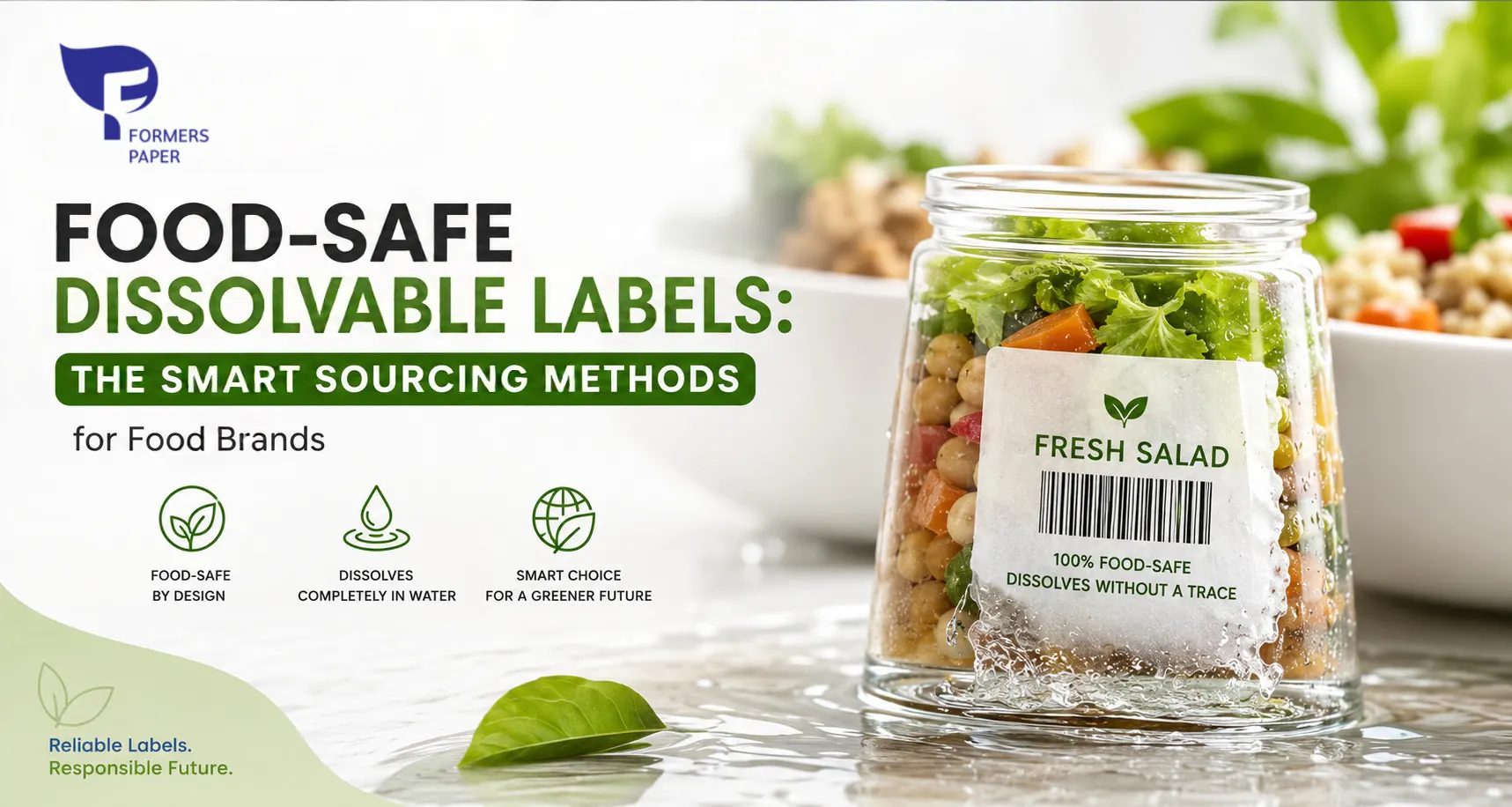
Every commercial kitchen and food plant uses labels every day. But most labels ruin containers with sticky mess, while others are not even safe for food contact. Food-safe dissolvable labels solve both problems in seconds.
If you supply food service brands, run a distribution business, or manage private-label packaging, you already know what a bad label does to your day. Residue builds up on containers. Adhesive will not let go. Inspectors flag the mess. Your customers start asking why you cannot find a better option. That is where a reliable food-safe label manufacturer helps you.
FormersPaper has spent more than 30+ years manufacturing paper and packaging products for customers across global markets, and food-safe dissolvable labels are one of the fastest-growing lines in its food safety catalogue. Whether you need water-soluble food labels for a single restaurant chain or dissolvable labels for direct food contact at an industrial scale, this guide breaks down what you need to know before you choose a supplier.
Food-safe dissolvable labels are labels built to dissolve completely in water, usually within thirty seconds, without leaving behind sticky residue or paper clumps. They are made from water-soluble paper and food-grade adhesive, so they can sit directly on food containers, packaging, and prep surfaces without creating a safety issue.
Unlike a standard sticker, food contact dissolvable labels are engineered to meet food safety standards from the start. That means the paper, the ink, and the adhesive all have to be safe for surfaces that touch food, not just safe for a countertop or a shipping box.
You will usually find these labels in three places:
Because they wash away completely, food contact dissolvable labels solve a problem that traditional labels never could. They fix what happens after the label has already done its job.
Also Read: PFAS-Free Baking Paper Manufacturer: A Complete Guide to Choosing the Right Supplier
If you are sourcing labels for a food business, a distributor, or a private-label brand, you are not just buying a sticker. You are buying a daily process. That process affects labour, sanitation, and compliance every single shift.
Here is what a poor labelling choice actually costs a B2B buyer:
A reliable dissolvable labels supplier removes every one of these problems in one move. Instead of managing adhesive buildup across hundreds of containers a day, your team drops the container in the sink, and the label disappears.
Think about what that means across a full week of shifts. A single kitchen might turn over hundreds of containers a day. Multiply that across a multi-unit chain, and the minutes saved on every container add up fast in labour hours, in container lifespan, and in fewer complaints during an inspection. None of that shows up as one big line item on a budget. It shows up quietly, week after week, in fewer hours spent scrubbing and fewer containers pulled out of rotation early because the surface is worn down.
For a B2B buyer managing procurement across several locations, that consistency is worth just as much as the upfront cost of the label itself. A supplier that solves this problem once, at the manufacturing stage, saves every one of your customers from solving it manually, one container at a time, on every single shift.
This is exactly why more restaurant groups, food processors, and private-label brands are asking their packaging partner for water-soluble food labels instead of standard adhesive stock. It is also why so many are going straight to a food-safe label manufacturer that can guarantee consistent quality at scale, instead of a reseller repackaging someone else's stock.
Also Read: Enviroprint Thermal Paper by FormersPaper: Zero-Phenol, Lab-Tested Receipt Paper
Not every supplier actually makes what they sell. Some are traders. Some are converters buying finished stock from someone else. FormersPaper is a vertically integrated dissolvable labels manufacturer, which means it controls the process from raw material to finished roll.
Not all food-safe dissolvable labels perform the same way, and as a buyer, you should not have to guess which ones will actually hold up. Here is what to check before you commit to a supplier.
Read More - How Businesses Can Choose the Best Carbonless Paper Supplier
Food contact dissolvable labels are not limited to one type of business. Here is where B2B buyers are putting them to work.
This is one of the most common questions B2B buyers ask, and the honest answer is that it depends on the materials used.
Water-soluble food labels dissolve in water, which means they do not end up scraped off and thrown in the trash the way traditional labels do. That alone cuts down on landfill waste. But dissolving in water is not the same thing as being biodegradable, and buyers should know the difference before they make sustainability claims of their own.
Here is what actually makes food-safe dissolvable labels a genuinely sustainable choice:
FormersPaper manufactures its direct food contact labels using FSC-certified pulp and water-based inks, so buyers get both the operational benefit and a sustainability story their own customers can trust. For B2B brands under pressure to report on sustainability, sourcing a water-soluble food labels partner with documented, verifiable practices matters just as much as the price on the invoice.
Read More- Linerless Label Manufacturer Checklist- How Retail & Logistics Teams Can Choose the Right Supplier
Traditional labels create hidden costs through extra labor, cleaning time, adhesive residue, and faster container wear. In contrast, food-safe dissolvable labels for direct food contact eliminate these inefficiencies at the source, saving time and reducing operational costs every time a container is reused.
Any manufacturer can claim their product is safe. A B2B buyer should ask for proof. Before signing with a food-safe labels manufacturer, request documentation for the following:
FormersPaper provides documentation across every one of these areas for its food-safe dissolvable labels because B2B buyers should never have to take a supplier's word for it.
Before you sign a contract, ask these questions.
Even experienced buyers make mistakes when they source labels for the first time, especially when they are moving away from standard adhesive stock. Here are the most common ones, and how to avoid them.
Read More- Top 10 Trusted High Sensitivity Thermal Paper Supplier
Many B2B buyers are not sourcing for a single location. They are supplying a regional chain, a national distributor, or an international foodservice group, and that changes what a supplier needs to offer.
FormersPaper operates production facilities across China, the UK, and Indonesia, which allows the company to support B2B accounts in multiple regions without forcing every customer through a single bottleneck factory. For buyers managing supply across borders, that kind of footprint matters just as much as the product itself.
Consistency is the real test at this scale. A label that performs well in one facility needs to perform exactly the same way in another, whether it ships from Shenzhen or from a facility closer to a customer's home market. FormersPaper applies the same quality checks, the same coating process, and the same testing standards across every facility that produces dissolvable labels for direct food contact, so a buyer in one country gets the same result as a buyer on the other side of the world.
This matters even more for growing brands. A regional restaurant group that expands into new markets should not have to requalify a new supplier every time it opens in a new country. Working with an established food-safe labels manufacturer that already operates internationally removes that friction and keeps a labeling program consistent no matter where the next location opens.
FormersPaper has manufactured paper and packaging products for more than 30+ years, with five production facilities and more than 600 pieces of production machinery across China, the UK, and Indonesia. As a dissolvable labels manufacturer, FormersPaper controls coating, printing, laminating, and converting in-house, so every B2B buyer gets consistent quality on every order, not just the first one.
Here is what sets FormersPaper apart as a food-safe labels manufacturer:
Whether your business needs water-soluble food labels for a single kitchen or dissolvable labels for direct food contact across a national distribution network, FormersPaper can match the specification to your operation.
Every business labels food a little differently, and a generic product rarely fits every operation. FormersPaper works directly with B2B buyers to customize:
This flexibility is why private-label brands, distributors, and multi-unit restaurant groups keep choosing FormersPaper as their dissolvable labels supplier instead of settling for an off-the-shelf product that does not fit their workflow.
Choosing food-safe dissolvable labels is not only a purchasing decision. It is an operational one. The right label reduces labor, protects compliance, and cuts waste every single day, across every shift and every location.
Before you choose a supplier, look past the price tag. Check the certifications. Ask about the manufacturing process. Request real samples and test them under your own conditions. A genuine dissolvable labels manufacturer will welcome every one of these questions, because a company that actually makes its own product already knows it holds up.
None of this needs to be complicated. It just needs to be done before the purchase order goes out, not after a problem shows up on the line.
FormersPaper combines more than three decades of manufacturing experience with vertically integrated production, international facilities, and a full range of direct food contact labels built for B2B buyers who cannot afford to guess. From single-location restaurants to national food-processing brands, this is a dissolvable labels supplier built to grow alongside your business.
Food-safe dissolvable labels are used to mark food containers, prep items, and packaging with dates, batch codes, or allergen information. They dissolve fully in water, so containers can be washed and reused without scraping off leftover adhesive.
Most food contact dissolvable labels dissolve within thirty seconds under running water. Exact times can vary slightly depending on water temperature and the specific product.
Yes, when sourced correctly. Dissolvable labels for direct food contact are made with food-grade paper, ink, and adhesive that meet food-contact material standards, unlike standard retail stickers.
A manufacturer controls the entire production process, from pulp to finished label, which means better quality control and consistency. A reseller purchases finished stock from someone else and sells it under their own name.
Yes. Many B2B buyers request custom branding, barcodes, or batch codes printed directly onto their food contact dissolvable labels rather than using blank stock.
They can be, especially when made with FSC-certified, plant-based paper and water-based ink. Buyers should ask their supplier for documentation rather than assuming every dissolvable label is automatically eco-friendly.
Look for food-contact material compliance, ISO 9001, ISO 14001, FSC certification, and RoHS compliance. A trustworthy supplier will provide this documentation without hesitation.
Yes. FormersPaper operates five production facilities with more than 600 pieces of manufacturing equipment, giving it the capacity to support both small accounts and large, recurring B2B orders.
Contact the FormersPaper team with your required specifications, estimated order volume, and preferred format. The team can help identify the right product, provide samples, and prepare a quotation.

Formers Paper is a leading manufacturer for a comprehensive range of sustainable paper & packaging products serving customers globally.
Shenzhen Formers Paper Co. Ltd, No.92 Zhugushi Road, Wulian community, Longgang District, Shenzhen, China