We wish you Happy Holidays & a joyful New Year!

Enviroprint Thermal Paper by FormersPaper, zero-phenol, lab-tested receipt rolls that are safer for staff, customers, and the environment.
July 27, 2026
John Doe
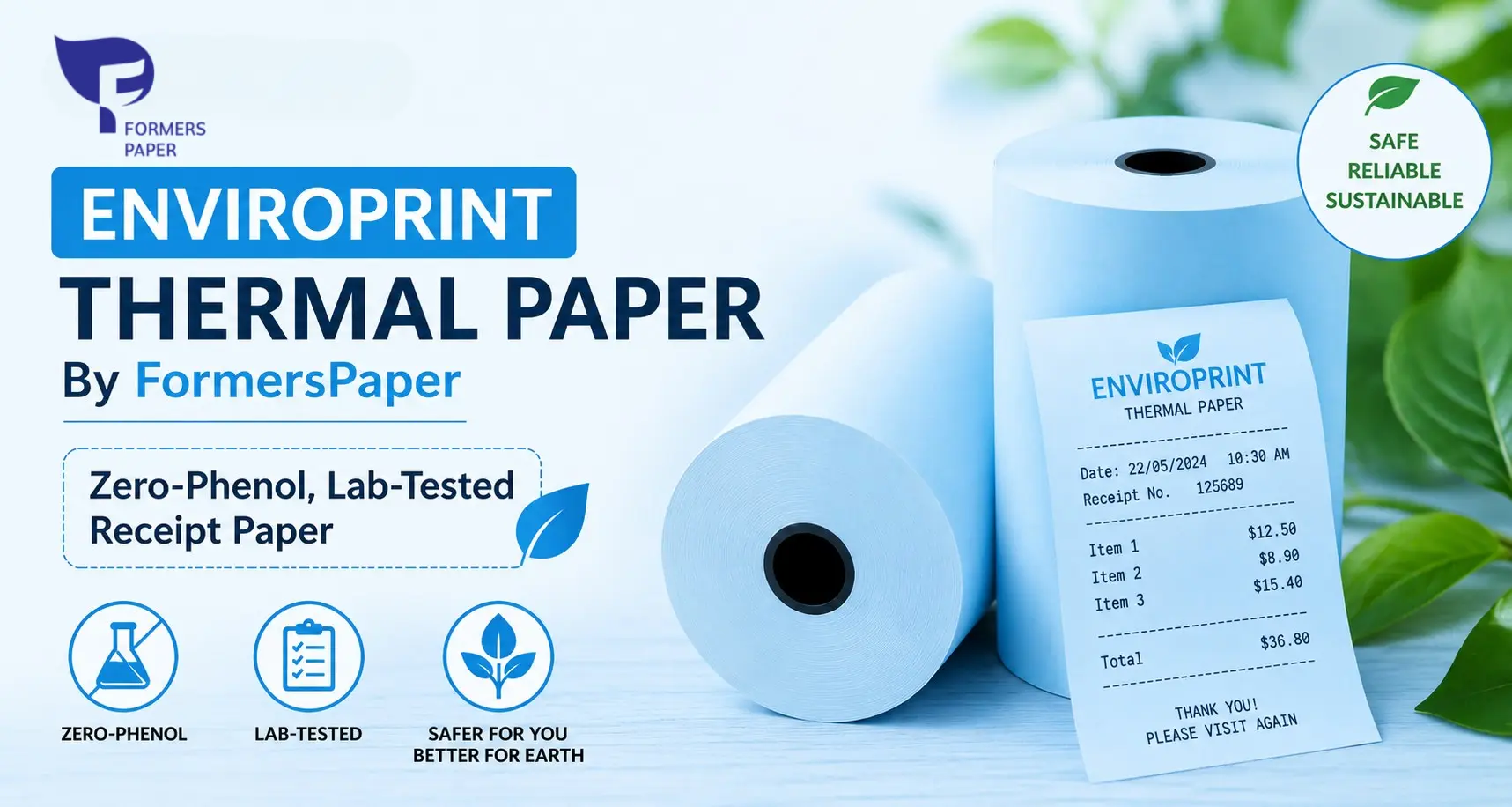
Every receipt your customer holds is a small test of trust. It has to print clean, last long enough to matter, and carry no chemistry nobody asked for. That test is exactly why more retailers, banks, and food service brands are switching to Enviroprint thermal paper this year, and why buyers scanning the market keep landing on the same question: what actually separates a genuine eco-friendly thermal roll from a paper that just wears a green label?
We have manufactured thermal paper for more than 30+ years at FormersPaper, and we have watched "eco-friendly" become one of the most overused words in this industry. So we wrote this blog the way we write all of them: plainly, with real specifications, real lab reports, and no filler. It explains what Enviroprint thermal paper is, how it differs from conventional thermal rolls, what the lab data actually shows, and how to evaluate any Enviroprint thermal paper supplier before you commit to a bulk order. Let's start with the basics.
Enviroprint thermal paper is our blue, phenol-free thermal paper, built on a carbon-based matrix imaging system instead of the chemical developers used in standard thermal rolls. Where conventional thermal paper relies on a leuco dye reacting with a phenolic developer under heat, Enviroprint thermal paper uses a physical imaging process. Heat activates the carbon-based layer directly, and the image appears without a chemical reaction taking place at all.
That single design choice changes almost everything downstream: the paper's safety profile, its recyclability, its manufacturing footprint, and its performance on standard equipment.
Here is what defines it:
Buyers who search for eco-friendly thermal paper usually find broad explainers about thermal printing in general. Few explain what happens inside the coating, and fewer still back it up with lab data. That is the gap this guide closes.
To understand why Enviroprint thermal paper matters, it helps to understand what it replaces.
Standard thermal paper uses a phenolic chemical developer, most commonly some form of bisphenol, to trigger the colour change when heat hits the coating. That chemistry works, but it comes with three well-documented downsides:
None of this is news to buyers who have already read up on phenol-free options. What most competing guides miss is the manufacturing side: how a low-energy, chemical-developer-free process actually functions, and how to verify a supplier's claims rather than take them on faith. Not every Enviroprint thermal paper supplier will volunteer that information upfront, which is exactly why it pays to ask. We will get to both.
Enviroprint thermal paper is built on a carbon-based matrix rather than a dye-developer pair. When the print head applies heat, the carbon layer responds directly, producing the image through a physical rather than chemical reaction. No phenolic compound is triggered, because none is present in the formulation to begin with.
Two performance curves show what this looks like in practice.
Optical density rises sharply once the paper crosses roughly 70°C, climbing fast through 90 to 110°C and levelling out near 130 to 150°C. In plain terms, the print activates quickly and predictably at standard thermal print-head temperatures, with no lag or patchy activation.
Optical density scales steadily with energy input, from roughly 3.2 to 15.2 mj/mm². That steady, near-linear climb is what gives every Enviroprint thermal paper roll consistent, even coverage across a receipt rather than dark patches next to faint ones.
Because the imaging mechanism is physical, the manufacturing process itself runs at lower energy intensity than paper built around chemical developer coatings. That lowers the carbon footprint of the paper before it ever reaches a printer, and it is one reason we can back sustainability claims with production data instead of marketing language alone.
Anyone can print "eco-friendly" on a spec sheet. We would rather hand you the lab reports.
We commissioned independent SGS testing on our Enviroprint thermal paper roll stock. Here is what came back:
US FDA 21 CFR 176.170, Chloroform Extractives (Report No. CANEC24027011702). This test checks whether a food-contact material leaches regulated substances under simulated contact conditions. The sample was tested against three simulants, 8% ethanol, n-heptane, and distilled water, at their required temperatures and durations. Every result came back Not Detected, and every simulant returned a clean PASS.
Phenol Monomer testing per EN 71-10/71-11:2005 (Report No. CANEC24026912402). This is the direct proof behind the phenol-free claim. The test measured for phenol content in the material, and the result was Not Detected, well under the method's detection limit. This is not a marketing phrase attached after the fact. It is a chemistry claim you can verify against a real report number issued by an accredited lab.
We publish these numbers because a genuine BPA-free EnviroPrint thermal paper product should be provable, not just promised. Ask any Enviroprint thermal paper supplier you are considering for equivalent documentation. If they cannot produce a report number you can trace, treat the sustainability claim as marketing copy rather than fact.
Beyond the chemistry, the environmental case holds up on three more fronts:
The phrase "BPA-free" gets attached to a lot of thermal paper that has simply swapped BPA for BPS, a close chemical cousin with many of the same concerns. That is not the same thing as phenol-free.
A genuine BPA-free EnviroPrint thermal paper roll should clear a higher bar than a single-chemical substitution:
When a supplier tells you their thermal paper is chemical-free or eco-friendly without a lab report behind it, ask directly: phenol-free according to which test, verified by which lab, on what date? A real BPA-free EnviroPrint thermal paper supplier answers that in one sentence. A reseller changes the subject.
This distinction matters more in regulated sectors. Healthcare facilities, food service operations, and financial institutions increasingly write phenol-free specifications into their procurement requirements, not just BPA-free ones. Confirm which standard your supplier is actually meeting before you assume the two terms mean the same thing.
An Enviroprint thermal paper roll performs the same core job as any thermal roll: it prints receipts, tickets, and tags, but without the chemical baggage. Typical applications include:
Because Enviroprint thermal paper runs on standard direct thermal (DT) and POS printers, from Epson- and NCR-style hardware to typical kiosk and mobile print units, switching an existing operation over does not require new equipment or retraining. That single fact removes the biggest objection procurement teams raise when they consider moving away from conventional stock: the cost and disruption of switching hardware. There is none, and moving to a BPA-free EnviroPrint thermal paper roll is often a same-week changeover rather than a procurement project.
Not every roll marketed as sustainable clears the same bar. Here is a practical checklist for identifying the best EnviroPrint thermal paper for your business, whether you are buying a single case or sourcing at wholesale volume.
Ask for the actual test report numbers, not a summary paragraph. A genuine Enviroprint thermal paper supplier hands these over without hesitation, because the results are already on file with an accredited lab like SGS.
A trader who resells someone else's coating cannot answer detailed questions about the imaging chemistry, the coating weight, or the energy profile of the manufacturing line. A genuine EnviroPrint thermal paper manufacturer coats the paper in-house and can walk you through exactly how the physical imaging process works, because they built it.
Confirm the roll works on your existing direct thermal and POS printers without firmware changes or new drivers. The best EnviroPrint thermal paper requires zero equipment investment to adopt.
A credible EnviroPrint thermal paper manufacturer publishes clear storage guidance: temperature range, humidity tolerance, and shelf life under those conditions. Ours is straightforward:
Look for the same certification backbone that matters across the paper industry: ISO 9001:2015 for quality management, ISO 14001:2015 for environmental management, and FSC certification for responsibly sourced fibre. Ask any EnviroPrint thermal paper manufacturer for copies, then verify the certificate numbers directly with the issuing body.
The best EnviroPrint thermal paper supplier tells you exactly what is and is not in the coating: no added pigments, no added dyes, no phenolic developer, full stop. Vague language like "eco-conscious formulation" without specifics is a signal to keep asking questions.
Score every candidate against these six points. A supplier who clears all six is treating you like a long-term partner. One who clears two or three is hoping you will not ask the harder questions.
Different sectors rely on eco-friendly EnviroPrint thermal paper rolls for different reasons, but the underlying demand is the same: print performance without the chemical trade-off.
Retail and quick-service restaurants print the highest receipt volumes of any sector, and staff handle that paper directly for entire shifts. Eco-friendly EnviroPrint thermal paper rolls reduce chemical exposure for employees while keeping checkout speed exactly where it was.
Banking and finance operations, including ATM networks, need transaction slips that stay legible for record-keeping and dispute resolution. Long-term image retention matters more here than in almost any other application, and it is one of the clearest advantages of an Enviroprint thermal paper roll over conventional stock, which fades within a few years.
Airlines and transit operators print boarding passes and tickets at extremely high volumes across global operations, often under varying climate conditions. Consistent print activation across a wide temperature range keeps gate operations moving without misprints.
Healthcare-adjacent and hospitality settings increasingly write phenol-free specifications into procurement policy, driven by staff safety and guest-facing sustainability commitments alike. For these buyers, eco-friendly EnviroPrint thermal paper rolls are becoming close to a standard requirement rather than a nice-to-have.
Across every one of these sectors, the pattern is consistent: businesses that switch to EnviroPrint thermal paper report no change in print quality or printer compatibility, only a change in what is no longer present in the coating.
FormersPaper is a vertically integrated manufacturer with more than 30+ years in the paper trade, and we coat, laminate, print, and convert in-house across five factories in China, the UK, and Indonesia. We do not buy finished thermal stock from a third-party mill and resell it under our own label. We built the Enviroprint thermal paper formulation ourselves, tested it independently, and stood behind every report number we published.
As an EnviroPrint thermal paper manufacturer, here is what we bring to the table:
Converters, printers, and distributors searching for a dependable Enviroprint thermal paper supplier typically shortlist us for the lab documentation, then stay for the manufacturing scale and regional coverage. We treat every order, from a sample request to a full-container shipment, as the start of a long-term relationship, not a single transaction.
If you already work with a supplier that cannot produce a traceable lab report on request, that is worth a second look before your next bulk order. A real EnviroPrint thermal paper manufacturer has nothing to hide in that conversation.
Before you contact any Enviroprint thermal paper supplier, have the following ready so the quotes you get back are actually comparable:
The clearer your brief, the faster you can compare a quote against your current supplier and see exactly where the difference lies.
Sustainability claims on thermal paper are cheap to print and expensive to verify, which is exactly why so few suppliers bother to provide the documentation behind them. Enviroprint thermal paper closes that gap with third-party SGS testing, a phenol-free carbon-matrix formulation, standard printer compatibility, and a manufacturer willing to put report numbers behind every claim.
Whether you are comparing a single roll against your current stock or sourcing at volume, the best EnviroPrint thermal paper is the one that hands you the lab reports before you ask twice. Send FormersPaper your specs, your volumes, and your certification requirements, and our regional team will reply with samples, documentation, and a firm quote. Making the switch to Enviroprint thermal paper takes one careful comparison. Make it once, and every order after that gets easier.
Enviroprint thermal paper uses a carbon-based matrix and a physical imaging process instead of a phenolic chemical developer. It is free from BPA and BPS, requires no added pigments or dyes, and is verified phenol-free through independent SGS lab testing.
Yes. Enviroprint thermal paper works on standard direct thermal (DT) and POS printers without hardware changes, firmware updates, or new drivers.
Ask for the third-party lab report number behind the claim. Our own documentation includes SGS Report No. CANEC24027011702 for FDA chloroform extractives and Report No. CANEC24026912402 for phenol monomer testing, both showing Not Detected results.
Store between 5°C and 30°C, away from direct sunlight, in a cool and dry environment. Under these conditions, the paper retains full performance for up to 12 months from the date of manufacture.
Retail, quick-service restaurants, banking and finance, airlines and transit, and hospitality all rely on eco-friendly EnviroPrint thermal paper rolls, largely because of staff safety, procurement policy, and long-term image retention requirements.
Score candidates on verified lab documentation, in-house manufacturing, printer compatibility, storage and shelf-life data, certifications on file, and transparent composition. A supplier who clears all six is worth a long-term relationship.
It is manufactured in accordance with internationally recognized food-contact regulations, but direct thermal paper, including Enviroprint thermal paper, is not recommended for direct food contact.


Formers Paper is a leading manufacturer for a comprehensive range of sustainable paper & packaging products serving customers globally.
Shenzhen Formers Paper Co. Ltd, No.92 Zhugushi Road, Wulian community, Longgang District, Shenzhen, China