We wish you Happy Holidays & a joyful New Year!

Learn what blue thermal paper is, how it improves print visibility and durability, and why it is a smart choice for businesses across industries.
June 10, 2026
John Doe
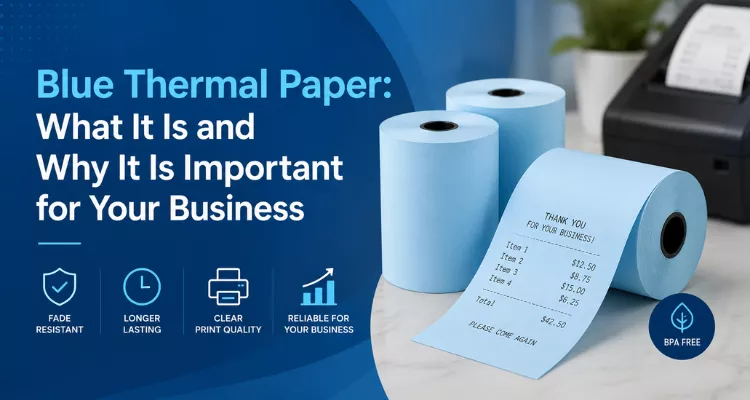
If you have ever picked up a receipt that looked slightly different, a cool blue-tinted paper instead of the familiar white, you have already held blue thermal paper in your hands. Most people do not think twice about it. But for businesses sourcing paper rolls at volume, that colour difference signals something important: a fundamental shift in how thermal paper is made, what chemicals it contains, and whether it can be recycled at the end of its life.
This blog covers everything you need to know about blue thermal paper, how it works, why it is gaining ground globally, how it compares to standard thermal paper, and what to actually check before you place a large order. We will also cover the compliance and chemical safety questions that most other guides skip over entirely.
Blue thermal paper is a type of direct thermal paper that produces a printed image through a physical reaction to heat, rather than through ink or a traditional chemical colour-former and developer system.
Standard white thermal paper uses a heat-sensitive coating built around a chemical reaction, a colour former (typically a leuco dye) and a developer (historically bisphenol A, or BPA, and related phenolic compounds) that combine under heat from the print head to produce a black or dark image. Blue thermal paper takes a different approach. Its imaging layer is built on a carbon-based matrix system. When the print head applies heat, a physical change occurs within the carbon matrix, producing the characteristic blue-tinted image without triggering a phenolic chemical reaction.
The result is a paper that is free from bisphenols, phenolic developers, and added pigments or dyes, a genuinely different product at the chemistry level, not just a rebranded blue thermal paper roll with a tinted coating.
Because there is no developer chemical involved, there is nob, no BPS, no BPAF, and no phenol. The paper can be safely handled, is food-contact compliant under international regulations, and critically, it can be recycled without contaminating the recycling stream, unlike conventional thermal paper, which is typically rejected by recycling facilities due to its chemical coating.
Understanding the mechanism helps you ask better questions when speaking to a blue thermal paper supplier.
In conventional thermal paper, the chemistry goes like this:
Blue thermal paper replaces this chemical reaction with a physical one:
Many comparison charts list superficial differences. Here is an honest breakdown of what actually changes between the two paper types.
Conventional thermal paper relies on a chemical reaction between a leuco dye and a phenolic developer. BPA was the dominant developer for decades. After widespread regulatory restrictions, including the EU's ban on BPA in thermal paper from January 2020, led manufacturers to shift to BPS and other bisphenol alternatives. These alternatives are now also under review, with EU Regulation 2024/3190 extending restrictions to food-contact materials covering additional bisphenols from January 2025.
Blue thermal paper bypasses this entire chemical category. The carbon-based matrix contains no bisphenols and no phenolic developers, making it compliant with current regulations and, importantly, positioned ahead of where regulations are heading.
This is where the environmental argument for Blue Thermal Paper becomes concrete. Conventional thermal paper cannot enter most paper recycling streams because its chemical coating contaminates the pulp. In many countries, thermal receipts are classified as residual waste rather than recyclable paper.
Blue thermal paper, because it carries no chemical developer coating, can enter the standard paper recycling stream alongside cardboard, office paper, and newsprint. For a business printing thousands of receipts per day, this is a meaningful difference in total waste output.
Blue thermal paper is engineered for long-term image retention well beyond the three-year archival limit that conventional thermal paper typically hits before fading becomes a problem. The carbon matrix image is also resistant to oils and moisture, which is relevant for receipts handled in food service, healthcare, and logistics environments.
Our BLUETICKET Blue Thermal Paper roll, for example, maintains print performance characteristics for up to 12 months from the date of manufacture under recommended storage conditions, and the printed image is designed for long-term archival stability.
One detail that matters enormously to businesses considering a switch: Blue Thermal Paper works on standard direct thermal (DT) and POS printers without any equipment modification. You do not need to buy new hardware or recalibrate your existing print heads. The paper is designed to run on the same thermal print heads currently used for conventional receipt paper.
Conventional thermal paper uses a comparatively complex chemical manufacturing process synthesising leuco dyes, developer chemicals, and stabilisers, which adds steps, energy, and chemical inputs. Blue Thermal Paper's carbon-based matrix uses simpler organic raw materials and a lower-energy manufacturing process. The overall carbon footprint of production is meaningfully smaller.
Blue thermal paper is not a niche product limited to a single sector. Its practical advantages make it a strong fit across multiple industries.
Here is the section that competing articles almost always skip.
The EU banned BPA in thermal paper from January 2020 under the REACH Regulation (EC) No 1907/2006. This was not the end of the regulatory story; it was the beginning of a broader chemical reclassification process.
EU Regulation 2024/3190, which applies from January 2025, extended restrictions to food-contact materials and covered additional bisphenols beyond BPA, including BPS and BPAF. Critically, this regulation also introduced a mandatory written Declaration of Compliance, requiring suppliers to formally document their chemical status rather than simply make verbal or general marketing claims.
If your supplier cannot produce a written Declaration of Compliance, they are not meeting the current EU standard. A claim of "BPA-free" on a product data sheet is not a declaration of compliance.
Several US states, including Connecticut, Minnesota, and Washington, have passed BPA restriction laws specifically targeting thermal paper, with phase-out deadlines running through 2026. California's Proposition 65 already requires warnings for BPA exposure, adding a compliance layer for businesses selling into that market.
The direction of travel is clear: chemical restrictions on thermal paper are tightening, not relaxing, across both the EU and the US.
Formers Paper's BLUETICKET thermal paper has been independently tested by SGS, one of the world's leading inspection and certification bodies, confirming not-detected (ND) results for phenol to EN 71-10/71-11:2005 standards and PASS results across all three simulants in the US FDA 21 CFR 176.170 Chloroform Extractives test. These are not marketing statements; they are third-party verified test reports.
When assessing a blue thermal paper supplier on chemical compliance, ask for these specific documents; do not accept marketing language as a substitute:
When requesting a quote for a Blue Thermal Paper roll in volume, these are the specifications that determine whether the paper performs correctly for your application.
A manufacturer who makes this paper and understands it answers all eight questions confidently, often with documentation ready. A reseller who buys from a mill and repackages it typically cannot answer questions three, five, or six without going back to their own supplier, a delay that tells you everything about how much control they have over the product.
The questions below separate a genuine blue thermal paper manufacturer from a reseller who cannot answer them clearly.
The distinctive blue tint of the paper and the blue-toned print are not incidental; they serve a real operational purpose in environments where multiple receipt types are in use. Blue receipts are instantly visually distinguishable from white conventional thermal receipts, carbonless copies, and laser-printed documents.
In a high-volume retail or hospitality environment where customer copies, kitchen copies, and management reports all pass through the same counter space, colour-coding by paper type reduces handling errors. Staff learn quickly that the blue receipt is the one for the customer; the white duplicate is the kitchen copy. That visual shorthand adds up to meaningful time savings across thousands of transactions.
If your only concern is cost per roll and you are not subject to EU regulations, conventional BPA-free thermal paper remains a functional option, but the regulatory and sustainability trajectory strongly favours moving toward bisphenol-free alternatives now rather than managing a forced transition later.
Blue Thermal Paper makes the strongest sense for businesses that meet one or more of these criteria:
At Formers Paper, we are a vertically integrated blue thermal paper manufacturer with over 15+ years of experience in thermal and speciality paper products. Our BLUETICKET thermal paper is the product of our in-house R&D investment in next-generation thermal imaging technology.
We produce BLUETICKET from a carbon-based matrix system free from BPA, BPS, phenolic developers, and added pigments or dyes. The paper has been independently tested by SGS for both phenol content (ND result to EN 71-10/71-11:2005) and FDA food-contact compliance (PASS result across all three simulants in US FDA 21 CFR 176.170). We can supply these test reports on request.
BLUETICKET runs on standard direct thermal POS printers without modification and is available in jumbo reel format for local converting as well as in finished blue thermal paper roll sizes for direct use.
We supply to retail, food service, banking, transport, and healthcare customers across multiple markets. Our fully integrated supply chain means we control the process from coating to finished roll, giving us and you confidence in consistent quality across every order.
If you are evaluating Blue Thermal Paper for your business, the best first step is to request a sample. Contact our team, and we will send you a test roll alongside the relevant compliance documentation so you can verify performance in your own equipment before committing to volume.
Yes. Blue Thermal Paper runs on any standard direct thermal printer with no hardware changes, recalibration, or new equipment required.
It meets FDA 21 CFR 176.170 food-contact compliance standards. Incidental contact in food service environments is acceptable; direct food wrapping is not recommended. Former's Paper's blue thermal rolls carry verified test results for all three FDA simulants, so you can request documentation directly from your supplier.
Yes. Free from phenolic developer chemicals, blue thermal paper enters standard recycling streams, unlike conventional thermal paper, which is classified as residual waste and must be landfilled. This makes Formers Paper's blue thermal line a meaningful upgrade for businesses with sustainability commitments.
Significantly longer than the three-year limit of conventional thermal paper. Store away from sunlight, heat, and plasticisers for best archival results.
BPA-free paper substitutes one bisphenol for another. Blue thermal paper eliminates the developer chemical, using a carbon-based matrix, a fundamentally different technology.
Request these four documents from any Blue Thermal Paper supplier:


Formers Paper is a leading manufacturer for a comprehensive range of sustainable paper & packaging products serving customers globally.
Shenzhen Formers Paper Co. Ltd, No.92 Zhugushi Road, Wulian community, Longgang District, Shenzhen, China