We wish you Happy Holidays & a joyful New Year!

Learn how to choose a BPA-free thermal paper supplier. Discover key benefits, safety standards, quality tips, and what businesses should know.
May 30, 2026
John Doe
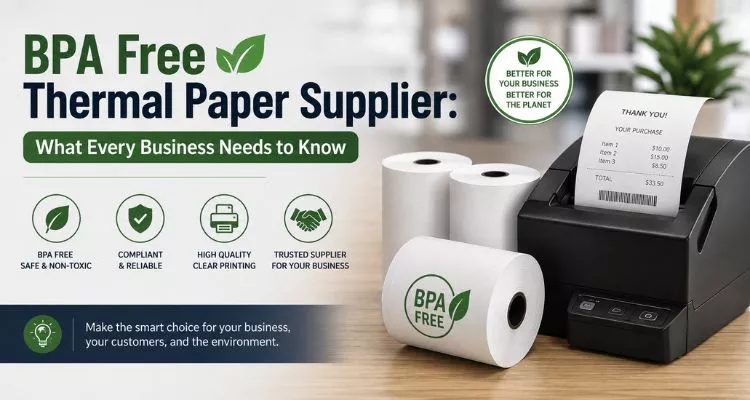
If you have been searching for a BPA free thermal paper supplier, you have already made the right call. Because most blogs online stop at "switch to BPA-free paper" and leave you wondering how to actually vet a supplier, what certifications to ask for, and whether the paper they sell will perform under pressure.
This blog is different. It will walk you through what BPA-free thermal paper actually means, the chemical compliance questions that most buyer guides skip entirely, the certifications that prove a supplier's claims, and how a BPA free thermal paper supplier like Formers Paper, with over 15 years of industry experience, approaches this topic from the production side. By the end, you will be able to write a proper request for quote and spot a weak supplier fast.
Thermal paper is heat-sensitive. A thermal printer head applies precise heat to the paper's surface, reacting with a chemical developer layer to produce text and images without any ink. For decades, the most common developer used was Bisphenol A (BPA) a synthetic chemical that delivers sharp, fast results but carries well-documented health concerns.
BPA is an endocrine disruptor. Studies have linked repeated dermal exposure to disrupted hormone function, reproductive effects, and developmental issues. Because thermal paper is held constantly by cashiers, restaurant staff, warehouse workers, and healthcare personnel, the exposure risk accumulates quickly especially in high-volume environments.
BPA-free thermal paper replaces that developer chemistry. Modern alternatives include Bisphenol S (BPS), Pergafast, and fully phenol-free formulations. Each has different performance characteristics and compliance profiles, which is exactly why simply asking for "BPA-free paper" is not enough when choosing a BPA free thermal paper supplier. You need to know what replaced the BPA and whether that alternative is itself under regulatory scrutiny in your target markets.
The three most widely shared guides on this topic from POSPaper, Star Micronics, and McDermid Paper cover the basics well: BPA is harmful, BPA-free paper is safer, switching is easy, and print quality does not suffer. That is all true.
But there are four important angles, none of which are addressed properly. This is where Formers Paper, as a vertically integrated manufacturer, can offer something genuinely different.
Several articles recommend BPS as a safe BPA alternative without noting that BPS is now itself under scrutiny. The EU's Regulation 2024/3190, effective January 2025, extended bans on bisphenols in food-contact materials to include BPS and BPAF — not just BPA. A supplier still selling "BPA-free" paper that uses BPS as its developer may be walking you into a compliance problem in European markets. Always ask what replaces the BPA.
Every guide tells you to "choose a trusted supplier." None of them tell you how to verify whether that supplier actually makes the paper. Traders and resellers can label anything "BPA-free" with no production-level control over chemical compliance. A true manufacturer, one with in-house coating lines, an R&D department, and ISO-certified facilities, can provide test reports, Declarations of Compliance, and documented quality control at source. A reseller cannot.
Most BPA-free guides focus on what the paper does not contain. A serious buyer also needs to know how the forest was managed (FSC certification), how the factory manages its environmental impact (ISO 14001), how occupational health is controlled (OHSAS 18001), and whether the manufacturer restricts the use of hazardous materials throughout its production process (RoHS). These are the certifications that protect your brand across international markets, not just the BPA-free label on the box.
Most guides target small domestic buyers. If you are a distributor, a regional retailer, or a business sourcing at scale across multiple markets (North America, Europe, the Middle East, and Asia, you have a completely different set of questions: minimum order quantities, lead time reliability, multi-format availability, and cross-market regulatory alignment. No published guide addresses this from a manufacturer's perspective.
Chemical regulations on thermal paper are tightening, and the pace is accelerating. Here is where things stand.
The EU banned BPA in thermal paper from January 2020. Regulation 2024/3190, effective January 2025, extended bans on bisphenols - including BPS and BPAF - to food-contact materials and introduced a mandatory written Declaration of Compliance. Suppliers must now formally document their chemical status, not simply claim it in marketing language.
Several states including California, Connecticut, Minnesota, and Washington have passed BPA restriction laws targeting thermal paper, with phase-out deadlines running through 2026. California's Proposition 65 already requires exposure warnings for BPA, adding a compliance layer for any business operating or selling there. Federal regulation on thermal paper has not yet matched state-level action, but the trajectory is clear.
Regulatory momentum is building across multiple markets. Businesses sourcing for export into Japan, South Korea, and Australia should monitor chemical safety requirements specific to thermal paper and food-contact materials in each jurisdiction.
The practical takeaway: specifying phenol-free or fully bisphenol-free stock now is not a premium decision. It is a supply chain future-proofing decision that saves you from an expensive swap later. For businesses that need to stay ahead of this curve, working with a certified phenol free thermal paper manufacturer from the outset is the lowest-risk procurement strategy.
When evaluating a BPA free thermal paper supplier, ask specifically what developer chemistry their paper uses. If you need the strictest formulation, look for a phenol free thermal paper manufacturer one that can document the absence of all phenol-based developer compounds, not just BPA. Here are the main options on the market.
BPS (Bisphenol S): The most common BPA substitute in early "BPA-free" products. Functional and effective, but now under regulatory restriction in Europe for food-contact applications. Not a safe long-term bet for businesses selling into EU markets.
Pergafast (Pergafast 201): A non-bisphenol developer that has been used as a cleaner alternative. Some manufacturers now offer Pergafast-free options as well, for businesses operating under the strictest chemical policies.
Fully Phenol-Free Formulations: The highest tier of compliance. These papers use developer chemistries with no added phenol compounds, making them suitable for the most regulated environments including healthcare, food-contact, and export into the strictest global markets. Sourcing from a phenol free thermal paper manufacturer that also functions as a high sensitivity thermal paper supplier ensures you get full compliance documentation alongside consistent print performance.
What to ask any supplier: Request a full ingredient disclosure or a Declaration of Compliance. Ask specifically whether the paper is BPS-free, not just BPA-free. Ask whether it is Pergafast-free if your market requires it. Any serious manufacturer can answer these questions directly and in writing.
Here is something most thermal paper guides will never tell you: chemical compliance is only as reliable as the manufacturer's control over their own production process.
A trader or reseller buys from a mill and resells. If the mill changes its developer chemistry, the trader often does not know until a problem surfaces. A converter adds value downstream but still depends entirely on the mill's formulation, which is why businesses sourcing thermal paper for converters should work directly with a mill-level manufacturer rather than relying on a converter's assurances about upstream chemistry. Neither a trader nor a converter can certify chemical compliance at source; they can only pass along whatever documentation they received.
A vertically integrated manufacturer is different. When the same organisation controls the coating process, the quality management system, and the R&D behind the formulation, they can provide accurate, production-level compliance documentation. They can tell you exactly what is in the paper because they made it.
Formers Paper operates five manufacturing facilities with over 600 pieces of advanced equipment across 3,229,100 sq. ft. (which is ~3.2 million, not 3 million) of production space. Our R&D team holds over 100 patents and works directly with universities and research centres to develop low-carbon, eco-friendly paper formulations. As a high-sensitivity thermal paper supplier, we engineer our coatings for precise, consistent thermal reactivity so print quality stays sharp across the full run, not just the first roll. When we provide a compliance document, it reflects what actually goes into our production lines, not a third-party claim we cannot verify.
When a BPA free thermal paper supplier presents credentials, here is how to read them. The same checklist applies whether you are evaluating a phenol free thermal paper manufacturer or a standard BPA-free producer the documents must match the claims.
ISO 9001:2015: Quality Management The baseline standard for consistent production quality. It formalises the process by which a manufacturer documents and monitors key performance metrics, ensuring the product leaving the factory matches the product described in the spec sheet. Without this, quality claims are anecdotal.
ISO 14001:2015: Environmental Management Demonstrates that the manufacturer has a formal Environmental Management System and continuously monitors and minimises its carbon emission impact. This matters for businesses with sustainability commitments and for markets with environmental import regulations. Formers Paper holds ISO 14001:2015 certification across our facilities.
OHSAS 18001: Occupational Health and Safety. An internationally recognised standard for occupational health and safety management. Signals that the manufacturer is committed to reducing accidents, complying with safety law, and actively managing workforce health - including exposure to the same chemicals you are trying to remove from your customer-facing paper. Formers Paper holds OHSAS 18001 certification.
RoHS: Restriction of Hazardous Substances demonstrates restrictions on the use of certain hazardous materials through quality assurance and total quality management. Relevant for businesses selling into markets where chemical substance restrictions are enforced across the supply chain. Formers Paper is RoHS certified.
FSC: Forest Stewardship Council Ensures that all products come from FSC-certified forests, meaning wood harvested from responsibly managed forests that provide environmental, social, and economic benefits. If your business has sustainability reporting obligations or green procurement policies, FSC certification from your paper supplier is a non-negotiable requirement. This applies equally whether you are buying finished rolls or sourcing as an NCR jumbo reel supplier purchasing bulk substrate. Formers Paper holds FSC certification.
ISO/IEC 27001: Information Security Management is relevant for business-to-business procurement where sensitive commercial data is exchanged. This certification ensures that your supplier's information security controls properly manage security risks around your orders, specifications, and pricing. Formers Paper holds ISO/IEC 27001 certification.
BPA-free thermal paper is relevant across every sector that uses thermal printing, but the stakes differ by use case.
Cashiers handle thermal receipts continuously throughout their shifts. The cumulative dermal exposure from standard BPA-coated paper is highest in this environment. Choosing a verified BPA free thermal paper supplier protects your frontline team and positions your brand as health-conscious to increasingly aware consumers.
Order tickets, kitchen dockets, and customer receipts circulate through environments where food contact is possible. Fully phenol-free paper, with explicit food-contact compliance documentation, is the correct specification here, not just generic BPA-free stock. Partnering with a phenol free thermal paper manufacturer ensures the formulation has been engineered and documented for exactly this use case.
Patient-facing receipts, prescription labels, and clinical documentation demand the highest compliance standards. Healthcare procurement teams typically require a full Declaration of Compliance, not just a certification logo on a brochure. Formers Paper serves the healthcare sector with certified production and documented quality assurance.
Shipping labels, barcode stock, and delivery documentation require consistent thermal performance across long storage periods and demanding handling conditions. Working with a high-sensitivity thermal paper supplier means your labels maintain scan-ready contrast even after extended storage in variable temperature environments. BPA-free stock should be specified alongside image permanence and temperature-resistance requirements.
Bank receipts, ATM rolls, and transaction documentation are handled by both staff and customers. Regulatory bodies in several markets have already moved to restrict BPA in financial transaction paper. Banks and payment processors sourcing at volume, whether buying finished rolls or working directly with an NCR jumbo reel supplier for in-house converting, should ensure their supply chain is formally documented for chemical compliance.
Tickets printed for gaming, events, and transport require security features and consistent image quality over time. Formers Paper's ticket solutions support up to 8-colour printing with additional security options, all available in certified BPA-free stock.
Most buyers ask about price and lead time. Serious buyers ask these questions first.
Chemistry: "Is your thermal paper BPA-free, BPS-free, and Pergafast-free? What developer chemistry do you use?" A genuine manufacturer answers this specifically. A reseller sends a spec sheet that says "BPA-free" and cannot answer what replaced it.
Documentation: "Can you provide a Declaration of Compliance confirming chemical status?" The EU's Regulation 2024/3190 requires this document in writing. Any supplier who hesitates on this for European markets is not correctly set up for current regulatory requirements.
Certifications: "Are your facilities ISO 9001, ISO 14001, FSC, and RoHS certified? Can you share certificates, not just logos?" Ask for the actual certificate with the scope statement and expiry date. Certificates with vague scopes or expired dates are a red flag.
Production control: "Do you manufacture this paper in-house, or do you source from a third party?" A vertically integrated manufacturer controls quality at source. A converter or trader cannot.
Samples and trials: "Can you supply a sample roll in our required specification before we confirm the full order?" A confident manufacturer says yes. Hesitation here suggests stock inflexibility or quality variance.
Lead time and supply reliability: "What is your standard production lead time, and what is your capacity for repeat orders?" At scale, supply consistency matters as much as compliance. Formers Paper's fully integrated supply chain, spanning five manufacturing facilities, is designed specifically to deliver at scale without compromising on timeline.
Formers Paper is a vertically integrated manufacturer. We produce thermal paper, including jumbo thermal POS paper reels available for local converting from the ground up, with full control over the chemical formulations used in our coating processes. Businesses looking for thermal paper for converters will find that our jumbo reels are produced under the same certified quality controls as our finished goods, meaning converters receive a compliant, documented substrate rather than an unmarked commodity roll. Our R&D team works continuously on green, low-carbon product development, in direct partnership with universities and research institutions.
Our certifications are not marketing claims. They are externally audited, formally documented standards that govern how we run our factories, manage our supply chain, and control the environmental and chemical profile of every product we ship. ISO 9001:2015, ISO 14001:2015, ISO/IEC 27001, OHSAS 18001, RoHS, and FSC certification cover quality management, environmental management, information security, occupational health, hazardous substance restriction, and responsible forestry, respectively.
We distribute globally across North America, Europe, the Middle East and Africa, and Asia, with dedicated regional contacts and a supply chain designed to serve international procurement teams at scale. We comply with local laws and regulations relating to business practice, workplace relations, and our customers' national legislative conditions - including chemical compliance requirements that vary by market.
If you need a BPA free thermal paper supplier, whether for finished paper rolls, custom-printed POS rolls with up to 8-colour capability, thermal paper for converters, or NCR jumbo reel supplier quantities for in-house converting operations, Formers Paper can provide the documentation, certifications, and production capacity to back every claim.
Sourcing from the right BPA free thermal paper supplier is not complicated once you know what questions to ask. The short version: find out what developer chemistry replaced the BPA, confirm the supplier controls their own production process, check that certifications are current and externally audited, and request written compliance documentation before you place any order.
A quick note on regulations: chemical compliance rules are still actively changing across multiple markets. Always confirm current requirements directly with your supplier and your own legal or compliance team before relying on any specific rule cited here.
BPA-free simply means Bisphenol A was not used in the formulation. Phenol-free goes further, specifying that no phenol-based developer compound of any kind was intentionally used. Fully phenol-free paper is appropriate for food-contact applications and the most regulated markets.
BPS was widely adopted as a BPA substitute, but it has since come under regulatory restriction in Europe. The EU's Regulation 2024/3190, effective January 2025, restricts BPS in food-contact materials. Always ask whether your supplier's "BPA-free" paper is also BPS-free.
Yes. A quality high-sensitivity thermal paper supplier delivers the same print clarity, image retention, and speed as conventional stock. There is no performance trade-off when the underlying paper quality is properly controlled which is why manufacturer certifications like ISO 9001 matter.
Some BPA-free and phenol-free formulations support recyclability, but it depends on the specific product. Ask your supplier whether their paper is suitable for recycling streams in your region and whether it carries FSC certification for responsible material sourcing.
At minimum: ISO 9001 for quality management, ISO 14001 for environmental management, and FSC for responsible sourcing. RoHS and OHSAS 18001 are important for hazardous substance restriction and workforce safety, respectively. Formers Paper holds all of these.
Contact our team to discuss your specification requirements and request samples. We serve customers across North America, Europe, the Middle East, Africa, and Asia with dedicated regional contacts.
Yes. As an NCR jumbo reel supplier and thermal paper for converters specialist, Formers Paper offers jumbo thermal POS paper reels for local converting, alongside our full range of finished goods. All jumbo reels are produced under the same ISO 9001-certified quality controls as our finished rolls, with compliance documentation available on request.


Formers Paper is a leading manufacturer for a comprehensive range of sustainable paper & packaging products serving customers globally.
Shenzhen Formers Paper Co. Ltd, No.92 Zhugushi Road, Wulian community, Longgang District, Shenzhen, China