We wish you Happy Holidays & a joyful New Year!

Choose the best carbonless paper supplier by evaluating quality, certifications, production capacity, pricing, & support.
May 30, 2026
John Doe
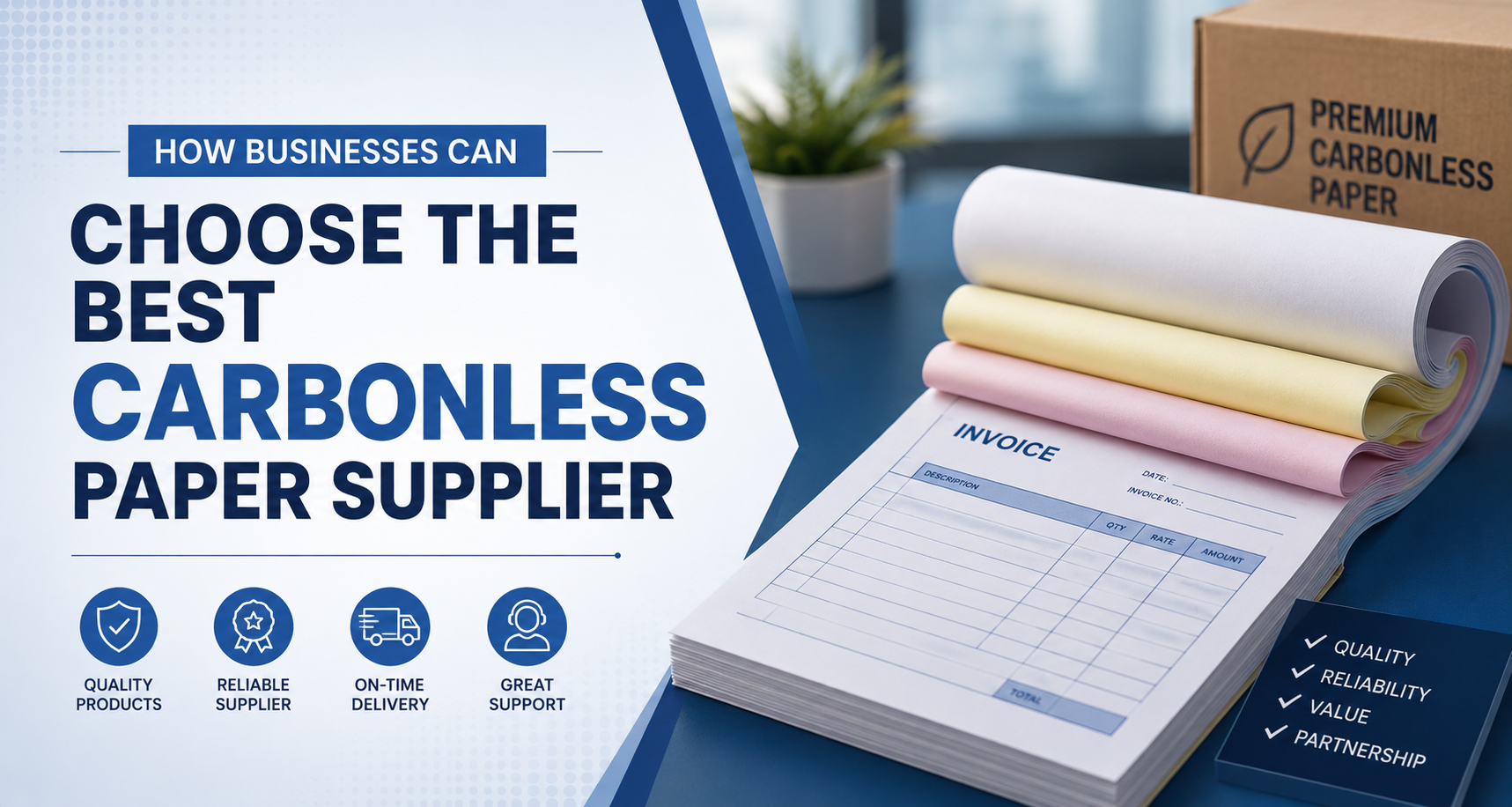
Picking the right carbonless paper manufacturer is harder than it looks. Search the term and you get pages of "top supplier" lists that all say the same thing. None of them tells you how to actually judge a supplier, match the paper to your business, or avoid a costly mistake on a large order.
This guide fixes that. We will walk through what a real carbonless paper manufacturer does, the specs you need to ask for, the certifications that matter, and how to vet any supplier before you wire money. By the end, you will be able to send a smart request for a quote and spot a weak vendor fast.
Carbonless paper, also known as NCR (No Carbon Required) paper, is a special type of paper used to create duplicate or multiple copies of handwritten or printed documents without using carbon sheets. It is widely used in invoices, receipts, order forms, delivery challans, business forms, and billing systems. Carbonless paper is coated with tiny chemical capsules that react under pressure. When someone writes or prints on the top sheet, the pressure breaks these capsules and transfers the image or text onto the sheets below. This process creates clear and instant copies.
Carbonless paper usually comes in sets of two or more sheets:
When pressure is applied through writing or printing, the chemical coating reacts and transfers the text to the next sheet.
Carbonless paper is commonly used in:
A true carbonless paper manufacturer makes the paper from the ground up. They choose the right base paper, usually 100% woodfree paper is the best, meaning good smoothness, strength and even tension. Then coating the base paper with the special layers that let it copy writing without carbon. Many sellers online do not do this. Knowing the difference saves you money and headaches.
The paper mill is where carbonless paper actually gets made. This is the source you want for bulk orders. Mills coat raw paper with dye and clay layers called CB, CFB, and CF coatings. They offer the lowest unit price and handle large volumes. Go straight to a mill whenever you can.
Converters buy big rolls from mills, then cut, sheet, perforate, and print them into finished forms. They're great if you need custom forms with specific sizes or numbering. But they add a markup on top of mill prices. Use a converter when customization matters more than getting the lowest possible price.
Traders make nothing at all. They simply buy from mills or converters and resell at a higher price. You pay extra for zero added value. Worse, traders have little control over quality. If something goes wrong with your order, they can't fix it at the source you're stuck waiting for.
Your supplier type directly affects price, lead time, and quality. Choosing wrong costs you time and money. Mills control the full process, so quality stays consistent. Converters add cost but offer flexibility. Traders add cost with no benefits. Always know exactly who you're buying from before placing any order.
Ask the right questions early. A real manufacturer answers confidently a trader hesitates or dodges. Ask about their coating lines and in-house quality lab. Request a live video factory tour. A genuine maker says yes without hesitation. A trader sends stock photos, stalls, or only shares a product catalogue.
Some warning signs are easy to spot if you know what to look for. Don't ignore them.Watch out for suppliers who hide their factory address, refuse a video audit, or list the same products across dozens of random websites. These are classic reseller moves not what a real manufacturer does.
The clearer your specs, the better your quote. Each setting below changes your price and your result, so choose them with care.
Ply Count: 'Ply' means how many copies you get. A 2-ply set gives one original and one copy. Carbonless paper runs from 2-ply to 6-ply. A restaurant pad may use 2-ply, while a logistics waybill needs more.
Weight (GSM): Heavier paper feels sturdier and lasts longer, but it costs more. Lighter paper saves money on big runs, but tears more easily. Pick your weight based on how rough the handling will be in daily use.
Image Color: Carbonless paper usually copies in blue or black. Blue is more popular than black these days, and more affordable. Ask about ageing resistance too, since some forms, like medical or legal records, must stay readable for many years.
Format: You can get rolls, flat sheets, or continuous computer forms. Match the format to your printer before you order. Old impact and dot-matrix printers need specific sizes, so confirm the exact dimensions first.
Customization: A strong carbonless paper manufacturer can add numbering, perforation, hole punching, padding, and your own printed branding. If you need custom forms, ask about this early. Custom work changes both the price and the lead time, so plan it from the start.
The Layer System: Each sheet has a job based on its coating. You do not need to be a chemist. Just remember the order: top, middle, bottom. These three layers work together to pass your writing down through the whole set cleanly.
CB (Coated Back): This is the top sheet. Its coated back captures your writing and transfers the image directly down to the sheet below it.
CFB (Coated Front and Back): These are the middle sheets. They receive the image from above and pass it further down to the next sheet.
CF (Coated Front): This is the bottom sheet. It only receives the final image and stops there, nothing transfers beyond this point.
Certifications prove quality claims. Always ask for paperwork. ISO 9001 is the baseline, it ensures consistent products batch after batch through a steady quality management system. Always demand proof, not just promises. If a supplier claims "100% virgin pulp" but can't provide test reports or compliance documents, treat it as a marketing line not a fact.
Most supplier lists skip chemical compliance entirely, leaving buyers exposed to costly recalls and tightening global regulations.
Most high-profile chemical bans target thermal paper, not carbonless. Understanding the difference prevents costly assumptions about your paper's compliance status. Thermal paper uses a heat-sensitive coating, while carbonless paper relies on different developer chemistry entirely. They are not the same product, and the regulations covering one do not automatically apply to the other, a distinction many buyers overlook.
The EU restricted BPA in thermal paper from January 2020. Regulation 2024/3190 then extended bans to food-contact materials in January 2025, covering additional bisphenols, including BPS and BPAF. This 2025 regulation also introduced a mandatory written Declaration of Compliance, meaning suppliers must now formally document their chemical status rather than simply claim it verbally or in general marketing language.
Carbonless paper uses a different chemistry than thermal, so the same regulations do not always apply directly. However, "not always" is not "never", and the gap is narrowing. The safest approach is to ask your carbonless paper manufacturer directly whether their product is BPA-free and phenol-free, then request actual test documents to verify. Never assume compliance without written confirmation assumptions create liability.
Several US states, including Connecticut, Minnesota, and Washington, have passed BPA restriction laws targeting thermal paper, with phase-out deadlines running through 2026, signalling the direction carbonless standards may follow.
California's Proposition 65 already requires warnings for BPA exposure, adding another compliance layer for businesses operating there. These state-level moves suggest federal carbonless paper standards could tighten sooner than many buyers expect.
Request phenol-free or BPA-free stock whenever possible; it future-proofs your supply chain against regulations that are still actively evolving across multiple markets. Always confirm current requirements directly with your supplier and your own legal counsel before relying on any specific rule. A carbonless paper manufacturer who answers compliance questions clearly, provides documentation willingly, and stays current with regulations is one genuinely worth trusting.
The right carbonless paper manufacturer for one business is the wrong fit for another. Match the supplier to your real needs. Here is what to prioritize by industry. For every industry, the rule is the same: tell the supplier your exact use case, and let them recommend the spec.
If you buy in bulk, supply chain structure is everything. A vertically integrated carbonless paper manufacturer in China controls the full process, from pulp to finished form, under one roof. That control is a real advantage for large buyers.
This setup is called vertical integration, and it helps you in three big ways. First, quality stays consistent because one team handles every step. Second, prices are easier to control. Third, lead times get shorter because nothing gets lost between vendors. You also deal with just one contact instead of chasing multiple suppliers. Ask about minimum order quantities, often called MOQs. Stock items usually have low MOQs. Custom runs need higher ones. Volume also drives your unit price down, so ask for price breaks at different quantities. Finally, ask if they can handle busy seasons without delays. A strong manufacturer gives you honest answers. That honesty is what separates a great supplier from a disappointing one.
Unit price alone won't tell you the full story. Know what domestic and overseas sourcing actually costs before you decide.
Domestic sourcing works best when speed and simplicity matter more than a low unit price. Local suppliers skip the customs hassle, cut down freight costs, and get your order to you fast, sometimes in just a few days. Small custom runs are easy to handle, and reordering is straightforward. When you add everything up, domestic sourcing often beats that tempting overseas quote.
Overseas sourcing gives you a better deal, especially knowing 80% microscopic capsules are being made in China. But in mind that Freight, duties, and tariffs all pile onto your final bill. Lead times stretch into weeks, MOQs run higher, and managing quality from far away gets tricky fast. Any delay hits harder when your supplier is halfway around the world. Always do the full math before you decide.
China-based manufacturers offer great prices for large orders because of high production capacity and lower costs. Big buyers go there to save money. Factories can handle massive volumes fast. If you order in bulk, the unit price drops significantly making it a smart move for high-volume businesses.
Don't let a low price distract you from checking quality. Every manufacturer must pass the same basic standards. Ask for certifications, samples, and compliance documents upfront. A trustworthy factory shares these without hesitation. If they stall or give vague answers, that's a red flag to walk away.
Finding the right factory takes a few smart steps. Don't just trust an online listing. First, confirm they're an actual mill, not a reseller. Then request a video factory tour. Always order a paid sample before placing a full order. These three steps protect you every time.
Shipping from China takes weeks, so you need to plan your orders well in advance. Order early and build extra time into your schedule. Also pick a supplier who responds quickly and writes clearly in English. Slow communication across time zones can delay your whole order.
Good manufacturers back their products with proper documents. Never skip this step. Ask for ISO 9001 certification, test reports, and a Declaration of Compliance. A reliable factory provides all of these without a fuss. Vague or missing paperwork is a serious warning sign. Don't ignore it.
A cheap unit price from China can look great until you add shipping and tariffs. Run the full math before you decide. Add freight, duties, and taxes to the quoted price. Then compare that total against local suppliers. The real winner is whoever costs less after every expense is counted.
Choosing a carbonless paper manufacturer in China comes down to three things: knowing who actually makes the paper, specifying the right product, and vetting the supplier with hard questions. The best carbonless paper manufacturer makes all three easy. Skip the generic "top supplier" lists and use the checklist above instead. The best carbonless paper manufacturer for your business is the one that matches your industry, your volume, and your compliance needs, and that can prove every claim with documents. Whether you source locally or work with carbonless paper suppliers overseas, run the total landed cost and ask for samples first. A quick reminder on the compliance section, chemical rules are still changing, so confirm the latest details with your supplier and your legal team before you rely on them. Do that, and you will be confident.
A mill makes paper from raw pulp and applies CB, CFB, and CF coatings. A converter buys mill rolls, then cuts, prints, or perforates them for finished forms.
Ask for a live video factory tour, coating line details, and in-house quality lab access. Real makers say yes instantly. Resellers stall, dodge, or send stock photos.
Most business forms use 50-55 GSM for standard runs. Heavier 60+ GSM lasts longer under rough handling but costs more. Pick weight based on daily wear conditions.
Not by default. You must ask your supplier directly and request written food-contact compliance documents. Hospitality order tickets touching food need explicit safety ratings, not vague claims.
It means the developer chemistry skips bisphenol A entirely. Always request written test reports and a Declaration of Compliance. Verbal claims hold zero legal weight during audits.
Quality stock stays readable for 5-7 years under normal storage. Archival-grade carbonless invoice books can hold up longer. Ask suppliers for ageing resistance specs before ordering.
Stock items often start around 500 sets. Custom-printed multi-part business forms usually need 5,000+ sets. Volume drives price down, so ask for tiered quotes upfront.
No. Carbonless paper relies on physical pressure to transfer images, so it only works with impact printers, dot-matrix machines, or handwriting. Laser heat damages the coating.
Add freight, duties, tariffs, and inland shipping to the quoted unit price. Then compare against domestic options. Formers Papershares a full landed-cost breakdown with every quote.
ISO 9001 is the baseline. FSC or PEFC proves responsible sourcing, and ISO 14001 covers environmental controls. Formers Paper provides all three plus a Declaration of Compliance.


Formers Paper is a leading manufacturer for a comprehensive range of sustainable paper & packaging products serving customers globally.
Shenzhen Formers Paper Co. Ltd, No.92 Zhugushi Road, Wulian community, Longgang District, Shenzhen, China