We wish you Happy Holidays & a joyful New Year!

Linerless label manufacturer checklist to evaluate suppliers, compare capabilities, and choose the right partner for retail and logistics
June 5, 2026
John Doe
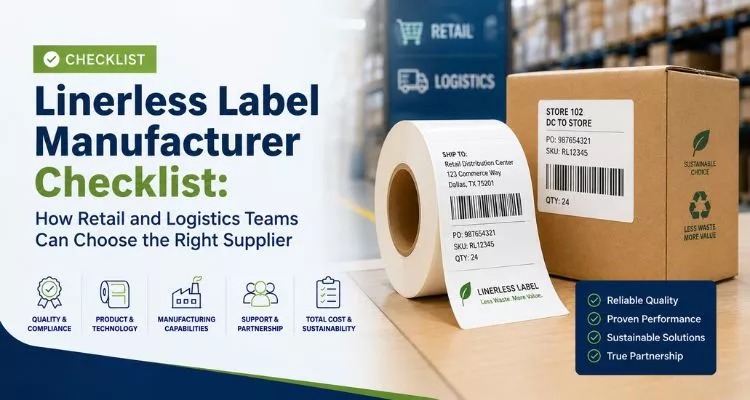
Switching to linerless labels looks like an easy win. It is a much more environmentally friendly product compared to conventional labels and gets about 40% less raw material per label, roughly 50% more labels per roll, and lower freight costs because you skip the silicone-coated backing paper. But those savings only happen if you pick the right linerless label manufacturer. The wrong one ships rolls that jam your printers, peel off freezer cartons, or arrive six weeks late from a port halfway around the world.
Most "top 10" lists rank the same five big names, SATO, CCL, Avery Dennison, Multi-Colour, and UPM. They don't tell you how to pick one for your warehouse, kitchen, or pharmacy line. This guide does. We'll walk through what a real linerless label manufacturer should produce, the nine things procurement teams should score vendors on, which industries need what, the sustainability questions worth asking, and a 10-question checklist you can send out tomorrow.
A linerless label is a sticky label with a silicone release coating on the front. That coating lets the label roll up on itself without sticking. No backing paper needed. It's a simple idea, but the chemistry is what separates a real linerless label manufacturer from a print shop with a slitter.
Thermal linerless rolls: The most common format the face stock is heat-sensitive, so printing happens without ribbons. A serious direct thermal labels manufacturer will publish image-life specs, BPA/BPS status, and recommended print speeds. In procurement specs, you'll often see the abbreviated form "DT" - a DT labels supplier is the same thing, just shorter.
Thermal transfer linerless variants: Less common because the ribbon mechanics get complicated without a liner, but a strong thermal transfer labels manufacturer offers them for applications where the print needs to survive sunlight, solvents, or years of archival storage, think pharmaceutical batch records or industrial asset tags.
Synthetic face stocks: Polypropylene (PP), polyethylene (PE), or BOPP for freezer, outdoor, chemical, or wet environments where paper would disintegrate. A synthetic labels manufacturer worth talking to will let you specify adhesive separately from face stock because cold-chain and chemical-drum applications need very different glue chemistry.
Top-coated paper: A thin coating on the face stock that improves print fidelity, scratch resistance, and ink anchorage. Any credible top coated labels supplier will share rub-resistance and solvent-resistance data without you having to ask twice.
Vellum face stock: A matte, slightly textured paper that looks premium under print, useful for hospitality and craft F&B applications. A vellum labels manufacturer typically serves restaurants, bakeries, and specialty retail rather than warehouses.
Beyond rolls, the strongest suppliers also work as A4 labels manufacturers and sheet labels manufacturers for office, healthcare, and low-volume retail jobs.
The big tell: do they coat their own silicone release in-house, or buy pre-coated stock and just slit it?
Score every vendor on these. Most won't show up on a sales deck, you have to ask.
Ask directly whether the silicone release is applied in their own facility. If the answer is vague, it's outsourced. Outsourced coating is fine for low volumes, but at scale you'll feel the difference in consistency between batches.
Hotmelt, acrylic, permanent, removable, freezer-grade (functional down to roughly −40°C), and food-contact-safe are the main ones. A capable label manufacturer will pair adhesive choice with face stock and does lamination in house.
The list that matters in 2026: FSC chain-of-custody for paper face stocks, ISO 9001 for quality management, ISO 14001 for environmental management, BRCGS for food-contact packaging, REACH compliance for the EU market, and FDA 21 CFR 175.105 for indirect food contact in the US. Pharmaceutical buyers will also ask about ISO 15378.
A strong top coated labels supplier publishes ink anchorage data, print density curves, and tested compatibility with major ribbon brands. Vague claims like "high-quality print" mean nothing in an RFQ ask for the test data.
Reasonable MOQs in 2026 are roughly 50,000 labels for a standard SKU and 100,000–250,000 for a custom-coated or pre-printed run. Standard lead times sit at 2–4 weeks; custom can stretch to 6–8. Anything significantly longer is a red flag unless they're shipping from another continent.
This is where most linerless rollouts fail. Linerless rolls need printers with anti-stick platens, specialized cutters, and label-presence sensors that don't rely on gap detection. Brands like SATO, Zebra, Bizerba, Digi and many more all have linerless-ready models, but not every model in their range qualifies. Ask which printer models your supplier has validated their rolls on and ask for the validation document, not a verbal confirmation.
A linerless label manufacturer that owns its paper mill or jumbo reel production has structural cost and consistency advantages. It also means fewer parties to blame when something goes wrong with a shipment.
Variable label lengths (one of linerless's biggest advantages), custom adhesives, pre-printed branding, day-of-week colour coding, and RFID integration. A linerless label manufacturer with an in-house R&D team can prototype these in weeks. A converter can't.
Different industries need different things. The supplier that's perfect for a 3PL warehouse rarely fits a hospital pharmacy.
This is Linerless's home turf. Variable-length shipping labels cut waste on multi-SKU pallets, you print only what the data needs. For cold storage and yard ops, you need a synthetic labels manufacturer who can supply freezer- and UV-grade stock. A good logistic labels manufacturer with in-house coating usually beats a converter on cost once you're past 5 million labels a year. Most warehouse orders specify a direct thermal labels manufacturer (often shortened to DT labels supplier in procurement docs) because shipping labels rarely need to last more than a few weeks.
Supermarket deli counters and weigh-scale stations run on thermal linerless. Variable weight needs variable length. Pick a scale labels manufacturer with tested compatibility for Bizerba, Digi, and Avery Berkel scales. Not every roll works with every cutter. For shelf-edge pricing, ask for removable adhesive. Smaller retailers and pop-up brands don't need roll labels; a manufacturer supplying A4 sheets for desktop printers serves them better.
QSRs and ghost kitchens need short-life, food-safe labels with day-dots and prep times. Dissolvable face stocks are getting popular because they wash off prep containers without residue. Premium F&B brands often pick a vellum labels manufacturer for jar and bottle labels where touch matters. Look for suppliers offering a full food labelling system — printer, labels, and software together.
Wristbands, specimen tubes, IV bags, and blister packs all have different needs. But the print has to survive. That's why pharma usually picks a thermal transfer labels manufacturer over direct thermal TT print doesn't fade in autoclaves or under fluorescent lights. For medical records and lab reports, an A4 labels manufacturer rounds out the supply basket.
WIP tracking, asset tags, hazardous-material drums, and finished-goods labels. Synthetic stocks dominate because plants destroy paper. For barcodes feeding MES and WMS systems, work with a thermal transfer labels manufacturer who supplies matched label-and-ribbon pairs; mismatched ribbons are the top cause of barcode read failures.
Every label company claims that linerless is greener. Most stop there. Here's what procurement teams should verify before signing a supplier contract.
Here's what every market-research listicle skips: linerless labels are dense and expensive, freight cost is only a small part of the total cost of ownership.
Linerless wins often, but not always. Here's the honest comparison.
Short version: linerless wins on volume, sustainability, and variable lengths. Lined formats still make sense when you can't upgrade existing printers, when you need ribbon-printed archival durability, or for low-volume sheet work.
adhesives in weeks, not quarters.
Why Formers Paper Is a Trusted Linerless Label Manufacturing Partner
Formers Paper fits that profile as a vertically integrated linerless label manufacturer with five sustainable manufacturing facilities, in-house coating, and worldwide distribution from our Shenzhen base. Want to put us through the 1How to Find the Right Linerless Label Manufacturer
Procurement isn't about who ranks #1 on a market-research blog. It's about which linerless label manufacturer hits your specs, volumes, certifications, and region consistently for the next five years.
The vendors worth shortlisting check most of these boxes. In-house silicone coating. Vertical integration from pulp to finished roll. Certifications including FSC, ISO 9001/14001, BRCGS, and FDA where applicable. A face-stock range wide enough that you don't switch suppliers for synthetic or vellum runs. Regional warehousing near your DCs. An R&D team that prototypes custom-question checklists? Request a sample roll or download our raw materials brochure. Both come back with the answers in writing.
A linerless label manufacturer makes the label stock coating, adhesive, slitting, and and sometimes pre-printing. A label printer just prints variable data onto stock that the manufacturer ships.
A direct thermal labels manufacturer makes heat-sensitive labels no ribbon, but the print fades. A thermal transfer labels manufacturer uses ribbons. Print lasts for years. Use a DT labels supplier for shipping, TT for pharma.
Yes, but only with freezer-grade adhesive and the right face stock. A synthetic label manufacturer supplying PP or PE stock with low-temp adhesive works down to about −40°C.
The good ones do. A vertically integrated supplier acting as an A4 labels manufacturer, sheet labels manufacturer, and scale labels manufacturer consolidates your label spend into one vendor.
At minimum: FDA 21 CFR 175.105, EU Regulation 1935/2004 and 10/2011, and BRCGS Packaging Materials. ISO 9001 and 14001 are table stakes. Big food brands also ask for Sedex.
You phrase it. Audit your fleet; many SATO, Zebra, and Bizerba models have linerless kits. A good logistic labels manufacturer maps current models to linerless-compatible ones over a 3–5 year refresh.


Formers Paper is a leading manufacturer for a comprehensive range of sustainable paper & packaging products serving customers globally.
Shenzhen Formers Paper Co. Ltd, No.92 Zhugushi Road, Wulian community, Longgang District, Shenzhen, China