We wish you Happy Holidays & a joyful New Year!

Formers Paper's thermochromic labels help food service businesses monitor temperature in real-time & strengthen food safety standards.
August 6, 2026
John Doe
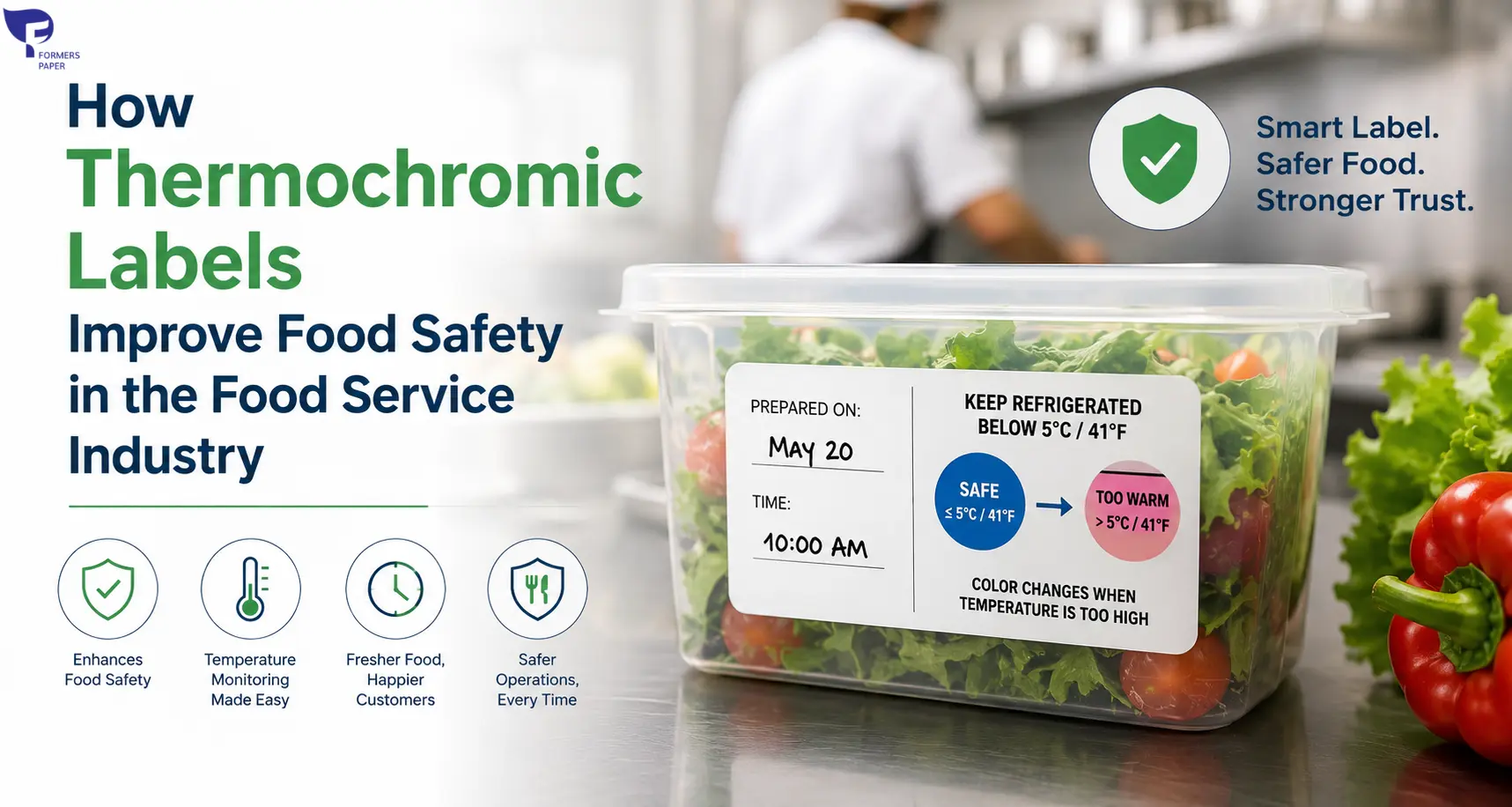
When it comes to protecting your brand and customer safety, thermochromic labels offer a smart, visual breakthrough that transforms temperature checking into instant proof.
Every food service business runs on trust. Your guests trust that their hot soup is safe, while delivery partners expect cold items to stay chilled. However, trust alone cannot protect your reputation when invisible safety risks are hiding in your kitchen. Can you look at a container of cooked chicken and guarantee it hasn’t spent two dangerous hours in the temperature "danger zone"? Honestly, no one can, not with the naked eye.
Whether you apply heat activated thermochromic labels to confirm safe hot-holding or permanent irreversible thermochromic labels for cold-chain compliance, this color-changing indicator reveals the truth at a single glance. Consequently, placing a dynamic thermochromic label on your packaging can mean the difference between a safe meal and a costly product recall.
For more than 30+ years, FormersPaper has been manufacturing paper and packaging products for customers across global markets, including the Food Labelling System line built for exactly this kind of application. As a vertically integrated manufacturer, FormersPaper controls key stages of production, including coating, laminating, printing, and converting. This gives food service buyers greater consistency, tighter quality control, and the flexibility to source thermochromic ink labels built to their exact specification.
A thermochromic label is printed with special ink that changes color when it reaches a certain temperature. The shift can go from one color to another, from clear to colored, or from colored to clear. Either way, it gives you a quick, visible signal that does not need any special equipment to read.
You do not need a thermometer or an app to check this indicator. You just look at it. That is what makes it so useful in a busy kitchen or on a fast-moving delivery line. Staff can check dozens of containers in seconds instead of stopping to test each one with a probe.
These labels are printed using flexo, silk screen, or offset printing, depending on the level of detail and the volume needed. The ink itself is engineered to respond to a specific trigger point, and a manufacturer like FormersPaper can adjust that trigger point to match a customer's exact food safety requirement. One version might be built to change at 60°C to confirm hot holding, while another might be built to flag anything above 4°C to protect a cold item.
Read More- Food-Safe Dissolvable Labels: The Smart Sourcing Methods for Food Brands
Before diving into the detailed technical specifications and manufacturing processes, here is a quick summary of how thermochromic labels improve food safety across your operations:
Read More : PFAS-Free Baking Paper Manufacturer: A Complete Guide to Choosing the Right Supplier
You do not need a chemistry degree to use these indicators, but it helps to know what is happening inside the ink. There are two main types of color-changing technology used in commercial labels today. Both technologies serve the same goal. They turn an invisible risk, like a container that got too warm during transport, into something your staff can catch with a glance.
Leuco dyes are organic, carbon-based compounds that shift between a colored state and a colorless state at a set trigger temperature. These dyes are the most common technology used in this space because they are affordable, reliable, and easy to print at scale. Most food service applications rely on a leuco dye system because it holds up well in kitchen and delivery conditions.
Thermochromic liquid crystals, or TLCs, reflect different wavelengths of light as the temperature changes. This creates a color shift across a spectrum rather than a simple on-off change. TLCs are valued for precision and are often used when a business wants to track a narrow temperature range rather than a single trigger point.
Read More: Airline Luggage Tags Manufacturer with RFID & Non-RFID Solutions
This kind of indicator is built to change color once a product reaches a safe serving or holding temperature. That makes it a natural fit for hot food service.
Picture a buffet line holding gravy, soup, or sauce. Heat activated thermochromic labels placed on the serving container let your staff confirm the food has reached a safe hot-holding temperature before it goes out to guests. No more relying on memory or a quick guess. The color tells the story.
These heat-triggered indicators are also useful in commercial kitchens that reheat previously cooked food. Health codes often require reheated food to pass through the danger zone quickly and reach a specific internal temperature. This kind of label gives kitchen staff a fast, low-cost way to confirm that step happened, without adding another piece of equipment to clean and maintain.
Delivery and catering businesses benefit too. A color-change indicator applied to insulated bags or containers can confirm that food stayed hot enough throughout the trip from kitchen to customer. That is a simple, visible way to back up your food safety claims if a customer or inspector ever asks.
Not every color-changing label works the same way once the temperature shifts back. This is one of the most important choices a food service buyer has to make.
Reversible labels change color when they hit the trigger temperature, then change back once conditions return to normal. These are useful for real-time checks, like confirming a drink is cold enough to serve or a dish is hot enough to plate. They are handy, but they do not leave a lasting record once conditions change back.
Irreversible thermochromic labels work differently. Once the ink crosses its trigger point, the color change stays. It does not fade back, even after the product cools down or warms back up. This permanent record is exactly what food safety teams need during a health inspection or an internal audit.
For example, a permanent indicator applied to a cold delivery box will show a lasting color change if the box ever warmed above a safe threshold, even if it was later placed back in a walk-in cooler. That kind of proof matters when you are trying to show a customer, a franchise partner, or a health inspector that your cold chain held up.
Many food service operators choose this label style for anything moving through delivery, third-party logistics, or long holding periods, since these are situations where a temperature breach is most likely to occur out of sight. It removes the guesswork and gives your team a paper trail to point to.
Food safety rules are not optional, and they are not getting simpler. Health departments expect food service businesses to prove that hot food stayed hot and cold food stayed cold. Thermochromic ink labels give you a low-cost, easy-to-use way to meet that expectation without slowing down your kitchen.
Here is why more food service brands are turning to this technology:
This approach is especially valuable for multi-location brands. A single specification can be rolled out across every restaurant, cloud kitchen, or catering hub in your network, so every location follows the same visible safety check, whether it is in Toronto, Mexico City, Kingston, or Los Angeles.
This kind of indicator is showing up across nearly every corner of the food service industry. Here is where it is making the biggest difference.
Heat activated thermochromic labels on chafing dishes and serving trays give staff a quick way to confirm hot food is holding at a safe temperature throughout an event. This matters most at large catered events, where food sits out for hours and staff cannot check every dish with a thermometer every few minutes.
Cold and hot bags used by delivery drivers can carry a color-change indicator that confirms the contents stayed within a safe range for the whole trip. This kind of permanent indicator is especially useful here, since it creates a lasting record even after the bag returns to normal temperature.
Sandwiches, salads, and prepared meals sold from a retail cooler can use this same approach to flag if the case ever warmed up during a power outage, a defrost cycle, or a supply chain delay.
Hospitals, schools, and correctional facilities often serve large batches of food on tight timelines. A single color-change indicator on a tray or cart gives kitchen staff a fast safety check before food reaches vulnerable populations.
Food distributors moving dairy, meat, or seafood across the USA, Canada, Mexico, and the Caribbean can apply these indicators to cases and pallets to confirm the cold chain held during transport, storage, and the final mile of delivery.
Not every supplier actually manufactures the products they sell. Some are traders that resell stock produced by someone else. FormersPaper is different. As a vertically integrated manufacturer, FormersPaper controls the full production process from raw material to finished product.
Production starts with selecting the right base paper or film for the application. Food service labels need a substrate that can handle grease, moisture, and repeated handling without breaking down.
Food-grade ink is applied through controlled coating and printing equipment. FormersPaper can set the trigger temperature to match a customer's exact specification, whether that means a heat-triggered program for hot holding or a cold-triggered design for refrigerated goods.
Each label is printed, cut, and finished to the size and format a customer needs, from small container tags to full case labels for pallets moving through distribution.
The finished thermochromic ink labels are cured under controlled conditions so the ink bonds properly and performs consistently at the trigger point. Before shipping, labels undergo quality testing to verify colour accuracy, adhesive strength, and trigger reliability.
FormersPaper packs and ships finished rolls, sheets, or custom formats, supporting both small operators and large multi-location food service brands.
This level of control means fewer supplier handoffs, fewer surprises, and a more consistent thermochromic label every time you reorder.
Before choosing a supplier, look closely at these features.
Food safety materials need real documentation, not just a marketing claim. When evaluating any manufacturer, ask for current certifications rather than taking quality for granted.
FormersPaper holds a range of internationally recognized certifications, including:
Food service buyers in the USA, Canada, Mexico, and the Caribbean should also confirm that these products meet local food-contact safety standards and support HACCP documentation requirements, since expectations can vary slightly by country and region.
One of the most important questions to ask any potential supplier is simple: do you actually manufacture the product yourself?
Some companies selling this technology are traders that purchase finished stock from a third party. That can create real problems, including quality inconsistencies, unexpected specification changes, and supply delays right when a food service brand needs the product the most.
FormersPaper manages key manufacturing capabilities in-house, including coating, laminating, printing, and converting. With more than 30 years of manufacturing experience, five production facilities, more than 600 pieces of production machinery, and roughly 3 million square feet of manufacturing and warehouse space across China, the UK, and Indonesia, FormersPaper is equipped to support both large national accounts and smaller regional operators.
FormersPaper's in-house R&D team, backed by more than 100 patents across the product range, keeps this color-changing technology moving forward instead of standing still. For food service buyers, that means access to newer trigger formulations as the market evolves.
Ask these questions before signing with any supplier.
Do they manufacture in-house? This tells you whether you are working with the actual producer or a reseller.
Can they document trigger accuracy? Ask for test data showing the exact temperature at which the color change happens.
Can they support your volume? Confirm production capacity and lead times against your real order volume, including peak seasons.
Can they customize the product? Ask about size, shape, color combination, and trigger point options for both reversible and irreversible designs.
Can they provide certifications? Request current documentation rather than relying on a claim in a sales brochure.
Can they support multiple regions? If your business operates across the USA, Canada, Mexico, or the Caribbean, confirm the supplier can support consistent supply and specifications across borders.
Can they provide samples? Always test a thermochromic label under your own kitchen or cold storage conditions before placing a large order.
Food service brands are under growing pressure to show responsible sourcing throughout their supply chain, and packaging is often the first place customers look.
FormersPaper supports sustainable manufacturing through FSC-certified sourcing, structured environmental management systems, waste reduction initiatives, and a no-dumping policy for production waste. These systems give food service buyers documented information they can use when reporting on their own sustainability commitments.
Choosing a supplier for this kind of labeling means looking past price alone. With FormersPaper, food service buyers get:
Whether you run one restaurant or manage food safety across an entire franchise network, FormersPaper's team can help you find the right specification for your business.
Thermochromic labels give your team, your guests, and your health inspectors a fast, visible way to confirm that food stayed within a safe temperature range from kitchen to table. Food safety should not depend on guesswork.
Before choosing a supplier, look at manufacturing capability, certifications, trigger accuracy, and the ability to support your specific menu and service style. FormersPaper combines more than three decades of manufacturing experience with vertically integrated production, international facilities, and food-grade ink formulations built for the demands of the food service industry.
Whether you need a hot-holding indicator program, a permanent cold-chain safety check, or a custom ink-based labeling rollout across multiple locations, FormersPaper's team can help you build a food safety solution that fits.
Contact FormersPaper today to discuss your requirements, request samples, and explore a reliable manufacturing partnership for your labeling program.
They give food service businesses a quick visual way to confirm that hot food reached a safe serving temperature or that cold food stayed within a safe range during storage and delivery.
Heat activated thermochromic labels change color once a product reaches a set warm temperature, which is useful for hot holding and reheating. Cold-activated labels work the opposite way, changing color to confirm a product has cooled or stayed cold enough.
It depends on your goal. Irreversible thermochromic labels create a permanent record once the trigger temperature is crossed, which is useful for compliance and audits. Reversible options are better suited for quick, real-time checks during active service.
Food-grade thermochromic ink labels are manufactured to meet food-contact safety standards, but buyers should always confirm certification and documentation with their supplier before using them near or on food.
Yes. A manufacturer like FormersPaper can adjust the trigger temperature, size, shape, and color combination to match a specific dish, container, or service style.
Yes. FormersPaper supports food service buyers across the USA, Canada, Mexico, and the Caribbean, with production facilities and supply capabilities built for international customers.
They give kitchen staff a simple, visible way to document temperature checks, which supports the recordkeeping expectations built into most HACCP-based food safety programs.
Contact the FormersPaper team with your application, required trigger temperature, estimated order volume, and preferred format. The team can recommend a suitable specification and provide samples and a quotation.


Formers Paper is a leading manufacturer for a comprehensive range of sustainable paper & packaging products serving customers globally.
Shenzhen Formers Paper Co. Ltd, No.92 Zhugushi Road, Wulian community, Longgang District, Shenzhen, China