We wish you Happy Holidays & a joyful New Year!

Looking for an airline luggage tags manufacturer? FormersPaper offers RFID & non-RFID solutions, custom designs & bulk orders. Get a quote today!
August 4, 2026
John Doe
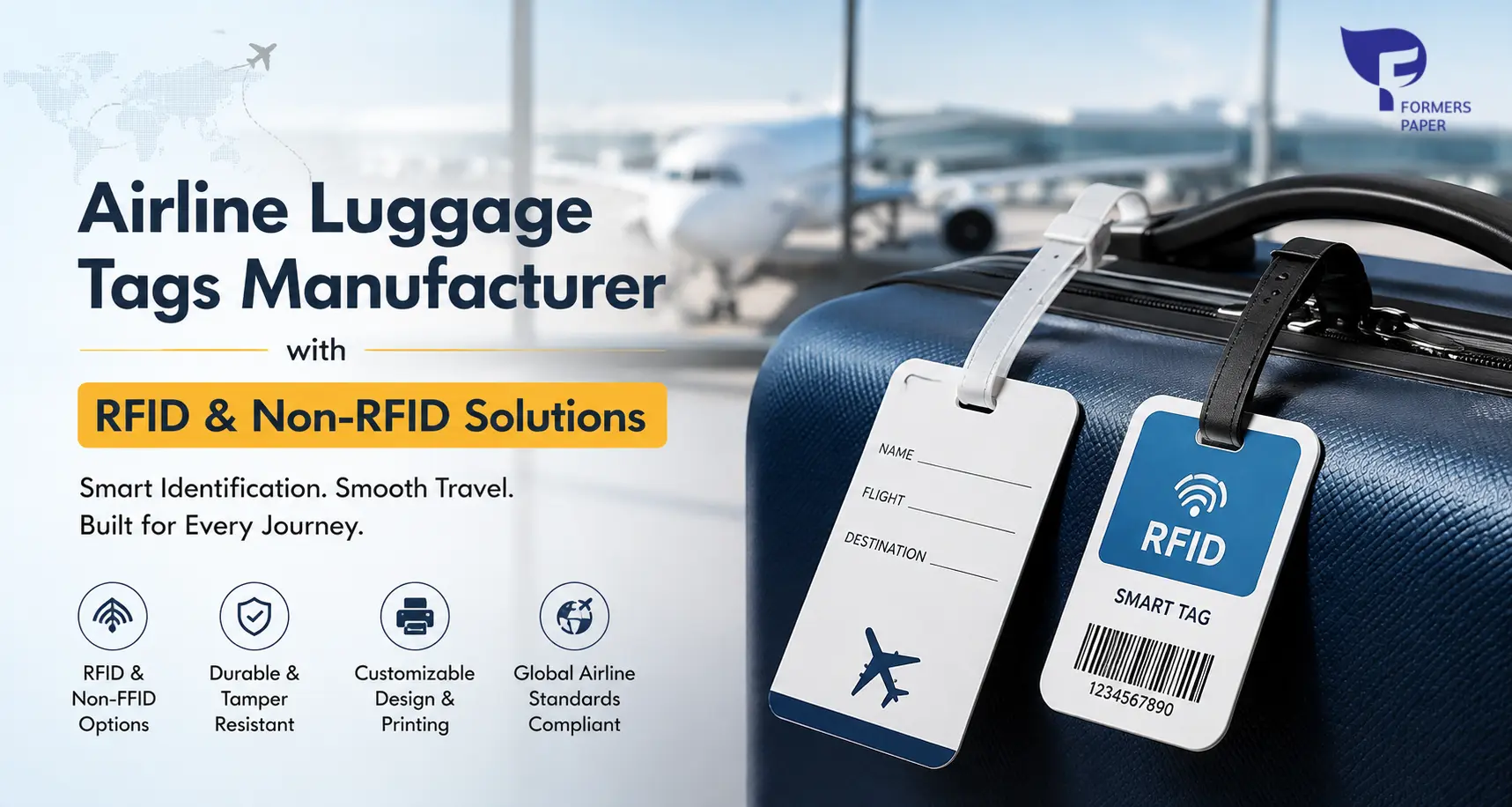
Every lost bag costs an airline far more than the tag attached to its handle. It damages passenger trust at the baggage carousel, drains ground staff hours during tracking, and leads to costly compensation claims. Selecting the right airline luggage tag manufacturer is a strategic procurement decision that directly impacts on-time performance, mishandling rates, and overall traveller satisfaction.
FormersPaper has over thirty years of experience producing paper, ticketing, and functional label products for global travel. Today, the company operates as a complete airline luggage tag manufacturer serving commercial carriers, ground handlers, and airport authorities worldwide. Whether your baggage operation uses barcodes, RFID technology, or a mix of both, FormersPaper produces reliable airline luggage tag stock that keeps baggage handling running smoothly.
This blog explains why FormersPaper is a trusted airline luggage tag manufacturer, how its RFID and non-RFID products compare, and why airlines, ground handlers, and travel document printers rely on these tags every day.
Every airline luggage tag that leaves a check-in counter has one primary job: survive the journey and keep the data readable from the first scan to the last. A luggage tag airline crews rely on is folded around a handle, dragged across a conveyor belt, rained on during ramp transfers, and stacked in a cargo hold for hours at a time. If the tag tears, smears, or lifts at the adhesive edge, the bag becomes unreadable to the system meant to route it, and that single failure turns into a mishandled bag report, a frustrated passenger, and a cost that lands squarely on the airline's balance sheet.
This is precisely why airlines and ground handlers cannot afford to treat the search for an airline luggage tag manufacturer as a box-ticking exercise. A cheap tag that fails at scale costs far more than it ever saves. When your airline works with a disciplined airline luggage tag manufacturer in the market, that risk gets designed out long before a single tag reaches your check-in desk.
FormersPaper built its reputation as a leading airline luggage tag manufacturer by refusing to treat any of these failure points as acceptable. Every airline luggage tag the company produces is engineered around four pressure points: material strength, adhesive performance, print durability, and fold resilience. Airlines that switch to FormersPaper typically do so after a competing luggage tag airline supplier has already let them down once, and they stay because the second experience looks nothing like the first.
Not every company that claims to be an airline luggage tag manufacturer actually manufactures anything. Many resellers buy finished stock from an anonymous mill, apply their own branding, and mark up the price without ever touching production themselves. FormersPaper takes the opposite approach.
As a vertically integrated airline luggage tag manufacturer operating in the global market, FormersPaper coats, prints, laminates, and converts every tag in-house, across five factories covering roughly 280,000 square metres of production and warehousing space. More than 600 pieces of advanced equipment support that output, backed by an in-house research and development team holding over 100 patents. This is the kind of infrastructure airlines expect from a serious airline luggage tag manufacturer, not a trading company operating out of a rented warehouse.
For any airline comparing airline luggage tag manufacturer options, that distinction matters enormously. A true manufacturer can fix a quality issue at the source, adjust a specification overnight, and scale a production run to match a sudden spike in demand. A reseller can only forward a complaint to someone else and hope for a faster reply. FormersPaper's regional teams across China, the UK, Indonesia, North America, Europe, the Middle East, Africa, and Asia exist precisely so airlines never have to wait long for that kind of responsiveness.
The aviation industry has moved decisively toward RFID, and any serious airline luggage tag manufacturer today needs to offer both technologies under one roof. FormersPaper does exactly that.
RFID-enabled tags carry a UHF inlay, typically built to EPC Gen2 and ISO 18000-6C standards, that can be read without a direct line of sight. Instead of a single scanner reading a single barcode, one bag at a time, RFID readers can capture dozens of tags simultaneously as bags move through a sorting system, often from several metres away. Airlines that have adopted RFID at scale have reported read accuracy above 97%, compared to a much wider and less reliable range for barcode-only systems, along with measurable gains in sorting speed and a real drop in mishandled baggage incidents.
FormersPaper produces the RFID-ready airline luggage tag face stock, adhesive layer, and protective coating that an RFID inlay depends on to survive the same punishing journey every other bag tag has to endure: heat, moisture, conveyor friction, and hours of handling. As a forward-looking airline luggage tag manufacturer in the industry, FormersPaper works directly with airlines and system integrators to specify the right base material and inlay integration method for each carrier's route network, volume, and existing baggage handling infrastructure.
RFID may be the direction the industry is heading, but barcode-based airline luggage tags remain the backbone of daily operations at airports around the world, and they are not going away soon. Barcode tags are affordable, compatible with virtually every airport's existing scanning infrastructure, and simple to produce at the volumes a global route network demands.
FormersPaper manufactures both thermal and thermal transfer barcode stock, giving airlines the flexibility to choose the right luggage tag airline format for each route. Thermal paper suits high-volume, short-haul routes where cost efficiency matters most. Synthetic stock, including PP, PE, and PET materials, resists tearing and moisture far better, making it the smarter choice for long-haul and international routes where a bag changes hands multiple times before it reaches the carousel.
This is exactly why airlines continue to rely on airline luggage tag manufacturers who refuse to specialize in only one technology. A regional carrier running short domestic routes may not need the investment RFID requires, while a major international hub managing high transfer volumes may need both formats running side by side on the same production line. FormersPaper's ability to supply both from a single vertically integrated facility is one of the reasons airlines treat the company as a long-term partner rather than a one-time vendor among competing airline luggage tag manufacturers.
Passenger bags are not the only luggage airlines need tagged, tracked, and identified. Tags for airline crew luggage identify the bags belonging to pilots, cabin crew, and ground staff, and this category answers to a completely different set of demands than a standard passenger tag ever will.
Crew bags travel far more often than a typical passenger bag, sometimes multiple times a week for years on end, which means a dependable airline crew luggage tag manufacturer has to build for repeated handling rather than a single one-way trip. This is exactly where most generalist airline luggage tag manufacturer operations fall short. Producing durable tags for airline crew luggage requires laminated or synthetic stock rated for constant reuse and adhesives strong enough to hold through years of handling and finishing that carries consistent airline branding for fast visual identification at the gate.
FormersPaper has built a dedicated capability as an airline crew luggage tag manufacturer precisely because so few companies treat this category with the attention it deserves. As a trusted airline crew luggage tag manufacturer, FormersPaper produces durable synthetic and laminated stock, adhesives engineered for repeated handling, and security label options including tamper-evident and tamper-resistant formats, since crew members frequently move bags through restricted areas that passengers never access.
Airlines sourcing from an established airline crew luggage tag manufacturer expect the same in-house coating, printing, and converting quality applied to every passenger-facing tag, and FormersPaper delivers exactly that consistency. An airline should never need a second, separate supplier for this category just because its primary partner cannot handle a specialized security run.
For airlines and ground handlers who have struggled to find an airline crew luggage tag manufacturer capable of matching passenger-tag quality with crew-tag durability, FormersPaper closes that gap directly. Every order placed with FormersPaper as the designated airline crew luggage tag manufacturer goes through the same adhesion, print durability, and fold testing applied to the company's standard tag lines, so airlines never compromise quality just because the order is smaller or more specialized than a passenger run. Working with a single, reliable airline crew luggage tag manufacturer also simplifies procurement, since branding files, security specifications, and reorder history all sit with one team instead of being scattered across vendors.
Sustainability commitments are no longer optional for major airlines, and tag sourcing is increasingly part of that conversation. This is where linerless airline luggage tags earn their place on any serious procurement shortlist.
Most labels, including a large share of the airline luggage tag stock in circulation today, are printed on a liner sheet that gets peeled away and discarded the moment the tag is applied. That liner is pure waste, and at airport volume, it adds up fast across thousands of departures a day. Linerless airline luggage tags remove that backing layer entirely. The adhesive is applied directly to the label stock and managed through specialized release coatings, so the roll still feeds cleanly through a printer without individual tags sticking to one another.
The appeal of linerless airline luggage tags extends well beyond sustainability, even though that angle matters more each year as airlines publish public environmental targets. Linerless stock also fits more tags per roll, which means fewer roll changes at a busy check-in counter during peak travel periods. Fewer roll changes translate directly into fewer delays at the desk, which is a meaningful operational benefit during a full bank of departures.
FormersPaper already manufactures direct thermal linerless labels for the food, hospitality, and logistics sectors, using specialized adhesive patterns and black sensor mark technology to keep the cut clean and prevent adhesive buildup on a printer's blade. That proven expertise transfers directly into producing linerless airline luggage tags for carriers who want to cut waste and reduce roll changes without giving up print quality or adhesive strength. An airline that adopts linerless airline luggage tags today locks in fewer roll changes, less shipping weight per case of stock, and a cleaner sustainability story to publish alongside its other environmental commitments. Very few companies offer linerless airline luggage tags with this level of proven cross-industry experience already in place, which gives FormersPaper a head start airlines can put to work immediately rather than waiting on an unproven pilot program.
Behind every check-in counter sits a stack of material decisions most travelers never think about, and most airline procurement teams only think about after something goes wrong.
1. Face Stock
Thermal paper is cost-effective and prints cleanly, which suits high-volume, short-haul routes where cost per unit matters most. Synthetic stock, built from PP, PE, or PET, resists tearing and moisture damage far better, which is why it tends to show up on long-haul and international routes where a bag changes hands several times before it reaches its destination carousel.
2. Adhesive
This is where a lot of cheaper stock quietly fails. A bond has to hold on leather, canvas, hard-shell plastic, and everything in between, then survive temperature swings inside a cargo hold and constant friction against a moving conveyor belt. A tag that lifts even slightly at the corner stops being readable within minutes, no matter how good the print underneath it looks.
3. Print Method
The print method is the third decision. Thermal transfer printing produces sharp, smudge-resistant results that hold up under handling and moisture exposure, which matters most on longer or higher-transfer routes. Direct thermal printing costs less and performs perfectly well for shorter turnaround journeys where the tag has a shorter functional lifespan.
4. Fold and Tear Strength
Fold and tear strength round out the list. A tag wraps around a handle or strap and stays folded for the length of a journey, sometimes for days if a bag gets delayed or rerouted. If the material weakens at the fold line, the tag tears loose long before the bag reaches its final stop.
FormersPaper tests every one of these four factors as a pass-or-fail measure on every production run, rather than treating durability as a rough estimate based on a handful of sample pieces pulled off the line.
None of this is complicated in theory. In practice, it is the difference between a bag that reaches the right carousel and one that generates a mishandled baggage report, a frustrated passenger, and a cost that lands on the airline's books instead of the supplier's.
Anyone can claim to be a leading airline luggage tag manufacturer in a brochure or a sales call. A certificate is different, because it means an outside auditor walked the factory floor and verified the claim directly.
FormersPaper holds:
Airlines evaluating any airline luggage tag manufacturer should ask for certificate numbers they can verify directly with the issuing body, not simply take a supplier's word for it.
These certifications are not paperwork for its own sake. ISO 9001:2015 confirms every batch of tag stock is tracked against the same documented standard, not just the first sample an airline happens to approve. ISO 14001:2015 matters directly to airlines building sustainability commitments around linerless stock and FSC-certified paper. ISO/IEC 27001 matters because a luggage tag airline supplier holds sensitive routing formats and proprietary branding files that need protection under a formal information security framework.
Production capacity matters just as much as paperwork. Airlines and ground handlers cannot afford to run short on tags during peak season, and this is exactly where a smaller airline luggage tag manufacturer quietly fails its customers. A supplier that cannot scale during a demand spike leaves ground staff improvising with whatever stock remains, which is exactly the kind of situation that leads to mishandled bags and damaged passenger trust. FormersPaper's five factories, over 600 pieces of advanced equipment, and roughly 280,000 square metres of production and warehousing space exist to make sure that scenario never happens on this airline luggage tag supplier's watch. Ask any luggage tag airline vendor what happens when demand spikes unexpectedly, FormersPaper's production footprint exists specifically so that answer can be a confident one.
Airlines rarely switch suppliers on a whim, and the ones that have moved their business to FormersPaper typically did so after comparing the company directly against other airline luggage tag manufacturers on seven measurable points: in-house production, verified certifications, material range, durability testing, production capacity, customization capability, and regional support.
FormersPaper clears every one of those points, which is why airlines, ground handlers, and travel document printers treat the company as more than just another name on a list of airline luggage tag manufacturers. They come for the basic airline luggage tag stock and stay for the wider catalog: boarding passes, security labels, crew formats, and linerless designs, all produced under the same vertically integrated roof and the same certifications.
Your airline's baggage operation runs on thousands of small decisions made long before a bag ever reaches the carousel, and the luggage tag airline staff attach at check-in is one of the most important of them. Choosing the right partner from among the world's airline luggage tag manufacturer options protects on-time performance, mishandling rates, and the passenger experience all at once.
Whether your airline needs RFID-ready stock, dependable barcode formats, a specialized airline crew luggage tag manufacturer, or linerless airline luggage tags built to cut waste at a busy check-in counter, FormersPaper has the in-house production, the verified certifications, and the global footprint to deliver at scale. For any airline that has ever dealt with a torn airline luggage tag that airline crews couldn't scan or a smudged barcode that stalled a carousel, the value of a dependable airline luggage tag manufacturer becomes obvious fast.
Conclusion
Send FormersPaper your exact specifications, including annual volumes, material choices, and custom requirements for RFID, non-RFID, or linerless stock. Our regional account team will quickly provide testing samples alongside a transparent quote. Compare our batch pricing and material durability directly against your current tag suppliers. When ground operations need reliable supply and zero check-in downtime, FormersPaper delivers the consistency your airline depends on for every flight, route, and passenger bag.
Verify ISO 9001:2015 and FSC certificates directly with the issuing body, confirm in-house production, check production capacity, and compare airline luggage tag manufacturers on total cost, not unit price alone.
Yes. FormersPaper manufactures RFID-ready and barcode-only tag stock from a single vertically integrated facility, so airlines source both technologies through a single relationship rather than splitting orders across vendors.
FormersPaper runs five factories across 280,000 square meters of production space, so an airline luggage tag manufacturer relationship with the company rarely means waiting through a peak season shortage.
Mostly continuity of supply. A primary partner plus a qualified backup protects against disruption, though spreading volume across too many vendors weakens pricing, specifications, and reorder consistency over time.
More than thirty years of production history. FormersPaper's adhesive formulas, coatings, and quality systems have already been proven across millions of real airport handling cycles worldwide, not projected ones.
Contact the regional team with expected volumes, route mix, and RFID or non-RFID requirements. FormersPaper responds with samples and a firm quote to compare against other airline luggage tag manufacturers.
Yes. FormersPaper builds laminated, security-featured crew formats rated for daily repeated handling, using the same in-house coating, printing, and converting process applied to every passenger-facing tag order.
Yes. Linerless stock fits more tags per roll, cutting roll changes during peak departure banks while removing an entire layer of disposable liner waste from the supply chain.
ISO 9001:2015 for quality, ISO 14001:2015 for environmental management, and FSC for sourcing are the baseline. FormersPaper also holds ISO/IEC 27001, OHSAS 18001, and RoHS compliance.
Consistency across every order. Airlines that compare FormersPaper against other airline luggage tag manufacturers on certifications, capacity, and testing discipline typically stay once the comparison is finished.


Formers Paper is a leading manufacturer for a comprehensive range of sustainable paper & packaging products serving customers globally.
Shenzhen Formers Paper Co. Ltd, No.92 Zhugushi Road, Wulian community, Longgang District, Shenzhen, China