We wish you Happy Holidays & a joyful New Year!

Looking for a trusted warehouse labels supplier? Discover expert buying insights and see why FormersPaper delivers high-quality warehouse labels worldwide.
July 10, 2026
John Doe
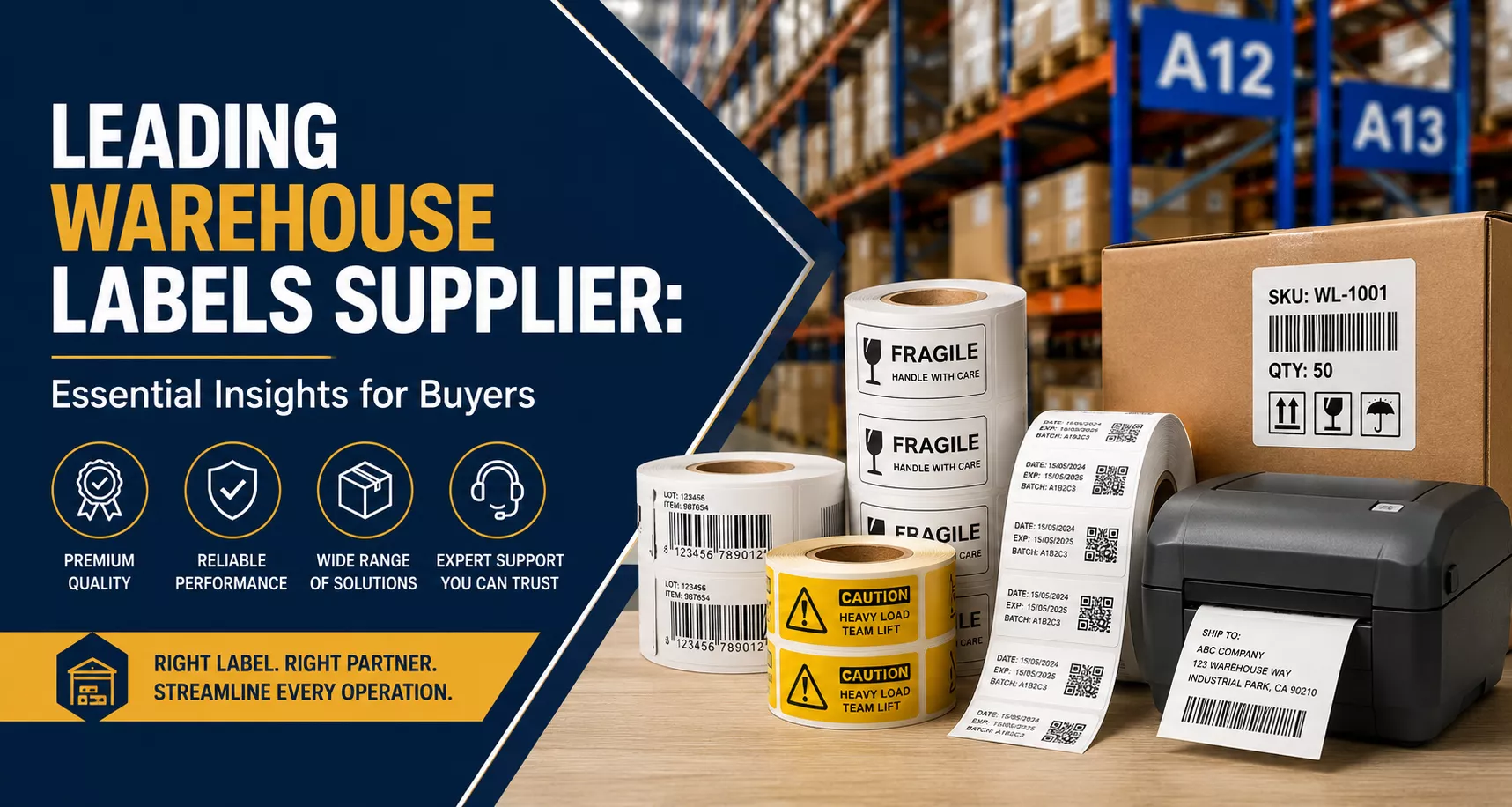
Hiring the right label partner is harder than most procurement managers expect. Search the term, and you get pages of results that all say the same thing: durable, customisable, and fast shipping. None of them tells you how to evaluate a supplier, matches the label material to your specific application, or avoids a costly mistake on a high-volume order.
This blog addresses those gaps. We will walk through what a real label manufacturer does, the specs you need to ask for, the certifications that actually matter, and how to vet any supplier before you commit. By the end, you will be able to send a smart request for a quote and spot a weak vendor fast.
A label is not just a sticker. In a busy warehouse or distribution centre, every label is a data point. If a rack label is hard to scan, placed at the wrong height, or made from the wrong material, your warehouse management system (WMS) loses visibility at that location. That translates to mis-picks, stock discrepancies, slower cycle counts, and real operational costs.
Most operations managers only think about labels when they run out or when something goes wrong. The smarter approach is to design your labelling system properly at the start, choose the right partner from day one, and get it right before it becomes a problem.
The competing articles ranking on Google today cover label types, materials, and general best practices well. What they consistently miss is the supply chain layer, specifically, who is actually making your labels, how your label substrate is engineered at the paper level, how to distinguish a manufacturer from a reseller, and why sourcing directly from a wholesale warehouse labels supplier changes your unit economics entirely. This blog covers all of that.
Not every company calling itself a label supplier is doing the same thing. The industry has three distinct tiers, and buying from the wrong tier costs you money, quality control, and lead time.
The paper mill is where label substrates are made from the ground up. This is where the base paper is chosen; the best-performing warehouse label stock starts with 100% woodfree paper, which delivers the smoothness, stiffness, and even tension that make labels run consistently through high-speed applicators and thermal printers without curling, jamming, or misfeeding. This strong foundation is essential for producing high-quality warehouse labelling supplies that meet the demands of modern logistics and inventory management.
At the mill level, base paper is coated with functional layers. For self-adhesive labels, this involves precisely engineered coating processes that determine printability, adhesion, and durability. For carbonless multi-part labels still used in logistics docket books and waybills, the coating process uses specific technical layers: CB (Coated Back) on the top sheet, CFB (Coated Front and Back) on the middle sheets, and CF (Coated Front) on the bottom sheet. These layers are made of dye and clay microcapsules that react under pressure to transfer images cleanly between plies; no carbon is required. Leading warehouse labels suppliers rely on these advanced manufacturing processes to deliver consistent quality and long-lasting performance.
Mills offer the lowest unit price and handle large volumes. If you are a high-volume buyer, going straight to a mill-level wholesale warehouse labels supplier is almost always the right call. It ensures a reliable supply of premium warehouse labelling supplies, competitive pricing, and consistent product quality for large-scale warehouse operations.
Converters buy jumbo rolls from mills and process them into finished label products, cutting, sheeting, perforating, die-cutting, numbering, and printing. They are the right choice when you need custom shapes, specific dimensions, sequential barcodes, or your own branding printed on the label face. Converters add a markup on top of mill prices, which is fair because they add genuine value. But understand the trade-off: you pay for that customisation capability.
Traders make nothing. They buy from mills or converters and resell at a margin. You pay extra for zero added value. Worse, traders have no control over quality at the source. If a batch has adhesion problems, coating inconsistencies, or dimensional issues, a trader cannot fix it; they can only chase their own supplier. That delay is yours to absorb.
Always know which tier you are dealing with before placing any order. A genuine label manufacturer can tell you clearly where their product is made, what base stock they use, and what coating process applies. If those questions get vague answers, you are probably talking to a trader.
Understanding where warehouse label production is concentrated helps buyers make smarter sourcing decisions. China dominates global label and specialty paper manufacturing, reflecting the country's strength in raw material sourcing, coating technology, and advanced production infrastructure. Today, many Worldwide warehouse suppliers rely on Chinese manufacturing because of its consistent quality, scalability, and competitive pricing.
This is not a risk; it is a reality of the global supply chain. The real question is whether you are accessing that manufacturing base directly or paying multiple layers of margin to intermediaries. Choosing experienced warehouse labels suppliers that manufacture at the source gives you better pricing, stronger quality control, and reliable production capacity. A warehouse labels supplier in China operating at the mill level offers the lowest unit cost, direct oversight, and the ability to meet large seasonal demand. A trader sourcing from China simply adds cost without adding control.
FormersPaper operates five manufacturing facilities across China, covering more than 300,000 m² (3,229,100 sq. ft.) of production and warehousing space. With over 600 advanced production machines and an in-house R&D department holding more than 100 patents, we are a direct manufacturer, not a middleman standing between you and the factory floor. As one of the trusted warehouse labels suppliers serving businesses worldwide, FormersPaper controls the entire production process, from base paper manufacturing to finished, converted labels ready for warehouse operations. This integrated approach enables us to support distributors, retailers, logistics providers, and Worldwide warehouse suppliers with consistent quality and dependable supply.
For businesses looking to reduce costs, improve quality, and secure a stable supply chain, partnering directly with a mill-level wholesale warehouse labels supplier is almost always the smartest long-term decision.
The competing articles cover label types reasonably well, but they rarely explain the substrate engineering behind each type. Here is what buyers actually need to understand.
Thermal labels are the backbone of modern warehouse labelling. FormersPaper manufactures both direct thermal and thermal transfer solutions:
Direct Thermal Labels: Print without a ribbon; heat from the print head activates the coating. FormersPaper provides both standard eco options for short-lifecycle shipping labels and premium top-coated stocks with water, oil, and plasticiser resistance for longer shelf life.
Thermal Transfer Labels: Use a ribbon to deposit ink onto the face stock, producing a highly durable output, especially for labels exposed to chemicals, UV light, or extended outdoor use.
Direct Thermal Linerless Labels: For high-efficiency logistics, FormersPaper also manufactures linerless thermal labels that eliminate backing paper waste, offering more labels per roll and reducing operational downtime.
While "rack" and "floor" labels are defined by how you use them, FormersPaper provides the high-durability synthetic and paper substrates required to build these heavy-duty systems:
Protecting high-value inventory and ensuring safety requires documented compliance. FormersPaper manufactures a dedicated range of security and warning solutions:
Standard adhesives fail in cold environments, causing labels to lift or fall off. FormersPaper offers specialized cold-temperature adhesives formulated to bond on first contact. These are engineered to maintain absolute adhesion through the full temperature range of your logistics operation, from ambient receiving docks straight into frozen storage.
The face stock, adhesive, and any topcoat or overlaminate all interact. Specifying one without the others is incomplete.
For standard warehouse label applications in clean, dry environments, a label built on a 100% woodfree paper face stock delivers excellent printability and consistent performance. Woodfree paper's smoothness ensures clean image transfer from thermal print heads. Its stiffness prevents the cockling and curl that cause label jams in automated applicators. Its even tension means rolls run true through high-speed dispensing equipment without drifting off-centre.
PP (polypropylene), PE (polyethene), and PET (polyester) face stocks are used where paper cannot hold up in high-humidity environments, chemical exposure, outdoor storage, or applications requiring labels to remain intact if submerged. Synthetic stocks cost more than paper, but in the right environment, they are the only viable option.
Permanent adhesives are appropriate for long-lifetime rack labels on fixed locations. Removable adhesives suit locations that change. Freezer-grade adhesives are essential for cold-chain applications. High-tack adhesives are needed for rough or low-energy surfaces like some racking powder-coat finishes.
A polyester or polypropylene overlaminate adds a significant durability layer on top of any printed label. In forklift-traffic environments, a laminated label can last years, where an unlaminated equivalent would fade or abrade within months.
Certifications are the difference between quality claims and quality proof. Ask for documentation, not promises.
ISO 9001:2015 is the baseline. It demonstrates a quality management system is in place, meaning the supplier consistently measures, monitors, and controls their production process. Without ISO 9001, quality is the supplier's word against yours.
ISO 14001:2015 covers environmental management. It demonstrates the supplier tracks and actively reduces their environmental impact, relevant for any business with sustainability commitments in their supply chain.
ISO/IEC 27001 certifies information security management. For a supplier handling your barcodes, location data, or proprietary label formats, knowing that information security is formally managed matters more than most buyers realise.
OHSAS 18001 (now superseded by ISO 45001 in newer certifications) is the international standard for occupational health and safety management. A supplier who is OHSAS 18001 certified has committed to reducing workplace accidents and complying with safety regulations, a signal of a professionally run operation.
FSC (Forest Stewardship Council) certification ensures that all paper-based products come from responsibly managed forests, providing environmental, social, and economic benefits. For buyers with sustainability requirements or eco-friendly supply chain commitments, FSC certification is essential, not optional.
RoHS certification demonstrates restrictions on certain hazardous substances, safeguarding both the people who handle the products and the environments those products enter.
FormersPaper's facilities are certified to ISO 9001:2015, ISO 14001:2015, ISO/IEC 27001, OHSAS 18001, FSC, and RoHS covering quality, environment, information security, workforce safety, responsible forestry, and material safety across all our production operations.
Before you contact any label manufacturer, have the following information ready. The clearer your brief, the better and more comparable the quotes you receive will be.
FormersPaper is a vertically integrated, sustainable multinational manufacturer. We operate five manufacturing facilities with over 600 pieces of advanced production equipment spread across more than 300,000 m² of production and warehousing space. Our fully integrated supply chain covers raw material production through coating, printing, and converting, meaning we operate as both a paper mill and a converter under one structure, giving customers access to the lowest possible unit cost on bulk products alongside genuine customisation capability.
Our label and sticker product range includes thermal shipping labels, barcode labels, direct-thermal linerless labels, thermal transfer and vellum labels, security labels, high- and low-temperature labels, and more.
We serve the warehouse & logistics industry directly, supplying high-performance water-resistant, oil-resistant, and scratch-proof thermal labels and specialty stocks. Our world-class manufacturing process is fully backed by audited global standards, including ISO 9001:2015, ISO 14001:2015, SGS, and RoHS certifications across our facilities to ensure strict quality control and environmental safety.
Operating across 5 advanced manufacturing locations spanning 300,000 square meters, our in-house R&D department holds more than 100 patents to deliver cutting-edge linerless and thermal transfer solutions. Shipping over 30 containers monthly, we guarantee mill-scale efficiency, competitive pricing, and reliable on-time delivery without surprises.
Choosing the right supplier is not a decision to make on price alone. The label substrate, adhesive system, and overlaminate all interact. The supplier's position in the supply chain determines how much control they have over what you receive. The certifications they hold determine whether their quality claims are documented or just marketing language.
FormersPaper is a leading vertically integrated specialty paper and labels manufacturer with five manufacturing locations, decades of industry experience, and a fully integrated production model that gives customers direct access to manufacturing-level quality and pricing. Whether you need standard thermal shipping labels in volume, heavy-duty synthetic stocks (PP/PET) engineered for custom warehouse rack and floor layouts, or a reliable long-term relationship for ongoing distribution operations, we have the manufacturing capability and verified global certifications to deliver.
Get in touch with our team to discuss your requirements, request samples, or get a quote for your labelling project.
A warehouse labels supplier provides rack labels, barcode labels, floor labels, and thermal shipping labels that help warehouses track inventory, reduce picking errors, and keep operations running accurately.
Ask for a factory video tour and coating process details. A genuine manufacturer answers confidently. A reseller sends stock photos, stalls on technical questions, or dodges the factory address.
The best warehouse labels are built on 100% woodfree paper, which delivers smoothness, stiffness, and even tension, ensuring consistent feeding through high-speed thermal printers without jamming or misfeeding.
Look for ISO 9001:2015 for quality, ISO 14001:2015 for environmental management, FSC for responsible forestry, and RoHS for material safety. These certifications confirm quality claims are documented, not just promised.
A rack labelling system assigns every aisle, bay, level, and position a scannable code linked to your WMS, eliminating mis-picks, speeding cycle counts, and keeping inventory data accurate.
A wholesale warehouse labels supplier sells at mill-level bulk pricing with minimal processing. A converter adds cutting, sheeting, printing, and numbering, offering more flexibility but at a higher unit cost.
Cold storage labels require freezer-grade adhesives that bond on first contact and hold through temperature shifts. Standard adhesives lift or bubble when products move from ambient areas into refrigerated environments.
Sourcing from a warehouse labels supplier in China lowers unit cost significantly. Formers Paper's vertically integrated supply chain base paper through finished labels, removes third-party handoffs and cuts lead times.
Prepare your face stock type, adhesive grade, print method, label dimensions, quantity, temperature range, and compliance requirements like FSC or RoHS before contacting any supplier for an accurate, comparable quote.


Formers Paper is a leading manufacturer for a comprehensive range of sustainable paper & packaging products serving customers globally.
Shenzhen Formers Paper Co. Ltd, No.92 Zhugushi Road, Wulian community, Longgang District, Shenzhen, China