We wish you Happy Holidays & a joyful New Year!

Synthetic facestock vs paper labels: see when film beats paper for moisture, heat, and long life. Find the right label material for your product.
September 11, 2026
John Doe
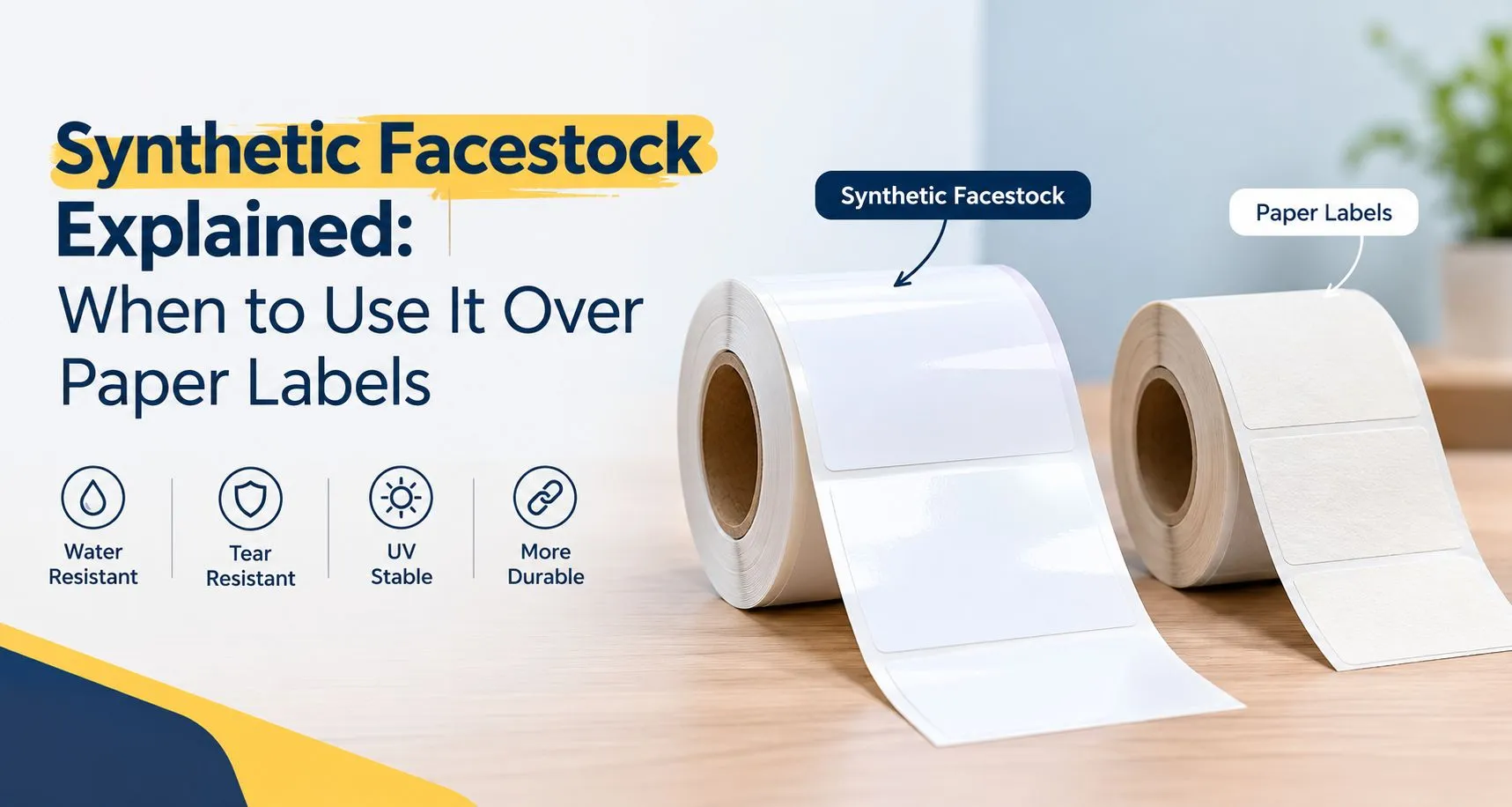
Picture two rolls of labels sitting side by side in your warehouse. Both look fine today. Six months from now, only one of them will still be readable. The other will be smudged, curled, or peeling off after a season in a damp storeroom or a hot delivery truck. The difference almost always comes down to one choice made long before the labels ever left the factory.
If you order labels for your business, you have probably run into this exact problem. A label that looks perfect on day one but fails once it hits the real world costs you money, time, and trust with your own customers. That is why more B2B buyers across the United States, Canada, Mexico, the Caribbean, and China now ask a very specific question before they place an order: should this job use synthetic label facestock instead of a paper label facestock?
This guide breaks down exactly what this film-based material is, how it compares to standard paper materials, and when you should reach for it instead of a basic roll. You will also learn what to look for in a synthetic facestock supplier, so you do not end up with labels that cannot survive the job you bought them for. Along the way, you will see how FormersPaper, a vertically integrated synthetic facestock manufacturer, builds labels that hold up under real working conditions instead of just looking good in a sample pack.
Key Takeaways
It is the printable top layer of a label made from plastic film instead of wood pulp paper. It sits above the adhesive layer and below the ink, coatings, and finish that give a label its final look. Think of it as the visible "face" of the label, the part your customers actually see and touch.
Standard label facestock, the paper kind, has served businesses for decades because it is cheap, easy to print on, and works fine in controlled, dry environments. But paper has a weakness that shows up the moment conditions get difficult. It absorbs moisture, tears easily, and fades fast when exposed to chemicals, sunlight, or constant handling.
Synthetic label facestock solves that weakness by replacing wood pulp with polymer film, most often polypropylene, polyester, or vinyl. These films do not soak up water the way paper does, so a label built on this kind of material keeps its shape, its color, and its readability in conditions that would ruin an ordinary label facestock within days.
A synthetic label facestock also behaves differently on the production line. Because plastic film naturally has low surface energy, manufacturers apply a surface treatment, usually corona or plasma treatment, before printing. This step raises the surface energy of the film so inks and adhesives bond properly instead of smearing or lifting off. Without this step, even a well-made film would print poorly and fail early. That same film structure gives this material a natural barrier feature, blocking moisture and gases from passing through, which adds another layer of protection on top of print quality and helps the label hold up in wet, humid, or airtight packaging conditions.
For a B2B buyer, the takeaway is simple. The material you choose for that foundation decides whether your label survives its job or fails partway through it, and increasingly, more businesses are landing on synthetic facestocks as the safer bet.
Choosing between paper and label facestock made from film is not about picking the fancier option. It is about matching the material to the job the label has to do.
Basic label facestock costs less per unit and works well for high-volume, short-life applications. This kind of label facestock carries a modest price premium, but that premium often pays for itself through fewer reprints and fewer complaints from customers holding a label that fell off.
This is where synthetic facestocks pull ahead by a wide margin. Paper tears, smudges, and curls when exposed to water, oil, or rough handling. Film resists all three, along with UV exposure, temperature swings, and many common chemicals and solvents.
A paper label may print sharp on day one, but ink can fade or smear if it gets wet or scuffed. A properly treated synthetic label facestock holds its print quality far longer, which matters for barcodes, ingredient lists, and safety warnings that must stay legible for the life of the product.
Paper suits indoor, short-term, low-stress jobs, such as shipping labels or internal inventory tags. This type of label facestock is built for jobs where the label needs to survive moisture, temperature extremes, chemical exposure, or years of handling.
Adhesive strength, print method compatibility, and certification requirements do not automatically shift based on the material itself. A business can order a food-safe, compliant label on either paper or film, as long as it matches the environment the label will actually face.
Many businesses use both. A warehouse might run paper for internal stock tags while ordering film for anything that leaves the building or faces tough conditions. The real question is never which one is "better". It is which one fits the job in front of you.
Not every film is built the same way, and these materials come in several forms. Each type brings different strengths, and knowing the difference helps you order the right material for your specific product instead of guessing.
Choosing among these options comes down to three questions: What surface is the label going on? What conditions will it face? And how long does it need to last? A supplier who understands these variables can match the right material to your product instead of defaulting to whatever sits in stock.
This is the question every B2B buyer eventually has to answer: do you need a film-based option, or will paper get the job done? Here is a practical framework to help you decide.
If none of these conditions apply, and your label just needs to survive a short trip from the warehouse to the store shelf, paper remains a smart, cost-effective choice. Film earns its slightly higher price tag only when the job actually calls for it.
Different industries lean on synthetic facestock for different reasons, but the underlying story is always the same: paper could not survive the conditions, so businesses moved to film.
Products that move in and out of refrigeration, freezers, or condensation-heavy environments need materials that will not absorb moisture or lose their print. Ingredient panels, allergen warnings, and expiry dates must stay legible through the entire cold chain, which is exactly where synthetic facestocks outperform paper label facestocks.
Medical and pharmaceutical labels often face sterilization, chemical exposure, freezing, and years of handling. A supplier serving this industry needs to deliver synthetic label facestocks that hold small text clearly under all of these conditions, since a smudged label on a vial or device is a safety issue, not just a cosmetic one.
Barcode accuracy matters as much as durability here. Labels get scanned, handled, and shipped across long distances, sometimes sitting in storage for months. Film keeps barcodes scannable and readable long after comparable label facestocks made from paper would have faded or torn.
Drums, containers, and equipment labeled with hazardous materials information need to survive solvents, oils, and outdoor exposure without losing legibility. This type of synthetic facestock, especially polyester, is built for exactly this kind of demanding environment.
Consumer-facing products still benefit from the sharper look and longer shelf presence that film provides, especially for premium products or anything stored under bright retail lighting for extended periods.
Across every one of these industries, the underlying question stays the same. Does the label simply need to identify a product for a few days, or does it need to survive real handling, real weather, and real compliance checks for months or years? That answer tells you whether basic paper will do, or whether you need a synthetic facestock supplier who can deliver something built for the job.
Knowing which material you need is only half the job. Finding a supplier who can actually deliver it, batch after batch, is the other half. Here is a checklist to run before you commit to a bulk order.
Some companies market themselves as a manufacturer while reselling film they never touched. Ask directly whether the supplier runs its own coating, laminating, and converting lines, or whether it outsources parts of the process to a third party.
Do not accept "fully certified" as an answer. Ask any supplier for specific certificate names, such as ISO 9001:2015 for quality management, ISO 14001:2015 for environmental management, RoHS for hazardous substance restrictions, and FSC for responsible sourcing. A genuine synthetic facestock will hand over these documents without hesitation, and so will the company standing behind it.
A film that looks great in a sales deck can behave differently on your actual product, in your actual environment, at your actual production speed. Test samples of any synthetic facestock on real surfaces before committing to a full run.
A single bad batch of label facestocks can shut down a production line or trigger a compliance issue. Ask how the supplier tests and controls quality across every run, not just the first one.
If your business ships across the USA, Canada, Mexico, the Caribbean, or China, confirm the synthetic label facestock you order can stay identical across every region, instead of drifting between local production batches.
Some jobs need a non-standard film gauge, a specific finish, or a specialty adhesive pairing. A supplier with an in-house research and development team can solve these requests instead of forcing your business into a narrow catalog of pre-set options.
Ask about lead times, minimum order quantities, and production capacity before your busiest season arrives, not during it.
Working through this checklist before your next order helps you avoid the two most common problems B2B buyers run into: a supplier who cannot prove their claims, and a synthetic facestock manufacturer who cannot keep up once your order volume grows.
Businesses shopping for synthetic facestock usually want the same four things: real production control, proof of certification, flexible specifications, and supply they can count on across every region they operate in.
FormersPaper delivers on all four. As a vertically integrated synthetic facestock manufacturer, FormersPaper controls its own coating, laminating, printing, and converting process across five factories with over 600 pieces of advanced production equipment, spread across roughly 3 million square feet of workshops and warehouses in China, the UK, and Indonesia. That level of control means the synthetic label facestocks you order today perform the same way as the ones you order a year from now.
Every FormersPaper facility holds ISO 9001:2015, ISO 14001:2015, ISO/IEC 27001, OHSAS 18001, RoHS, and FSC certification, covering quality management, environmental care, information security, workplace safety, hazardous substance restrictions, and responsible sourcing. These are named, checkable documents, not vague claims on a homepage.
An in-house research and development team backs FormersPaper's production, holding more than 100 patents that help solve custom label requests instead of turning them away. Whether your business needs a specific synthetic label facestock, a custom finish, or a non-standard adhesive pairing, FormersPaper's Labels & Stickers Manufacturer team can engineer a solution instead of pointing you to a generic catalog page.
FormersPaper already supplies businesses across retail, food and beverage, healthcare, and warehousing and logistics, with direct supply lines into the USA, Canada, Mexico, and the Caribbean, alongside its manufacturing base in China. For B2B buyers who need one dependable partner instead of juggling several regional vendors, that combination of scale, certification, and reach is hard to match.
Ready to compare FormersPaper against your current supplier? Contact FormersPaper for samples, specifications, and a factory-direct quote on synthetic facestock labels.
Even the best synthetic facestock will not perform well if it is stored badly before use. A few habits protect your labels from the moment they leave the factory:
Synthetic facestocks are far more forgiving than paper when it comes to storage, but even the toughest synthetic label facestocks perform poorly after months on a hot loading dock or a damp corner of a warehouse.
Choosing between paper and synthetic facestock is not about picking the more expensive option out of habit. It comes down to matching the material to the job the label actually has to do. A short-term shipping label headed for a warehouse shelf does not need the same durability as a chemical drum label headed outdoors for two years.
What does not change, no matter which material you choose, is the importance of working with a synthetic facestock supplier who controls its own production, backs its claims with real certifications, and can prove consistency across every batch of label facestocks it ships. The right synthetic facestock manufacturer protects your brand's reputation just as much as it protects the product underneath the label.
Before your next bulk order, run your shortlist of vendors through the checklist covered in this guide. Ask for real samples, real certificate names, and honest answers about who actually manufactures the synthetic label facestock your business depends on. Compare paper against film side by side, and let the application decide, not habit.
Synthetic facestock is a plastic film label material, most commonly polypropylene, polyester, or vinyl, used as the printable top layer of a label instead of paper. It resists moisture, chemicals, and rough handling far better than standard label facestock.
It typically carries a modest premium per label, but the cost is often offset by fewer reprints, longer shelf life, and stronger performance in demanding conditions. For short-term, low-stress applications, paper remains the more cost-effective option.
BOPP, or biaxially oriented polypropylene, offers strong moisture resistance at a lower cost and suits cold-chain and everyday consumer labels. PET, or polyester, offers superior heat, chemical, and abrasion resistance, making it a better fit for industrial and long-life applications.
Ask directly whether the company runs its own coating, laminating, and converting lines, and request a facility overview or certification documents. A genuine manufacturer of synthetic label facestocks answers without hesitation, while a reseller tends to change the subject.
Look for ISO 9001:2015 for quality management, ISO 14001:2015 for environmental management, RoHS for hazardous substance restrictions, and FSC for responsible sourcing. FormersPaper holds all of these, along with ISO/IEC 27001 and OHSAS 18001.
Yes. FormersPaper maintains manufacturing facilities and direct supply lines that serve all of these regions, helping B2B buyers keep specifications consistent no matter where a shipment is headed.
Food and beverage, healthcare, warehousing and logistics, chemical and industrial, and retail all rely on this material, though each industry prioritizes different properties such as moisture resistance, chemical resistance, or barcode durability.


Formers Paper is a leading manufacturer for a comprehensive range of sustainable paper & packaging products serving customers globally.
Shenzhen Formers Paper Co. Ltd, No.92 Zhugushi Road, Wulian community, Longgang District, Shenzhen, China