We wish you Happy Holidays & a joyful New Year!

A restaurant & catering buyer's guide to food-safe packaging standards: FDA and FSSAI rules, must-check certifications, and how to vet any supplier.
September 1, 2026
John Doe
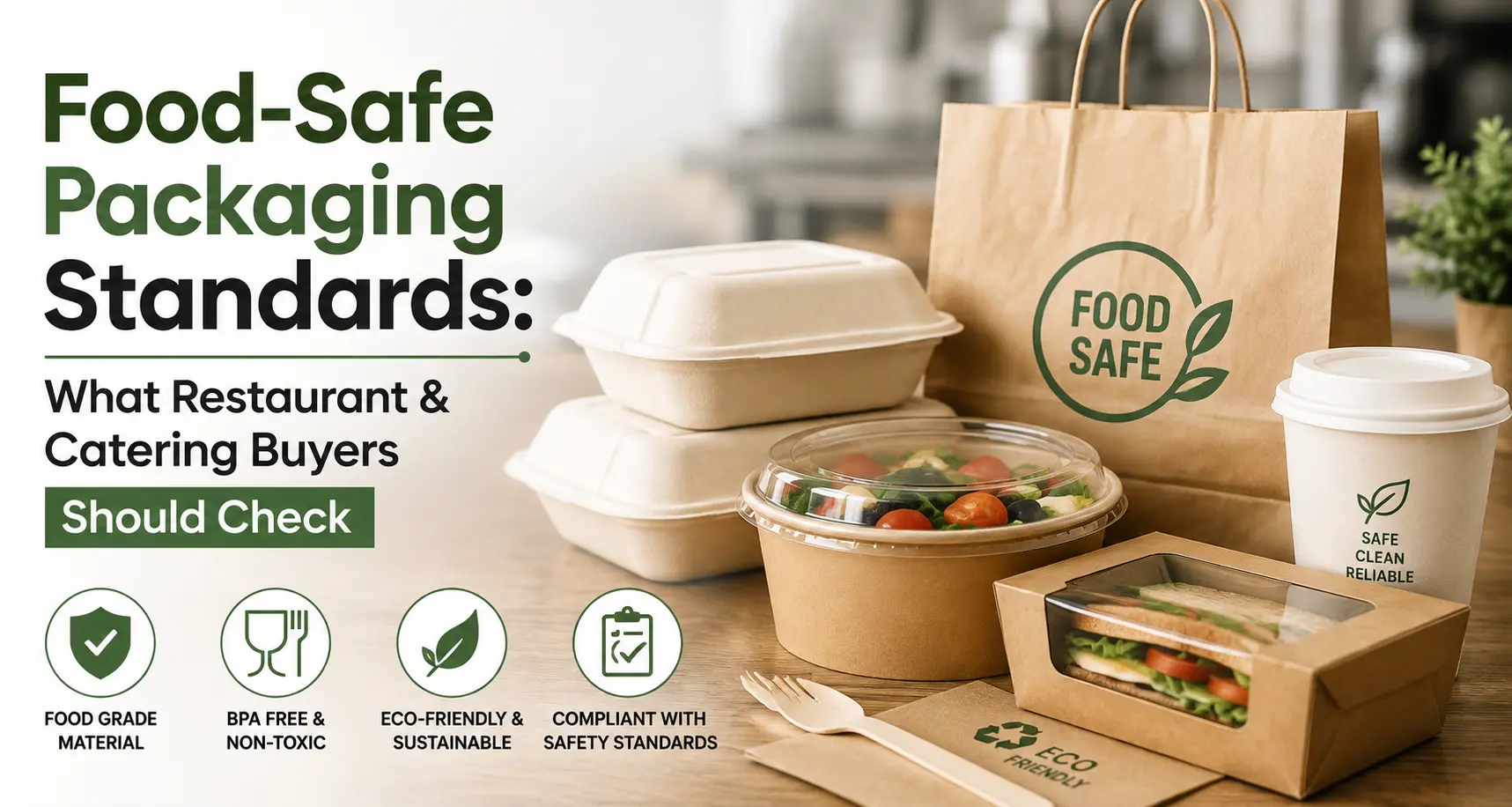
A single mislabeled roll of baking paper can shut down a catering kitchen faster than a broken oven. A batch of food-contact packaging that fails a health inspection can cost a restaurant group its permit for a day, a week, or longer. This is the real cost of getting food-safe packaging wrong, and it is why food-safe packaging standards matter so much to the people who buy on behalf of restaurants, catering companies, and foodservice distributors.
You already know the stakes. Every napkin liner, every sheet of baking paper, every food label, and every piece of eco-friendly packaging that touches a customer's meal carries risk if it is sourced from the wrong supplier. This guide breaks down the food-safe packaging standards you need to check before you sign a purchase order, explains the certifications that actually matter, and shows you how to verify a supplier instead of taking their word for it.
You will also see why so many restaurant chains and catering operators across the United States, Canada, Mexico, the Caribbean, and China treat their packaging supplier relationship as a long-term partnership, not a one-time purchase. Navigating food-safe packaging correctly, the first time, protects your brand, your customers, and your bottom line all at once.
Food-safe packaging is any material that comes into direct or indirect contact with food and does not pass harmful substances into that food. This covers baking paper, food labels, business forms used near prep stations, and eco-friendly packaging used for takeout and delivery. The term sounds simple, but it hides a lot of technical detail that most buyers never see until something goes wrong.
Meeting food-safe packaging standards means doing three things at once. It has to protect the food from contamination. It has to hold up under real kitchen conditions, including heat, grease, and moisture. And it has to meet the food packaging standards set by the country or region where your restaurant or catering business operates. A sheet of baking paper that curls, tears, or leaches chemicals at oven temperature does not meet food-safe packaging standards, no matter what the label claims.
This is where food grade packaging comes into the picture. Food grade packaging simply means the material was manufactured and tested specifically for contact with food, using approved coatings, approved inks, and approved raw materials. A supplier who cannot explain how their food grade packaging is tested is a supplier you should not trust with your kitchen's daily operations.
A single restaurant can survive one bad batch of packaging. A restaurant group running fifteen, fifty, or two hundred locations cannot. When a supplier fails to meet food-safe packaging standards, that failure does not stay contained to one kitchen. It spreads across every location using the same product, on the same day, during the same shift.
Health inspectors do not care whether your packaging problem started with your kitchen team or your food safe packaging materials supplier. They care whether the food-safe packaging materials in your walk-in and prep line pass inspection. A single non-compliant batch of baking paper or food labels can trigger a citation, a fine, or in serious cases, a temporary shutdown. This is the real reason food-safe packaging standards deserve the same scrutiny you already give to food suppliers.
Catering businesses face an added layer of risk because their packaging travels. Food that leaves a commercial kitchen and sits in transit for an hour or more depends entirely on food safe packaging materials holding their integrity the whole way. A label that smears, a container that leaks grease, or a wrap that fails at serving temperature reflects directly on your brand, not on the manufacturer nobody saw.
This is exactly why navigating food-safe packaging has become a procurement priority instead of an afterthought for growing restaurant and catering operations. Buyers who build a habit of checking food packaging standards before they order in bulk protect their business from repeat mistakes, and they build a shortlist of suppliers they can trust for years, not just for one order.
If your restaurant or catering business operates in the United States, FDA food packaging safety requirements are the baseline you cannot skip. The FDA regulates any material that comes into contact with food under its food contact substance rules, and it requires that these materials do not transfer harmful chemicals into the food they touch.
Understanding FDA food packaging safety requirements starts with knowing what counts as a food contact substance. Baking paper, food labels used on ready-to-eat items, and any wrap or liner touching food directly all fall under this scope. A supplier who cannot speak clearly about how their materials meet these rules is not a supplier who has done this work before.
This matters even more for buyers sourcing packaging internationally. A manufacturer based outside the United States that ships into the US market still has to meet the same FDA food packaging safety requirements as a domestic supplier. Ask your supplier directly how their food-safe packaging materials are formulated and tested against these standards, and ask for documentation in writing rather than a verbal assurance.
Buyers sourcing for operations that touch multiple regions, or working with distributors who supply across borders, often run into a mix of regional rules. FSSAI food packaging guidelines, used in the Indian food safety framework, are one example of how different regulatory bodies approach the same core problem: keeping food-safe packaging materials free of migration risk and contamination.
While FSSAI food packaging guidelines apply specifically within that regulatory system, the underlying principle is universal and shows up in food packaging standards everywhere. Materials must not alter the taste, smell, or safety of the food they contact. Labels and coatings must be tested for migration. Suppliers must be able to document what went into the product they are shipping you.
The lesson for restaurant and catering buyers is this: whether you are checking FSSAI food packaging guidelines, FDA rules, or Health Canada requirements, the questions you ask your supplier stay consistent. What material is this made from? What tests has it passed? Can you show me the certificate? A supplier confident in its food-safe packaging standards answers these questions without hesitation.
Certifications are not paperwork for the sake of paperwork. Each one verifies a specific part of how your supplier operates, and together they build a full picture of whether a company takes food-safe packaging standards seriously or just talks about them on a website. Regulators, auditors, and your own quality team all rely on the same certifications to confirm a manufacturer meets recognized food packaging standards before a single roll ships.
This certification confirms your supplier runs a documented quality management system, meaning every batch of packaging is tracked, tested, and held to the same standard, not just the first sample you happened to approve. For food-safe packaging standards, consistent quality management is not optional. A buyer ordering baking paper or food labels at scale needs every shipment to match the last one.
This certification shows your supplier actively monitors and reduces its environmental impact, which matters if your restaurant group has sustainability commitments to your own customers or investors. Eco-friendly packaging claims mean little without a documented environmental management system behind them.
For buyers negotiating custom specifications, private-label packaging, or proprietary label designs, this certification confirms your supplier protects sensitive business information with a formal information security system, rather than leaving your specs exposed.
A supplier that protects its own workforce tends to run a tighter, more reliable production line. This certification is recognized internationally as the standard for occupational health and safety management, and it is worth checking alongside your food-safe packaging standards review.
FSC certification confirms that the wood fiber behind your paper packaging comes from responsibly managed forests. For restaurant and catering buyers who want to market their packaging as sustainably sourced, this is one of the few claims backed by an independent, verifiable chain of custody.
RoHS restricts the use of certain hazardous substances in manufacturing. While originally built for electronics, RoHS compliance is a useful signal that a packaging manufacturer takes hazardous material restrictions seriously across its full product line, not only where regulators are watching most closely.
BPI certification confirms a product has passed rigorous testing against recognized compostability standards. If your restaurant or catering business is moving toward compostable packaging, BPI certification is the documentation that proves the claim instead of just repeating it.
Together, these certifications form the backbone of food-safe packaging standards that any serious provider of food-grade packaging solutions should hold. FormersPaper's production facilities carry ISO 9001:2015, ISO 14001:2015, ISO/IEC 27001, OHSAS 18001, RoHS, and BPI certification, giving restaurant and catering buyers real, named documentation to check rather than a vague homepage claim.
A list of certifications only gets a buyer halfway there. These checks turn that list into a decision you can stand behind.
Plenty of companies selling food safe packaging materials are reselling stock made somewhere else entirely. Ask directly whether they run their own coating and converting lines, and whether you can request a factory audit. A genuine manufacturer answers without hesitation.
"Food grade" and "food safe" mean nothing without documentation behind them. A supplier claiming to offer food grade packaging should hand over migration test results, material composition sheets, and certification numbers you can verify independently, without pushback.
A sample that performs well in a sales call can behave differently in your actual kitchen, under your actual volume. Test baking paper at your real oven temperatures. Test labels on your real containers. This single step catches problems most suppliers never mention upfront.
Baking paper needs different specifications than food labels, and food labels need different specifications than eco-friendly takeout packaging. A supplier offering food-grade packaging solutions across multiple product lines should be able to explain why each material fits its specific job, not offer a one-size-fits-all answer.
Do not accept "fully certified" on a spec sheet. Ask for the actual certificate files for ISO 9001:2015, ISO 14001:2015, FSC, RoHS, and BPI, and verify the expiration dates yourself.
A restaurant group's busiest season is the worst time to discover a supplier cannot keep up. Ask about minimum order quantities, standard lead times, and what happens if you need a rush reorder.
Restaurant and catering brands operating in the United States, Canada, Mexico, and the Caribbean need a supplier who understands that food packaging standards vary across regions. A supplier that already ships to all four regions has solved this problem for other clients like you.
Buyers who run through this checklist consistently end up sourcing food safe packaging materials that perform the same way in every kitchen, every shift, every time, instead of hoping this order matches the last one.
Most restaurant and catering procurement teams are not shopping for one product. They are managing a whole basket of food-safe packaging materials that touch different parts of the operation, from the prep line to the front counter to the delivery bag.
Silicone-coated baking paper is one of the most common examples of food grade packaging you will find in any commercial kitchen, and it is also one of the most heavily used food safe packaging materials. It needs to release baked goods cleanly, resist grease, and hold up at high oven temperatures without breaking down or transferring anything into the food. Food-grade silicone-coated baking paper engineered for consistent non-stick performance protects delicate pastries and high-volume production runs alike, which is exactly why bakeries and catering kitchens depend on a dependable supply.
Accurate food labeling protects your business from far more than a bad customer review. Automated food labeling systems that track expiry dates, allergen information, and prep dates help kitchens stay compliant with local health codes while cutting down on manual labeling errors during a busy shift. This is one of the fastest-growing categories within food-safe packaging standards compliance, because regulators increasingly expect traceability, not just a clean container.
Restaurant and catering brands facing pressure from customers, regulators, and their own sustainability commitments are increasingly turning to eco-friendly packaging made from kraft paper and other recyclable materials. Honeycomb paper, folded kraft paper, and padded kraft envelopes offer a genuine substitute for plastic-based packaging in delivery and takeout operations, while staying within the same food-safe packaging standards that apply to any other product touching your food.
Kitchen order pads, docket books, and guest checks sit close to the food prep environment even though they are not direct food-contact materials. A supplier who understands the full picture of a restaurant kitchen, not just the packaging that directly touches food, tends to build food-grade packaging solutions with the whole operation in mind.
When you evaluate food-grade packaging solutions as a full basket, rather than product by product, you reduce the number of vendors you manage and increase the consistency across everything that reaches your customers.
If your restaurant or catering business operates across more than one country, food-safe packaging standards do not travel with you automatically. What passes inspection in the United States is not identical to what Health Canada expects, and Mexican and Caribbean regulatory bodies bring their own requirements into the mix.
This is where sourcing from a single manufacturer with genuine regional reach makes a measurable difference. A supplier already shipping compliant food safe packaging materials into the United States, Canada, Mexico, and the Caribbean has already done the work of understanding what changes from one border to the next. That saves your procurement team from researching four separate regulatory frameworks on your own, and it keeps your packaging specifications identical no matter where a location sits.
Buyers sourcing internationally should also ask how a supplier handles chemical restrictions that vary by market. Regulations around bisphenol compounds, phenol-free coatings, and hazardous substance limits differ by country, and a manufacturer who understands US and Canadian rules alongside the expectations baked into regional food-safe packaging standards elsewhere is better positioned to keep your packaging compliant everywhere you operate, not just in your home market.
FormersPaper is a vertically integrated manufacturer, meaning coating, laminating, printing, and converting all happen in-house rather than across a chain of subcontractors. This matters directly for food-safe packaging standards because it means FormersPaper controls its own quality at every stage of production, instead of relying on a third party whose processes it cannot fully verify.
The company operates five manufacturing facilities with more than 600 pieces of advanced production equipment, spread across roughly 3 million square feet of production and warehouse space across China, the UK, and Indonesia. An in-house R&D team holding more than 100 patents means custom specifications get solved directly rather than passed along to someone else.
For restaurant and catering buyers specifically, FormersPaper supplies baking paper, food labeling systems, eco-friendly packaging, business forms, and labels built to serve the hospitality and retail sectors it already works with across North America. Every facility carries ISO 9001:2015, ISO 14001:2015, ISO/IEC 27001, OHSAS 18001, RoHS, and BPI certification, giving buyers real, checkable documentation instead of a marketing claim. These certifications map directly onto the food packaging standards restaurant and catering buyers are expected to verify before signing a purchase order.
What sets FormersPaper apart from restaurant and catering brands managing multiple locations is its regional reach. With supply lines already serving the United States, Canada, Mexico, and the Caribbean, FormersPaper helps growing restaurant groups keep their food safe packaging materials identical across every location, without forcing procurement teams to onboard a new supplier every time they open in a new country.
Ready to compare FormersPaper against your current supplier? Contact FormersPaper for samples, specifications, and a factory-direct quote.
Every restaurant and catering buyer eventually learns the same lesson: food-safe packaging standards are not a checkbox you clear once and forget. They are an ongoing responsibility that touches every shipment, every new location, and every regulatory update across the markets you serve. Navigating food-safe packaging well means asking the right questions before you order, not after a health inspector finds a problem.
Use the checklist in this guide the next time you evaluate a supplier. Request real certificates. Test real samples. Confirm your supplier actually manufactures the food grade packaging they sell, rather than reselling stock they never touched. Building a relationship with a manufacturer who takes food-safe packaging standards seriously, instead of chasing the lowest quote every quarter, is what protects your brand as you grow.
One rule worth remembering: never choose a packaging supplier on price alone. A cheap roll of baking paper or a poorly tested food label that fails inspection costs far more in fines, reprints, and lost customer trust than the few cents you might save upfront. The right partner for navigating food-safe packaging is the one who passes your own tests, backs every claim with real documentation, and can grow with you as you open new locations.
Food-safe packaging standards are the technical and regulatory requirements that confirm a packaging material will not contaminate or compromise the food it touches. Restaurant and catering buyers need to check these standards because non-compliant packaging can trigger health code violations, product recalls, and serious damage to customer trust.
Packaging that is safe for contact with food in general use is often described the same way as food grade packaging, but the second term refers specifically to materials manufactured and tested under approved standards for direct or indirect food contact. In practice, buyers should treat the two terms as closely related and always ask suppliers for testing documentation regardless of which term is used, since both fall under the same food packaging standards regulators check during an inspection.
Restaurant buyers in the United States should confirm that any food-contact material meets FDA food packaging safety requirements around chemical migration, meaning the material cannot transfer harmful substances into food under normal use. Ask your supplier for documentation showing how their food safe packaging materials meet these requirements before ordering in bulk.
FSSAI food packaging guidelines apply specifically within the Indian regulatory system, but the core principles they cover, including migration testing and safe material sourcing, mirror food packaging standards used around the world. Buyers sourcing internationally should ask suppliers how their process aligns with recognized standards in whichever region guidelines apply.
Look for ISO 9001:2015 for quality management, ISO 14001:2015 for environmental management, ISO/IEC 27001 for information security, OHSAS 18001 for workplace safety, FSC for responsible sourcing, RoHS for hazardous substance restrictions, and BPI for compostability. FormersPaper holds all of these certifications across its production facilities.
Ask specific questions about their coating and converting lines, their batch testing process, and whether you can request a factory audit. A genuine manufacturer of food-grade packaging solutions answers these questions in detail, while a reseller tends to change the subject or stall.
Yes. FormersPaper maintains supply lines into all four regions, which helps multi-country restaurant and catering brands keep their food-safe packaging materials consistent no matter where a location operates.
Catering businesses face added complexity because their packaging often travels for an hour or more before food reaches the customer. Navigating food-safe packaging successfully for catering means checking not only compliance certifications but also real-world performance, such as leak resistance and temperature stability during transit.


Formers Paper is a leading manufacturer for a comprehensive range of sustainable paper & packaging products serving customers globally.
Shenzhen Formers Paper Co. Ltd, No.92 Zhugushi Road, Wulian community, Longgang District, Shenzhen, China