We wish you Happy Holidays & a joyful New Year!

Security labels & tamper-evident stickers buyer's guide: types, tamper response, adhesive selection, and questions to ask before you order.
September 19, 2026
John Doe
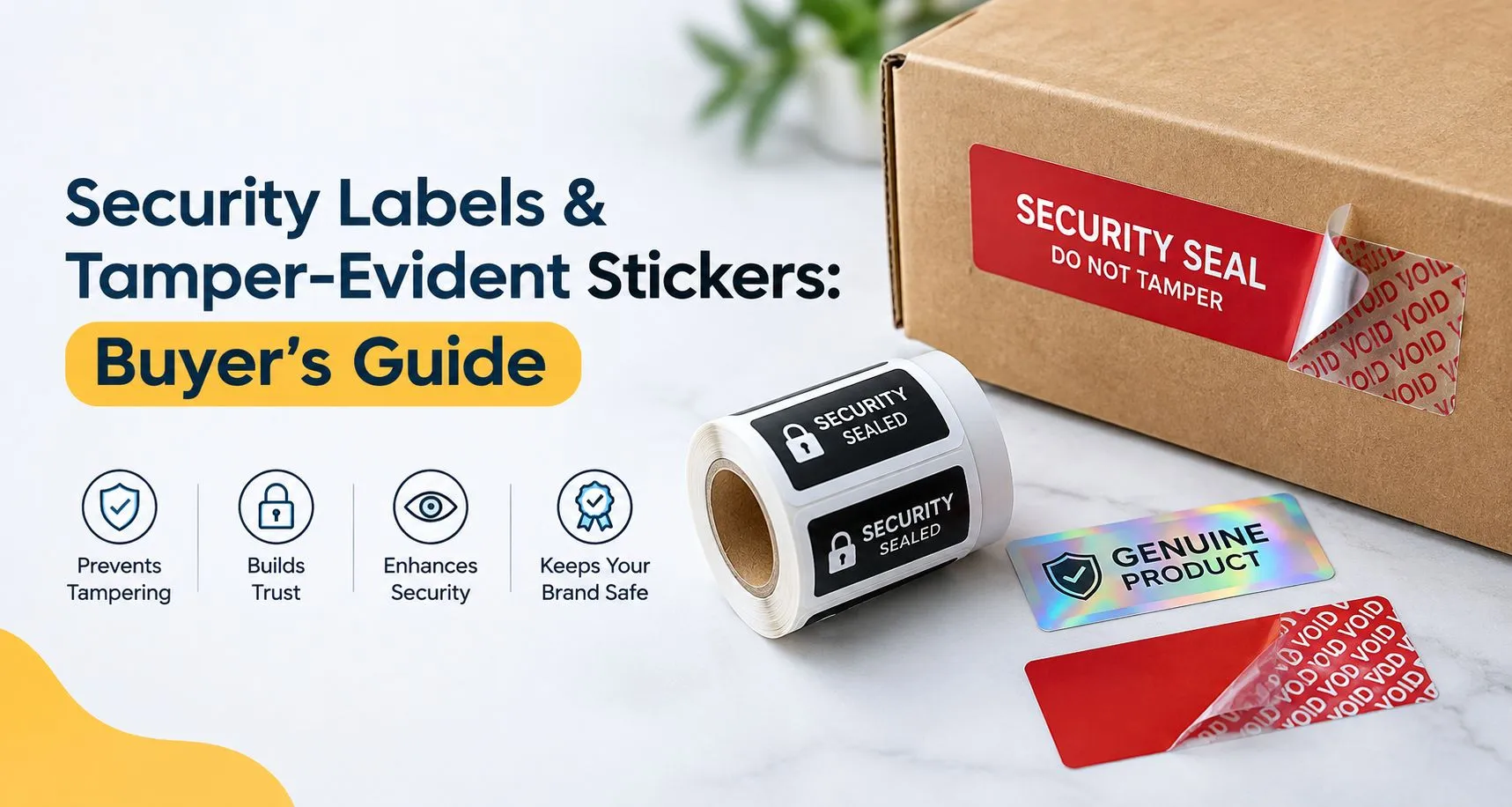
When your products move through warehouses, distributors, retail stores, and international supply chains, packaging security becomes a business concern. A seal that breaks, changes, leaves a message, or shows clear damage can tell your team that someone has opened or interfered with a package.
That is where security labels and tamper-evident solutions become useful. They help businesses protect packaged goods, improve product control, support traceability, and make unauthorized access easier to spot.
For B2B buyers, the decision involves more than finding a sticker at the lowest price. You need to consider the package surface, adhesive, label material, application method, storage conditions, security requirements, print design, order volume, and supply consistency.
A reliable security label manufacturer should also understand your production process. If you buy in bulk for the USA, Canada, Mexico, China, or Caribbean markets, your supplier needs to deliver consistent specifications across repeat orders.
This buyer's guide explains how tamper-evident solutions work, the main types available, where businesses use them, what specifications matter, and how you can assess a security label manufacturer before placing a B2B order.
Security labels are labels designed to protect products, packages, documents, or assets from unauthorized opening, removal, or interference. Depending on the design, a label may show a visible message, break into pieces, leave residue, or become damaged when someone tries to remove it.
A basic product label identifies an item. A security label adds another function: it can provide visible evidence when someone interferes with the package.
For example, a warehouse team may seal a carton before shipment. If the seal remains intact when the carton reaches the customer, the receiving team has a simple visual security check. If the seal shows a VOID message, breaks apart, or leaves visible evidence, the team knows that someone may have opened the package.
The exact result depends on the label construction. A security label manufacturer can use different materials, adhesives, cuts, coatings, and printing methods to create the required effect.
This makes security labels useful across supply chains where businesses need better control over packaged goods.
The main purpose of tamper-evident security labels is simple: make interference visible.
A label can achieve this in several ways. Some labels reveal a hidden message when someone attempts removal. Others break into small pieces. Some leave a residue on the package or split into layers.
The adhesive and face material play a major role. When a person pulls the label away from the surface, the construction reacts according to its design.
For example:
These mechanisms do not make tampering impossible. Instead, they make unauthorized interference easier to detect.
That difference matters when you evaluate tamper proof security labels for commercial use. A buyer should not assume that any label can stop every attempt at unauthorized access. The better question is whether the label provides the right level of visible evidence for your product and supply chain.
You may see the terms tamper evident and tamper proof used together in the label market. They describe related ideas, but they do not mean exactly the same thing.
A tamper-evident product provides evidence when someone attempts to open, remove, or interfere with it. A truly tamper-proof product would imply that tampering cannot happen, which is a much stronger claim.
For most packaging applications, tamper evidence offers the more practical approach.
When you source tamper proof security labels, ask your supplier what happens when someone tries to remove the label. Does it display a message? Does it break? Does it leave residue? Does it damage the label face?
The answer tells you more about the product than the marketing term alone.
You should also consider what happens after an attempted removal. If your receiving team needs a fast visual check, a clear VOID message or obvious destruction may work better than a subtle security feature.
A good security label specification should therefore describe the actual response to tampering rather than rely only on broad terms.
Different products need different security responses. A pharmaceutical carton, electronics box, warehouse shipment, and industrial component may all require different label constructions.
Here are the main solutions you may encounter when sourcing security labels.
VOID labels reveal a word, pattern, or message when someone attempts to remove them.
The hidden message may appear on the label, the application surface, or both, depending on the construction.
These labels work well when your receiving team needs a quick visual indication. A visible VOID message can also discourage casual interference because the person opening the package knows that the action will leave evidence.
FormersPaper lists tamper-evident labels that display a VOID message immediately upon removal and cannot be reused.
Destructible labels use a face material that breaks apart when someone tries to remove it.
Instead of peeling away as one clean piece, the label can fragment into small pieces. This makes reuse difficult and gives your team clear evidence of interference.
This construction can work well when your priority involves preventing someone from removing a label intact and applying it to another package.
Residue labels leave a visible mark or pattern on the application surface after removal.
They can provide strong visual evidence because the package itself shows that someone attempted to remove the seal.
However, residue may not suit every application. If your packaging needs to remain clean after legitimate opening, you should discuss this requirement with your manufacturer before production.
Some buyers need visible tampering evidence without leaving adhesive residue on the package.
These labels can use a construction that changes or reveals a message without transferring adhesive to the surface.
Your supplier should assess the package material, surface finish, adhesive requirements, and intended use before recommending a suitable construction.
Slits or cuts can make a label difficult to remove in one piece.
Once someone tries to peel the label, the cuts can create visible damage. This approach can add another layer of protection for cartons, bags, containers, and other packaging formats.
Some applications need more than simple tamper evidence. Businesses may add visual security features, unique numbering, barcodes, or other printed elements to support identification and traceability.
These features can help your team connect a physical package with an internal record.
However, you should only pay for security features that solve a real business need. Extra features can increase production complexity and cost.
The terms security labels stickers, and security labels often appear in searches for the same type of product. In practical B2B sourcing, the important point is not the wording. It is the construction and performance of the finished label.
A buyer may need a small sticker for a box, a larger seal for industrial packaging, or a roll format for automated application.
Your supplier should understand the difference between the adhesive, face stock, liner, printing, finishing, and final application format.
If you purchase thousands or millions of pieces, small specification differences can affect production efficiency. That makes the conversation with your manufacturer important before you approve the final specification.
The construction depends on the intended use.
Common face materials across the wider label industry include paper and synthetic materials. Synthetic options can provide useful performance in applications that face moisture, handling, or demanding environmental conditions.
The adhesive also matters. A permanent adhesive may provide a different removal response from another adhesive system. The surface itself also affects performance.
Before you place an order, provide your supplier with details about:
A good security label manufacturer can then match the construction to the application rather than simply selling a standard product.
Adhesive performance can determine whether your label works as intended.
Imagine applying a security sticker to a dusty carton or a surface with a heavy coating. Even a well-designed label may not perform properly if the surface does not support good adhesion.
Your team should therefore consider:
For B2B buyers, adhesive selection also affects waste. A label that fails during application can create rejected packages, extra labor, and production delays.
This is why you should discuss the full application process with your security label manufacturer.
Businesses often need security and identification in the same product. Security barcode labels can connect a physical package to a database, shipment, inventory record, or internal tracking system.
A barcode can identify the product or package, while the tamper-evident construction can indicate whether someone has interfered with it.
You may also need sequential numbering, QR codes, variable data, or other printed information. The right combination depends on how your business manages inventory and shipments.
For example, a logistics company can apply a unique code to each package. When the package arrives, staff can scan the code and inspect the security seal. This creates two checks: identity and package condition.
For high-volume applications, you should also confirm that the label format works with your scanners and application equipment.
Warehouse and logistics operations depend on controlled movement.
Packages can pass through several hands before reaching their destination. A security seal provides a simple visual checkpoint at different stages.
FormersPaper specifically supplies labels and stickers for warehouse and logistics applications and also lists tamper-proof security bags among its solutions for this industry. Its website states that its logistics solutions support different customer requirements and applications.
In these environments, security labels can support:
For international B2B shipments, you should also consider the environment the package will face during transportation. Heat, humidity, handling, and storage can all affect label performance.
Retail products can face unauthorized opening, product switching, and return-related issues.
A visible seal can provide an extra control point before the product reaches the customer.
For example, a retailer can use a security sticker across a package opening. If the seal remains intact, staff can quickly inspect it. If the seal shows damage, the product can receive further inspection.
This approach can also support brand trust. Customers can see that the package has not been opened since sealing.
However, the label should match the packaging design. A security feature that looks poor or damages the package during normal handling may create a different customer problem.
Industrial businesses often handle components, equipment, spare parts, tools, and packaged materials.
These products may move through warehouses, distributors, service centers, and customers before final use.
In such environments, security labels can help identify packages and show signs of interference.
You may also need durable printing, variable information, barcodes, or specific dimensions.
The label should fit your workflow. A small component may need a compact label, while a large carton may require a larger security seal.
Not every application requires an adhesive label. Some businesses also use plastic seals or other physical security devices.
plastic security seals can work for applications where a package, container, bag, or equipment component has a suitable attachment point.
You may also encounter pull-tight labels, which use a tightening mechanism to secure certain products or assets.
pull-up labels represent another format used in specific applications where the label or seal needs a particular handling method.
These options show why you should start with the application rather than the product name. Tell your manufacturer what you need to secure, how people will apply the product, and what evidence you need after interference.
The manufacturer can then assess the appropriate format.
Some businesses use plastic indicative labels when they need a visible indication that a seal has changed or been opened.
You may also come across tamper resistant labels in supplier catalogs. The exact construction and level of security can vary, so buyers should ask for technical details rather than relying on the product name.
Indicative labels can serve a useful role where your team needs a quick visual check.
However, no security label should be treated as a complete security system. Physical seals work best when you combine them with sensible handling procedures, inventory controls, access management, and inspection processes.
Selecting the right product starts with your application.
Is the surface paper, cardboard, plastic, metal, glass, or a coated material?
A smooth surface may behave differently from a textured or porous surface. Give your manufacturer a clear description or sample when possible.
Do you want a VOID message? A label that breaks? Visible residue? A security cut? Or another response?
The answer will determine the construction.
Will the package face heat, cold, humidity, moisture, sunlight, or heavy handling?
If you ship products across different climates, discuss those conditions before production.
Will workers apply the labels by hand? Will equipment apply them automatically?
Your answer can affect roll configuration, label orientation, spacing, and dimensions.
You may require:
If you need security barcode labels, discuss the barcode size, scanner requirements, print quality, and variable-data process early.
B2B requirements often involve repeat orders. Your supplier should understand your expected monthly or annual volume.
This helps with production planning and supply continuity.
Samples allow your team to test the label on the actual package.
Test adhesion, removal behavior, print quality, barcode scanning, handling, and storage conditions before approving a large production run.
Before you approve a supplier, ask practical questions.
A security label is a small product, but a supply failure can affect a much larger operation.
If you run a packaging line and your labels arrive late, production may slow down. If the label construction changes between batches, your application process may also change.
That is why B2B buyers should assess the manufacturer's complete production system.
FormersPaper operates a vertically integrated production model with in-house coating, laminating, printing, and converting. The company says it operates facilities across China, the UK, and Indonesia and has more than 600 advanced pieces of production equipment across five manufacturing factories and about 3 million square feet, or 280,000 square meters, of production workshops and warehouses.
For large B2B programs, vertical integration can give the manufacturer greater control over the production process, material flow, quality control, and delivery planning.
FormersPaper serves customers globally with paper and packaging products, including labels and stickers.
Its label and sticker range includes thermal, barcode, scale, security, and linerless solutions. The company states that its security label range includes tamper-resistant labels that break when tampered with, tamper-evident labels that display a VOID message after removal, and destructible labels that break into small pieces during removal.
This product range gives B2B buyers access to different security approaches under one manufacturing partner.
FormersPaper also operates an in-house R&D department and states that it has more than 100 patents. Its vertically integrated model gives the company control over more of the production process, from material handling through converting and finished-product production.
For buyers that need ongoing supply, this manufacturing model can support larger production programs and repeat requirements.
Our company also states that its facilities hold ISO 9001, ISO 14001, and ISO/IEC 27001 certifications, alongside other certifications and standards listed on our About Us page. Buyers should always confirm which certification applies to their specific product and facility before making a compliance claim.
That point matters because certification should support a real procurement requirement, not simply appear as a marketing statement.
B2B buyers increasingly look beyond price.
Quality consistency, production control, environmental management, supply reliability, and documentation can all affect a long-term supplier relationship.
FormersPaper states that its ISO 9001:2015 certification supports its quality management program, while ISO 14001:2015 covers its environmental management system. It also lists ISO/IEC 27001 for information security management.
The company also states that it follows a minimal-waste strategy and a no-dumping policy for waste materials.
For a procurement team, these details can form part of the supplier review process. You should still request the documents and product-specific information that your own procurement, quality, and compliance teams require.
The lowest quoted price may not produce the lowest total cost.
Poor adhesion, application waste, inconsistent printing, late shipments, or label failure can create additional costs.
A label can perform differently on your actual packaging than it does on a sample material.
Always test before approving a major production run.
A VOID label, destructible label, and residue label provide different responses.
Match the mechanism to your security requirement.
The wrong adhesive can create peeling, residue, application problems, or poor tamper evidence.
Your purchase order should define dimensions, material, adhesive, printing, roll or sheet format, quantity, packaging, and other critical requirements.
A label can provide visible evidence, but your business still needs sensible inspection and handling procedures.
Before placing your next order, review the following:
The right security solution starts with your actual application.
You need to know what you are protecting, where the label will go, how people will apply it, what conditions it will face, and what evidence you need after an attempted opening.
For B2B buyers, the manufacturer matters just as much as the label itself. A capable production partner should understand materials, adhesives, printing, converting, quality control, volume requirements, and international supply.
FormersPaper combines vertically integrated manufacturing, in-house R&D, extensive production equipment, and a broad labels and stickers portfolio to serve business customers globally. Its security label range includes tamper-resistant, tamper-evident, and destructible options for applications across logistics, warehousing, retail, and industrial sectors.
Whether your business operates in China, the USA, Canada, Mexico, or the Caribbean, your sourcing decision should begin with clear specifications and practical testing. Once your requirements are defined, you can work with a security label manufacturer to develop a solution that fits your packaging process, security needs, and expected order volume.
The goal is not simply to buy a sticker. It is to build a reliable packaging-security step that works consistently across your supply chain.
If you are sourcing security labels and stickers for a B2B application, FormersPaper can help you discuss the product requirements, application, and production needs before you place an order.
Security labels help businesses show visible evidence when someone attempts to open, remove, or interfere with a package or product. They can support packaging security, warehouse controls, retail applications, logistics, and industrial uses.
Not always. tamper-evident stickers form one category within the broader security label market. A security label can include tamper evidence, identification, traceability, or other security features depending on its construction.
Tamper-evident security labels are labels designed to show visible evidence after an attempted removal or other interference. They may reveal a VOID message, break apart, or leave a visible indication.
Security labels generally provide evidence or deterrence rather than guaranteeing that tampering cannot occur. Their value comes from making interference visible.
Ask about materials, adhesive, tamper response, printing, dimensions, application method, production capacity, quality systems, certifications, samples, lead time, and repeat-order support.
The term tamper proof security labels can create an unrealistic expectation. Most security labels provide evidence of interference rather than making physical tampering impossible.
Security barcode labels combine identification with a security function. A barcode can connect a package to inventory or tracking information while the label construction can show signs of interference.
B2B manufacturers can support different specifications depending on their capabilities. Discuss your dimensions, material, adhesive, printing, security mechanism, quantity, and application process before production


Formers Paper is a leading manufacturer for a comprehensive range of sustainable paper & packaging products serving customers globally.
Shenzhen Formers Paper Co. Ltd, No.92 Zhugushi Road, Wulian community, Longgang District, Shenzhen, China