We wish you Happy Holidays & a joyful New Year!

Sticky edges on A4 labels? Learn what causes label adhesive ooze and run a simple 5-step test to spot it early, avoid printer jams and costly wasted stock.
November 12, 2026
John Doe
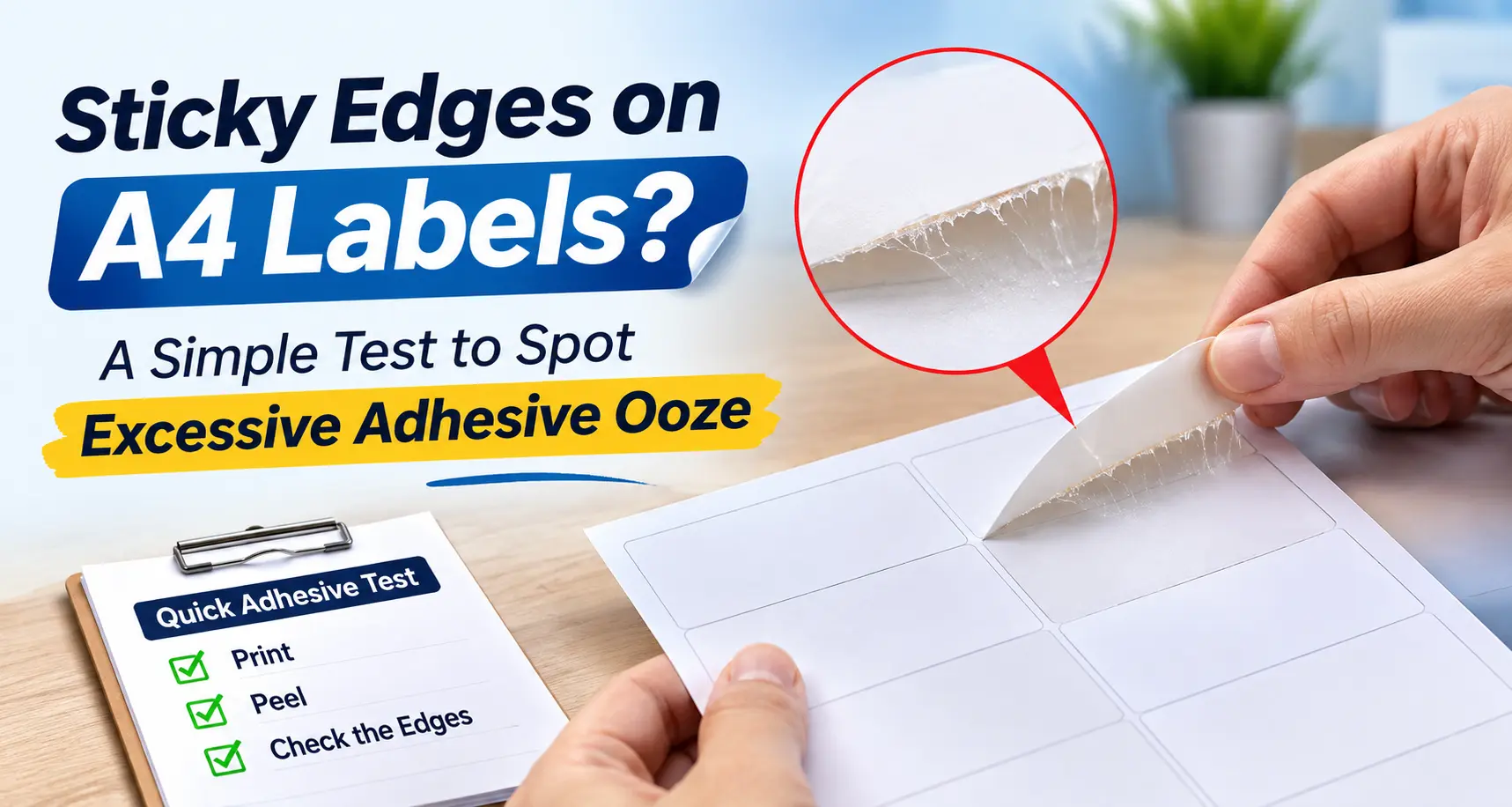
When you open a fresh pack of A4 labels and peel the first sheet, your finger suddenly catches on something tacky because the next sheet lifts together while a thin line of glue shows along the cut edge. That small mess actually has a name, which is label adhesive ooze. Although it looks minor initially, it can quickly jam a printer, waste an entire batch, and delay an urgent order unexpectedly.
Unfortunately, many buyers meet sticky edges on A4 labels only after the carton reaches their busy print room. By then, however, the sudden delay already costs money and causes unwanted stress. Hence, this blog gives you an A4 label sticky edge test that takes about a day and needs no lab setup. Consequently, you will also learn why label adhesive ooze happens, how to read your results properly, and what to ask your supplier directly.
FormersPaper, a B2B manufacturer of labels and paper products, wrote this blog from the factory side. So it also shows what a maker checks before sheets leave the plant.
Label adhesive ooze means glue that moves past the cut edge of a label. It leaves a tacky rim on the label, the liner, or the next sheet. Heat, weight, and time push the adhesive outward. You often notice it first as a sticky edge.
Avery UK warns that warm labels can leak adhesive from the edges. The leak then builds up on packing lines and printer rollers. So label adhesive ooze often starts as a sticky or uneven edge.
You will meet this problem in two forms. Sheet label adhesive ooze makes A4 sheets cling together in a pack. On rolls, you see sticky roll edges and sticky roll sides, plus adhesive residue on label rolls and their liners. This blog starts with sheets, then moves to rolls.
Sticky edges on A4 labels cost money because they cause printer jams, wasted sheets, and slow work. A tacky rim can pull the next sheet into the feed. It can also leave glue on the rollers. Then your team stops, cleans, and reprints. Each stop adds a hidden cost.
Picture a busy print room in Mexico City. A clerk loads three hundred sheets. One sheet label drags the next into the feed, and the printer jams. The clerk cleans the rollers and wastes both sheets. Now repeat that for the whole shift.
Adhesive ooze on A4 labels hurts distributors too. A buyer in Toronto opens a carton, finds clinging sheets, and sends it back. You then pay for freight twice. Catching sheet label adhesive ooze early costs far less than a return.
Adhesive ooze on A4 labels rarely has one cause. Too much adhesive, warm storage, heavy stacking, a rough die cut, and the wrong adhesive all play a part. Because the causes overlap, a single sticky edge never names the culprit by itself.
Here are the usual suspects.
Notice the pattern? Almost every cause of label adhesive ooze involves heat, pressure, or too much glue. That makes a simple test possible.
The A4 label sticky edge test has five quick checks: a light-and-touch check, a paper-transfer check, a stack check, a warm-room check, and a printer check. You need a few sheets, plain paper, a flat weight, and about a day. You do not need a lab.
This test does not replace lab methods. It simply tells you whether a pack deserves a closer look. Take at least ten sheets from the middle and the bottom of a carton, not only the top.
Hold a sheet at a low angle under a bright lamp. Look along every cut edge. A shiny rim or a wet-looking line is a warning. Next, touch the edge with a clean, dry fingertip. Does the edge of the sheet label feel sticky or stringy? Avery UK suggests this same finger check.
Press the label edge onto a plain white sheet for ten seconds. Use light thumb pressure. Peel it away, then study the white paper. Shiny marks, fibres, or a gummy line mean sheet label adhesive ooze has started.
Make a neat stack of ten sheets. Place a flat board on top, then a weight. A ream of 80 GSM A4 paper weighs about 2.5 kg, so it works well. Leave the stack for 24 hours at normal room temperature. Then separate the sheets one by one. Does any sheet label tear or cling?
Repeat the stack in a warmer spot that matches your real storage, such as a shelf near a dispatch door. Do not use an oven. First, ask your supplier about label roll storage and shelf life limits, including the maximum safe temperature. Afterwards, let the sheets rest for 24 to 48 hours before you judge them, as Avery advises.
Run five or six sheets through the printer you really use. Then look at the rollers and the paper path. Do you see glue or paper dust? Check the printed sheets for edge marks too.
Run this a4 label sticky edge test on the first carton from every new supplier. Together, these checks catch label adhesive ooze before your customers do.
Read your results in three levels: pass, watch, and fail. Pass means clean edges and easy separation. Watch means light tack with no transfer. Fail means clear label adhesive ooze: visible residue, clinging sheets, or glue on the printer. Photograph everything, because your supplier acts faster on clear evidence.
Pass: The edges look dry, the white paper stays clean, and the sheets lift apart with ease. You see no label adhesive ooze, so you can use the pack.
Watch: One check shows a faint tack, but nothing transfers and nothing jams. Hold the stock, repeat the test on another carton, and ask your supplier about storage limits.
Fail: You see glue on paper, on rollers, or between sheets. Stop using the pack, and call your supplier.
This scale is a practical blog, not an industry standard. A pass on the a4 label sticky edge test also needs formal peel data. A clean edge means little if the label no longer sticks. FINAT FTM 1 measures peel at 180 degrees, and ASTM D6252 measures peel at 90 degrees. These tests measure bond strength, not ooze. So check both, because adhesive ooze on A4 labels and weak bonding are separate problems.
Sheets and rolls show label adhesive ooze in different ways. Sheet label adhesive ooze makes sheets cling in a stack. Rolls show sticky roll edges or sticky roll sides. The tacky rim also leaves adhesive residue on label rolls, liners, and printer blogs. So check each format for label adhesive ooze and how it behaves.
On a roll, many layers press together, and winding tension adds more pressure. A very tight wind can squeeze adhesive towards the edge and create sticky roll edges. Guanma's blog quotes printer maker Cab, who lists heavy coating, runny adhesive, and tight rewinding as possible contributors to adhesive residue on label rolls.
A sheet label has a different risk. It sits in a stack, so every sheet label carries the weight of the sheets above it. That weight grows towards the bottom of the carton. This is why the test above asks you to pull sheets from the middle and the bottom.
Here is a quick rule. If the sticky spot sits on a cut edge, look at the adhesive and the cutting. If you find sticky roll sides, look at storage, coating, and winding.
If you find sticky roll sides, take photos before you wipe anything. Cleaning erases the clues your supplier needs. Keep the roll, the carton, and the wrapper together. Then note the lot number, the position of the sticky spot, and how the shipment travelled.
ZFU Labels gives the same advice. Photograph first. Keep an unopened roll from the same delivery as a control. Avoid random solvents or powder. When you clean a machine, follow the machine maker's steps.
Treat sticky roll edges as a clue, not a verdict. They do not name the cause by themselves. Storage, coating, and winding can each play a part, so compare matched rolls from the same lot.
If adhesive residue on label rolls keeps returning, keep a simple log. Write the date, the room, the roll number, and the printer. Then sticky roll edges become a pattern you can trace, not a mystery.
Good label roll storage and shelf life habits stop most ooze before it starts. Keep labels cool, dry, and away from sunlight. Avery UK suggests 16°C to 25°C and about 50% humidity. Store stock low, because heat rises, and let it rest for 24 to 48 hours before use.
Your market changes the risk. In Mexico and the Caribbean, heat and humidity both push on adhesive. Avery says heat softens it and humidity weakens the bond. So air-conditioned storage pays off, because heat and weight can cause sticky roll edges and adhesive residue on label rolls.
In Canada, cartons often move from a cold truck into a warm room. Let them rest before you open them. In the USA and China, long routes and hot warehouses bring the same risk. So check cartons when they arrive, not months later.
Shelf life depends on the adhesive and the face material. So ask your supplier for it in writing, and note the date each carton arrives.
Before placing a bulk order for A4 sheets or label rolls, directly verify these critical parameters with your supplier to prevent adhesive leaks and stock waste:
FormersPaper is a B2B manufacturer, so it sells to businesses, not to walk-in shoppers. Its Labels & Stickers range includes A4 sheets for laser and inkjet printers, plus thermal, barcode, linerless, security, and freezer labels. Buyers in China, the USA, Canada, Mexico, and the Caribbean order from it.
The company runs a vertically integrated model. Coating, laminating, printing, and converting happen in-house. FormersPaper operates five factories across China, the UK, and Indonesia, with more than 600 machines. It also holds more than 100 patents. Its facilities carry ISO 9001:2015 quality and ISO 14001:2015 environmental certifications.
Why does this matter for you? When one maker controls the coating, the lamination, and the cut, it can trace label adhesive ooze back to its step more easily. FormersPaper also tackles curl. Its Labels page explains that it controls moisture, manages tension, and decurls sheets during lamination. That does not promise zero ooze. Even so, it shows careful control of the sheet.
One honest note: no supplier can promise zero sheet label adhesive ooze. So FormersPaper suggests the same step this blog does. Test samples on your own printer and your own surface before you place a big order. Also ask about label roll storage and shelf life when you request samples. The Warehouse & Logistics and Retail pages show how its labels fit daily work.
To wrap things up, label adhesive ooze rarely gives you an advance warning before causing trouble. It starts as a sticky edge on a single sheet, and it ends as a jammed printer and a late order. Adhesive ooze on A4 labels costs far less to fix when you spot it early. A short test, a few photos, and clear supplier answers help you catch label adhesive ooze in time.
Remember three things. First, test sheets from the middle and bottom of the carton, not only the top. Second, never wipe sticky roll sides before you photograph them. Third, follow good label roll storage and shelf life rules, because heat and weight start the most trouble.
Want to run this test on real A4 labels? Contact FormersPaper with your printer type, surface, and monthly volume. The team can discuss samples and specifications with you.
Too much adhesive, heat, heavy stacking, and rough die cutting cause most cases of label adhesive ooze. Humidity and printer heat add to the problem. Several causes often work together, so one sticky edge alone cannot name the cause.
Normal tack stays under the label face, where it belongs. Sheet label adhesive ooze reaches the cut edge, the liner, or the next sheet. If your fingertip feels glue at the edge, or a white sheet picks up a shiny mark, you likely have ooze.
Do not wipe them first. Photograph the roll, keep the wrapper and carton, and note the lot number. Sticky roll edges need supplier guidance, not random solvents. Follow your machine maker's steps when you clean printer parts.
Heat, heavy loads, tight winding, or too much adhesive can push glue past the edge. Adhesive residue on label rolls then lands on liners, blogs, and rollers. Record where and when it starts, because that clue helps your supplier.
It depends on the adhesive and face material, so ask your supplier for the shelf life in writing. Good label roll storage and shelf life habits help every material: cool and dry rooms, no sunlight, and no heavy loads on top.
Heavy stack weight and warm warehouse heat push glue outward over time, causing sheet label adhesive ooze. Always test sheets from the middle and bottom layers using an a4 label sticky edge test.
Fusing heat warms the sheet label, melting soft glue and squeezing it past the cut edges. This creates label adhesive ooze that jams printers and ruins batches


Formers Paper is a leading manufacturer for a comprehensive range of sustainable paper & packaging products serving customers globally.
Shenzhen Formers Paper Co. Ltd, No.92 Zhugushi Road, Wulian community, Longgang District, Shenzhen, China