We wish you Happy Holidays & a joyful New Year!

Permanent hot melt adhesive vs water-based acrylic adhesive: compare tack, UV and heat resistance, specs and applications to pick the right label adhesive.
October 22, 2026
John Doe
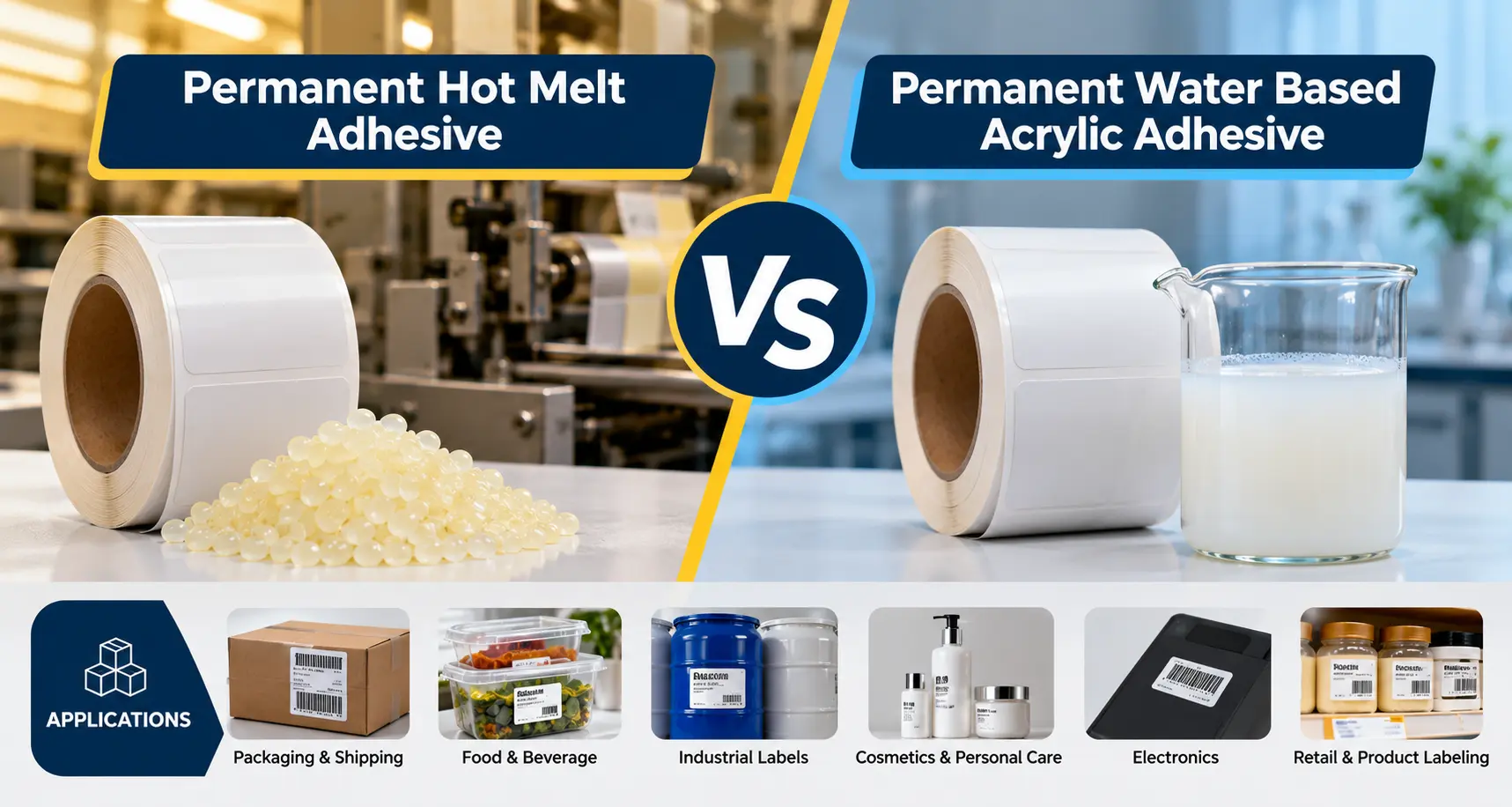
Imagine thousands of labels being printed, packed and shipped to customers, only to start peeling off before they reach their destination. Barcodes become difficult to scan, product information gets damaged, and warehouse teams are left dealing with avoidable delays. The problem may not be the label material or printing quality at all. It could be the adhesive holding the label in place.
For businesses that depend on pressure-sensitive labels, choosing the wrong adhesive can lead to packaging failures, product identification issues and unnecessary operational costs. A label applied to a corrugated shipping carton has different bonding requirements from one used on a plastic bottle, refrigerated product or industrial container.
This makes choosing between permanent hot melt adhesive vs permanent water-based acrylic adhesive an important decision for label manufacturers, procurement managers and packaging businesses.
Both are widely used pressure-sensitive label adhesives, but they offer different bonding properties. Hot melt adhesives are generally known for their high initial tack and quick bonding, while water-based acrylic adhesives are often selected for their ageing, UV and temperature resistance.
But which one is right for your application?
In this guide, we will explain the difference between hot melt and acrylic adhesive, compare their technical properties and explore their applications across different industries. We will also cover the key specifications buyers should check before placing a bulk label order.
A permanent adhesive is designed to keep a label attached to the surface on which it is applied. Unlike removable adhesives, which are made to peel away more easily, permanent adhesives are intended to maintain the bond throughout the label's expected service life.
When someone tries to remove a permanent label, the face material may tear, the label may break or adhesive residue may remain on the surface.
Most permanent pressure-sensitive adhesives create a bond through pressure. The label is simply placed on the surface and pressed into position. No additional water, heat or separate bonding agent is normally required during application.
However, permanent does not mean that every adhesive offers the same bonding strength.
Actual performance depends on:
Therefore, choosing between hot melt and water-based acrylic adhesives requires more than comparing their names or purchase prices.
Hot melt adhesive is a thermoplastic adhesive applied in a heated, molten state. Once it cools, it forms a solid bonding layer.
In pressure-sensitive label manufacturing, many hot melt adhesives use rubber-based polymers combined with tackifying resins and other ingredients. These components help provide initial tack, flexibility and bonding strength.
The manufacturing process generally involves these steps:
Conventional hot melt formulations generally do not rely on water or solvent evaporation during coating. They are therefore commonly described as 100% solid systems.
1. High Initial Tack
Hot melt adhesives generally provide strong initial grab. This helps labels bond quickly when pressed against a suitable surface.
This property is useful in high-speed labelling operations where quick adhesion is important.
2. Good Performance on Selected Rough Surfaces
Many hot melt formulations can bond effectively to corrugated cardboard, paperboard and other textured surfaces. This makes them useful for shipping, warehouse and logistics labels.
3. Suitable Options for Cold Environments
Specially formulated hot melt adhesives can perform well in refrigerated and freezer applications. However, buyers should check the minimum application temperature separately from the service temperature.
4. Fast Bond Development
Hot melt adhesives develop their bond quickly after application, which can support production lines that require fast handling.
Although hot melt adhesives offer several advantages, buyers should also consider their limitations:
The correct formulation should always be selected according to the actual label application and operating environment.
Water-based acrylic adhesive is made using acrylic polymers dispersed in water. It is commonly used in pressure-sensitive label manufacturing where stable adhesion, ageing resistance and environmental durability are important.
During coating, the liquid adhesive is applied to the selected material. The coated material then passes through a drying system, where water evaporates and the acrylic particles form a continuous adhesive film.
Once dried, the adhesive layer provides the required pressure-sensitive bonding properties.
The manufacturing process generally includes:
Unlike hot melt adhesives, water-based acrylic adhesives require a drying stage to remove water and form the adhesive film.
1. Good Ageing Resistance
Acrylic adhesives are generally recognised for their resistance to ageing. The right grade can maintain its bonding properties over an extended period.
2. UV and Weather Resistance
Many acrylic formulations offer good resistance to UV exposure and outdoor weather conditions. This makes them useful for selected product identification, industrial and outdoor labelling applications.
3. Good High-Temperature Performance
Compared with many standard rubber-based hot melts, acrylic adhesives generally offer better resistance to elevated temperatures. However, the maximum service temperature must be confirmed for the specific grade.
4. Long-Term Adhesion
Water-based acrylic adhesives can provide stable long-term bonding on suitable surfaces. They are often considered for applications where a label needs to remain attached for an extended period.
5. Compatibility with Selected Label Materials
Acrylic adhesives are used with different paper and synthetic label constructions. Special formulations may be required for low-surface-energy plastics such as polyethylene (PE) and polypropylene (PP).
Water-based acrylic adhesives also have certain limitations:
It is also important to remember that not every water-based adhesive is permanent acrylic. Some water-based adhesives are designed for removable or repositionable applications. Buyers should confirm the exact adhesive type before ordering.
Both adhesive types are used in pressure-sensitive labels, but their properties and performance can differ.
Actual performance depends on the adhesive formulation, coating weight, label construction, application surface and environmental conditions.
For procurement managers and label buyers, technical specifications are essential when evaluating different adhesive options.
A supplier may describe an adhesive as high tack, permanent, freezer-grade or high-temperature resistant. However, these descriptions alone do not provide enough information to evaluate its performance.
Buyers should request measurable technical values from the adhesive manufacturer's Technical Data Sheet (TDS).
The values should always be interpreted alongside their test conditions. For example, a peel adhesion result obtained on stainless steel may not represent performance on corrugated cardboard or a PE container.
Three important tests help buyers understand the bonding performance of pressure-sensitive label adhesives.
Peel Adhesion
Peel adhesion measures the force needed to remove a label from a surface at a specified angle and speed. It helps determine how strongly a label is attached after application.
Loop Tack
Loop tack measures the initial grab of an adhesive when it comes into contact with a surface. A higher loop tack value can indicate stronger initial contact under the specified test conditions.
Shear Resistance
Shear resistance measures how well an adhesive can resist movement when a force is applied parallel to the bonded surface. It is particularly relevant for labels that need to remain attached during long storage periods or under continuous loading.
B2B buyers can request adhesive performance results based on recognised FINAT test methods.
These tests provide a useful basis for comparing adhesive grades. However, test results are only directly comparable when the same test surfaces, conditions, dwell times and procedures are used.
Temperature is one of the most important factors when selecting permanent label adhesives.
A label applied in a controlled factory environment may later travel through refrigerated warehouses, hot delivery vehicles or outdoor storage areas. Therefore, buyers must consider two separate temperature specifications.
Many hot melt adhesives offer good initial bonding in cold applications, and specialised formulations are available for freezer and refrigerated labels.
However, the adhesive must be designed for the actual application temperature. Applying a standard permanent hot melt label to a cold or frosted surface may lead to poor bonding.
Acrylic adhesives generally offer good resistance to heat and ageing compared with many standard rubber-based hot melts.
They are commonly considered for applications where labels may experience high storage temperatures or extended sunlight exposure. However, high-temperature performance varies by grade. Buyers should confirm the maximum service temperature with the supplier.
Moisture resistance depends on the complete label construction, not only the adhesive.
The face material, adhesive, coating and printing method all influence how a label performs in humid or wet conditions.
Some acrylic formulations may develop a cloudy appearance after prolonged water exposure, particularly in transparent constructions. Special moisture-resistant grades should be evaluated where appearance and water exposure are critical.
The label's application surface can significantly influence adhesive performance.
Different packaging materials have different surface properties, which affect how well an adhesive can spread, make contact and maintain a bond.
Polyethylene is a low-surface-energy plastic. Standard adhesives may struggle to achieve strong and consistent adhesion on some PE surfaces.
Specially formulated hot melt and acrylic adhesives may be required depending on the material grade and application conditions.
Polypropylene is widely used in bottles, containers and flexible packaging.
Because it also has relatively low surface energy, adhesive selection is important. Buyers should test the exact PP surface rather than assuming that an adhesive suitable for another plastic will perform equally well.
PET is commonly used for clear bottles, containers and synthetic labels.
Both hot melt and acrylic adhesives can be used in selected PET labelling applications. The correct choice depends on the container surface, label construction and operating conditions.
PVC is used in flexible films, packaging and other industrial materials.
Some flexible PVC materials contain plasticisers that can migrate into the adhesive layer and affect bonding over time.
Certain acrylic formulations offer better resistance to plasticiser migration than conventional rubber-based hot melts. However, compatibility should always be confirmed through testing.
Buyer recommendation: Provide your supplier with an actual sample of the container, carton or packaging material. Testing the exact surface is more reliable than selecting an adhesive based only on the general material name.
Different industries have different label performance requirements. The right adhesive depends on the product surface, storage conditions, printing requirements and expected label life.
Understanding hot melt adhesive applications and water-based acrylic adhesive applications can help procurement teams shortlist the right label construction.
Shipping and warehouse labels are commonly applied to corrugated cartons, packaging boxes and other surfaces used during transportation.
Hot melt adhesives are often considered for these applications because of their high initial tack and suitability for selected rough surfaces.
Important requirements include:
Cold-chain labels are used on products that move through refrigerated warehouses, food storage facilities and freezer environments.
These labels must remain attached despite low temperatures, moisture and repeated handling.
Both specialised hot melt and freezer-grade acrylic adhesives can be considered. Buyers should check the minimum application temperature, service temperature range and moisture resistance before selecting a label.
Product labels are used on glass jars, plastic bottles, cartons and other retail packaging.
Water-based acrylic adhesives are commonly considered for applications requiring good ageing resistance, clarity and long-term bonding.
For transparent labels, the adhesive's appearance and compatibility with the face material are particularly important.
Healthcare and pharmaceutical labels are used for product identification, sample tracking, packaging and inventory management.
These applications may involve glass, plastic containers, medical packaging and other specialised surfaces.
The adhesive must be selected according to the exact substrate, storage conditions and relevant regulatory requirements.
Industrial and outdoor labels may face sunlight, heat, moisture and long periods of exposure.
Acrylic adhesives are often considered for applications requiring good UV and ageing resistance. However, the label's face material, printing system and protective coating must also be suitable for the operating environment.
Security labels are used to identify unauthorised access, tampering or product interference.
The adhesive must work with the complete security label construction, including the face material and any destructible or tamper-evident features.
The right adhesive is selected according to the surface and the intended security function.
There is no single adhesive that performs best in every situation. Before placing a bulk order, B2B buyers should evaluate the following factors.
Before approving a label specification, ask your supplier:
These questions help procurement teams make decisions based on technical suitability rather than price alone.
Selecting the right adhesive is only one part of producing a reliable label. The face material, coating, printing method, adhesive formulation and converting process must work together to deliver consistent results.
FormersPaper offers label and sticker solutions for businesses across logistics, warehousing, retail, packaging and industrial sectors.
Its product range includes different label constructions and formats designed for varied business applications.
Thermal labels are used for shipping, barcode printing, retail operations and product identification.
Depending on the application, buyers can evaluate the face material, coating and adhesive requirements to achieve reliable printing and scanning performance.
Synthetic label materials such as PP, PE and PET are used in applications where paper labels may not meet the required durability or surface compatibility.
The adhesive must be selected according to the specific synthetic material and the surface to which the label will be applied.
Linerless labels do not use a conventional release liner, making their construction different from standard label rolls.
FormersPaper's linerless label range includes different face materials and adhesive options, including removable acrylic, hot melt and specialised UV adhesives.
Adhesive selection is especially important because linerless labels must also work with the dispensing and cutting mechanisms of the application equipment.
Barcode labels support product tracking, inventory management and shipping operations.
Their performance depends on print quality, label material, adhesive bonding and compatibility with scanning systems.
Security labels help businesses identify tampering and protect products or packaging.
The adhesive and face material must be selected according to the intended tamper-evident function and application surface.
Every business has different labelling needs. Before finalising a label specification, buyers should consider:
By evaluating these factors together, businesses can develop a label construction that matches their operational requirements.
To explore available label solutions, visit FormersPaper and discuss your application requirements with the team.
For food packaging applications, adhesive selection requires additional attention. Labels may be applied to outer cartons, bottles, wrappers or packaging that comes into direct or indirect contact with food.
The required compliance depends on the intended use, packaging construction and destination market.
For example, US FDA regulation 21 CFR 175.105 covers certain adhesives used in food packaging under specified conditions. However, this does not automatically mean that every hot melt or water-based acrylic adhesive is approved for every food-contact application.
Before purchasing labels for food packaging, request:
Procurement teams should evaluate the complete packaging construction rather than relying only on a general adhesive description.
A technical data sheet provides useful information, but actual application testing is equally important.
A label that performs well in a laboratory may behave differently on a production line or during transportation.
Follow these steps before approving a bulk label order.
Step 1: Provide the Actual Application Surface
Share a sample of the carton, bottle, container or packaging material with your label supplier.
Step 2: Confirm Application Conditions
Specify whether the label will be applied at room temperature, in a refrigerated environment or on a cold product.
Step 3: Request Adhesive Test Results
Ask for peel adhesion, loop tack and shear resistance values, along with the relevant test conditions.
Step 4: Test Label Samples
Apply sample labels to the actual packaging material using the intended application process.
Step 5: Evaluate Bond Development
Allow the adhesive to develop its bond according to the supplier's recommended dwell time.
Step 6: Test Environmental Conditions
Expose samples to the expected temperature, humidity, moisture and handling conditions.
Step 7: Check Printing and Scanning Performance
For barcode and logistics labels, confirm that the printed information remains readable and scannable after testing.
Step 8: Approve the Final Specification
Once the label passes the required tests, document the approved face material, adhesive grade, dimensions and other technical parameters before placing the bulk order.
This process helps reduce label failures, production interruptions and avoidable procurement costs.
The choice between permanent hot melt adhesive and permanent water-based acrylic adhesive depends on the performance requirements of your label.
Hot melt adhesives are generally preferred when high initial tack, fast bonding and adhesion to selected rough surfaces are important. Specialised grades can also support refrigerated and freezer applications.
Water-based acrylic adhesives are commonly considered when good ageing resistance, UV stability, long-term bonding and heat resistance are required.
However, the final decision should never be based on adhesive chemistry alone. The application surface, label material, minimum application temperature, service temperature, peel adhesion, loop tack and shear resistance must all be considered before approving a specification.
For B2B buyers, the best approach is to request the manufacturer's technical data sheet, compare the relevant test results and evaluate sample labels under actual operating conditions.
Looking for customised labels for logistics, retail, packaging or industrial applications?
Visit FormersPaper to explore its label and sticker solutions and discuss your material, adhesive and printing requirements with the team.
The main difference is their adhesive chemistry and coating process. Hot melt adhesives are generally applied in a heated molten state and develop bonding properties as they cool. Water-based acrylic adhesives are applied as a liquid dispersion and dried to form an adhesive film. Hot melt is generally known for high initial tack, while acrylic is commonly selected for ageing, UV and heat resistance.
Not necessarily. Hot melt adhesives often provide higher initial tack, but final bonding strength depends on the formulation, surface material and testing conditions. Acrylic adhesives can provide strong long-term adhesion on suitable surfaces. Peel, loop tack and shear test results should be compared before selecting an adhesive.
Both specialised hot melt and freezer-grade acrylic adhesives can be suitable for freezer labels. The most important specifications are minimum application temperature, service temperature range and performance on cold or moist surfaces. Always test the selected label on the actual packaging material.
Many acrylic adhesive formulations offer good UV and ageing resistance, making them suitable for selected outdoor applications. However, the face material, printing system, protective coating and adhesive grade must all be designed for the intended environment.
Yes, specially formulated acrylic adhesives can bond to selected PE and PP surfaces. However, these plastics have relatively low surface energy, which can make adhesion difficult. Always test the exact container or packaging surface before approving a bulk order.
Important specifications include coat weight, 180° peel adhesion, loop tack, shear resistance, minimum application temperature, service temperature range, dwell time and compatibility with the application surface. Request the manufacturer's technical data sheet for the exact adhesive grade.
These are recognised FINAT test methods used to evaluate pressure-sensitive label adhesives. FTM 1 measures peel adhesion, FTM 8 measures shear resistance and FTM 9 measures loop tack.
Hot melt adhesives can work on selected plastic surfaces, but performance depends on the plastic type and adhesive formulation. PE, PP, PET and PVC surfaces may require different adhesive constructions. Testing is recommended before bulk production.
No. Permanent adhesives are designed to keep labels attached, while removable adhesives are formulated to allow labels to be removed more easily and with minimal residue. Some water-based acrylic adhesives are permanent, while others are designed for removable applications.
Not necessarily. Thermal and synthetic labels have different face materials and application requirements. The adhesive should be selected according to the label construction, printing process, surface material and operating environment.
A technical data sheet provides important information about adhesive properties, recommended application conditions and test results. It helps procurement teams compare products, evaluate suitability and reduce the risk of label failure after bulk production.
FormersPaper offers different label and sticker solutions, including thermal, synthetic, linerless, barcode, security and other application-specific labels. Businesses can discuss their face material, adhesive, printing and format requirements to identify a suitable label construction.


Formers Paper is a leading manufacturer for a comprehensive range of sustainable paper & packaging products serving customers globally.
Shenzhen Formers Paper Co. Ltd, No.92 Zhugushi Road, Wulian community, Longgang District, Shenzhen, China