We wish you Happy Holidays & a joyful New Year!

Direct thermal vs thermal transfer labels, learn how they differ, how long prints last, and what they cost, so you can pick the right label for your needs.
October 9, 2026
John Doe
Imagine a pallet leaving your warehouse on Friday. The barcodes look clear and easy to scan. But two weeks later, when the shipment arrives, the receiving team finds that half of the barcodes no longer scan. The labels have faded after sitting in a hot container. The result? You may need to reprint labels, deal with delayed orders, and explain the problem to an unhappy customer.
Situations like this are more common than you might think. And often, the problem starts with a simple decision, Which type of thermal label should you use? In this guide, we’ll explain direct thermal vs. thermal transfer labels in simple terms. You’ll learn how both types work, where each one performs best, and how to choose the right option for your business. We’ll also cover important label materials and buying considerations, especially if you purchase labels in bulk.
FormersPaper is a label stock manufacturer, not a reseller. We manufacture our own label materials through processes such as coating, laminating, printing, and converting. This gives us practical experience with the problems that can happen on real production lines. Whether you buy labels for retail, logistics, food service, healthcare, or industrial use, this guide will help you understand your options and make a more informed choice.
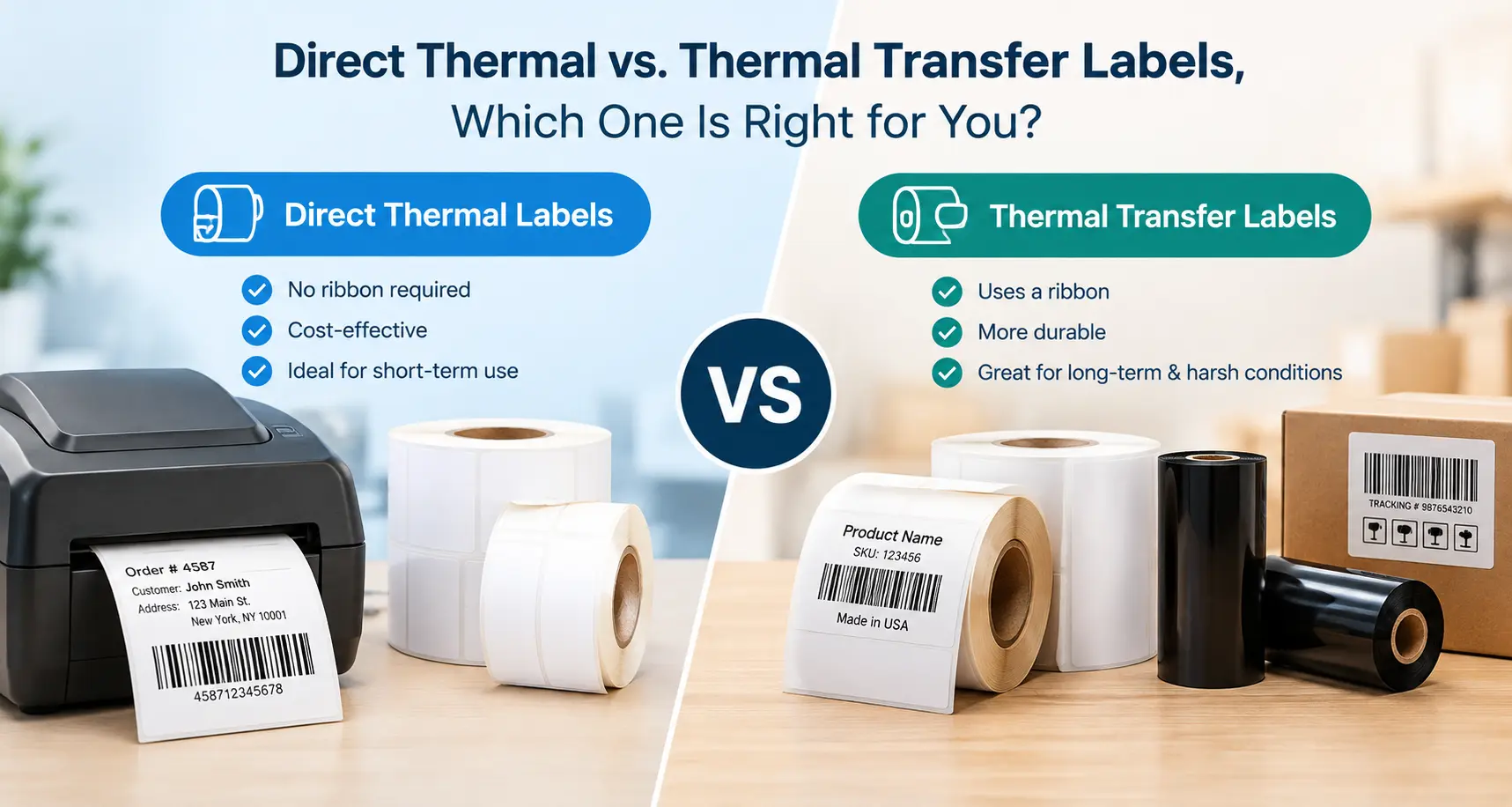
Direct thermal labels are a good choice when you need labels for a short period. They are commonly used for shipping labels, weighing scales, food rotation, receipts, and temporary retail labels. They are also simple and affordable because they do not need a ribbon.
Thermal transfer labels are a better option when your labels need to last longer or handle tough conditions. They can stand up better to heat, sunlight, moisture, rubbing, chemicals, and long-term storage. They do require a ribbon, which adds to the running cost, but the print is more durable.
So, how do you choose between direct thermal and thermal transfer labels?
Start with one simple question: How long does the label need to stay clear and readable?
If you only need it for a few days or weeks, direct thermal is often enough. If it needs to remain readable for months or years, thermal transfer is usually the safer choice.
Both direct thermal and thermal transfer printing use heat to create an image, but they work in different ways. The main differences are how the label is printed, how long the print stays readable, and the overall cost.
With direct thermal printing, the label reacts to heat and creates the image without using a ribbon. With thermal transfer printing, a ribbon transfers ink onto the label.
Here’s a simple breakdown of the key differences:
Direct thermal labels are a good choice for short-term applications such as:
Thermal transfer labels are better for applications where labels need to last longer, such as:
In simple terms: Choose direct thermal when you need a quick, affordable label for short-term use. Choose thermal transfer when you need a label that can handle tougher conditions and remain readable for a long time.
Direct thermal labels are made with a special heat-sensitive coating. When the label passes through a thermal printer, the printer heats tiny dots on the label. Wherever the heat touches, the coating turns dark and creates the text, barcode, or image.
The best part? You don’t need ink, toner, or a ribbon. This makes direct thermal printing simple, quick, and affordable. It works much like the receipt printer you see at a supermarket, the label itself contains the material needed to create the print.
However, direct thermal labels are not designed for every situation. The heat-sensitive coating can react to sunlight, high temperatures, rubbing, oils, and certain chemicals. Over time, the print may fade, become darker, or lose its readability. That’s why direct thermal labels are usually a better choice for short-term applications such as shipping, food labels, receipts, and temporary identification.
At FormersPaper, we manufacture direct thermal labels in different materials to suit different applications:
We also manufacture direct thermal linerless labels for food service, hospitality, and logistics applications. Because we control the coating process in-house, we can produce label materials to meet specific performance needs.
Thermal transfer printing is a popular choice when you need labels that stay clear and readable for a long time. Unlike direct thermal printing, this method uses a ribbon to transfer ink onto the label. The printer heats the ribbon, causing the ink to stick to the label surface. The label itself does not react to the heat.
Because the ink forms a separate layer on the label, thermal transfer prints are generally more durable. They can handle heat, moisture, sunlight, and rubbing better than direct thermal labels. This makes them a good option for products, warehouse items, assets, and labels that need to last for months or even years.
Thermal transfer printing uses three main parts, the label material, the ribbon, and the printer settings. Choosing the right ribbon is important for getting a clean and long-lasting print.
There are three common ribbon types:
Using the wrong ribbon can lead to smudging, poor print quality, or weak barcodes. It is always a good idea to check compatibility with your printer supplier before placing a large order.
At FormersPaper, we offer thermal transfer and vellum labels made from semi-gloss paper, matte paper, and durable synthetic materials. These labels are suitable for barcode, product identification, and asset tracking applications where clear printing and reliable traceability are important.
Thermal transfer does cost more because you need both labels and ribbons. However, when durability matters, the extra cost is often worth it.
Not sure whether you have direct thermal or thermal transfer labels? You can find out in just a few seconds with a simple test.
Start by taking one of your labels and scratch the surface firmly with your fingernail. If the scratched area turns dark or black, you most likely have a direct thermal label. If nothing happens, it is more likely to be a thermal transfer label.
There is another easy way to check. Open your thermal printer and look inside. If you see a ribbon between the print head and the label, the printer is set up for thermal transfer printing. If there is no ribbon, it is likely using direct thermal printing.
This quick check can help you avoid ordering the wrong type of label, especially when buying rolls in large quantities.
However, keep in mind that the scratch test is not always perfect. Top-coated direct thermal labels are designed to handle more wear and scratching, so the dark mark may be very light or difficult to see.
It’s also important to remember that many thermal printers support both printing methods. If you put thermal transfer labels into a printer without a ribbon, the labels may come out blank because they need the ribbon to create the image.
Before replacing your labels, check your printer settings, printing method, and label material. A quick check can prevent wasted labels, unnecessary reprints, and extra costs.
When choosing between thermal transfer and direct thermal labels, knowing what you already have is the first step toward buying the right roll.
The best thermal label depends on how long you need it to last and where you will use it. For short-term, indoor applications, direct thermal labels are usually a simple and affordable choice. For labels that need to survive heat, moisture, rough handling, or long storage, thermal transfer is often the better option.
Before placing a large or bulk order, it’s always a good idea to test a few samples. Print them on your actual printer and use them on your real packaging. This helps you make sure the label sticks well, scans correctly, and stays readable in the conditions it will face.
Your industry also plays a big role in choosing between direct thermal and thermal transfer labels.
Direct thermal labels are usually cheaper to run because they do not need a ribbon. You only need the label stock, which can help keep your printing costs low. Thermal transfer labels cost more because you need both the labels and a ribbon. However, the higher upfront cost can be worth it when your labels need to stay clear and readable for a long time.
When comparing direct thermal vs. thermal transfer label costs, don’t look only at the price of a roll. Think about the total cost of using the labels. This includes reprints, failed barcode scans, damaged labels, and the time your team spends replacing them.
For example, imagine a barcode fades during shipping. Your customer may not be able to scan the package, which could delay the delivery. Your team may then need to print a new label or even write the information by hand. One small label problem can quickly become a bigger business cost.
On the other hand, thermal transfer may not be necessary for every job. If a label only needs to stay readable for a few days, direct thermal can be the simpler and more affordable choice.
If you buy labels in bulk, it’s also important to ask your label stock manufacturer about quality and batch consistency. The coating, adhesive, and printing performance should remain consistent from one batch to another. This helps your printers and scanners work reliably and reduces unexpected problems.
The weather and storage conditions around your products can make a big difference when choosing between direct thermal and thermal transfer labels. A label that works well indoors may not perform the same way in a hot truck, cold warehouse, or shipping container.
Heat and sunlight are especially important for direct thermal labels. These labels use a heat-sensitive coating to create the print. Because the coating reacts to heat, high temperatures and strong sunlight can cause the print to fade, darken, or become difficult to read.
Cold environments can create other problems. Freezers, frost, and condensation can affect labels, especially when cold products move into warmer areas. That is why it is important to test your labels in the conditions they will actually experience, not just on a printer in your warehouse.
Here are some common conditions buyers may face:
If your labels need to survive extreme temperatures, moisture, or long transport times, thermal transfer printing may be the better choice. We also manufacture freezer and cold-chain labels designed for demanding temperature conditions.
When choosing between direct thermal and thermal transfer labels, you don’t always have to pick one or the other. There is another option that can work well for many everyday applications.
Top-coated direct thermal labels have an extra protective layer that helps protect the printed surface from water, oil, and plasticizers. This makes them more suitable for environments where labels may face light moisture or frequent handling.
There are also synthetic direct thermal labels made with materials such as PP, PE, or PET film. These materials are stronger than standard paper and can offer better durability while still allowing you to use a printer without a ribbon.
This can be useful for businesses that need labels for chilled cartons, busy kitchens, food packaging, or parcels that are handled frequently. Instead of immediately moving to thermal transfer printing, you can consider a more durable direct thermal material first.
However, it’s important to understand the limits. These options can improve durability, but they do not make direct thermal labels completely resistant to high heat, strong sunlight, or long-term exposure. If your labels need to remain readable for several years or must withstand harsh outdoor conditions, thermal transfer is usually the better choice.
Many label buying guides focus only on basic paper labels and overlook these alternatives. But direct thermal printing is not limited to paper. Synthetic direct thermal stocks can give businesses more flexibility when they need better durability without adding a ribbon to their printing process.
Choosing the right printing method is important, but it is only one part of getting a label that works well. The label material, adhesive, and liner are just as important. Even the clearest print can fail if the label does not stick properly or cannot handle the conditions it will face.
When choosing a self-adhesive label material, think about where and how the label will be used. Consider the surface, temperature, moisture, and the way the label will be applied.
Most self-adhesive labels have three main parts: facestock, adhesive, and liner.
Special adhesive patterns and black sensor marks can also help with clean cutting and prevent adhesive from building up on the printer blade.
FormersPaper takes a hands-on approach to label manufacturing. Instead of buying labels from other suppliers and reselling them, we coat, laminate, print, and convert our products in-house. This gives us better control over quality and helps us understand how label materials perform in real-world applications.
We operate five factories across China, the UK, and Indonesia, with more than 600 machines across around 280,000 square meters of workshop and warehouse space. With more than 30 years of experience in the paper industry, our team understands the materials and printing processes behind both direct thermal and thermal transfer labels. Our R&D team also holds more than 100 patents, supporting our ongoing product development.
Quality and responsible manufacturing are important to us. Our certifications include ISO 9001:2015 for quality management, ISO 14001:2015 for environmental management, ISO/IEC 27001 for information security, FSC for responsible forestry, and RoHS compliance. However, certifications can vary depending on the product and manufacturing facility, so it’s best to confirm which certifications apply to your specific order.
For buyers in the USA and Canada, our Indonesia facility provides an additional sourcing option and can provide a Certificate of Origin.
Not sure whether direct thermal or thermal transfer labels are right for your application? We can help you compare materials and test samples before you place a large order. This way, you can make your decision based on actual performance rather than guesswork.
Choosing the right label material is easier when you focus on three things, how long the label needs to last, where it will be used, and what happens if the label fails. For short-term and indoor applications, direct thermal labels are often a simple and cost-effective choice. They are commonly used for shipping, receipts, food labels, and other jobs where the label does not need to last for a long time.
If your labels need to survive heat, sunlight, moisture, rubbing, chemicals, or long storage, thermal transfer is usually the better option. These labels use a ribbon to print on the surface, which helps create a more durable and long-lasting image. Not every application fits neatly into one category. If you need something between basic direct thermal and heavy-duty thermal transfer, top-coated direct thermal or synthetic direct thermal labels may be worth considering. The right choice depends on your specific working conditions.
For bulk orders, it is always a good idea to test samples before placing a large order. A small test can help you check print quality, barcode scanning, durability, and how the labels perform during shipping and storage. If you’re planning a bulk label order, send us your printer model, label size, application, and shipping route. The FormersPaper team can recommend a suitable label material and prepare sample rolls for testing.
Want to find the right label for your application? Request a quote today and let’s get started.
Direct thermal labels have a special heat-sensitive coating, so they don’t need a ribbon. Thermal transfer labels use a ribbon to transfer ink onto the label. This makes the print more durable and better suited for heat, sunlight, and regular handling.
Direct thermal labels usually cost less to run because you don’t need to buy ribbons. Thermal transfer labels have an extra ribbon cost, but they can be more cost-effective when labels need to last longer and you want to avoid replacing faded or damaged labels.
A thermal printer uses a print head with tiny heated dots. With direct thermal labels, the heat makes the label coating turn dark. With thermal transfer labels, the heat melts ink from the ribbon onto the label.
Direct thermal labels can often last for several months to around a year indoors, depending on the conditions. Heat, sunlight, friction, and certain chemicals can cause the print to fade or darken faster. For important applications, it’s best to test the labels in the same conditions where they will actually be used.
Some thermal printers can handle both types, but not all. A direct thermal-only printer cannot use a ribbon for thermal transfer printing. Always check your printer model before ordering labels.
For most warehouse applications, thermal transfer labels are a good choice. They offer better durability and can keep barcodes readable through handling, storage, and transportation.
Start with this guide to understand the different label materials and their uses. You can then share details about your printer, application surface, and shipping or storage conditions with our team. We can recommend a suitable starting material and provide samples for testing.
Look for a manufacturer that produces and converts its own label materials and can provide sample rolls before you place a large order. This allows you to test the material with your printer and application first. FormersPaper manufactures and converts its own label stock and can provide samples for testing.


Formers Paper is a leading manufacturer for a comprehensive range of sustainable paper & packaging products serving customers globally.
Shenzhen Formers Paper Co. Ltd, No.92 Zhugushi Road, Wulian community, Longgang District, Shenzhen, China