We wish you Happy Holidays & a joyful New Year!

Discover how to select industrial adhesive safety stickers based on synthetic facestock, adhesive technology, temperature resistance, surface compatibility, and durability.
October 26, 2026
John Doe
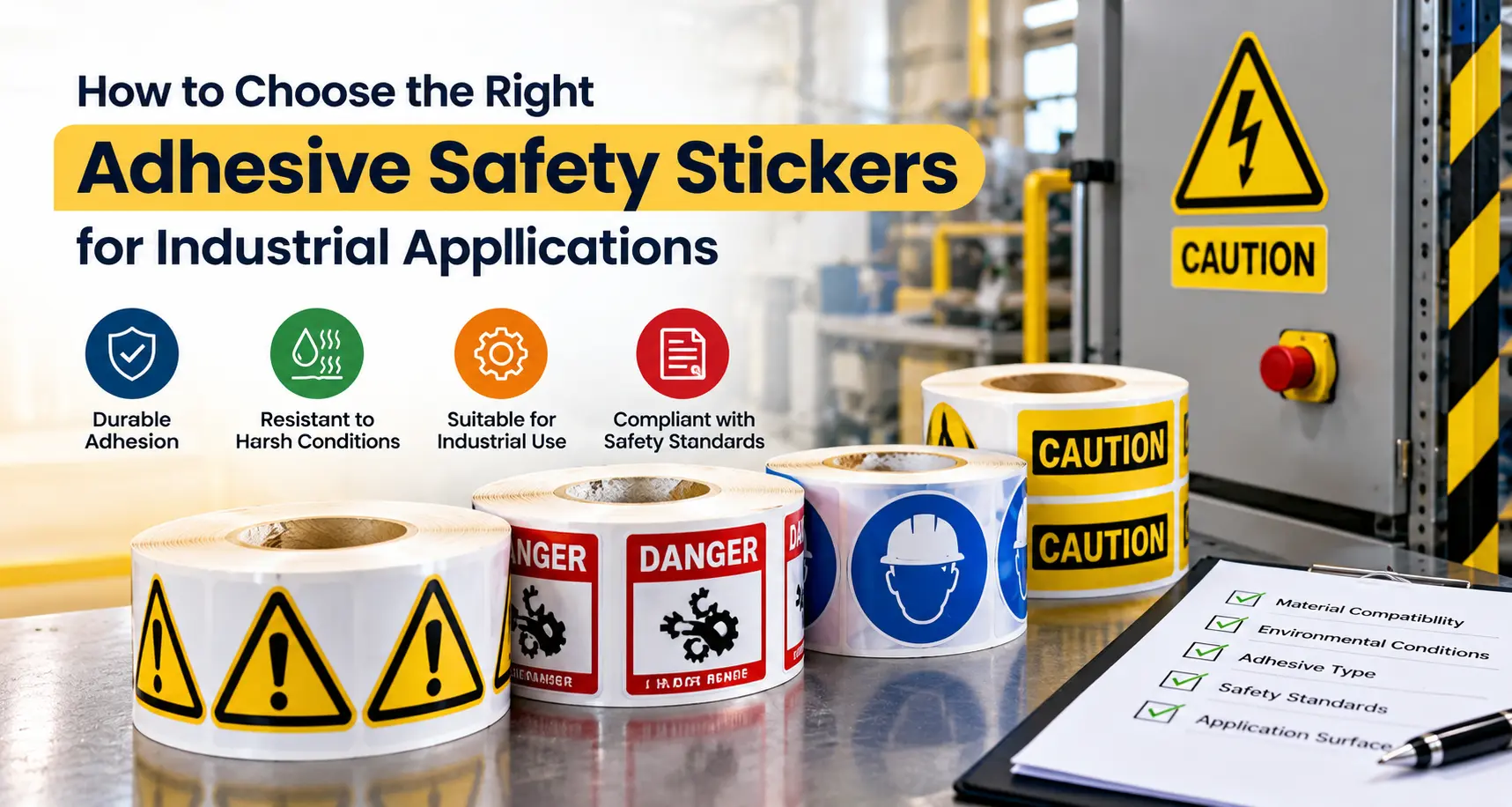
A safety warning is only useful when it stays where employees can see it. Think about a manufacturing facility where workers handle heavy machinery, transport packaged goods, and manage chemical containers throughout the day. Every shift involves equipment handling, material movement, and routine safety checks. Now imagine an important warning sticker peeling away from a machine or becoming unreadable on a shipping pallet. Employees may miss essential handling instructions, and the business could face avoidable operational and safety risks.
This is why industrial businesses cannot treat safety stickers as ordinary packaging accessories. They need labels that remain attached, maintain clear printed information, and perform under the conditions found in factories, warehouses, and distribution centres.
However, selecting the right adhesive safety stickers involves more than choosing a design or printing a warning message. The facestock, adhesive formulation, surface material, temperature range, and protective coating all influence the finished product's performance.
For procurement managers, packaging manufacturers, and industrial buyers, understanding these technical details makes it easier to specify the right product and avoid unnecessary replacements.
In this guide, we'll explain how to choose adhesive safety stickers for industrial applications, including synthetic facestock options, pressure-sensitive adhesives, top-coated materials, temperature resistance, and important manufacturing considerations.
Industrial adhesive safety stickers are self-adhesive labels designed to communicate warnings, handling instructions, equipment information, and other important messages.
They are commonly applied to machinery, packaging materials, storage containers, electrical equipment, cartons, and pallets.
Most pressure-sensitive labels have three basic components:
These components work together to determine how the label performs.
For example, a synthetic PET facestock may provide better resistance to tearing and abrasion than ordinary paper. However, the adhesive must also be suitable for the application surface and operating temperature.
Industrial safety labels help businesses communicate information consistently across different work areas.
Common applications include:
FormersPaper manufactures warning stickers with large black text on a white background, helping make handling instructions easy to notice. These products can be used on bags, boxes, bubble wrap, shrink wrap, and pallets.
The right sticker depends on the information being communicated and the conditions in which it will be used.
Warning stickers alert employees to potential hazards and handling precautions.
They are commonly used on industrial packaging, machinery, and storage equipment.
These labels communicate serious hazards and help employees identify areas or equipment that require special attention.
These stickers display equipment information, operating instructions, maintenance details, and identification codes.
Electrical labels communicate risks associated with electrical installations, while chemical labels provide important hazard and handling information.
Chemical labelling must also follow the applicable regulatory requirements for the substance and market.
These stickers are particularly useful for manufacturers, warehouses, and logistics companies.
They can communicate instructions such as fragile handling, stacking restrictions, orientation requirements, or other packaging precautions.
For businesses handling high volumes of goods, these labels help maintain consistent communication throughout the supply chain.
Before requesting a quotation, industrial buyers should understand the application requirements.
The following factors help determine which label construction is appropriate.
Facestock is the material that forms the visible part of the label.
FormersPaper offers synthetic facestock options, including polypropylene (PP), polyethylene (PE), and polyester (PET), for different labelling applications.
Each material has different properties.
When selecting a facestock, consider the application surface, handling conditions, and expected service life.
The adhesive is responsible for keeping the sticker attached to the surface.
Industrial buyers should consider the following adhesive characteristics:
A strong initial grab is useful, but it does not automatically guarantee long-term adhesion.
The adhesive should be selected according to the surface material and operating conditions.
Some industrial stickers are exposed to high temperatures, while others are used in refrigerated or frozen environments.
In these situations, both the facestock and adhesive must be suitable for the expected temperature range.
FormersPaper's product portfolio includes hot and cold temperature labelling solutions. Its website lists heat-resistant options from 60°C to 250°C and cold-resistant options from -5°C to -225°C for specified product grades. Buyers should confirm the exact grade, application conditions, and technical specifications before ordering.
Industrial stickers may come into contact with moisture, oils, cleaning agents, and other substances.
For these applications, consider:
FormersPaper lists top-coated label options with resistance to water, oil, and plasticizers, along with specialised options for alcohol resistance and smudge-proof performance. The specific performance of each option should be checked against the actual exposure conditions.
Not every industrial sticker needs to remain permanently attached.
Permanent adhesives are useful for long-term identification and warning applications. Removable adhesives are suitable when labels need to be taken off without leaving unwanted adhesive residue.
FormersPaper's linerless label range includes removable acrylic, hot melt, and UV adhesive options. These technologies are part of its wider label portfolio; the appropriate adhesive for a particular safety sticker should be confirmed with the manufacturer.
Material selection has a direct effect on the durability and performance of industrial labels.
For businesses operating in demanding environments, synthetic facestock can offer advantages over conventional paper materials.
Polypropylene is a widely used synthetic material for labels and stickers.
It can be considered for applications involving regular handling and moisture exposure.
Common considerations include:
Polyethylene is a flexible material that can be useful for labelling curved containers and flexible packaging.
Its flexibility makes it worth considering for applications where the labelled surface may bend or change shape.
Polyester is often considered for demanding applications where labels need to withstand regular handling, abrasion, and challenging operating conditions.
PET-based industrial stickers may be suitable for:
The overall performance depends on the complete label construction rather than the facestock alone.
A top coating and a protective laminate serve different purposes.
A top coating is applied to the label surface to improve particular properties, such as print performance and resistance to water, oil, or plasticizers.
A laminate is an additional protective layer applied over the printed surface.
For industrial applications, a scratch-resistant laminate can help protect printed information against abrasion and regular handling.
The right option depends on the expected exposure and required service life.
Selecting the right adhesive is just as important as choosing the facestock.
Different adhesive technologies provide different bonding characteristics.
Pressure-sensitive adhesives form a bond when the label is pressed against a suitable surface.
They are widely used in self-adhesive labels because they allow straightforward application without requiring additional activation through heat or water.
Their performance depends on the adhesive formulation, surface energy, application pressure, and environmental conditions.
Acrylic adhesives are commonly used in applications where long-term bonding and environmental resistance are important.
Depending on the formulation, they can provide good ageing performance and resistance to UV exposure.
Hot melt adhesives are commonly selected when quick initial bonding is required.
They are useful for many packaging and labelling applications, particularly where labels are applied at high production speeds.
However, their suitability for prolonged heat exposure depends on the specific adhesive formulation.
UV adhesive technology is another option listed in FormersPaper's wider labelling portfolio.
The correct adhesive grade should be selected according to the application, surface, and required bonding performance.
When reviewing adhesive specifications, industrial buyers should understand three important performance terms:
These measurements help buyers compare adhesive performance, but they should always be considered alongside the actual application conditions.
Industrial environments can expose stickers to different forms of stress.
Understanding these conditions before selecting a product can help prevent premature label failure.
Heat can affect adhesive bonding, film stability, and print quality.
Applications near motors, heating equipment, and industrial ovens may require specialised high-temperature facestock and adhesive combinations.
Always verify the maximum service temperature of the complete label construction.
Cold environments can affect adhesive flexibility and bonding performance.
For refrigerated and frozen applications, consider freezer-grade adhesive systems designed for the relevant application temperature.
Water and regular washdowns can damage unsuitable paper labels.
Synthetic PP and PET facestock options, combined with suitable adhesive and surface protection, may be more appropriate for these applications.
Industrial cleaning and processing environments may expose labels to oil, alcohol, and chemical substances.
FormersPaper lists specialised label options with water, oil, plasticizer, and alcohol resistance. However, buyers should check the compatibility of the selected grade with the exact chemicals used at their facility.
Direct sunlight can gradually affect printed colours and certain adhesive systems.
For outdoor labelling, consider UV-resistant inks, suitable facestock, and adhesive formulations designed for environmental exposure.
A durable label also needs clear printing and an appropriate finished format.
For B2B buyers, printing and converting specifications are important, especially when ordering large quantities or integrating labels into production lines.
FormersPaper offers printing options from one to ten colours across its labels and stickers portfolio. This allows businesses to specify different colours, warning messages, symbols, and custom artwork according to their requirements.
Die-cutting allows labels to be produced in specific shapes and dimensions.
It is useful when stickers need to fit particular equipment panels, packaging areas, or product surfaces.
Surface coatings and protective laminates can improve specific performance characteristics.
Depending on the construction, these processes may support:
Labels supplied in rolls must match the requirements of the application equipment.
Industrial buyers should confirm:
These specifications are particularly important when labels are applied through automatic dispensing or packaging equipment.
Some label constructions use black sensor marks to help printers and dispensing equipment identify label positions.
FormersPaper also lists specialised adhesive patterns designed to support clean cutting and reduce adhesive buildup on printer blades in its linerless label solutions.
These are useful technical considerations for buyers evaluating automated label application and linerless systems. They should not be assumed to be requirements for every conventional safety sticker.
Different industries require different label specifications.
Manufacturing facilities use stickers on machinery, control panels, equipment, and packaging.
Labels may need to withstand oil, abrasion, temperature changes, and regular handling.
Warehouses use warning stickers on cartons, pallets, shrink wrap, and storage containers.
Large, readable print and reliable adhesion help maintain handling instructions throughout transportation and storage.
Chemical and pharmaceutical facilities require labels that communicate handling information and product hazards.
Material and adhesive selection should consider chemical compatibility, moisture exposure, and applicable regulatory requirements.
Automotive and heavy equipment manufacturers may require durable identification and warning labels for components, machinery, and packaging.
Synthetic facestock and suitable adhesive systems can be considered for applications exposed to oil, heat, and abrasion.
Food processing and cold-chain businesses may need labels that remain readable in refrigerated, frozen, or moisture-prone conditions.
Freezer-grade adhesives and appropriate synthetic or top-coated materials can be considered depending on the application.
For businesses purchasing thousands of labels, a clear product specification helps prevent manufacturing and application problems.
Before requesting a quotation, prepare the following information:
1. Facestock Material: Specify whether you require Paper, Polypropylene (PP), Polyethylene (PE), or Polyester (PET), depending on your application.
2. Adhesive Type: Mention whether you need permanent, removable, hot melt, acrylic, or a specialised adhesive grade.
3. Application Surface: Share the surface where the stickers will be applied, such as cardboard, plastic, metal, glass, or packaging film.
4. Temperature Requirements: Specify both the application temperature and the operating temperature the stickers must withstand.
5. Environmental Exposure: Explain whether the stickers will be exposed to water, oil, UV radiation, alcohol, chemicals, or abrasion.
6. Printing Requirements: Share the required number of printing colours and provide your artwork or design specifications.
7. Finishing Requirements: Mention whether you need top coating, protective lamination, or custom die-cutting.
8. Supply Format: Specify whether you require stickers in roll format or sheet format.
9. Order Quantity: Provide your initial order quantity and estimated repeat order volume to help the manufacturer plan production accordingly.
Choosing a manufacturing partner is an important part of maintaining consistent product quality and supply.
FormersPaper provides a range of custom labelling solutions for businesses across manufacturing, warehouse and logistics, retail, and other industries.
Its labels and stickers portfolio includes warning stickers, synthetic labels, thermal labels, barcode labels, scale labels, security labels, and hot and cold temperature labelling solutions.
Some of the company's manufacturing capabilities and product features include:
1. Multiple Synthetic Facestock Options
FormersPaper offers PP, PE, and PET synthetic materials for different labelling applications.
2. Different Adhesive Technologies
Its wider label portfolio includes removable acrylic, hot melt, and UV adhesive options, depending on the product application.
3. Custom Printing and Die-Cutting
The company offers custom colours, shapes, and printing options to meet different business requirements.
4. Protective Label Solutions
Its product range includes top-coated and laminated options designed for specific performance requirements, including water, oil, UV, and scratch resistance.
5. Integrated Manufacturing Capabilities
FormersPaper describes its manufacturing model as vertically integrated, with in-house capabilities covering raw material processing, coating, lamination, printing, and converting.
The company also reports five manufacturing locations, more than 600 pieces of advanced equipment, and an in-house R&D team with over 100 patents. These capabilities support its wider paper, packaging, and labelling product portfolio.
For businesses looking for a long-term manufacturing partner, the ability to discuss material selection, adhesive requirements, custom printing, and production volumes with one supplier can simplify procurement.
Explore the FormersPaper Labels & Stickers product range or contact the team to discuss your industrial labelling requirements.
Choosing the right adhesive safety stickers for industrial applications requires more than selecting a suitable design. Businesses need to consider facestock, adhesive technology, surface compatibility, environmental exposure, printing requirements, and expected service life.
Synthetic materials such as PP, PE, and PET offer different performance characteristics, while adhesive technologies such as acrylic and hot melt serve different bonding requirements. Top coatings, protective laminates, and specialised resistance properties can further improve label suitability for demanding applications.
For B2B buyers, the best approach is to define the application requirements, request technical specifications, and test samples before approving a bulk order.
Looking for a manufacturer that can support your custom industrial labelling requirements?
Connect with FormersPaper to discuss your preferred facestock, adhesive technology, printing requirements, and production volume.
PP, PE, and PET are common synthetic facestock options. PP is suitable for many general-purpose applications, PE offers flexibility for curved surfaces, and PET is often selected for demanding applications requiring durability and dimensional stability.
Synthetic facestock refers to plastic-based label materials such as polypropylene, polyethylene, and polyester. These materials are used when applications require specific properties such as moisture resistance, flexibility, or improved durability.
Acrylic adhesives are commonly used where long-term bonding and environmental resistance are important. Hot melt adhesives are known for quick initial bonding and are widely used in packaging applications. The correct choice depends on the application and adhesive grade.
Top-coated labels have an additional surface coating designed to improve specific properties, such as print performance and resistance to water, oil, and plasticizers.
PET facestock can be considered for high-temperature applications, but the complete label construction must be suitable for the required temperature. The adhesive, ink, and protective coating also influence performance.
A scratch-resistant laminate protects the printed surface from abrasion and regular handling. It can help maintain the readability and appearance of labels in demanding environments.
Permanent adhesive labels are designed for long-term bonding, while removable labels are intended to be taken off when required. Removability depends on the adhesive formulation, application surface, and time the label remains attached.
Black sensor marks help certain printers and automatic labelling systems detect label positions and maintain accurate feeding or cutting. Their use depends on the equipment and label construction.
Yes. Industrial stickers can be customised according to material, dimensions, adhesive, printing colours, artwork, and finishing requirements. Businesses should share their application specifications before production.
Ask about available facestock materials, adhesive options, technical specifications, temperature resistance, printing capabilities, protective coatings, die-cutting, roll dimensions, production capacity, and sample testing.


Formers Paper is a leading manufacturer for a comprehensive range of sustainable paper & packaging products serving customers globally.
Shenzhen Formers Paper Co. Ltd, No.92 Zhugushi Road, Wulian community, Longgang District, Shenzhen, China