We wish you Happy Holidays & a joyful New Year!

Discover how to choose prescription medication labels for pharmaceutical packaging. Explore materials, adhesives, printing options, and label specifications for businesses.
October 29, 2026
John Doe
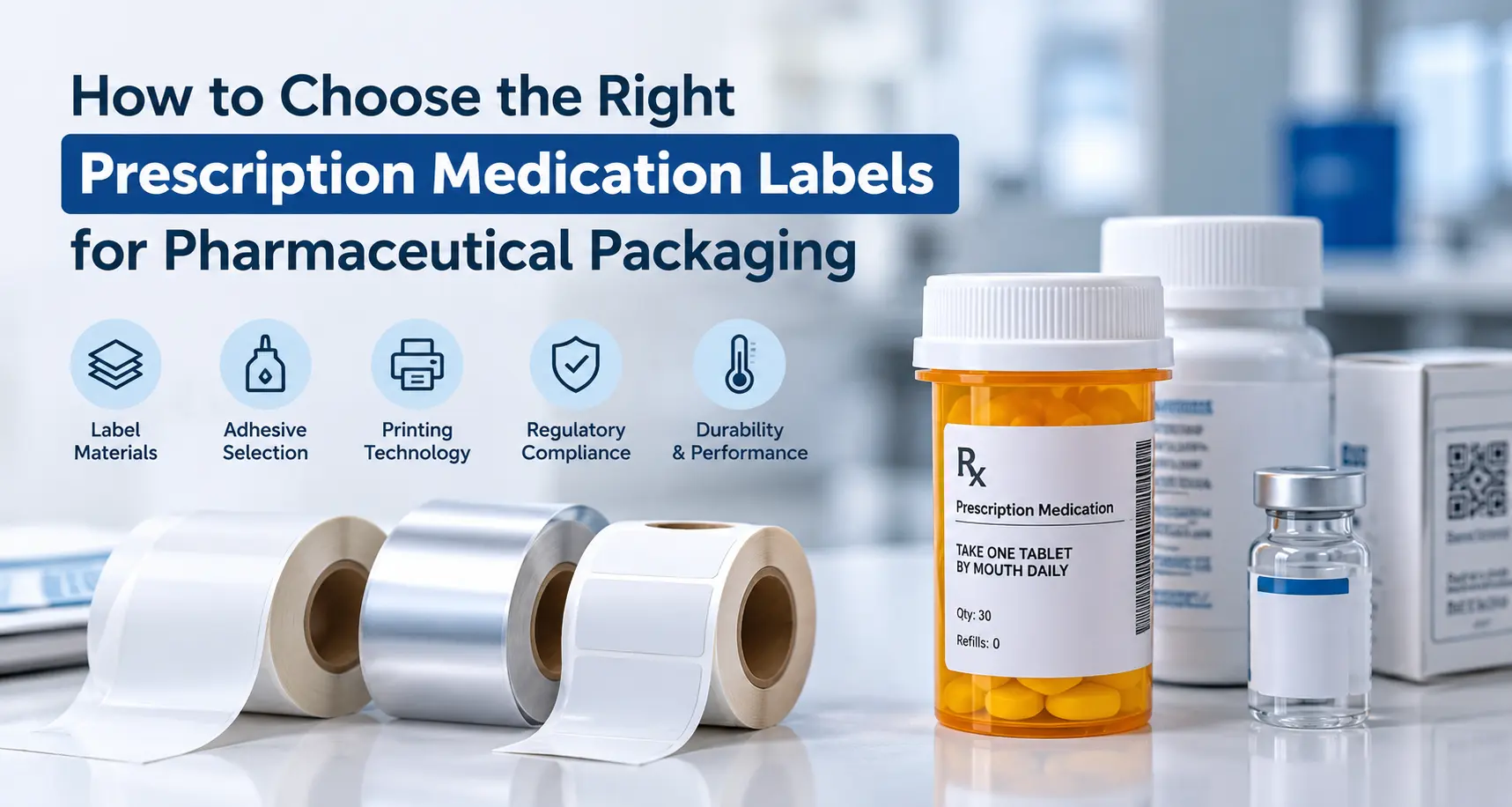
When it comes to pharmaceutical packaging, even a small label plays an important role in protecting product information, maintaining identification, and supporting safe handling.
Imagine a medicine bottle arriving at a pharmacy with a faded label, peeling edges, or a barcode that cannot be scanned. Such problems can create difficulties for pharmacists, distributors, healthcare providers, and pharmaceutical manufacturers. In an industry where accurate information matters, the quality of a label should never be overlooked.
For pharmaceutical manufacturers, packaging companies, and procurement managers, choosing the right prescription medication labels involves more than selecting a suitable design. The label material, adhesive, printing technology, and resistance to environmental conditions all affect its performance.
At FormersPaper, we understand the importance of selecting the right label materials for different packaging requirements. From paper-based options to synthetic materials such as PP, PE, and PET, the right combination can help businesses meet their specific printing and application needs.
But how do you decide which material and adhesive are suitable for your pharmaceutical packaging?
In this guide, we will explain the different types of prescription medication labels, important material considerations, adhesive properties, printing methods, and technical specifications that pharmaceutical packaging buyers should evaluate before placing bulk orders.
Prescription medication labels are applied to medicine bottles, vials, cartons, and other pharmaceutical containers to display important product and usage information.
They help identify medicines and communicate details such as product names, dosage instructions, warnings, batch numbers, and expiry dates, depending on the packaging type and applicable regulations.
For pharmaceutical manufacturers and packaging suppliers, selecting the right label construction is important for maintaining consistent print quality and reliable adhesion.
A suitable pharmaceutical label should:
Prescription labels help pharmacists and patients identify medicines and understand important instructions.
For manufacturers, they also support packaging operations by displaying product information, batch identification, and other required details.
Poor-quality labels can create several operational problems, including peeling, smudging, unreadable barcodes, and printing inconsistencies.
These issues may result in product rework, packaging delays, and additional costs.
That is why businesses should evaluate the complete label construction rather than focusing only on the face material or purchase price.
The right label format depends on the medicine container, available printing space, application process, and packaging requirements.
Here are some commonly used label types that pharmaceutical packaging businesses should understand.
Pressure-sensitive labels have an adhesive backing that allows them to stick to a surface when pressure is applied.
They are widely used across different packaging applications, including medicine bottles, glass containers, plastic packaging, and pharmaceutical cartons.
Their performance depends on the face stock, adhesive formulation, and surface characteristics.
Wraparound labels cover a larger portion of cylindrical containers, such as medicine bottles and vials.
They provide additional printing space for product information and identification details.
The material should be flexible enough to follow the container's shape without lifting or wrinkling.
Tamper-evident labels are designed to show visible signs if someone attempts to open or interfere with a package.
Depending on the construction, these labels may display a void message, break apart, or leave visible evidence after removal.
They are useful for packaging applications where evidence of tampering is required.
Multi-layer labels provide additional space for information without requiring a larger container.
They can be useful for products that need detailed instructions, multilingual information, or additional product details.
Barcode labels help businesses identify products and manage inventory across the pharmaceutical supply chain.
Depending on the applicable market requirements, pharmaceutical packaging may also require unique product identifiers and serialization information.
Clear printing and reliable scanning are essential when selecting these labels.
Label material selection is one of the most important decisions for pharmaceutical packaging buyers.
Different materials offer different levels of flexibility, print performance, moisture resistance, and durability. The right choice depends on the container surface and the conditions in which the label will be used.
At FormersPaper, our label material range includes different options such as PP, PE, and PET, along with paper-based and specially coated label solutions for various applications.
Paper labels are a practical option for applications where exposure to moisture, chemicals, and rough handling is limited.
They offer good printability and can be a cost-effective choice for many packaging requirements.
However, standard paper labels may not be suitable for environments where frequent moisture exposure or demanding storage conditions are expected.
BOPP (Biaxially Oriented Polypropylene) labels are commonly used when moisture resistance and dimensional stability are important.
They can be considered for different bottle and container applications where paper labels may not provide the required durability.
Polyethylene (PE) labels are flexible and can work well on squeezable containers and curved surfaces.
Their flexibility helps them follow the shape of certain packaging formats.
PET (Polyethylene Terephthalate) labels offer good dimensional stability and resistance to rubbing and moisture.
They are suitable for applications where a stronger and more durable label material is required.
The following comparison can help procurement teams understand the differences.
Different Label Materials and Their Applications
1. Paper Labels
2. PP/BOPP Labels
3. PE Labels
4. PET Labels
The final selection should always be based on actual packaging conditions and application testing.
Explore FormersPaper's label materials: Visit our Labels & Stickers product range to learn more about available label materials, coatings, and adhesive options.
You can also read our guide on Synthetic Facestock Explained to understand the differences between synthetic label materials.
A good label material needs the right adhesive to perform properly. Even a high-quality PP, PE, or PET label may lift or detach if its adhesive is not suitable for the packaging surface.
Pharmaceutical containers can be made from glass, PET, PP, and PE. Since these materials have different surface characteristics, adhesive selection should be based on compatibility testing.
Permanent adhesives are designed to keep labels attached during their intended use.
They are commonly selected for medicine bottles, containers, and cartons where the label is expected to remain in place.
Some packaging applications require labels that can be removed without leaving excessive adhesive residue.
Removable adhesive grades can be considered when clean removal is an important requirement.
Glass and plastic containers require different adhesive considerations.
PP and PE surfaces can be more challenging because of their relatively low surface energy. A standard adhesive may not provide the required bonding performance.
Before approving a label for bulk production, test it on the actual container.
When purchasing pharmaceutical packaging labels, buyers should evaluate the following properties:
FINAT test methods, including FTM 1, FTM 8, and FTM 9, provide standardised approaches for evaluating different adhesive properties.
Labels used for refrigerated pharmaceutical products need suitable adhesive performance under low temperatures and possible condensation.
Ask your label supplier for the minimum application temperature and service temperature range of the selected adhesive grade.
For more information, read our comparison guide: Permanent Hot Melt Adhesive vs. Permanent Water-Based Acrylic Adhesive.
The printing method affects the appearance, durability, and production efficiency of pharmaceutical labels.
The right technology depends on the printing volume, label material, information requirements, and expected storage conditions.
Direct thermal printing uses heat to create text and images on specially coated label material.
It does not require an ink ribbon, making it a convenient option for certain short-term labelling applications.
However, direct thermal printing can be more sensitive to heat, light, and friction.
Thermal transfer printing uses a heated printhead and ribbon to transfer ink onto the label surface.
It is often preferred when printed information needs better resistance to handling and environmental exposure.
The correct combination of label material and ribbon should be tested before production.
Flexographic printing is commonly used for high-volume label manufacturing.
It supports printing on different materials and helps maintain consistent output across larger production runs.
Digital printing is useful for shorter production runs, customised designs, and labels requiring frequent artwork changes.
It also offers flexibility when businesses need multiple versions of a label.
Pharmaceutical labels may include barcodes and other product identification information.
Poor print contrast, incorrect barcode dimensions, or damaged printing can affect scanning accuracy.
Always check barcode readability before approving a production batch.
For a detailed comparison, read our blog on Direct Thermal vs. Thermal Transfer Labels.
Pharmaceutical labelling requirements vary depending on the product, country, and packaging category.
Manufacturers and procurement teams should confirm the applicable regulations before approving label artwork and materials.
In the United States, pharmaceutical labelling is subject to applicable FDA requirements and other relevant regulations.
However, manufacturer product labels and pharmacy dispensing labels have different requirements.
Businesses should confirm the exact information required for their product and market.
Depending on the application and regulations, labels may need to include:
Barcodes and serialization information help identify pharmaceutical products and support supply chain traceability.
The required format, placement, and information depend on the applicable market regulations.
Important product information should remain clear and easy to read.
The label layout should provide sufficient space for mandatory details, suitable font sizes, and good contrast.
Final artwork should always be checked and approved by the responsible pharmaceutical or regulatory team.
Selecting the right label material is only one part of the process. Businesses should also understand the problems that can occur during printing, application, storage, and transportation.
Labels may lift from the edges or detach when the adhesive is not suitable for the container surface.
How to prevent it: Check surface compatibility and test the adhesive on the actual packaging material.
Printed information may become difficult to read because of rubbing, moisture, heat, or unsuitable printing materials.
How to prevent it: Choose a suitable printing method and test the face stock, coating, and ribbon combination.
Incorrect label dimensions or unsuitable material flexibility can cause wrinkles and air bubbles during application.
How to prevent it: Match the label size and material to the container shape and application equipment.
Poor printing quality or incorrect barcode dimensions can result in scanning difficulties.
How to prevent it: Test barcode readability using the scanning equipment used in your production or distribution process.
Moisture and condensation may affect the label material and adhesive.
How to prevent it: Select suitable cold-resistant materials and adhesives and test them under the expected storage conditions.
Some pharmaceutical products require specialised label features because of their storage conditions or packaging requirements.
Two important categories to consider are tamper-evident labels and cold-chain labels.
Tamper-evident labels help indicate whether someone has attempted to open or interfere with a package.
Common options include:
These solutions can help businesses select packaging labels that provide visible evidence of interference.
Certain medicines require controlled-temperature storage and transportation.
Labels used in these conditions should maintain their adhesion and print readability within the specified temperature range.
Before selecting a cold-chain label, consider:
FormersPaper's label range includes cold-resistant and heat-resistant options for specific applications. The website lists certain grades with stated temperature capabilities from -5°C to -225°C for cold-resistant applications and 60°C to 250°C for heat-resistant applications.
These ranges are grade-specific, not universal specifications. Contact our team for the technical details of the material and adhesive suitable for your application.
For pharmaceutical manufacturers, packaging converters, and distributors, choosing a reliable supplier is just as important as selecting the correct label material.
A good supplier should understand different material requirements, offer suitable adhesive options, maintain consistent production quality, and provide technical information when needed.
Here are some important factors to consider.
Look for suppliers offering different label materials, including paper, PP, PE, and PET.
A wider material range makes it easier to find suitable options for different container surfaces and packaging conditions.
Check whether the supplier has the manufacturing facilities and equipment needed to handle your requirements.
In-house coating, laminating, printing, and converting capabilities can provide greater control over the production process.
Request technical data sheets covering:
Different businesses have different label sizes, roll specifications, and printing requirements.
Choose a supplier that can support customised specifications and consistent repeat orders.
Ask for relevant quality management certificates and manufacturing documents.
Check that the certifications are current and applicable to the facility supplying your order. General quality certifications should not be confused with pharmaceutical-specific regulatory approval.
Finding the right label material supplier is important for businesses that need consistent product quality, reliable supply, and different material options.
At FormersPaper, we work with different paper and synthetic label materials to support a range of industrial and commercial packaging requirements.
Our product range includes:
We offer different material options, including PP, PE, and PET, along with specialised coatings and adhesive choices.
These options allow buyers to explore label constructions based on their container surface, printing process, and application requirements.
FormersPaper describes its vertically integrated manufacturing setup with in-house coating, laminating, printing, and converting operations.
Our manufacturing network includes five facilities across China, the UK, and Indonesia, with more than 600 machines.
Our listed certifications and credentials include:
The exact certification and documentation requirements should be checked against your intended application and destination market.
Whether you are a packaging converter, distributor, manufacturer, or wholesale buyer, selecting the right material is important for achieving the required label performance.
Explore our Labels & Stickers range or learn more about our Healthcare Industry solutions.
For product specifications, samples, or bulk supply enquiries, our team can help you discuss the available material and adhesive options.
Before requesting a quotation, procurement teams should prepare a detailed specification sheet.
Sharing the correct information helps suppliers recommend suitable materials and reduces the chances of ordering an unsuitable label construction.
1. Face Material
2. Adhesive Specifications
3. Temperature Requirements
4. Printing Requirements
5. Label and Roll Specifications
6. Quality Testing
Even when the technical specifications look suitable, practical testing is important before starting large-scale production.
Follow these steps to evaluate your selected label material:
Step 1: Share Your Actual Packaging
Provide samples of the medicine bottles, vials, cartons, or containers on which the labels will be applied.
Step 2: Explain Your Printing and Storage Conditions
Share your printer model, application process, and expected storage temperatures.
Step 3: Request Label Samples
Ask for sample rolls with the proposed face stock, adhesive, and coating.
Step 4: Test Label Application
Apply the labels using your actual packaging equipment. Check for wrinkles, bubbles, and edge lifting.
Step 5: Check Print Quality and Durability
Review text clarity, barcode readability, rubbing resistance, and moisture performance.
Step 6: Approve the Final Specification
Document the approved material, adhesive, label dimensions, printing method, and quality requirements before placing your bulk order.
Choosing the right prescription medication labels requires careful consideration of material quality, adhesive performance, printing technology, and packaging conditions.
A label that works well on one container may not deliver the same results on another. That is why pharmaceutical manufacturers and packaging buyers should evaluate the complete label construction before making a purchasing decision.
At FormersPaper, we offer a range of paper and synthetic label materials, including PP, PE, and PET, along with different coating and adhesive options for various business requirements.
Whether you are looking for durable synthetic labels, suitable adhesive materials, or customised self-adhesive label solutions, choosing the right specifications is the first step towards reliable packaging performance.
Looking for suitable label materials for your business?
Contact FormersPaper to discuss your label requirements, explore available materials, and request product information.
Prescription medication labels are labels applied to medicine containers to display important product and usage information, such as the medicine name, strength, dosage instructions, warnings, and other required details.
The best material depends on the packaging surface and storage conditions. Paper may be suitable for dry environments, while PP, PE, and PET are considered for applications requiring greater moisture resistance, flexibility, or durability.
Permanent adhesives are commonly used when labels need to remain attached throughout their intended use. The right adhesive depends on the container material, application temperature, and storage conditions.
Synthetic labels generally offer better resistance to moisture and rubbing, while paper labels can be a practical choice for dry, controlled environments. The right option depends on the application.
Yes. Thermal transfer labels are used in different packaging applications where durable printing is required. The correct label material and ribbon combination should be tested for the intended conditions.
Adhesive compatibility helps ensure that labels remain attached to the container. Different surfaces, such as glass, PET, PP, and PE, may require different adhesive formulations.
Buyers should evaluate the face material, adhesive type, label dimensions, printing method, temperature resistance, barcode readability, and supplier quality documents. Testing samples before bulk production is also recommended.
Cold-chain labels are designed for products that require controlled-temperature storage and transportation. They use suitable materials and adhesives to maintain adhesion and print readability within specified temperature conditions.
Look for a supplier offering different material options, manufacturing capabilities, technical support, quality documentation, and consistent bulk supply. Request samples and test them on your actual packaging before confirming an order.


Formers Paper is a leading manufacturer for a comprehensive range of sustainable paper & packaging products serving customers globally.
Shenzhen Formers Paper Co. Ltd, No.92 Zhugushi Road, Wulian community, Longgang District, Shenzhen, China