We wish you Happy Holidays & a joyful New Year!

Direct thermal linerless labels made simple, fix jams, glue build-up and printer fit with the right adhesive and roll design. Request samples today.
November 16, 2026
John Doe
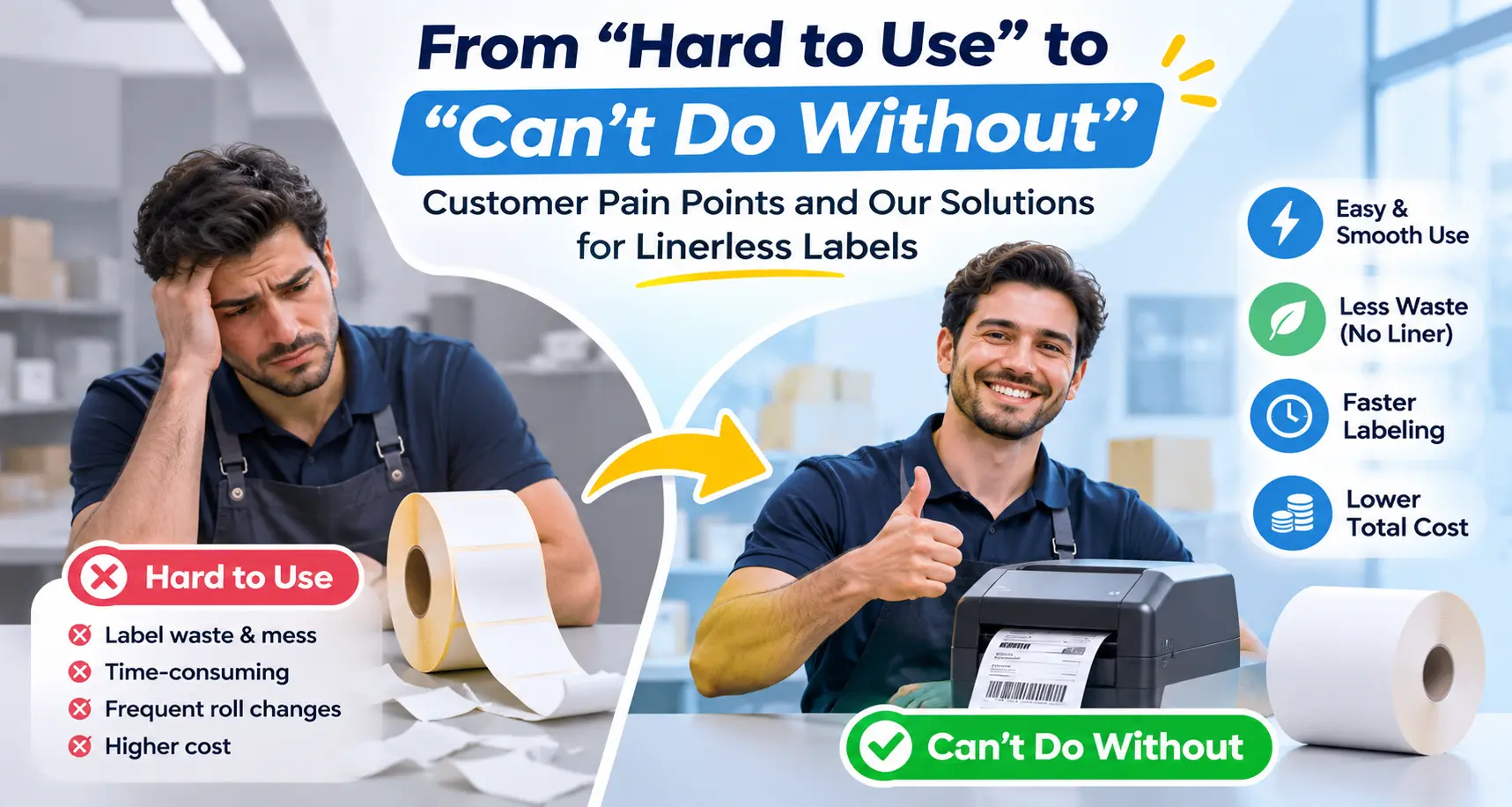
What if a small change in your labelling process could save time, reduce paper waste, and make everyday operations easier? That's exactly what many businesses expect when they consider switching to linerless labels. But making the switch is not always as simple as it sounds.
For businesses that handle hundreds or thousands of labels every day, even a small printing issue can slow down the entire workflow. Sticky cutter blades, adhesive build-up, frequent roll changes, and concerns about printer compatibility are some common problems buyers worry about. As a result, many businesses still see linerless labels as difficult to manage rather than a smarter labelling solution.
But here's the good news, most of these challenges have practical solutions. With the right adhesive, quality materials, proper roll design, and compatible printing equipment, linerless labels can become a reliable part of daily operations.
At FormersPaper, we understand that B2B buyers need more than just a label roll. They need consistent quality, smooth printing, dependable performance, and products that fit their business requirements. As a manufacturer of labels, paper rolls, and thermal products, we focus on helping businesses find practical labelling solutions.
In this guide, we'll explore the most common customer pain points with linerless labels and explain how the right product choices can solve them. We'll also help you understand what to look for before making the switch. Because the goal isn't just to make linerless labels easier to use. It's to make them a solution your business can't imagine working without.
Linerless labels are sticky labels on a roll with no backing paper. A release coating stops the layers from sticking together, so the roll unwinds smoothly. Buyers hesitate because these labels need the right printer, cutter and adhesive. When all three match, the system works very well.
A normal label sits on a liner. You peel the label off, and the liner becomes waste. A linerless roll skips the liner. The printer prints on the roll, and a built-in cutter cuts each label to length. So you can print a short label for a small pack and a long label for a big carton from the same roll. That is why sustainable labels often start with the liner.
Many buyers pick direct thermal linerless labels. Heat makes the image, so you need no ink and no ribbon. FormersPaper makes direct thermal linerless labels for food, hospitality, logistics and retail work. You can choose a paper or synthetic face stock, which is the printable top layer. You can also choose a removable acrylic, hotmelt or UV adhesive. Many people also call this product linerless thermal labels.
So where does the fear come from? Mostly from habit, from equipment and from a few bad trials on the wrong machine. The best linerless labelling starts with knowing these five worries, because each one sits on a real shop floor. Let us look at them one by one. Good linerless label solutions answer every worry, and they also support sustainable labelling.
No. A linerless roll often holds more labels than a lined roll of the same size, because a lined roll wastes space on the liner. So you usually change rolls less often. The worry comes from habit. Your team knows how long a lined roll lasts, and a new roll needs a new rhythm.
Here is the simple maths. On a lined roll, the liner takes up a big part of the thickness. Remove the liner, and more label material fits in the same space. TSC Printers says up to 40% more labels can fit on a roll of the same outer diameter. Avery Dennison says about 50% more. The real gain depends on your label, your adhesive and your roll size, so treat these as ranges and not as promises.
Then why does it feel like more roll changes? Because many operators count rolls by metres, not by labels. A linerless roll may show a different length, even though it prints more labels. Once your team sees the new numbers, the worry usually fades.
Time matters here. Advanced Automation, an equipment supplier, estimates that one roll change takes about 3 to 5 minutes. Fewer changes also support sustainable labelling, since each roll core and wrapper goes further.
What we do: FormersPaper makes linerless thermal labels in custom sizes, materials and finishes. Share your printer model and your daily label count with our team. We will help you pick a roll size that fits your shifts. Good linerless label solutions start with your numbers, not ours.
Because the machine does not match the label. Linerless printers need a non-stick platen roller and a cutter that stays clean. A standard printer for lined labels does not have these parts. When you run linerless thermal labels on that machine, you get half cuts, glue on the blade and poor label feed.
A buyer tries linerless on a standard printer. The cutter gums up. The labels do not drop clean. Then the team says, "Linerless does not work."
Hold on. The label did not fail. The machine did.
Think of cooking an egg in a pan with no non-stick coating. Same egg, wrong pan.
Three parts must work as one team:
FormersPaper builds its direct thermal linerless labels with special adhesive patterns and black sensor mark technology. Together, these help give a clean cut and stop glue from building up on the printer's cutting blade. Good linerless label solutions always pair the label with the right machine.
Before you buy, check your printer. Ask the printer maker if it supports linerless media. Look for a non-stick platen roller and a linerless cutter. If your printer does not have them, you may need an upgrade. We will tell you that honestly. The best linerless labelling setup starts with the machine, not the label.
They can, but only if you pick the right adhesive and face stock and test them in real conditions. A linerless roll has no liner, so your material choice matters even more. Never trust a data sheet alone.
Think about where your labels live. A food business sticks them on cold tubs and hot takeaway bags. A site in the Caribbean or Mexico adds strong heat and humidity. The Barcode Warehouse, a UK supplier, notes that temperature and humidity can change how an adhesive behaves. So test in your own climate, not in a brochure. Even eco friendly labels fail if they peel off in the heat. Sustainable labels must still stick.
FormersPaper offers removable acrylic, hotmelt and UV adhesives. Each one behaves in its own way. So we ask about the surface, the temperature and how long the label must stay on. Then we suggest samples to test. That is how you reach the best linerless labelling result for your line.
Here are two honest limits:
Our labels come from ISO, SGS and RoHS certified facilities, and FormersPaper holds ISO 9001:2015 for quality and ISO 14001:2015 for environmental management. Still, a certificate never replaces a trial on your own line. Strong linerless label solutions always include a real test.
Yes, and you should start small. A good supplier lets you test samples on your own machine before you order in volume. At FormersPaper, you can ask for samples and a quote that covers specifications, minimum order, lead time and price. Then you scale up only after the test works.
Nobody likes to buy 50 rolls just to learn that the cutter jams. Some suppliers sell direct thermal linerless labels and leave you alone with the rest. Here is a simple trial plan you can follow:
Notice step 6. Stopping is a fine result too, because you learn the answer cheaply. Test sustainable labels the same way you test any other label. Eco friendly labels deserve the same fair trial. The best linerless labelling partner never pushes you to buy before you are ready.
Count the savings, not just the feelings. Linerless removes backing paper waste, fits more labels on a roll and can cut storage and freight per label. Then show your finance team a clear story of waste and cost.
Everyone likes sustainable labelling in theory. Finance teams want proof, and that is fair. So start with four numbers:
Then run a trial and measure again. Avery Dennison says linerless thermal labels use about 33% less material, and TSC Printers says fewer roll types can simplify stock. Treat these as starting points, and check them against your own data. Direct thermal linerless labels cut liner waste at the source, so the numbers often look clear.
Be careful with big green claims. Many buyers search for eco friendly labels, but not every "green" label saves waste. So ask for facts. Real eco friendly labels come with proof. At FormersPaper, our paper comes from FSC-certified forests, we hold ISO 14001:2015, and we follow a no-dumping policy for waste. We also work with universities and research centres on low-carbon paper. Facts like these support sustainable labels far better than a slogan can. Smart linerless label solutions turn those facts into numbers.
Linerless is one good step toward sustainable labelling. It is not the only step, and it does not suit every job. Sustainable labels earn their name on your line, not on a brochure.
Linerless is not for every job. Skip it if you print big batches ahead of time, if your printer cannot take linerless media, or if the label must stay in strong sunlight for years. In those cases, lined labels may serve you better.
Watch for these red flags:
Even eco-friendly labels fail when they do not suit the job. Surprised to hear this from a manufacturer? We would rather see you win with the right label than lose with the wrong one. The best linerless labelling choice sometimes means saying no to linerless.
FormersPaper is a B2B manufacturer based in Shenzhen, China. We run 5 factories across China, the UK and Indonesia, with over 600 machines and about 280,000 square metres of workshops and warehouses. We coat, laminate, print and convert in-house, so one team controls the whole process. Our R&D team holds over 100 patents, and we have worked in the paper industry for more than 30 years.
For you, this means three things. You deal with the maker, not a middleman. You can ask for custom sizes, materials and finishes in our direct thermal linerless labels and linerless thermal labels. And you get a team that knows your market. Our North America team supports buyers in the USA, Canada, Mexico and the Caribbean, and our Shenzhen office supports buyers in China. We give the best linerless labelling advice we can, and we back it with honest linerless label solutions, sustainable labelling goals and eco friendly labels that you can test. Our sustainable labels start with FSC-certified paper.
Want printer-ready paper too? See our Paper Rolls page. Want the full label range? Visit Labels & Stickers. Working in food or hospitality? Read about our hospitality work. Running a warehouse? See our warehouse and logistics page. Comparing paper types? Read Thermal vs Bond. Worried about chemicals? Read BPA-Free and our Enviroprint post.
Before making your final choice, keep in mind that most daily troubles with linerless rolls come from old floor habits and mismatched printers rather than any actual defect in the label itself. Therefore, you should always run a small trial directly on your own active machine under your real local weather conditions while carefully tracking your time and material savings so your finance and management teams can easily see the real value.
Since the packaging industry continues to evolve quickly, there is no reason to sit back and wait for a rival to move first when you can launch a quick floor trial and learn right away. Whenever you need dependable linerless label solutions built to suit your specific printer and product alongside your budget, simply reach out and connect with FormersPaper.
It suits jobs where you print and apply a label right away. Examples include takeaway tubs, parcel labels, shelf-edge labels and weigh-scale labels. Food service, hospitality, logistics and retail teams use it most.
Yes. You need a printer made for linerless media, with a non-stick platen roller and a suitable cutter. A standard printer for lined labels often gives poor cuts and glue on the blade. Check with your printer maker first. Then send your model to our team, and we will match our linerless label solutions to it.
They can, if you choose the right adhesive and face stock. Test them in your own fridge, kitchen, truck or warehouse. FormersPaper offers removable acrylic, hotmelt and UV adhesives. Ask for samples, and run a real trial before you place a bigger order.
They remove liner waste, which is a clear gain. Still, each site must measure its own savings. Not every label that claims to be green saves waste. FormersPaper paper comes from FSC-certified forests, and we hold ISO 14001:2015. Use both facts and your own data to judge sustainable labeling.
Start with samples on one line. Count roll changes, jams and bad cuts for one or two weeks. Compare the results with your current labels. Then decide whether to scale up. Sustainable labels need the same fair test as any other label.
Yes. Our North America team supports these markets. Write to Roy Xu at roy.xu@formerspaper.com or call +1 236 992 6399.


Formers Paper is a leading manufacturer for a comprehensive range of sustainable paper & packaging products serving customers globally.
Shenzhen Formers Paper Co. Ltd, No.92 Zhugushi Road, Wulian community, Longgang District, Shenzhen, China