We wish you Happy Holidays & a joyful New Year!

Thermal vs. bond paper rolls: compare speed, cost, and durability to pick the right paper for your printers.
August 13, 2026
John Doe
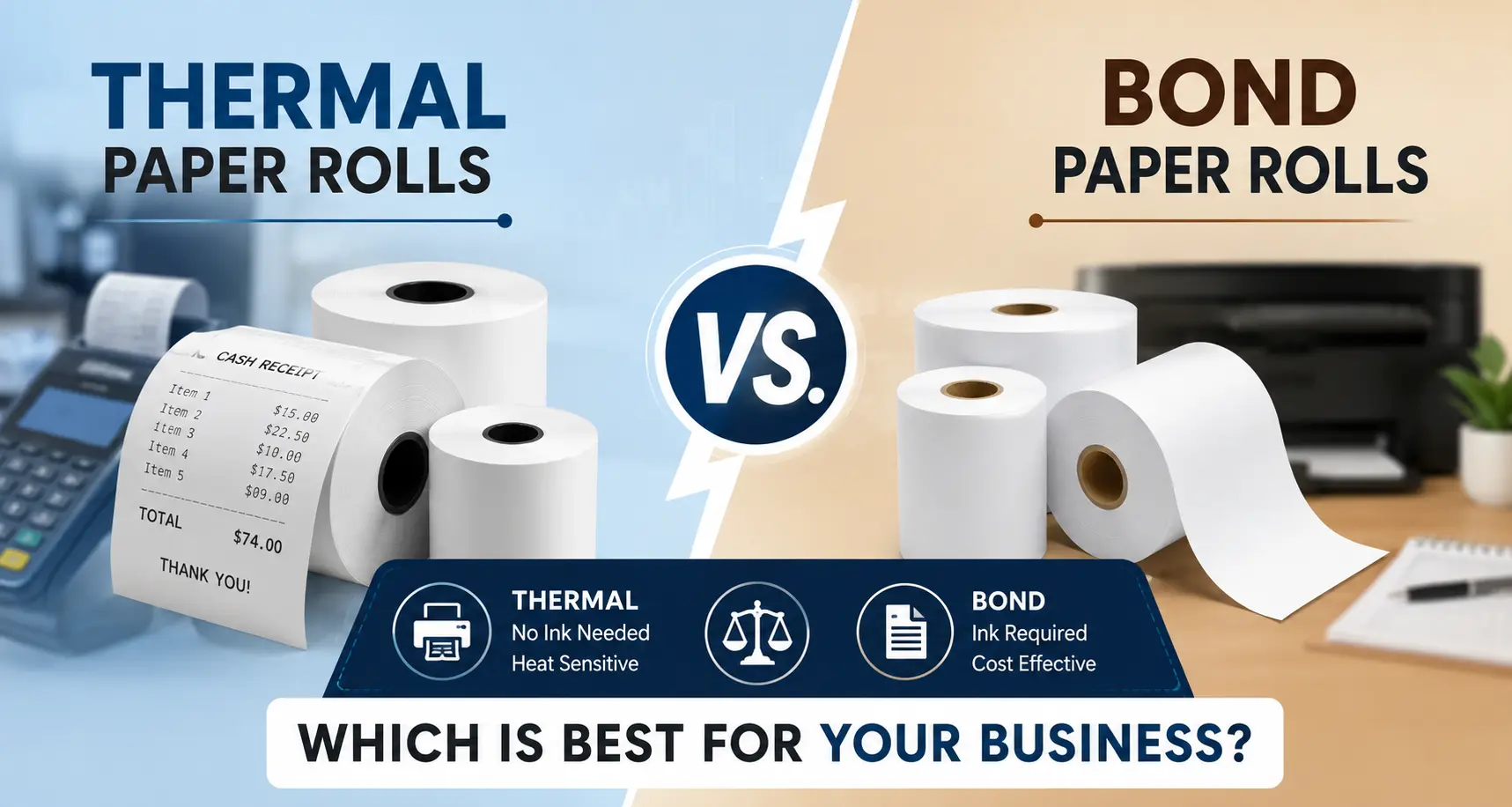
Your receipt printer just jammed for the third time this week, and you're staring at two boxes of paper wondering which one actually belongs in that machine. Sound familiar? If you order paper rolls for a store, restaurant, warehouse, or hospital front desk, you've probably faced this exact question. Thermal vs. Bond Paper Rolls is one of the most common comparisons B2B buyers search for, and for good reason. Pick the wrong roll, and you get smudged receipts, printer downtime, or a supply order that doesn't fit your equipment at all.
This guide breaks down thermal vs. bond paper rolls in plain language, so you can make the right call without needing an engineering degree. We'll cover how each paper is made, where it performs best, what it costs over time, and how to pick a supplier who won't leave you short on stock. As a manufacturer shipping thermal paper vs. bond paper rolls to businesses across the USA, Canada, Mexico, the Caribbean, and China, FormersPaper hears this question from procurement teams every day.
If your business runs high transaction volume, thermal paper is usually the better fit. If you need long-lasting, multi-part, or archival records, bond paper still holds an edge. Most companies weighing thermal vs. bond paper rolls for the first time end up stocking both, one for the front counter and one for the back office. Comparing bond paper vs. thermal paper side by side, as we do below, makes the choice obvious once you know your printer hardware and your record-keeping needs.
A thermal paper roll is a speciality paper coated with heat-sensitive chemicals. When a thermal printer's print head touches the paper, it applies precise heat instead of ink. That heat triggers a color-changing reaction in the coating, and the text appears almost instantly, usually in black, though some coatings turn blue or red.
Here's what's actually happening inside the paper. A thermal roll is built from layers, not just one flat sheet:
Because there's no ink cartridge or ribbon involved, thermal printers run faster, quieter, and need far less maintenance. That's why thermal paper rolls dominate point-of-sale systems, ATMs, parking terminals, and shipping label printers. If your business processes a high volume of transactions every day, this is usually where the conversation about thermal rolls vs. bond rolls starts and ends.
One tradeoff worth knowing, standard thermal paper can fade over time, especially with heat or direct sunlight exposure. A receipt left on a car dashboard in summer is a classic example. FormersPaper addresses this with high-sensitivity coatings and protective top-coat options that extend image life well beyond standard thermal stock, which matters a lot if your industry needs receipts to stay legible for warranty claims or returns. This is a core part of any thermal paper vs bond paper comparison, since coating quality directly affects how long a receipt stays readable after it leaves the printer.
A bond paper roll is a more traditional, uncoated paper made from wood pulp fibers. Unlike thermal paper, it doesn't react to heat. Instead, it needs an outside source of ink, either from an ink ribbon in an impact or dot-matrix printer, or from a traditional inkjet or laser printer for sheeted bond paper.
Bond paper rolls are common in older cash registers, dot-matrix receipt printers, and multi-part carbonless forms where a business needs a duplicate copy pressed through at the same time. Because the printer physically strikes the paper through a ribbon, bond paper can also handle more than one layer at once, which is useful for businesses that need a customer copy and a merchant copy printed in a single pass.
Bond paper has a few real advantages over thermal stock. It's more resistant to heat and sunlight, so records printed on bond paper tend to hold up longer in storage. That's part of why some finance departments, legal offices, and archival record-keepers still prefer it for documents that need to last years, not months. It's also compatible with laser and inkjet printers when used in sheet form, giving it more flexibility outside of receipt printing.
The tradeoffs come down to speed and upkeep. Ribbon-based printers are slower and noisier than thermal printers. You'll also need to keep ink ribbons in stock and replace them regularly, which adds a recurring cost and another item on your procurement list. In a bond paper vs. thermal paper comparison, bond paper generally loses on speed and daily maintenance but can win on long-term document durability. That's the heart of the bond paper vs. thermal paper tradeoff: speed and low upkeep on one side, long-term readability on the other.
Before you place a single order, it helps to see thermal vs. bond paper rolls laid out feature by feature. The chart below captures the thermal rolls vs. bond rolls comparison procurement teams reference most often when writing a purchase order.
When you line up thermal vs. bond paper rolls side by side, a few clear patterns show up. Here's a quick breakdown B2B buyers use to compare the two:
This is the fastest way to answer thermal paper rolls vs. bond paper rolls for most procurement teams, but the right answer really depends on your printer hardware, your transaction volume, and how long you need each printed record to stay readable.
If you're running a busy checkout counter, a logistics hub scanning hundreds of shipping labels a day, or a quick-service restaurant printing tickets nonstop, thermal rolls almost always win on speed and running cost. If you're printing multi-part forms, legal documents, or records that need to survive years in a filing cabinet, bond paper still holds its ground. Understanding thermal vs. bond paper rolls at this level helps you avoid ordering the wrong stock for equipment you already own. Some businesses run a mixed fleet of thermal and impact printers across different locations. In that case, understanding thermal paper vs bond paper rolls at the individual store level, not just the paper type level, keeps your ordering accurate location by location.
Choosing between thermal vs. bond paper rolls isn't only about coating chemistry. Roll dimensions matter just as much, because the wrong size simply won't fit your printer.
Width is measured across the face of the roll. Common widths for both thermal and bond stock include 44mm, 57mm, 76mm, and 80mm, depending on your printer model.
Diameter is the total roll size measured edge to edge across the spindle hole. Counter-based POS printers typically take 60mm to 80mm rolls, while mobile and handheld printers need smaller 30mm to 40mm rolls.
Core size, the diameter of the cardboard tube at the center, is most commonly 12.7mm, though larger industrial printers sometimes need a bigger core.
Length determines how many prints you get per roll before a changeover, which matters for high-volume counters that don't want frequent roll changes during a rush.
Getting these specs wrong is one of the most common ordering mistakes buyers make when comparing paper purchase options. A quick way to avoid it, send your printer model number to your supplier and let them confirm the exact width, diameter, and core size before your order ships. FormersPaper's team reviews these specs on every custom or bulk order, whether you're comparing for a single storefront or standardizing specs across hundreds of locations.
Cost isn't just the price per roll. It's the total cost of keeping your printers running. Here's how thermal paper vs. bond paper compares once you factor in the full picture.
Upfront and running costs. Thermal rolls typically cost a bit more per roll than plain bond paper, but you save on ink ribbons, which need regular replacing in ribbon-based systems. Over a year of high-volume printing, many businesses find thermal paper cheaper overall once ribbon costs are added in.
Printer maintenance. Thermal printers have fewer moving parts. No ribbon means less jamming, less cleaning, and fewer service calls. Impact printers using bond paper and ribbons need more regular upkeep, and worn ribbons produce faded, hard-to-read text long before the roll itself runs out.
Durability of the printed record. This is where bond paper earns its keep. Thermal prints can fade from heat, light, or friction over months. Bond paper printed with ink resists fading much longer, which matters for businesses that must retain readable records for tax, legal, or warranty purposes.
Environmental factors. Because thermal coatings involve chemical layers, sourcing from a manufacturer that offers phenol-free or otherwise responsibly formulated coatings matters if your company has sustainability targets. Bond paper, being uncoated wood pulp, is generally easier to recycle.
Weighing these factors is exactly why so many procurement teams search for thermal paper vs. bond paper rolls before locking in a supplier contract. The paper itself is only half the decision. The other half is who's making it and how consistent their quality control really is. When you tally paper cost, ribbon cost, maintenance calls, and staff time together, thermal paper rolls vs. bond paper rolls stops being a simple price-per-roll comparison and becomes a real operating-cost decision.
Different industries lean toward different rolls, and knowing where your business fits makes the decision much easier. Seeing how real companies approach by sector often settles the question faster than any spec sheet.
Retail and supermarkets. High transaction counts, fast checkout lines, and POS systems built for thermal printers make thermal rolls the default here.
Restaurants and hospitality. Kitchen tickets and customer receipts both benefit from thermal's speed. Some kitchens still use bond paper for multi-copy order slips handed to two stations at once.
Warehousing and logistics. Barcode labels, shipping manifests, and scan-heavy operations rely on thermal paper rolls and thermal transfer labels for speed and legibility under scanner light.
Healthcare. Patient wristbands and lab labels use thermal stock, while certain compliance documents needing long-term legibility still use bond paper.
Banking and ATMs. ATM receipt paper is almost always thermal, chosen for reliability in unattended machines that run for weeks without service.
Finance, legal, and government offices. Multi-part carbonless forms, contracts, and archival paperwork still favor bond paper for its durability and compatibility with standard printers.
Gaming and ticketing. Lottery, event, and parking tickets typically use thermal paper for its speed and clarity, sometimes with tamper-evident coatings.
Seeing your own industry on this list is usually the fastest way to settle a thermal roll vs. bond roll debate internally. From there, the real work is finding a manufacturer who can supply the exact width, length, and coating spec your printers need, at the volume your business actually orders. No matter which industry you're in, the underlying question usually comes back to the same two factors: how fast you need to print and how long you need the record to last.
Here's something most comparison guides skip: the paper type is step one. Who manufactures it is step two, and it's the step that actually protects your operations.
Founded in 1995 by Ms. Wei Ren in Shenzhen, FormersPaper has spent three decades building a vertically integrated production process: coating, laminating, printing, and converting all happen in-house instead of being outsourced. Every extra vendor in a supply chain is another point where quality can slip, or delivery timelines can stretch.
FormersPaper runs five factories with over 600 pieces of advanced equipment across roughly 280,000 square metres of production and warehousing space, backed by an in-house R&D team holding more than 100 patents. For a B2B buyer comparing thermal vs. bond paper roll suppliers, that scale translates into consistent coating quality, reliable batch-to-batch performance, and the capacity to fulfil large recurring orders without last-minute shortages.
Certifications matter just as much as equipment. FormersPaper holds ISO 9001:2015 for quality management, ISO 14001:2015 for environmental management, ISO/IEC 27001 for information security, OHSAS 18001 for occupational health and safety, RoHS compliance, and FSC certification for responsibly sourced fibre. These aren't badges on a page. They're the paper trail compliance teams ask for before signing a supply contract, especially in regulated industries like healthcare, finance, or government.
So when you're weighing thermal paper vs. bond paper rolls for your next order, ask your supplier the same questions you'd ask about the paper itself: Can they show certifications? Do they control their own coating process? Can they scale with your order volume as your business grows? A supplier who can answer yes to all three turns the thermal vs. bond paper rolls decision from a one-time purchase into a dependable, long-term supply relationship.
There's no single right answer here, only the right answer for your printers, your volume, and your record-keeping needs. Use these questions to make the call.
How many transactions do you process daily? High volume favors thermal. Occasional or low-volume printing gives bond paper more room to compete. This single question resolves most of the Thermal Paper vs. Bond Paper debate before you even get to the other four.
What printer hardware do you already own? Thermal paper won't print on an impact printer, and bond paper won't work in a thermal-only unit. Check your hardware before your paper order.
How long do you need records to stay legible? Months, thermal is fine, especially with a protective topcoat. Years of bond paper or a high-sensitivity thermal coating built for longevity is the safer bet.
Do you need multiple copies per transaction? Bond paper with carbonless layers handles this. Standard thermal paper does not. On this point alone, thermal paper vs. bond paper stops being close, and bond paper is the clear choice.
What's your total cost of ownership? Add up paper cost, ribbon cost (if applicable), printer maintenance, and downtime. Thermal usually wins for high-volume daily use once ribbons are factored in.
Running through these five questions turns an abstract thermal paper roll vs. bond paper roll debate into a concrete purchasing decision your whole team can agree on. And if the answer still isn't obvious after all five, that's usually a sign your business needs both: thermal for the counter and bond for the back office, sourced from one supplier so specs stay consistent across departments. Weighing bond paper vs. thermal paper this way, question by question, is far more reliable than guessing based on price alone.
Businesses sourcing paper rolls across North America, the Caribbean, and China face a common challenge: finding a supplier who can deliver consistent quality at scale without the delays that come from working through multiple middlemen. FormersPaper's regional teams support customers across these markets directly, backed by manufacturing capacity built specifically for large, recurring B2B orders.
FormersPaper's product range covers far more than a single paper type. The catalog includes thermal receipt and label stock, business forms and docket books, baking and food-contact papers, ticketing stock, jumbo reels and raw materials for converters, eco-friendly packaging papers, and printed labels and stickers. That range matters if your thermal vs. bond paper roll decision today turns into a broader packaging or labelling need down the road. Working with one certified manufacturer for multiple paper categories simplifies procurement and keeps quality consistent across your supply chain.
Whether you need finished, converted rolls ready to load into a printer or jumbo reels for your own converting line, FormersPaper's in-house production covers both without handing your order off to a third-party coater or converter along the way.
At the end of the day, thermal vs. bond paper rolls comes down to matching the paper to your printer, your transaction volume, and how long your records need to stay legible. High-volume, fast-paced operations usually lean thermal. Long-term records and multi-copy forms are usually lean-bound. Many businesses end up needing both, depending on the department or location.
There's no need to overthink thermal vs. bond paper rolls once you know your printer, your volume, and your record-retention window. What doesn't change is the importance of your supplier. A manufacturer with in-house production, real certifications, and the capacity to scale with your order volume protects you from the stockouts and quality issues that come from working with resellers or uncertified vendors.
FormersPaper manufactures both thermal and bond paper rolls in-house, backed by ISO 9001:2015, ISO 14001:2015, ISO/IEC 27001, OHSAS 18001, RoHS, and FSC certifications, and ships to businesses across the USA, Canada, Mexico, the Caribbean, and China. Whichever side of the thermal vs. bond paper rolls decision your business lands on, working with a certified, vertically integrated manufacturer means one less variable to worry about. If you're ready to lock in a reliable, certified paper roll supply for your business, contact FormersPaper today for a quote or request free samples to test against your printers before you commit to a bulk order.
Thermal paper uses a heat-sensitive coating and needs no ink, while bond paper needs ink from a ribbon or cartridge to print. This is the core of every thermal vs. bond paper roll comparison, and it's also the fastest way to answer thermal paper rolls vs. bond paper rolls if you only have one minute to decide.
Bond paper generally resists fading better over long periods, especially in heat or sunlight. Standard thermal paper can fade within months unless it has a protective top coat. This durability gap is the deciding factor for many buyers weighing thermal paper vs. bond paper rolls for archival or compliance use.
No. Thermal printers need heat-sensitive coated paper to produce an image, and plain bond paper won't react to the print head.
Thermal rolls often cost slightly more per roll, but bond paper requires ink ribbons, which add ongoing costs. Once you factor in ribbons and maintenance, thermal paper rolls vs. bond paper rolls costs often even out or favour thermal for high-volume use. Comparing sticker price alone is the single biggest mistake buyers make in this thermal paper vs. bond paper decision.
Carbonless bond paper is built for multi-copy printing. Thermal paper can't produce carbon-style duplicate copies.
It depends on the coating and the manufacturer's certifications. Look for suppliers with RoHS compliance and FSC-certified sourcing, like FormersPaper.
Check your printer's manual for width, diameter, and core size, or send your printer model to your supplier directly. FormersPaper's team matches specs for both thermal and bond orders.
Yes. FormersPaper manufactures both thermal and bond paper products in-house, along with related categories like labels, tickets, and packaging papers, so B2B buyers can consolidate orders with a single certified supplier.
No. A thermal vs. bond paper roll decision based on price per roll alone misses ribbon costs, maintenance, and how long the printed record needs to last. Looking at the total cost of ownership gives a more accurate answer than comparing sticker prices.
Ask for proof of certifications, sample rolls to test on your own printers, confirmed roll specs (width, diameter, core size), and realistic lead times for your order volume. This applies whether you're comparing thermal paper vs. bond paper rolls for one location or standardising supply across dozens. Buyers who skip this step often end up re-comparing bond paper vs. thermal paper all over again a few months later, after a bad batch or a missed delivery window.
Not really. Thermal vs. bond paper rolls isn't a competition with one universal winner. It's a matter of matching the paper to your printer, your transaction volume, and your record-retention needs. Many B2B buyers stock both thermal paper rolls and bond paper rolls side by side for different parts of their operation.
Work directly with a certified manufacturer rather than a reseller. FormersPaper supplies both thermal paper vs. bond paper rolls in bulk to B2B buyers across the USA, Canada, Mexico, the Caribbean, and China, with consistent specs across every batch.
Frame it around total cost of ownership. Show them the paper cost, ribbon cost, maintenance history, and how long records need to stay legible. Once finance sees thermal rolls vs. bond rolls laid out this way, the numbers usually decide for you.


Formers Paper is a leading manufacturer for a comprehensive range of sustainable paper & packaging products serving customers globally.
Shenzhen Formers Paper Co. Ltd, No.92 Zhugushi Road, Wulian community, Longgang District, Shenzhen, China