We wish you Happy Holidays & a joyful New Year!

Learn how long thermal paper lasts, why receipts fade, and how to store them. Expert tips for B2B buyers from FormersPaper.
October 5, 2026
John Doe
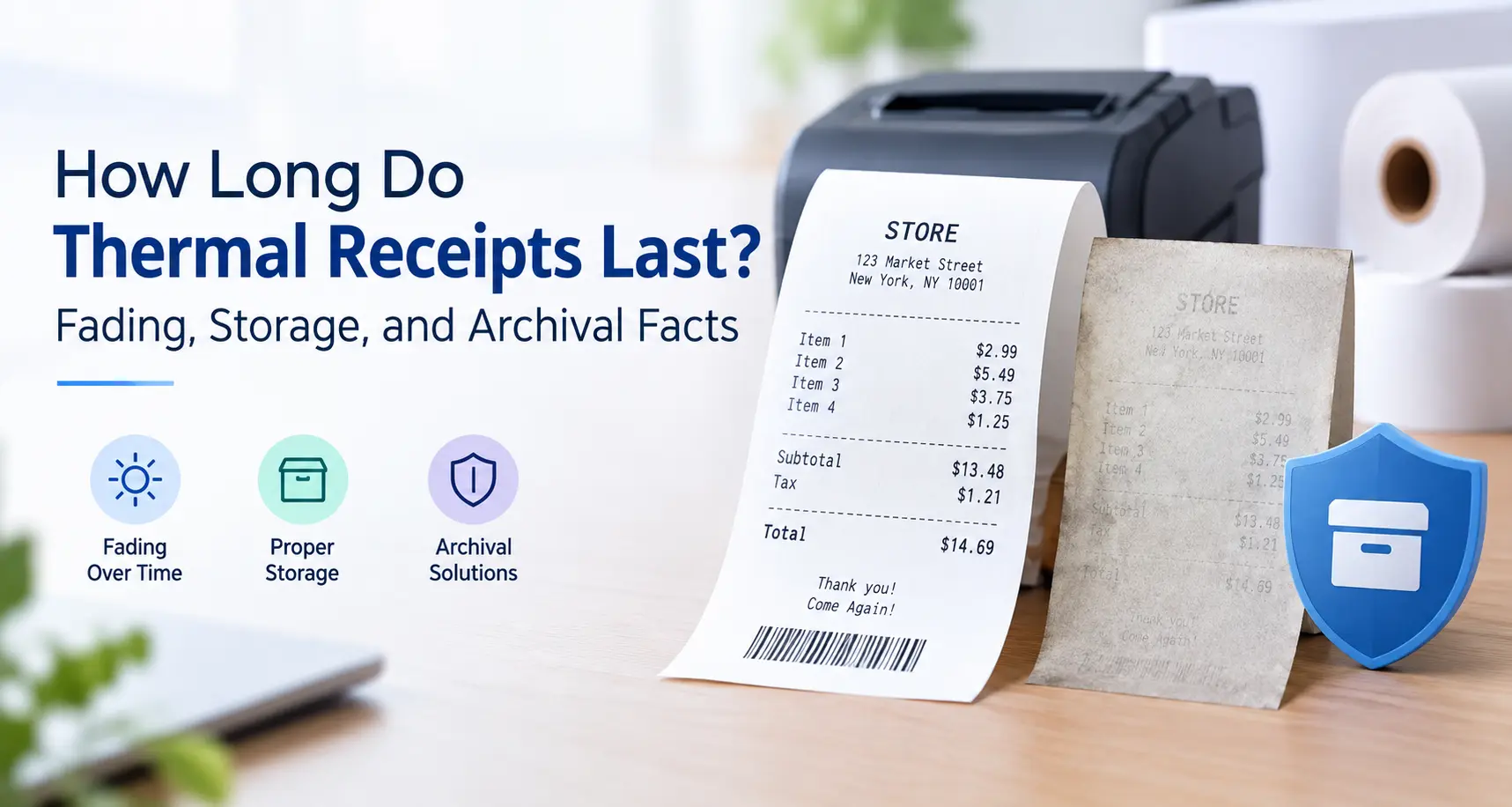
A customer walks into your store six months after a big purchase. She needs the receipt for a warranty claim. She pulls a pale gray slip from her wallet, and you can barely read the total. Now you have an unhappy customer and a dispute nobody can settle.
This story plays out every day, and it leads to one simple question: do thermal receipts fade? Yes, they do. A thermal printer makes the image with heat, not ink, so heat, light, and chemicals can wipe it away. Buyers who ask how long thermal paper lasts get an honest answer with two parts. The paper grade matters, and so does the place where you keep the receipt.
This guide gives you the facts. You will learn why receipts fade, how storage changes the result, and what to ask your supplier before a bulk order. FormersPaper, a vertically integrated thermal paper manufacturer, wrote it for B2B buyers in China, the USA, Canada, Mexico, and the Caribbean.
Yes, thermal receipts fade. A thermal printer forms the image with heat, not ink. The coating on the paper turns dark where the print head touches it. That coating stays sensitive after printing, so extra heat, strong light, or certain chemicals can slowly fade the print or turn the whole page dark.
Here is how the print works. The coating holds a color-changing dye and a developer. The print head heats a tiny spot, and the two parts melt together and react. That spot turns dark. Those dark spots make up your text, barcode, and total.
A top coat adds a shield against water, oil, and light, but no top coat makes thermal paper permanent. So when a buyer asks, do thermal receipts fade, the honest answer is yes, in time. Paper quality and storage set the speed.
Standard thermal receipts often stay readable for about one to three years when you keep them cool, dry, and dark. Better coated grades can last longer. Heat, sunlight, or chemical contact can wipe a receipt in weeks. No one can promise one exact number, because storage matters as much as paper quality.
No industry-wide expiry date exists for thermal paper lifespan. Two receipts printed in the same minute can age very differently. One goes into a filing box in a cool office and stays clear. The other rides on a hot truck dashboard and goes blank by summer. So do thermal receipts fade in one year or in five? Both can happen.
Archive experts take a strict view. The National Archives of Australia says thermal paper does not suit records of long-term value. It warns that modern thermal papers can show heavy fading in as little as five years, even with good storage.
Your receipt is proof of sale, a warranty record, and part of your audit trail. Build your record system around paper that fades.
Why do receipts fade? Heat, sunlight, moisture, chemicals, friction, and a weak coating all break down the image. The print comes from a heat reaction, so anything that adds heat or dissolves the coating changes the image. Most fading comes from storage mistakes, not from age alone.
Heat is the biggest enemy. Do thermal receipts fade faster in a hot room? Yes, and thermal paper fading time shrinks with every extra hour of heat. A car dashboard, a hot kitchen, or a spot near a heater can turn a receipt dark or blank.
Light breaks down the image. A receipt pinned to a bright window loses contrast fast. Office lighting fades it as well, only more slowly.
Do thermal receipts fade in damp rooms? Yes. Moisture softens the coating and lifts the print. Damp rooms also curl paper and make receipts stick together.
Hand sanitizer, cleaning spray, skin oil, and adhesive tape can lift the image. Some PVC sleeves and wallets contain plasticizers, which are softening agents that can pull the image out of the paper.
Rubbing a receipt against cards, coins, or other paper scuffs and darkens it.
A thin coating and a weak top coat start out weak. Printer settings matter too. Low print density gives a faint receipt with little image to lose. High density burns the coating and shortens its life. Most printers work well at the factory default.
Thermal paper fading time changes with every exposure. A hot car or bright window can wipe a receipt in days or weeks. Plastic sleeves and sanitizer can damage it in weeks or months. Cool, dark storage can keep it readable for years. Treat every receipt as a short-term record unless you copy it.
Why do receipts fade so fast in a parked car? Heat and light hit the coating at the same time.
Watch for early warning signs. Do thermal receipts fade all at once? No. The loss starts small. A fading receipt often shows these:
Pull a sample from your archive every quarter. If the print looks weak, copy those records now.
Two myths cost businesses money. Heat cannot revive a faded receipt. A hair dryer may bring back a faint image for a moment, but it usually turns the page black. Laminating does not protect thermal paper either, because a laminator uses heat. A photocopy lasts longer, because toner sits on plain paper.
Unused thermal rolls age too. Thermal paper shelf life depends on the coating, the storage room, and the temperature. FormersPaper lists up to 12 months for its Enviroprint paper when you store it at 5°C to 30°C (41°F to 86°F) and away from sunlight. Plan your orders around that window.
Do thermal receipts fade before you print them? Not exactly, but an aging roll can print weaker, and a weak start shortens the life of the finished receipt. How long does thermal paper last on the roll? The same rules apply, and the clock starts at the factory.
Many industry guides suggest a stricter target: below 25°C (77°F) and 45% to 65% relative humidity.
Bulk buyers face extra risk. Shipping containers can get very hot on long ocean trips, and buyers in Mexico and the Caribbean also deal with warm, humid air. Follow these rules:
Good planning around thermal paper shelf life saves money. You throw out fewer rolls, and your printers make fewer faint receipts.
Store printed thermal receipts flat, in a cool, dark, dry place. Use paper envelopes or acid-free folders, not plastic. Keep them away from heat, sunlight, and chemicals. Scan every receipt you must keep on the day you receive it. Then file the paper original as a backup.
Follow these steps:
These habits cut thermal paper fading time, but they do not stop it. Do thermal receipts fade after you scan them? No. A digital copy never fades, so a scan is your best backup.
Retention rules differ by country and record type, and the USA, Canada, and Mexico each set their own. Ask your accountant or tax authority how long you must keep sales records. So how long does thermal paper last compared to the law? Usually not long enough. A digital copy closes that gap.
BPA-free labels do not set how long a receipt lasts. The coating design, the top coat, and the storage conditions matter more. Some BPA-free grades last as long as standard grades, and some do not. Ask your supplier for image stability data, not only a BPA-free claim.
Do thermal receipts fade faster on BPA-free paper? Not by default. The label tells you about one ingredient. It says nothing about thermal paper lifespan.
FormersPaper makes Enviroprint, a blue, phenol-free carbon-matrix thermal paper with no BPA or BPS. SGS reports back that claim. Report CANEC24027011702 covers FDA 21 CFR 176.170 chloroform extractives. Report CANEC24026912402 covers phenol monomers. FormersPaper also designs Enviroprint for stronger archival stability than conventional thermal paper. See the Enviroprint post and the BPA-Free post for details. One note: FormersPaper does not recommend Enviroprint for direct food contact.
Bond paper works better for long-term records because ink or toner sits on stable paper and does not depend on a heat reaction. Thermal paper works better for speed, low upkeep, and fast counter service. Most B2B teams use both: thermal for the customer receipt, and bond or digital files for records they must keep for years.
Do thermal receipts fade while bond records stay sharp? Often, yes. The trade-off is clear. Thermal paper lifespan is shorter, but you skip ink, toner, and ribbons. Read the Thermal vs Bond post for a full side-by-side.
Choose thermal rolls by coating quality, not only by price. Ask for the coating type, test reports, sample rolls, and batch records. Match the roll to your printer's width and core. Then test samples in your real heat and storage conditions before you place a bulk order.
Use this checklist with any supplier:
Here is a quick spec guide for Paper Rolls from FormersPaper:
A bank may need stronger image stability than a coffee shop. Tell your supplier how long you must read the print, and the team can suggest a grade. Visit the industries pages to see how FormersPaper serves each sector.
FormersPaper controls thermal roll production in-house, from coating to laminating to printing to converting. The company runs five factories and more than 600 machines across China, the UK, and Indonesia. It holds ISO 9001:2015 and ISO 14001:2015 certificates. B2B buyers get one supplier for the full process.
Here are the facts behind that claim:
In-house coating gives the team a direct say in the layer that decides image stability. Do thermal receipts fade on FormersPaper rolls? Every thermal roll fades in time, but the team can help you match a grade to your printers, your climate, and your record rules. Talk to them about your thermal paper lifespan needs.
You cannot stop fading forever, but the question "why do receipts fade" has a practical answer: heat, light, chemicals, and weak coatings. Each one has a fix. Pick a coated roll from a supplier who shows the reports. Store it cool and dark. Scan what matters. Then the next time a buyer asks, "Do thermal receipts fade?" you can say yes and show your plan.
Ready to source thermal rolls that hold their print? Contact FormersPaper for a quote and free samples.
Yes. Even in cool, dark storage, the coating slowly changes. Good storage slows the loss but does not stop it.
Heat drives the reaction that makes the image, so warm air speeds up the fade. Keep rolls and printed receipts in cooler, darker rooms.
Standard receipts often stay readable for about one to three years in a cool, dark, dry cabinet. Some coated grades last longer.
It depends on the grade and the storage room. FormersPaper lists up to 12 months for Enviroprint at 5°C to 30°C, away from sunlight.
It can, but the BPA-free label does not decide it. The coating and top coat matter more. Ask for image stability data before you buy.
Not reliably. Once the coating loses the image, it is gone. Heat may bring back a faint print for a moment, but it usually turns the page black.


Formers Paper is a leading manufacturer for a comprehensive range of sustainable paper & packaging products serving customers globally.
Shenzhen Formers Paper Co. Ltd, No.92 Zhugushi Road, Wulian community, Longgang District, Shenzhen, China