We wish you Happy Holidays & a joyful New Year!

The true cost of thermal paper goes beyond the roll price. See how cheap rolls damage print heads and how to calculate your real cost per receipt.
November 12, 2026
John Doe
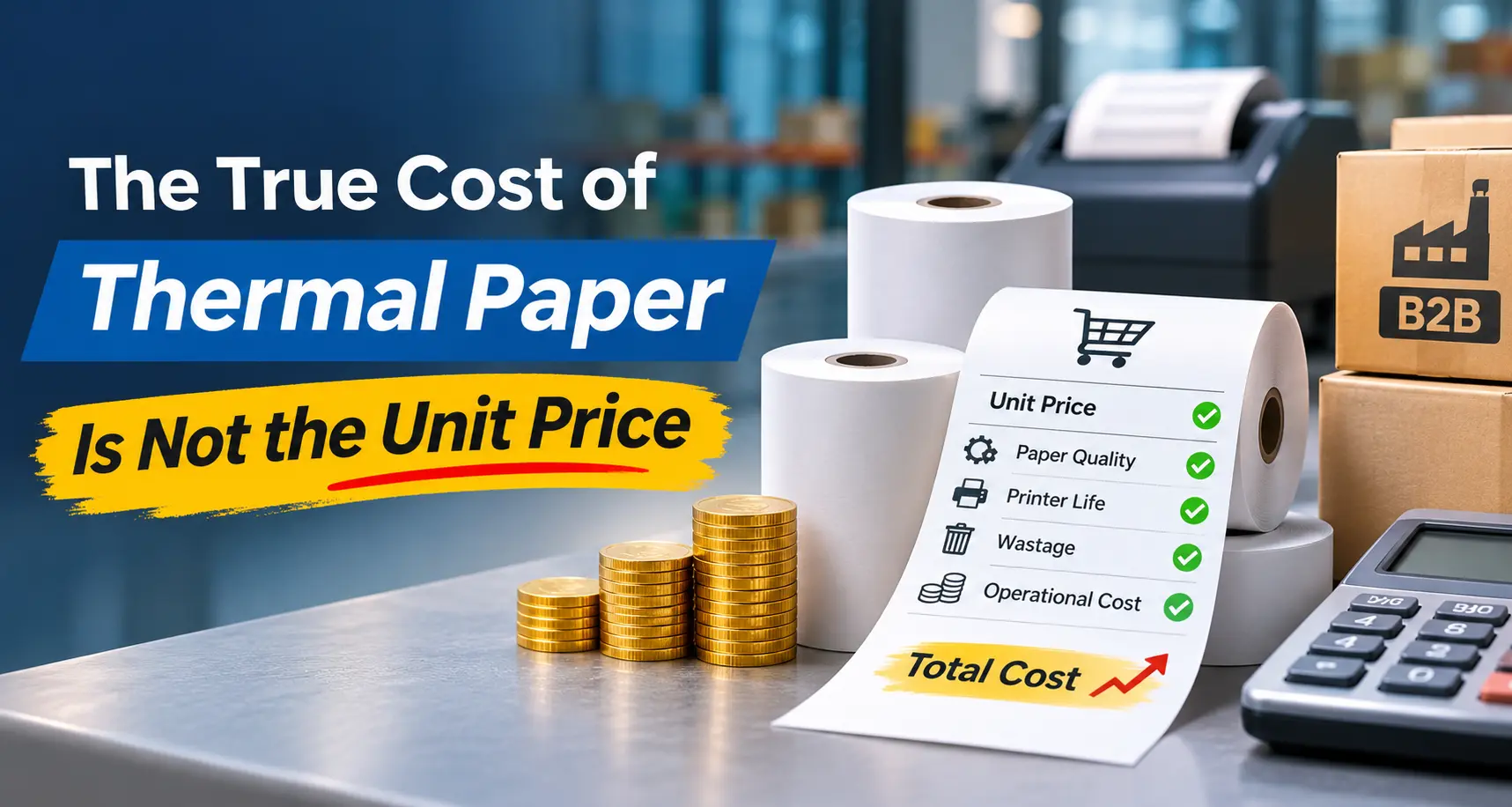
A convenience store owner saved $36 on paper in one year, but he later paid $640 to fix his printer. So, did he really save anything?
Here is the short answer. The cost of thermal paper does not end at the price on your quote. It also includes repairs, reprints, lost time, and wasted stock.
Generally most buyers focus only on one obvious number which is the price per roll. That number is easy to compare, so people trust it too much. This blog shows you the other numbers. Together, they make the true cost of thermal paper.
You will see how paper quality, roll size, coating, and storage change your bill. You will discover how a direct manufacturer can effectively help you keep expenses low. We make thermal paper rolls in our own factories, so we write from what we see on the production floor.
A cheaper roll saved one store owner about $36 in a year. It then led to a repair bill of about $640. The bill covered cleaning, a new print head, an emergency reorder, and lost management time. The lesson is simple: the cost of thermal paper hides outside the roll price.
The owner switched to a lower-priced supplier. He saved a few cents on each roll. Over one year, those cents added up to about $36.
Then the trouble began. Within six months, his POS printer started printing faint, blurry receipts. His scanners could not read the barcodes. A technician opened the printer and found a thick layer of paper dust and coating residue on the print head.
Cleaning the head, buying a new one, reordering paper in a hurry, and losing management time during downtime pushed the bill to about $640. That is nearly 18 times the savings.
Here is the catch. Nobody on his team linked the repair to the paper. The rolls looked fine on the shelf. The damage grew slowly, one receipt at a time. That is the true cost of thermal paper in one small shop.
The cost of thermal paper has six parts: the roll price, print head wear, reprints, downtime, wasted stock, and paperwork. Most buyers count only the first part. The other five grow quietly. Together, they can wipe out any saving on the quote.
Think of a truck tyre. A cheap tyre looks great on the invoice. But if it wears out early, you pay for towing, fuel, and a late delivery. Paper works the same way.
The true cost of thermal paper shows up after months, not on day one. So, ask every supplier what their paper will cost you after six months.
Low-quality paper sheds dust and leaves coating residue on the print head. The residue weakens print density, fades characters, and lowers barcode read rates. In bad cases, the head overheats in spots and breaks. A new head and a service call add far more to the cost of thermal paper than the paper saving does.
Why does this happen? A thermal printer has no ink. Instead, the print head heats the paper, and the coating changes colour. The head repeats this thousands of times a day.
Good paper has an even coating that sticks well to the base paper. It develops colour steadily under heat and sheds very little dust. Cheap paper cuts costs with a rough coating mix and uneven application. As the head heats it, fine paper dust and uncured coating slowly build up on the head surface.
Later, the head can overheat in small spots and fail. At that point, the roll price no longer matters. The true cost of thermal paper rolls often shows up at the print head, not at the checkout.
If your receipts already look faint, read our blog on 7 thermal printer troubleshooting fixes. It shows you what to check before you call a technician.
Coating is the thin layer that turns heat into print. An even coating gives clear, steady images and little dust. An uneven coating gives patchy print and more residue. Because coating affects print quality and printer wear, it shapes the cost of thermal paper more than the price tag does.
Here is a question you can ask any supplier today: "Who coats this paper?"
Some sellers buy rolls from other factories and resell them. Those sellers cannot tell you much about the coating, because they do not control it. A manufacturer that coats its own paper can answer in detail. It can also keep each batch close to the last one, since one team handles coating, laminating, printing, and converting.
FormersPaper works this way. We coat, laminate, print, and convert in-house, so we check quality at each step. Our R&D team holds over 100 patents, and we also partner with universities on low-carbon paper.
You do not need to take our word for it. Ask for samples, run them on your own printer, and check the print yourself. The true cost of thermal paper rolls also depends on who coats them, so this check pays off.
Steady coating also means fewer reprints, and fewer reprints mean fewer rolls. So, the cost of thermal paper falls even when the price per roll stays the same.
The wrong roll size or GSM raises the cost of thermal paper in two ways. A roll that does not fit causes jams and feed errors. A roll that is too thick or too long wastes paper. So, match the roll to your printer first, and compare prices after that.
Size sounds boring. Yet it decides how often staff change rolls and how often the printer jams. Here are common formats we see:
GSM, or grams per square metre, tells you how heavy the paper is. Most thermal rolls use 48 to 65 GSM. A 55 GSM roll is a common pick for POS printers. Portable printers often use 35 to 40 GSM.
Thickness also changes how much paper fits on a roll. For example, an 80 mm roll with a 12 mm core and 55 GSM paper, about 0.065 mm thick, holds roughly 75 m. Thicker paper gives you fewer metres on the same roll.
So, compare the price per metre, not the price per roll. A roll that looks cheaper may hold less paper. Our thermal paper roll size chart helps you match rolls to printers.
This is why the true cost of thermal paper rolls always starts with the right fit.
BPA-free and phenol-free paper helps you lower compliance risk and keeps the cost of thermal paper steady. Rules on bisphenols keep changing across markets, and buyers now ask for proof. A supplier who gives you test reports saves you time, delays, and awkward questions from your own customers.
In the United States, some states have their own rules on BPA in receipt paper. California's Proposition 65 can also require warnings. Canada, Mexico, China, and Caribbean markets have their own rules too. Because these rules keep changing, you should check the current rules for your market.
So, ask your supplier for documents, not promises. The true cost of thermal paper rolls includes this paperwork. It stays small when the papers are ready, and it grows large when they are not.
Here is what we can show for Enviroprint, our phenol-free thermal paper. Enviroprint uses a carbon-based imaging layer. We designed its coating with no BPA, no BPS, and no phenol. SGS also ran lab tests on it:
These are lab results. They are not an FDA approval. Also, we do not recommend direct thermal paper of any brand for direct food contact.
Our posts on BPA-free thermal paper suppliers and Enviroprint thermal paper explain more.
Heat, light, and long storage fade thermal paper. Faded receipts cause return disputes and record problems. Store your rolls in a cool, dry, dark place, and use older stock first. Poor storage raises the cost of thermal paper without any warning.
Fading is slow, so many buyers miss it. A receipt may look sharp today and weak after a year. Standard grade paper often fades in three years or less. If you must keep receipts for returns, warranties, or audits, that matters. That slow loss adds to the true cost of thermal paper.
We advise you to keep rolls between 5°C and 30°C, away from direct sunlight. When you store Enviroprint this way, it keeps full performance for up to 12 months from the date of manufacture.
If your store sits in the Caribbean or in southern Mexico, keep rolls away from warm walls. Also, do not buy more stock than you can use in a few months. Dead stock is part of the cost of thermal paper too.
Read our blog on how long thermal receipts last for more detail.
To check your own cost of thermal paper, add up paper, reprints, downtime, print head repairs, and wasted stock for one year. Then divide the total by the number of receipts you print. The result is your cost per receipt. Compare that number, not the roll price, when you choose a supplier.
You can do this in one afternoon. Follow these steps:
Now you have a number that shows your true cost of thermal paper. From here, compare suppliers on the cost of thermal paper per receipt, not per roll.
Next, test before you commit. Ask for samples from two suppliers. Run them on the same printers for 30 days. Then compare print quality, jams, and print head cleanings. We recommend samples before any bulk order, and we are happy to send them.
To get a quote, send your printer model, roll size, GSM, quantity, and destination. Our quote then confirms the specs, minimum order, lead time, and price. Not sure if thermal is right for your counter? Read our blog on thermal vs bond paper rolls.
A manufacturer controls coating, roll size, and quality checks in one place. A trader buys from other factories and may change sources between orders. For repeat buyers, steady quality often matters more than a small price gap. So, ask who makes your paper before you compare the cost of thermal paper across quotes.
If you run many printers, a change in quality hurts you more. One weak batch can mean jams across ten stores. For multi-store buyers, the true cost of thermal paper rolls depends heavily on batch quality.
FormersPaper is a manufacturer with over 30 years in the paper industry. We run five factories across China, the UK, and Indonesia. Our workshops and warehouses cover about 280,000 square metres, and we operate over 600 machines.
Our Indonesia plant makes BPA-free and phenol-free thermal paper in 48, 55, and 65 GSM. It can also give an official Certificate of Origin. US and Canadian buyers may ask their customs broker whether this helps with duty costs.
Our website lists ISO 9001:2015 for quality management and ISO 14001:2015 for environmental management. It also lists FSC for paper from certified forests. Our advice stays simple: ask any supplier which certificate covers your thermal rolls.
We support buyers in the USA, Canada, Mexico, and the Caribbean through our North America team, and buyers in China through our Shenzhen office. Restaurants also buy guest checks from us, so see our pages for the USA, Canada, Mexico, and the Caribbean.
The cost of thermal paper is never just the unit price. It also includes the print head, the reprints, the downtime, and the stock you throw away. When you count all of it, the cheapest roll is often the most expensive one.
So, check your own numbers this month. Then ask your suppliers hard questions about coating, size, and paperwork. The true cost of thermal paper becomes clear once you do.
If you want a partner who gives test reports and samples, talk to FormersPaper. We help buyers see the true cost of thermal paper rolls before they order. Visit our Paper Rolls page, send us your printer details, and we will blog you from there.
The true cost of thermal paper rolls is the roll price plus everything the roll causes. That includes print head wear, reprints, downtime, wasted stock, and paperwork. Add these for one year and divide by your receipts. The result shows your cost per receipt, which is a fairer number than the roll price.
Cheap paper often has a rough, uneven coating. When the head heats it, fine dust and uncured coating build up on the head. The residue causes faint print and poor barcodes. In bad cases, the head overheats in spots and fails. That damage lifts the true cost of thermal paper far above the roll price.
No. BPA-free paper does not become a food-contact paper. We do not recommend direct thermal paper of any brand for direct food contact. Lab reports, like our SGS reports, show test findings. They do not equal an FDA approval.
Start with fit, coating, storage, and proof. Match the roll to your printer, choose even coating, store rolls well, and ask for test reports. These steps cut the cost of thermal paper without lowering your print quality.
FormersPaper manufactures rolls in-house with even coating and exact GSM specifications. This prevents print head wear, reduces paper dust, eliminates jamming, and protects your total operational budget over time.
Storing paper away from heat and light prevents premature fading. Good storage habits protect important transaction records, avoid customer disputes over faint receipts, and stop rolls from turning into useless dead stock.


Formers Paper is a leading manufacturer for a comprehensive range of sustainable paper & packaging products serving customers globally.
Shenzhen Formers Paper Co. Ltd, No.92 Zhugushi Road, Wulian community, Longgang District, Shenzhen, China