We wish you Happy Holidays & a joyful New Year!

Choose the right thermal paper rolls: compare sizes, GSM, grades and BPA-free options. Factory-direct B2B supply from FormersPaper.
October 3, 2026
John Doe
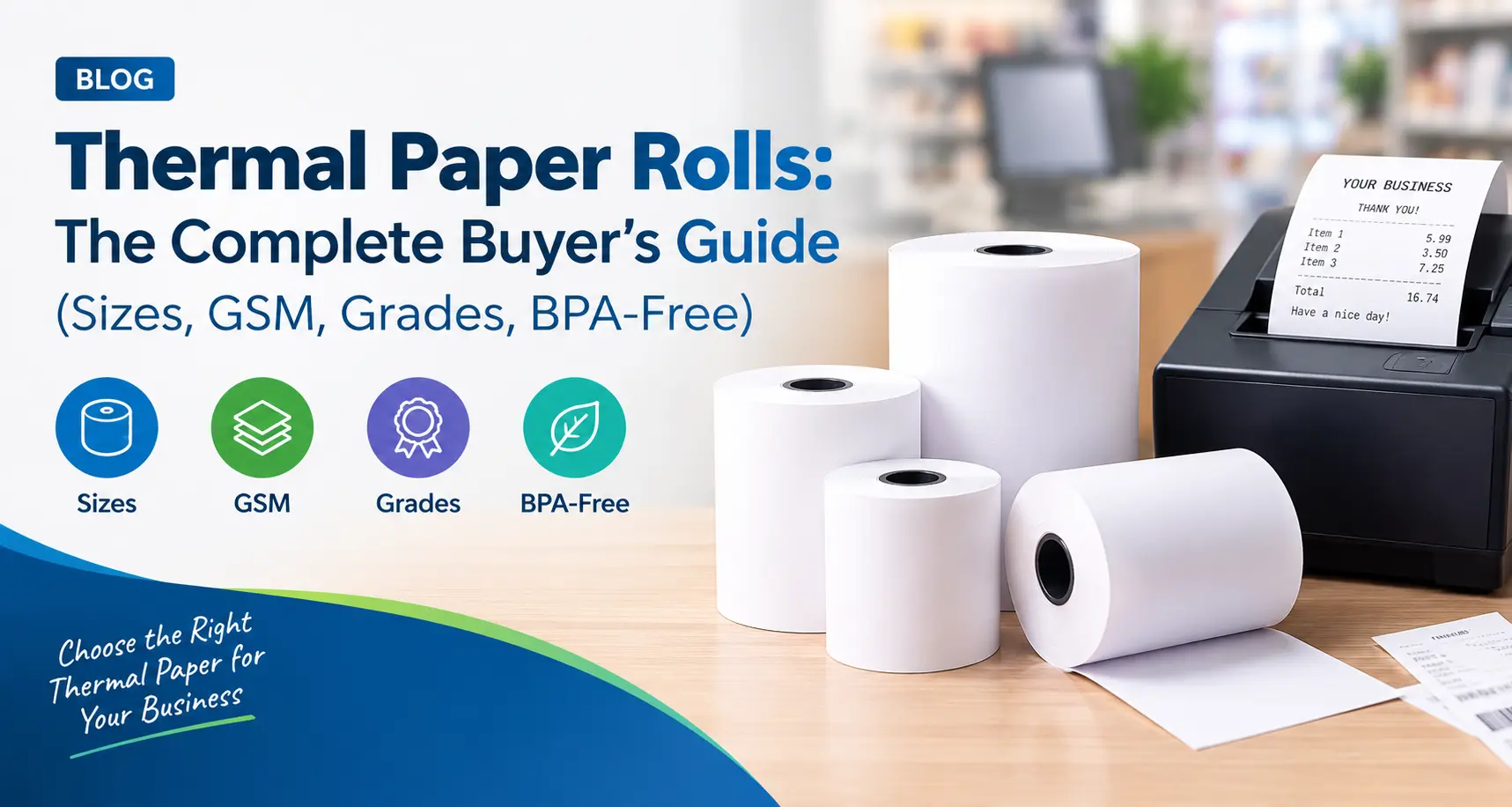
Picture a busy checkout line. The cashier taps "print," and nothing comes out. The thermal paper roll is the wrong size, or the paper is too thick, or the coating is weak. One small mistake slows the line and costs you money.
Thermal paper rolls look simple, but each one has a size, a weight, a coating, and a chemistry. Pick well, and your printers run all day. Pick badly, and you get faint receipts, jams, and unhappy customers.
This blog teaches you how to buy the right rolls. You will learn about sizes, GSM, grades, and BPA-free thermal paper. You will also see how FormersPaper makes thermal paper rolls for B2B buyers in China, the USA, Canada, Mexico, and the Caribbean.
Thermal paper rolls carry a heat-sensitive coating. A thermal printer warms tiny dots on the roll, and the coating turns dark where the heat lands. You need no ink, toner, or ribbon. That makes printing fast, quiet, and cheap to run.
Inside the printer, the print head holds hundreds of tiny heating dots. Each dot heats for a split second. The coating reacts and leaves a dark mark. Together, the marks form text, barcodes, and logos. Printer makers call this direct thermal printing.
The paper does most of the work. Makers coat thermal paper on one side, and that side must face the print head. A thermal paper roll with a weak coating prints light. A thermal paper roll with a rough surface wears out your print head. So smart buyers ask about coating quality, not just price.
FormersPaper coats, laminates, prints, and converts in its own factories. That control helps FormersPaper keep quality steady from one order to the next. It also lets the team answer detailed questions about what goes into each of its thermal paper rolls.
A thermal paper roll size has three numbers: width, outside diameter, and core size. Width and diameter must fit your printer's paper bay. The core must fit the spindle. Most shops use 80 mm or 57 mm widths. Check your printer manual first, then place your order.
Sizes come in millimeters and inches. Buyers in the USA and Canada often quote a thermal paper roll size in inches. Buyers in China and Mexico often quote it in millimeters. Common formats appear below.
POS Receipts (Retail & Restaurants)
Card Terminals
ATMs
Kiosks & Ticket Machines
The most common POS thermal paper roll measures 80 mm wide and 80 mm across. Card terminals and mobile printers use the 57 mm width. Some sellers list rolls by length in feet, such as 2 1/4" x 50 ft or 3 1/8" x 230 ft.
Core size trips up many buyers. Most small thermal paper rolls use a 12 mm core. Big ATM and kiosk rolls use 25 mm or larger. Some printers accept coreless rolls. Coreless rolls cut waste and cost, but your printer must support them. Check the core before you lock in any thermal paper roll size.
These are common formats, and your printer may differ. FormersPaper also cuts custom sizes, so send your specs if you do not see your match.
Roll length depends on diameter, core size, and paper thickness. A bigger roll or thinner paper gives you more meters. You can estimate length with one short formula. That lets you compare quotes fairly, because two thermal paper rolls with the same width can hold very different amounts of paper.
The formula is: length = 3.14 x (D x D - d x d) / (4 x t). D is the outside diameter. The letter d is the core diameter. The letter t is the paper thickness. Use millimeters for all three. You get D and d from the thermal paper roll size on your spec sheet.
Try it on a POS thermal paper roll. Take an 80 mm roll with a 12 mm core. A 55 GSM sheet measures about 0.065 mm thick. The math gives you roughly 75 meters.
Real rolls vary a little. Tight winding packs in more paper. Loose winding packs in less. So ask for the length in meters on every quote, and do not judge a roll by its diameter alone. Every thermal paper roll holds a fixed length, so make the seller state it.
GSM means grams per square meter. It measures paper weight. Lower GSM gives you a thinner sheet and a longer roll. Higher GSM feels stiffer. Most thermal paper rolls use 48 to 65 GSM. Pick the weight that fits your printer and your job.
GSM does not measure thickness. Some sellers mix the two up. Microns measure thickness, and GSM measures weight. A 55 GSM sheet of thermal paper runs roughly 60 to 65 microns thick. Always ask which unit a quote uses.
GSM
35-40
Best for
Portable printers
What to know
Thinnest sheet. Longest roll for its size.
GSM
48
Best for
High-volume receipts
What to know
Low cost per meter. Fine for short-term records.
GSM
55
Best for
Everyday retail printing
What to know
The balanced pick for most shops
GSM
65
Best for
Tickets and busy counters
What to know
Stiffer sheet. Handles rough use better.
Most shops pick 55 GSM for a POS thermal paper roll. A 65 GSM thermal paper roll feels stiffer and takes rough use better. FormersPaper's Indonesia plant makes BPA-free thermal paper and phenol-free thermal receipt paper in 48, 55, and 65 GSM. Its ultra-thin 35 and 40 GSM range suits portable printers.
Grades describe how the coating on your thermal paper rolls performs. Standard grades suit short-term receipts. Better coatings print darker and fade slower. Phenol-free grades drop chemical developers. Pick a grade by how long you need the print to last, and by how fast your printer runs.
This is the basic choice for short-term receipts. Ordinary thermal paper often fades in three years or less, so do not use this grade for records you must keep.
This coating reacts fast, so it prints dark at high speed. Fast kitchen, ATM, and ticket printers benefit most. Read FormersPaper's high-sensitivity guide to learn more.
Enviroprint is FormersPaper's blue, phenol-free thermal receipt paper. It uses a carbon-based layer instead of a chemical developer. It has no BPA, no BPS, and no phenol, so it goes further than basic BPA-free thermal paper. Each Enviroprint thermal paper roll runs on standard direct thermal and POS printers, so you change no hardware.
FormersPaper's R&D team also offers a physical thermal technology. It makes dark images without chemical developers or dyes. It resists fading from light and heat, so it suits thermal paper rolls that must store important records for years.
BPA-free thermal paper has no bisphenol A in its coating. BPS-free goes a step further and drops a close chemical cousin. Phenol-free thermal receipt paper goes furthest and removes phenol-based developers. Your staff touch receipts all day, so ask each supplier for proof, not just a label on the box.
Some suppliers swap BPA for BPS and stop there. BPS sits in the same chemical family, so some BPA-free thermal paper rolls still carry that concern. That is why many buyers now write "phenol-free" into their purchase specs. Rules on bisphenols keep changing across regions, so check the rules where you sell.
Ask for lab reports with real numbers. FormersPaper tested its Enviroprint thermal paper roll stock with SGS. The phenol test (EN 71-10/71-11:2005, report CANEC24026912402) returned a Not Detected result. A second SGS report (CANEC24027011702) ran the FDA 21 CFR 176.170 chloroform extractives test. It also returned Not Detected in all three test liquids. Those are lab results, not an FDA approval.
Keep one limit in mind. FormersPaper does not recommend direct thermal paper of any brand for direct food contact. It says that up front, and you should hear it from every supplier.
FormersPaper's Indonesia plant also makes BPA-free thermal paper rolls and phenol-free thermal receipt paper. Orders from that plant include an official Indonesia Certificate of Origin. The Indonesia route gives buyers in the USA and Canada a low-tariff option, so ask your customs broker how it applies to your order. Buyers in China, Mexico, and the Caribbean can ask for the same BPA-free thermal paper. Read more in FormersPaper's BPA-free guide.
Every industry needs a slightly different roll. Retail and restaurants mostly use a POS thermal paper roll at 80 mm. Card terminals use 57 mm. Banks need long ATM rolls. Clinics need rolls for medical monitors. Match the roll to the job, then test it on your own printer.
FormersPaper ships thermal paper rolls to buyers across China, the USA, Canada, Mexico, and the Caribbean. Preferred sizes differ by country, so tell the team where the rolls will land.
Thermal paper rolls print with heat. Bond rolls print with ink or ribbon. Thermal wins on speed, noise, and running cost. Bond wins when you need records that last for many years. Most POS, ATM, and ticket printers only take thermal rolls, so check your machine first.
Read the full Thermal vs Bond comparison for more detail. Most problems with thermal paper rolls come down to a few causes. Use this table to spot them fast.
Faint Print
Paper Jams
Fast Fading
Roll Will Not Fit
FormersPaper is a B2B manufacturer of thermal paper rolls, not a trader. It coats, laminates, prints, and converts in-house across five factories in China, the UK, and Indonesia. Buyers get factory-direct supply, custom sizes, and paperwork they can check. That keeps orders on spec.
Here is what stands behind that promise:
A trader buys finished thermal paper rolls and relabels them. It cannot tell you what sits in the coating. A manufacturer can. Ask any supplier one simple question: can I see your production floor?
Send your printer model, thermal paper roll size, GSM, quantity, and destination. FormersPaper then confirms specs, minimum order, lead time, and price in a quote. Ask for samples first. Test them on your own printers before you place a large order.
Have this checklist ready:
Store BPA-free thermal paper rolls and all other stock in a cool, dry place away from sunlight, heat, oil, and chemicals. For Enviroprint, FormersPaper advises 5°C to 30°C, with up to 12 months of full performance from the manufacture date.
The right roll saves you time, money, and headaches. Match each POS thermal paper roll to your printer's width, diameter, and core. Pick a GSM and grade that fit your job. Ask for proof on every BPA-free thermal paper claim. Then test samples before you buy in bulk.
FormersPaper makes thermal paper rolls, checks the quality, and backs its claims with paperwork. Send your specs and volumes through the contact page, or explore partnership options. The team will reply with samples and a quote.
Check your printer manual for width, outside diameter, and core size. Most POS printers take 80 mm or 57 mm widths. Match all three numbers, not just the width.
Most shops use 55 GSM. Choose 48 GSM for low cost and 65 GSM for stiffer paper. Use 35 or 40 GSM for portable printers.
BPA-free thermal paper has no bisphenol A. Phenol-free thermal receipt paper avoids all phenol-based developers, including BPS. Phenol-free is the stricter choice.
Storage matters most. Keep rolls cool, dry, and out of sunlight. Printed receipts fade faster in heat, light, and oil. For Enviroprint, FormersPaper advises 5°C to 30°C and up to 12 months of full performance.
Yes. FormersPaper serves buyers in China, the USA, Canada, Mexico, and the Caribbean. Its Indonesia plant also gives buyers in the USA and Canada a low-tariff route with a Certificate of Origin.


Formers Paper is a leading manufacturer for a comprehensive range of sustainable paper & packaging products serving customers globally.
Shenzhen Formers Paper Co. Ltd, No.92 Zhugushi Road, Wulian community, Longgang District, Shenzhen, China