We wish you Happy Holidays & a joyful New Year!

Non-phenol thermal paper rolls for POS receipts, tickets & labels. Clear prints, BPA & BPS-free options, custom sizes. Request a quote from FormersPaper.
October 13, 2026
John Doe
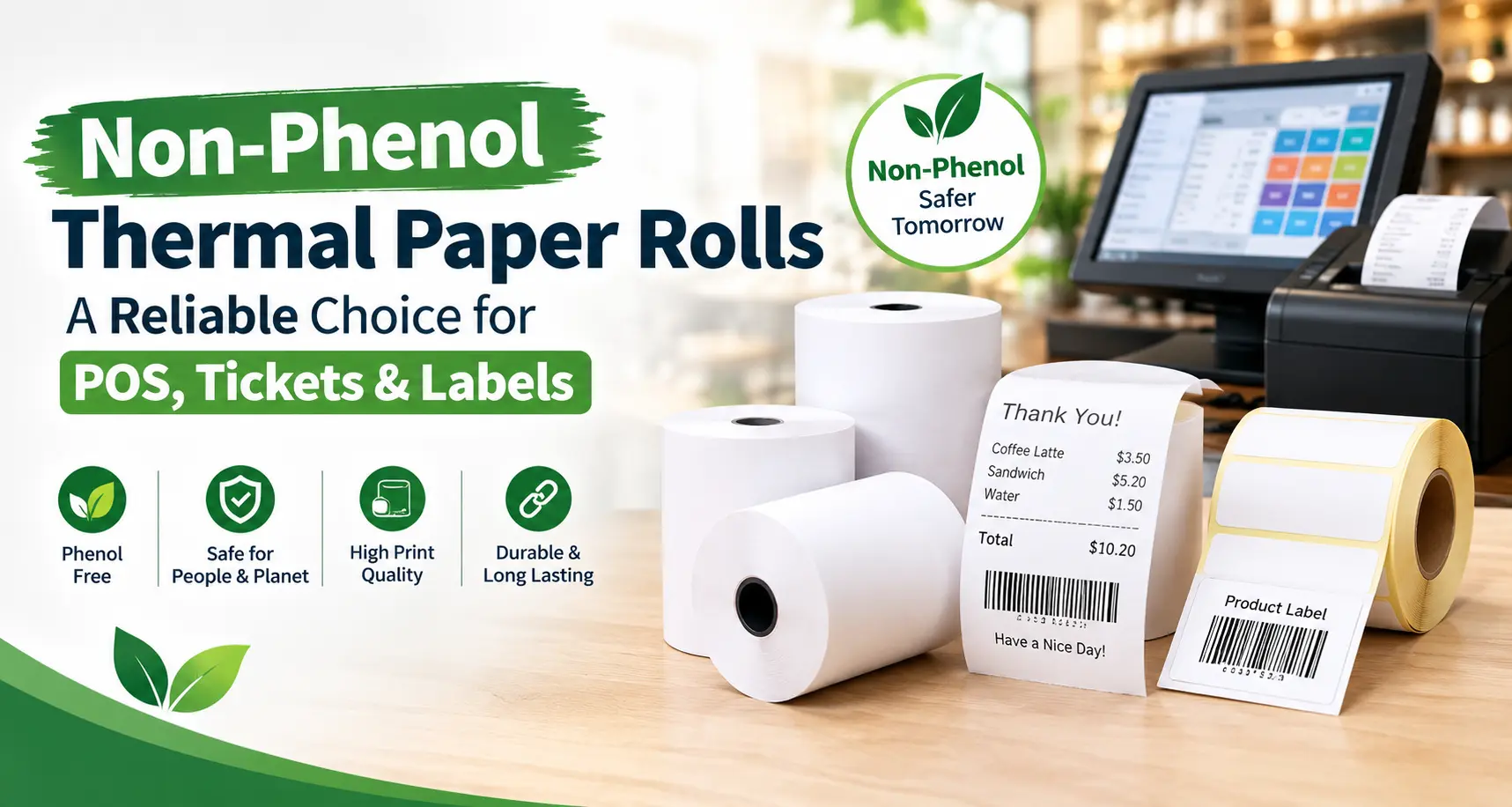
Choosing the right thermal paper is important for businesses that need clear printing, reliable performance, and consistent quality. Non-phenol thermal paper rolls are becoming a preferred choice for businesses looking for thermal printing solutions without phenol-based developers such as BPA and BPS, depending on the paper formulation. These papers are designed to support everyday printing needs while meeting specific customer and application requirements.
From retail stores and supermarkets to ticketing services, logistics companies, and label manufacturers, non-phenol thermal paper offers a practical solution for different business applications. It is widely used in POS receipts, tickets, barcode labels, shipping labels, and other thermal printing applications where clear print results and dependable performance matter.
For businesses, choosing high-quality non-phenol thermal paper rolls can help maintain smooth printing operations and deliver a better experience for customers. However, selecting the right paper also requires attention to print sensitivity, image quality, paper thickness, durability, and printer compatibility.
Whether you are a distributor, wholesaler, converter, or business owner, understanding the benefits of non-phenol thermal paper can help you make an informed purchasing decision. In this guide, we will explore its key features, common applications, and important factors to consider when choosing a reliable supplier for your thermal paper requirements.
Non-phenol thermal paper rolls are heat-sensitive rolls that skip phenol-based chemicals, including BPA and BPS. A thermal printer warms the coating, and the coating turns dark. You get clear text and barcodes with no ink, no toner, and no ribbon. The coating simply has no phenolic developer inside.
Here is how that works. The print head holds hundreds of tiny heating dots. Each dot heats for a split second, and the coating leaves a dark mark. Together, the marks form text, logos, and barcodes.
Standard thermal paper makes that mark with two parts: a dye and a developer. The developer is often a bisphenol, like BPA or BPS. Both belong to the phenol family. Phenol free thermal paper rolls skip that developer. So where did the phenol go? It left the formula.
You will see many names for the same idea. Buyers search for phenol free thermal paper, non-phenol paper, phenol free paper rolls, and non-phenol thermal receipt paper rolls. They also look for phenol free receipts and phenol-free receipt paper. All of these point to one goal: a coating with no phenol-based developer.
Choosing the right thermal paper is important for businesses that need reliable printing and safer paper alternatives. When comparing phenol-free vs. BPA-free thermal paper, it is important to understand that these terms do not mean the same thing.
BPA-free thermal paper is made without Bisphenol A (BPA), a chemical previously used in many thermal paper coatings. However, BPA-free paper may contain other developers, including Bisphenol S (BPS), depending on the formulation. This means that BPA-free does not always mean the paper is free from all phenols.
Phenol-free thermal paper, on the other hand, is designed without phenolic developers, including BPA and BPS. Instead, it uses alternative chemical developers to produce clear text and images when exposed to heat. This makes it a suitable option for businesses looking for thermal paper without phenol-based developers.
Both types are used for printing POS receipts, tickets, labels, and other business documents. However, the right choice depends on your application, printing requirements, and product specifications.
For businesses looking for a more suitable thermal paper solution, understanding these differences can help make purchasing decisions easier. Before choosing a supplier, check the paper's technical data sheet and relevant compliance documents to confirm its composition and performance.
Cashiers, restaurant staff, ticket agents, and retail workers often handle thermal paper throughout the day. Certain chemicals used in thermal coatings may transfer to the skin during handling. Choosing suitable thermal paper can help businesses address chemical exposure concerns and meet their purchasing requirements.
Regulations and restrictions on thermal paper chemicals vary by country and may change over time. Businesses purchasing paper for markets such as the USA, Canada, Mexico, China, and the Caribbean should check the applicable local requirements before finalizing their product specifications. When sourcing thermal paper, ask your supplier whether the product is BPA-free or fully phenol-free. Request relevant technical documents and certifications to verify its composition.
Non-phenol thermal paper rolls are a practical choice for businesses that need reliable printing for receipts, tickets, and labels. These papers are made without phenolic developers, such as BPA and BPS, depending on the product specifications. They offer an alternative for businesses looking to meet specific material requirements while maintaining dependable printing performance. Here are the key benefits of non-phenol thermal paper rolls.
One of the main benefits of non-phenol thermal paper is that it uses alternative developers instead of phenolic developers. This makes it a suitable option for businesses looking to avoid BPA, BPS, and other phenol-based substances in their thermal paper. However, buyers should check the product specifications and relevant documentation to confirm the paper's chemical composition.
High-quality non-phenol thermal paper produces clear text, sharp images, and readable barcodes when matched with a compatible printer. Its printing performance depends on factors such as thermal sensitivity, coating quality, and paper formulation. Choosing the right paper helps businesses maintain consistent print quality during everyday operations.
Non-phenol thermal paper rolls are used in various industries, including retail, hospitality, transportation, and logistics. They are suitable for POS receipts, ticket printing, barcode labels, shipping labels, and other applications that use compatible thermal printers.
Every business has different printing needs. Some require standard receipt rolls, while others need specific paper widths, thicknesses, roll lengths, or coating properties. Non-phenol thermal paper is available in different specifications to suit various applications. Working with a reliable supplier helps businesses select the right product for their printers, production needs, and quality standards.
Choosing the right non-phenol thermal paper rolls is important for achieving clear printing, smooth printer performance, and consistent quality. Whether you need thermal paper for POS receipts, tickets, or labels, consider your application, paper specifications, and printer requirements before making a purchase. Here are some important factors to help you select the right thermal paper for your business.
Paper GSM (grams per square metre) indicates the weight of the paper, while thickness affects its feel, strength, and suitability for different applications. The right GSM depends on your printing needs and equipment. For example, receipt printing and ticket applications may require different paper specifications. Always check the recommended GSM and thickness before ordering non-phenol thermal paper rolls.
Print quality is an important factor when choosing thermal paper. High-quality paper should produce clear text, readable barcodes, and sharp images. Thermal sensitivity also matters because it affects how well the paper responds to heat from the printer. Selecting paper with suitable sensitivity can help maintain consistent printing results and reduce printing issues.
Not all thermal paper rolls are suitable for every printer. Before purchasing, check the required roll width, roll diameter, core size, and printing technology. Using compatible thermal paper helps ensure smooth feeding, reliable printing, and fewer interruptions during daily operations.
Before buying non-phenol thermal paper, review the technical data sheet, chemical composition, and available compliance documents. Confirm whether the product is free from BPA, BPS, and other phenolic developers according to your requirements. If specific certifications or regulatory compliance are important to your business, ask the supplier for supporting documentation.
Choosing a reliable supplier that offers consistent quality, clear product specifications, and suitable technical support can help you find the right non-phenol thermal paper rolls for your business needs.
Choosing a reliable non-phenol thermal paper supplier is important for businesses that need consistent quality, dependable printing performance, and timely deliveries. Whether you are a wholesaler, distributor, printer, or label manufacturer, the right supplier can help you meet your business requirements and maintain smooth operations.
A trusted supplier offers high-quality non-phenol thermal paper rolls with consistent coating, clear print results, and specifications suited to different applications. These rolls can be used for POS receipts, tickets, barcode labels, shipping labels, and other thermal printing needs.
Another important factor is product transparency. A reliable supplier should provide technical data sheets and relevant documentation to help you verify the paper's composition, including whether it is free from BPA, BPS, and other phenolic developers. This information makes it easier to select products that meet your specific requirements.
Businesses should also consider customization options, production capacity, pricing, and delivery schedules when choosing a thermal paper supplier. For bulk orders, consistent product quality and a dependable supply chain are especially important for avoiding delays and maintaining customer satisfaction.
Before placing an order, compare product specifications, request samples when possible, and discuss your printing requirements with the supplier. Choosing the right non-phenol thermal paper manufacturer or supplier can help your business maintain reliable printing operations and build long-term business relationships.
If you are looking for non-phenol thermal paper rolls for POS, tickets, or labels, work with a supplier that understands your application requirements and provides consistent product quality with appropriate technical support.
FormersPaper makes Enviroprint, a blue line of phenol free thermal paper rolls with a carbon-based layer instead of a dye and developer pair. Heat activates the carbon layer directly. The image forms through a physical process, not a chemical reaction. No phenolic compound sits in the coating, so none can react.
Two lab curves show how it behaves. First, image density rises sharply once the paper passes about 70°C. It climbs fast between 90°C and 110°C. Then it levels off near 130°C to 150°C. In plain words, the print turns on fast and stays steady.
The second curve tracks energy. Image density rises in a steady line as energy goes from about 3.2 to 15.2 mj/mm². That smooth climb helps each receipt print evenly, with no dark patches next to faint ones.
Enviroprint has no BPA, no BPS, and no added pigments or dyes. The blue tone comes from the material itself. It runs on standard direct thermal and POS printers, including Epson- and NCR-style hardware, kiosks, and mobile units. You do not change printers, drivers, or staff training. That is why buyers can move to phenol free thermal receipt paper rolls without a long project.
Print life gets a boost too. Standard thermal paper often fades in three years or less. FormersPaper engineers Enviroprint for far longer image stability.
Non-phenol thermal paper rolls are a suitable option for businesses that need reliable thermal printing materials for everyday operations. From retail receipts to tickets and product labels, these papers support different printing applications. They are especially relevant for businesses looking for thermal paper made without phenolic developers, subject to the product's specifications and documentation.
Thermal paper distributors and wholesalers can add non-phenol thermal paper rolls to their product range to meet the needs of customers looking for alternatives to conventional thermal paper. Buying in bulk can help businesses manage inventory and supply products to retailers, offices, and other commercial customers. When choosing a supplier, distributors should consider product consistency, competitive pricing, bulk order availability, and timely delivery.
POS paper and label manufacturers need thermal paper that delivers consistent printing quality and works well with their production equipment. Non-phenol thermal paper can be used for manufacturing receipt rolls, barcode labels, shipping labels, and other compatible products. Manufacturers should check paper GSM, thickness, coating quality, thermal sensitivity, and printer or converting machine compatibility before placing an order.
Ticket printing companies require thermal paper that produces clear, readable text and helps ensure important details remain visible. Non-phenol thermal paper rolls can be used for transport tickets, parking tickets, event tickets, and queue management systems, depending on the application. Businesses should select the appropriate paper specifications based on printer requirements, expected handling, and image durability.
Whether you are a distributor, manufacturer, or ticket printing company, choosing a reliable non-phenol thermal paper supplier can help you maintain consistent quality and meet your customers' printing requirements.
Non-phenol thermal paper rolls fit any direct thermal printer that prints receipts, tickets, or labels. Retail counters, kitchens, banks, airports, and warehouses all run that kind of printer. The printer does not change. Only the coating does. Check your printer type and roll size first, then match the roll to the job.
Retail and restaurant counters print all day. The most common POS roll is 80 mm wide and 80 mm across. Card terminals often use 57 mm rolls. Kitchen printers run fast and hot, so ask for phenol free paper rolls in a high-sensitivity grade. Phenol free thermal receipt paper rolls suit these counters because staff touch the paper all day. See FormersPaper's Retail and Hospitality pages for more.
Banks and kiosk owners use long rolls so staff refill less often. ATM rolls often measure about 150 mm across with a 25 mm core. Banks keep records, so print life matters. Non-phenol thermal receipt paper rolls with strong image retention help here. Read the ATM and fax roll guide or visit the Finance page.
Parking, transit, gaming, and event printers need stiffer paper. A 65 GSM sheet handles rough use better. Ticket stock also has to stay readable after a rough day. FormersPaper makes tickets for these markets, so ask the team whether phenol free paper rolls suit your ticket printer and volume.
Direct thermal labels print with the same heat method as phenol free thermal paper rolls, so the same phenol question applies. FormersPaper also makes labels and stickers. Send your label specs, and the team will confirm what it can supply with a phenol-free coating.
A roll has four numbers that matter: width, outside diameter, core size, and GSM. Most POS printers use 80 mm or 57 mm widths. Most small rolls use a 12 mm core. Most shops pick 55 GSM. Always check your printer manual before you order.
Here are the common formats. A POS roll is 80 mm wide and 80 mm across, with a 12 mm core and about 60 to 80 meters of paper. A card terminal roll is 57 mm wide and about 40 mm across, with a 12 mm core and about 18 meters. An ATM roll runs 80 to 85 mm wide and about 150 mm across, with a 25 mm core and 200 to 250 meters.
These are common formats, and your printer may differ. Non-phenol paper follows the same size rules as standard paper, and FormersPaper also cuts custom sizes. The size chart guide has more detail. Now to GSM. It means grams per square meter, and it measures weight, not thickness. A lower GSM gives a thinner sheet and a longer roll. FormersPaper's Indonesia plant makes phenol free paper rolls in 48, 55, and 65 GSM. Its ultra-thin 35 and 40 GSM range suits portable printers. Pick 48 for high-volume receipts, 55 for everyday retail, and 65 for tickets and busy counters. Always ask for the roll length in meters. Two rolls with the same width can hold very different amounts of paper. FormersPaper confirms the minimum order and lead time in each quote, so send your specs first.
With 30+ years of experience in the paper manufacturing business, FormersPaper understands the importance of product quality, reliable performance, and customer satisfaction. For businesses looking to buy non-phenol thermal paper rolls for POS receipts, tickets, and labels, choosing an experienced manufacturer can help ensure a dependable supply and consistent product quality.
With a fully vertically integrated production model, including in-house coating, laminating, printing, and converting, FormersPaper combines manufacturing expertise with advanced production technology. Its manufacturing facilities across China, the UK, and Indonesia support the production of paper solutions for customers in global markets. This integrated approach helps streamline production, support product development, and offer competitive pricing.
FormersPaper's manufacturing capabilities include five factories, more than 600 pieces of production equipment, and over 3 million square feet (approximately 280,000 square metres) of production workshops and warehouses. These facilities support large-scale manufacturing and help meet the requirements of different industries.
The company reports certifications and standards across its manufacturing operations, including ISO 9001, ISO 14001, ISO/IEC 27001, OHSAS 18001, RoHS, and BPI. Buyers should confirm the specific certifications applicable to the relevant facility and product before placing an order.
Innovation plays an important role in developing paper products that meet changing market needs. FormersPaper reports holding more than 100 patents and provides integrated solutions for packaging supplies, logistics equipment, and customised customer requirements. Its research and development capabilities support ongoing product improvement and innovation.
Businesses are increasingly looking for paper products that meet their environmental and material requirements. FormersPaper works with universities and research centres to develop paper products focused on greener solutions and lower emissions. Buyers interested in non-phenol thermal paper should review the product's composition and supporting documentation to confirm that it meets their specific requirements.
Consistent quality is essential for thermal paper used in POS receipts, tickets, and labels. FormersPaper highlights its ISO 9001-certified quality management capabilities, which support structured quality control. Buyers should also evaluate the paper's coating quality, thermal sensitivity, print clarity, and compatibility with their equipment.
Responsible sourcing and recycling are important considerations when selecting paper products. FormersPaper highlights its commitment to recycled materials and responsible forest management. For businesses with specific sustainability goals, checking the recycled content, sourcing information, and relevant environmental certifications can help support informed purchasing decisions.
Whether you are a thermal paper distributor, wholesaler, POS paper manufacturer, label converter, or ticket printing company, FormersPaper offers manufacturing experience and a range of paper production capabilities to discuss your requirements.
Looking for a non-phenol thermal paper supplier for bulk orders? Contact FormersPaper to discuss your required GSM, paper width, roll dimensions, printing application, and product specifications. Its team can help you explore suitable solutions for your business needs.
Non-phenol thermal paper rolls give your staff a cleaner touch and your records a longer life. Phenol free thermal paper rolls run on the printers you already own. The best phenol-free receipt paper comes from proof: a report number, a clear spec, and a supplier that coats its own paper. Check those three things, and you can order with confidence.
Ready to compare non-phenol thermal receipt paper rolls? Send your specs for non-phenol thermal paper rolls through the contact page, or explore partnership options. The FormersPaper team will reply with samples and a quote.
Non-phenol thermal paper can be a suitable choice for businesses looking to avoid phenolic developers, including BPA and BPS. BPA-free thermal paper does not contain BPA but may use other phenolic developers. The better option depends on your business requirements, product specifications, and compliance needs. Always check the manufacturer's documentation before purchasing.
Non-phenol thermal paper rolls are used in various industries, including retail, hospitality, transportation, logistics, and ticketing. Common applications include POS receipts, parking tickets, transport tickets, barcode labels, shipping labels, and other thermal printing needs. The paper should match the requirements of the intended application.
Yes, non-phenol thermal paper can be used in compatible POS printers. Before purchasing, check the roll width, roll diameter, core size, GSM, and thermal sensitivity to ensure the paper meets your printer's requirements. Choosing suitable paper helps maintain clear printing and smooth printer operation.
Before buying non-phenol thermal paper rolls, check the paper GSM, thickness, coating quality, print sensitivity, roll dimensions, and printer compatibility. You should also review the technical data sheet and relevant compliance documents to verify the paper's chemical composition. If you are buying in bulk, consider the supplier's manufacturing capabilities, product consistency, pricing, and delivery schedule to ensure the product meets your business needs.


Formers Paper is a leading manufacturer for a comprehensive range of sustainable paper & packaging products serving customers globally.
Shenzhen Formers Paper Co. Ltd, No.92 Zhugushi Road, Wulian community, Longgang District, Shenzhen, China