We wish you Happy Holidays & a joyful New Year!

Thermal paper roll size chart for POS printers. Compare 57mm and 80mm widths, diameters, cores, and GSM so you order the right roll the first time.
October 1, 2026
John Doe
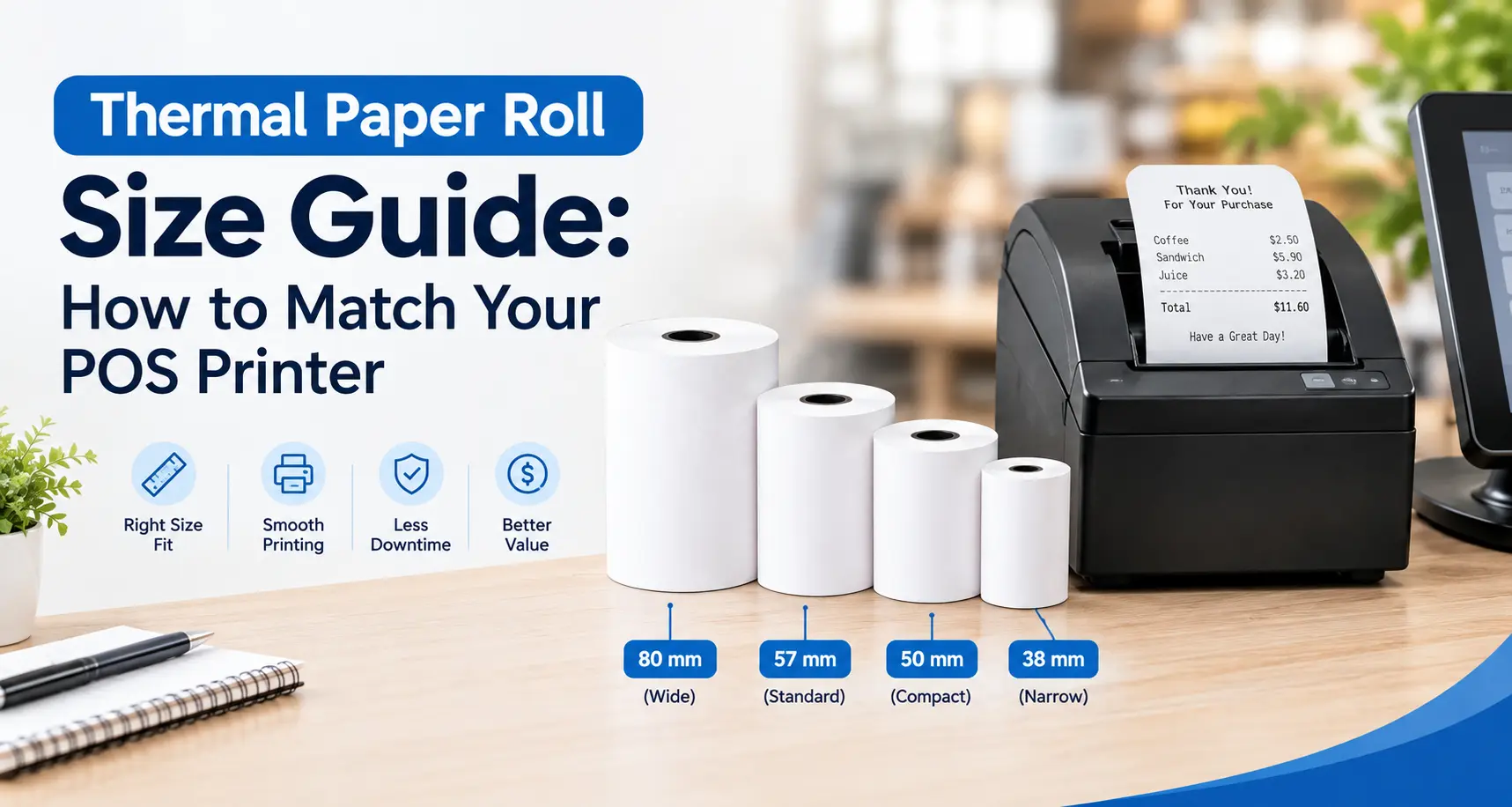
You're standing at the checkout counter and the printer just jammed again. You open the paper compartment and pull out a roll that looks almost right, but not quite. This happens more often than you'd think, and it almost always comes down to one problem: nobody checked the thermal paper roll sizes before the order went out.
If you buy paper rolls for a store, a restaurant, a pharmacy, or a warehouse, you already know that getting POS paper roll sizes wrong costs you time, money, and a line of frustrated customers. This guide walks you through everything you need to know about thermal paper roll sizes, from the numbers on the label to a full size chart your team can use before the next order. You'll also see how a POS thermal paper roll from a real manufacturer like FormersPaper can help you avoid these headaches altogether.
A thermal paper roll size uses three numbers together: paper width, roll diameter, and core size. The width has to match your printer's paper path, the diameter has to fit inside the compartment, and the core has to sit on the spindle. Skip one number, and the roll may not work at all.
Most people look at a label like "80mm x 80mm x 12mm" and assume the first number is all that matters. That's where most ordering mistakes start.
Every roll uses three simple measurements. Width tells you how wide the paper sits inside your printer. The diameter tells you how big the finished roll measures from edge to edge. Core size tells you how big the hole in the middle is, where the roll sits on the spindle or holder.
Once you understand these three numbers, reading any thermal receipt paper size becomes much easier. A roll marked 57 x 40mm simply means the paper measures 57mm wide and the full roll measures 40mm across. Simple, right? This same logic applies to every version of thermal paper roll sizes you'll come across, whether you're buying handheld printer rolls or full desktop POS rolls. Learning to read thermal paper roll sizes correctly the first time saves your team from reordering later.
Two widths cover almost every POS printer in use today: 57mm (about 2 1/4 inches) for handheld and mobile terminals, and 80mm (about 3 1/8 inches) for desktop and countertop printers. Beyond width, you still need to match diameter and core size before you place a bulk order.
Buyers searching for POS paper roll sizes usually land on the same two widths again and again. Here's a straightforward thermal paper roll sizes chart you can use as a starting point before you confirm against your printer's manual.
1. 57mm (2 1/4″) Width
2. 57mm (2 1/4″) Width
3. 80mm (3 1/8″) Width
4. 80mm (3 1/8″) Width
5. 44mm (1 3/4″) Width
6. 76/79mm (~3″) Width
Every row answers a slightly different question. If you run a food truck or a delivery service, the 57mm column is almost always your answer. If you run a supermarket counter or a hotel front desk, the 80mm column fits nearly every machine you own.
Some buyers still call this a thermal paper rolls size chart, but the idea stays the same: match every number, not just the width. A clear thermal receipt paper size chart like this one turns a guessing game into a two-minute check. Whichever POS paper roll sizes you land on, always confirm the exact figures against your printer model before you place a large order. That's really what a good thermal paper roll sizes chart should do for you.
Core size is the cardboard or plastic tube at the center of the roll, and most POS printers use an 11mm, 12mm, or 12.7mm core. A few larger kiosks and ATMs use a 25.4mm (1 inch) core instead. Get this wrong, and the roll won't sit on the spindle even if the width is perfect.
Core size feels like a small detail until the roll won't spin freely on your printer's holder. Most small POS printers use an 11mm or 12mm core. Some desktop machines use a 12.7mm (1/2 inch) core instead. ATMs and larger kiosks sometimes need a 25.4mm (1 inch) core to hold a longer roll.
Checking the core is part of any real thermal paper roll size check, not an extra step you can skip. Many buyers only think about width, but a full thermal paper rolls size review always includes the core. A POS thermal paper roll with the wrong core won't seat properly, no matter how well the width matches.
Choose 57mm for handheld terminals, mobile card readers, and compact printers where space is tight. Choose 80mm for countertop POS systems, kitchen printers, and any machine that prints full receipts with logos, itemized lists, and totals. When in doubt, measure your current roll or check your printer's model number.
Ask yourself one simple question: does your printer sit on a counter, or does it fit in your hand? Handheld card machines, mobile printers, and small ticket machines almost always take the 57mm width. Full-size POS terminals, kitchen order printers, and self-service kiosks almost always take the 80mm width.
Most businesses that run more than one type of printer end up ordering both, which is exactly why a single thermal paper roll sizes chart matters so much for a growing operation. A well-made POS thermal paper roll should run cleanly on either width without smudging, jamming, or fading halfway through a shift. Getting your POS paper roll sizes locked in for every machine you run keeps your ordering simple and your counters moving fast. Whether you print at 57mm or 80mm, thermal paper roll sizes should never be the reason your line slows down.
Width tells you if the paper fits your printer's slot, but it says nothing about whether the full roll fits inside the compartment or whether the core matches your spindle. Two rolls can share the same width and still be completely different products once you check diameter, core, and length.
Here's a mistake we see often. A buyer orders "80mm thermal paper" and expects it to work everywhere. But an 80mm x 60mm roll and an 80mm x 80mm roll share only one number. The second roll holds far more paper, weighs more, and needs more room inside the printer.
This is exactly why a real thermal receipt paper size specification always includes at least three numbers, not one. A supplier who only asks for width isn't giving your thermal paper rolls size request the attention it deserves. Confirm every field in the thermal paper roll size specification before your order ships, not after it arrives. Treating thermal paper roll sizes as a single number is the single most common reason bulk orders get returned. FormersPaper checks every field in thermal paper roll sizes on every order, whether you need fifty rolls or fifty thousand.
GSM (grams per square metre) controls how thick the paper is, and thickness directly changes how much paper fits on a roll of a given diameter. A thinner 35gsm or 40gsm sheet gives you a longer roll for the same size, while a heavier 55gsm or 65gsm sheet holds up better for records you need to keep.
Two rolls can share the exact same width and diameter and still hold very different amounts of paper. The difference usually comes down to GSM. FormersPaper produces thermal stock across a full range, including 35gsm and 40gsm ultra-thin paper for portable printers that need maximum roll length, plus 48gsm, 55gsm, and 65gsm options for standard POS and archival-grade printing.
This is a detail most thermal paper roll sizes charts skip entirely, even though it changes how often you need to swap rolls. If your team compares a single thermal paper roll size across two different suppliers, always ask for the GSM before you compare price. A cheaper thermal paper rolls size option often means thinner paper and a shorter roll, not a better deal. For receipts you need to keep, like tax records or warranty slips, a heavier thermal receipt paper size resists fading far longer than a thin, budget sheet. If coating safety matters to your business as much as thickness does, our BPA-Free Thermal Paper guide breaks down what to check before you order.
Check your printer's manual first for supported width, maximum diameter, and core size. If the manual is missing, measure your current roll with a ruler, or measure the paper compartment itself. Always confirm all three numbers with your supplier before placing a bulk order, and test a single sample roll first whenever you're unsure.
Follow these steps before your next order:
Following these steps turns thermal paper roll sizes from a guessing game into a simple checklist your whole team can use. Every POS thermal paper roll FormersPaper ships gets checked against these same specifications before it leaves the factory. This process works whether you're confirming POS paper roll sizes for one store or standardizing them across two hundred locations. Buyers who skip this step often end up reordering the same thermal paper rolls size twice within a month. A five-minute check against your printer manual can save you from a wrong thermal paper roll size shipment entirely. That single habit protects your business from the most common thermal paper roll sizes mistake we see across every industry we serve.
FormersPaper has manufactured paper products for more than 30+ years, running five vertically integrated factories across China, the UK, and Indonesia. Every roll ships to a confirmed width, diameter, core, and GSM specification, and every facility holds ISO 9001:2015, ISO 14001:2015, ISO/IEC 27001, OHSAS 18001, RoHS, and FSC certifications.
Getting the size right is only half the job. The other half is working with a manufacturer who checks these numbers on every single order, not just the first one. FormersPaper has coated, printed, and converted thermal paper in-house since 1995, so we control every step instead of outsourcing it to a third party who might not care about your exact specifications.
Our Indonesia facility gives US and Canadian buyers a low-tariff sourcing option, complete with an official Certificate of Origin, while our five factories across China, the UK, and Indonesia give us the scale to fill both small test orders and large recurring contracts. Regional teams support buyers directly across North America, Europe, the Middle East, Africa, and Asia, so a question about your order never sits waiting for a time zone to line up.
Whether you need a single confirmed thermal paper roll sizes specification or a full custom production run, our team reviews every measurement before it ships. Every POS thermal paper roll we manufacture carries real certifications behind it, not just a claim on a spec sheet. Standardizing POS paper roll sizes across every location keeps your ordering simple no matter how many stores or terminals you run. That's the difference between guessing at thermal paper roll sizes and ordering from a manufacturer who's already done the checking for you.
Explore our full Paper Rolls range, including thermal, bond, and carbonless options, or read our Thermal vs. Bond Paper Rolls guide if your business runs more than one printer type.
Getting thermal paper roll sizes right isn't complicated once you know which three numbers to check. Width tells you if the paper fits your printer's slot. Diameter tells you if the full roll fits inside the compartment. Core size tells you if the roll sits on the spindle the way it should. Whether you're ordering a single case for one shopfront or standardising a full thermal paper rolls size specification across every location you run, cross-checking these numbers before you order saves you time, money, and a jammed printer during your busiest hour.
FormersPaper manufactures every POS printer size in-house, backed by real certifications and more than 30 years of experience, and ships to businesses across the US, Canada, Mexico, the Caribbean, and China. Every POS thermal paper roll we ship reflects that same standard, whether it's a single sample or a full container order. If you already know your thermal receipt paper size specification, request a quote today. If you're still confirming your thermal receipt paper size, our regional team is ready to help you match the right roll to your printer, every single time.
Q. What is the standard thermal receipt paper size for most POS printers?
Most countertop POS printers use an 80mm width, while handheld and mobile devices use 57mm. Always confirm against your printer manual before ordering in bulk.
Q. Is there a difference between thermal paper roll size and thermal paper rolls size?
No. Both phrases describe the same idea: the width, diameter, and core measurements that define a roll. Suppliers and buyers use the terms interchangeably.
Q. What core size do most POS thermal paper roll machines use?
Most machines use an 11mm or 12mm core. Larger kiosks and ATMs sometimes require a 25.4mm (1 inch) core, so always check your printer's spindle size first.
Q. Can I use an 80mm roll in a printer built for 57mm paper?
No. The width has to match your printer's paper path exactly. A wider roll won't feed correctly and can damage the print head over time.
Q. How do POS paper roll sizes affect how often I need to reorder?
A larger diameter roll holds more paper and lasts longer before a change. Thinner GSM paper also stretches roll length further at the same diameter.
Q. What's the easiest way to confirm thermal paper roll sizes before a bulk order?
Check your printer manual first. If that's not available, measure your current roll's width, diameter, and core, or measure the paper compartment directly.
Q. Are BPA-free thermal paper rolls available in every size?
Yes. FormersPaper offers BPA-free and phenol-free options, including our Enviroprint line, across the same standard widths used in most POS printers today.
Q. Does FormersPaper support custom thermal paper roll size requests for large accounts?
Yes. Our team reviews custom width, diameter, core, and GSM combinations for buyers across the US, Canada, Mexico, the Caribbean, and China, and can quote sample rolls before a full production run.
Q. Why do two rolls with the same width sometimes have different thermal paper rolls size specifications?
Width is only one part of the specification. Diameter, core, and GSM can all vary even when the width matches, which changes roll length and total paper capacity.
Q. What POS thermal paper roll certifications should I ask a manufacturer for?
Ask for ISO 9001:2015, ISO 14001:2015, FSC, and RoHS at minimum. These confirm quality management, environmental management, responsible sourcing, and restricted-substance compliance.
Q. How does GSM change thermal receipt paper size recommendations for high-volume stores?
Higher-volume counters often choose heavier GSM for durability, even though it slightly shortens roll length at the same diameter. Lower-volume counters can use thinner GSM for longer rolls.
Q. What's the fastest way to compare POS paper roll sizes across suppliers?
Ask every supplier for the same five numbers: width, diameter, core, length, and GSM. Comparing anything less leaves gaps that cause ordering mistakes.
Q. Does core size really matter if the thermal paper roll size already matches on width and diameter?
Yes. A roll with the wrong core won't seat on the spindle, even when width and diameter are both correct.


Formers Paper is a leading manufacturer for a comprehensive range of sustainable paper & packaging products serving customers globally.
Shenzhen Formers Paper Co. Ltd, No.92 Zhugushi Road, Wulian community, Longgang District, Shenzhen, China