We wish you Happy Holidays & a joyful New Year!

Thermal vs paper prescription labels cause severe delays. Learn which label style resists smudging, handles high volume, and protects your pharmacy workflow.
November 13, 2026
Jane Smith
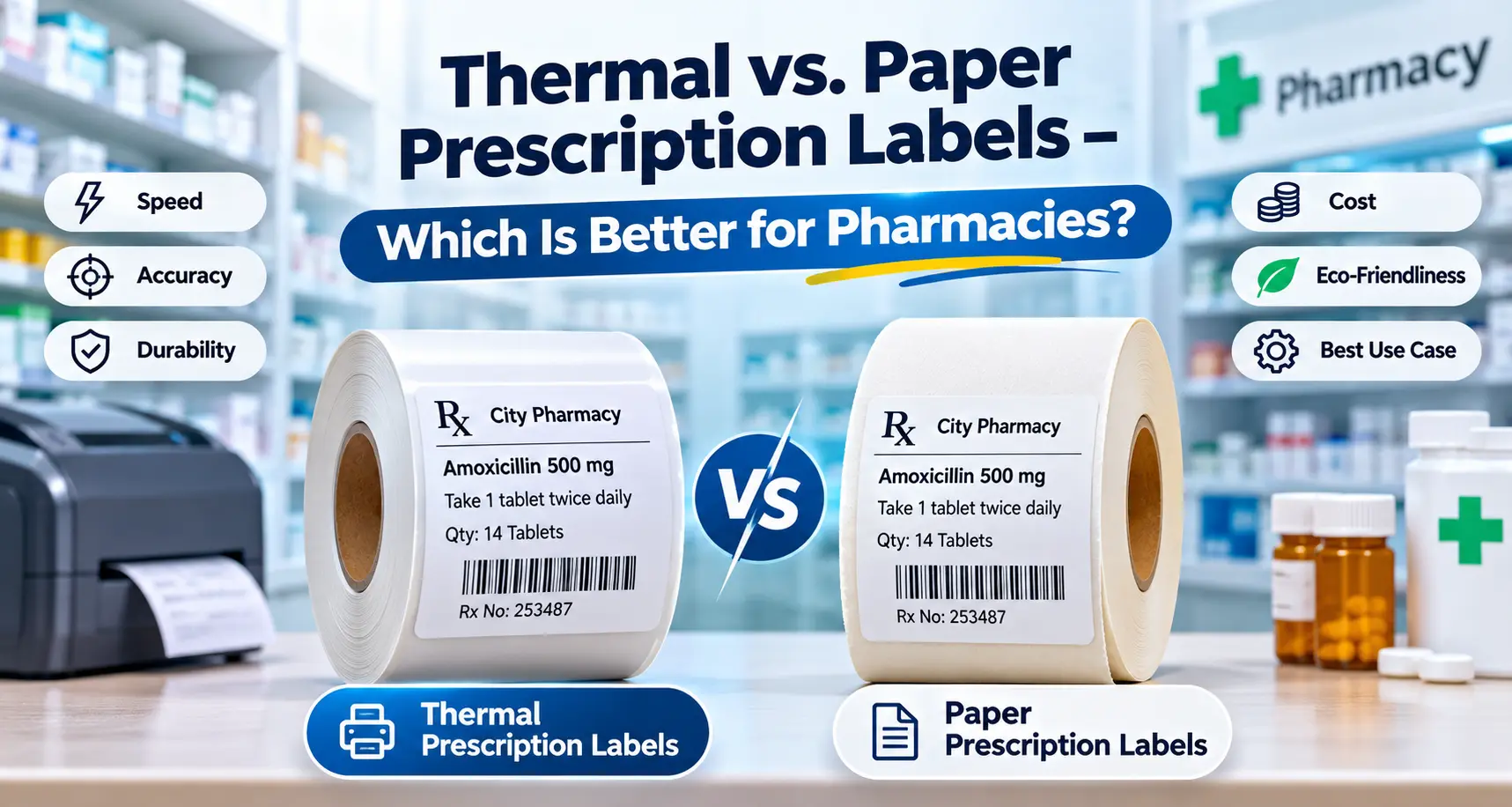
A busy Monday morning at your pharmacy counter leaves you barely any time to breathe. Ten patients wait in line while you quickly print a label and stick it on a vial before calling the next person. Two weeks later, one of those customers wipes the bottle with a sanitiser cloth, and the dosage instructions suddenly turn into a messy grey smear.
Naturally, that tiny sticker has now turned into a serious headache for your shop. Because prescription labels carry vital details like the patient's name, medicine, and exact dose, even a single smudged word can easily confuse someone. Therefore, the material of your sticker matters just as much as your printer does.
In this blog, we will simply explain thermal vs paper prescription labels so you can confidently choose the right option for your counter. Read through the complete blog from FormersPaper below to discover which are the best prescription labels for your pharmacy before you place your next order.
Choose direct thermal when your pharmacy prints many labels every day and desperately needs speed. Choose paper when you print fewer labels, want colour, and already own a laser printer. Most busy counters choose thermal, while many small shops do quite well with paper, so your daily volume, budget, and local climate will ultimately decide the winner.
Honestly, the thermal vs paper prescription label question has no single answer that works for everyone. Still, this quick overview of thermal vs paper prescription labels will definitely point you in the right direction.
Choose thermal if you:
Choose paper if you:
Prescription labels for pharmacies come in two main types. Direct thermal stock has a heat-sensitive coating that turns dark under heat, so it needs no ink. Paper stock has no such coating, so it needs ink or toner. Both kinds of prescription labels stick to the vial with glue on the back.
The printer head heats tiny dots on the label. Where the heat touches the coating, it turns dark. That dark spot forms the text and the barcode. You need no ink, no toner and no ribbon. Many pharmacies choose thermal labels for this reason. They work like a shop receipt, but they stick to a vial.
Paper prescription labels for pharmacies usually come on A4 sheets. A laser printer melts toner onto the paper with heat. An inkjet printer sprays liquid ink that soaks in. You then peel the label off the sheet and stick it on the vial.
A thermal transfer printer uses a ribbon that melts ink onto the label. The print lasts longer, but ribbons add cost. Read Our blog on direct thermal vs. thermal transfer labels for more detail.
Keep one idea in mind for thermal vs paper prescription labels. The coating, not the glue, makes the difference. Now comes the part that worries pharmacists most. Will the print survive?
Laser prints on paper usually last well in storage. Plain thermal labels can fade with heat, light, oil and rubbing. Top-coated and synthetic direct thermal stock fix much of that. So the answer to thermal labels vs paper prescription labels depends on where the bottle lives after it leaves your counter.
Durability matters most in thermal vs paper prescription labels, because a lost word is a safety risk. Think about a patient's home. The bottle sits in a bathroom, a kitchen or a hot car. Prescription labels for pharmacies must survive all of that.
Direct thermal coating reacts to heat, sunlight, rubbing, oil and some chemicals. Inkjet ink can run when it gets wet. Laser toner usually handles moisture better.
Now the good news. FormersPaper makes top-coated direct thermal stock that resists water, oil and plasticizer. It also makes synthetic PP, PE and PET stock, plus special coatings for high heat, UV, alcohol resistance and smudge-proof prints. So a pharmacy can match the stock to the risk.
How long does a plain direct thermal print last? FormersPaper's own blog says several months to around a year indoors. Many prescriptions run for 30 to 90 days, so that is often enough. For hot, wet or oily places, pick a tougher grade.
Here is a thought worth keeping. The best prescription labels are not always the toughest ones. They match the bottle's real life. The best paper prescription labels follow the same rule: pick a smooth, coated face for clean print, and test it on your own printer.
Direct thermal prints faster and needs less fuss. You load a roll, press print and move on. Paper sheets need more handling, and one label can waste the rest of the page. This is the thermal labels and paper prescription labels difference that your staff feel first.
Speed shows up fast in thermal vs paper prescription labels. Thermal labels come on rolls, so you do not change ribbons or toner. Thermal labels also need less shelf space.
Paper prescription labels for pharmacies come on sheets. You feed an A4 page, print one label, and the rest of the page waits.
One warning before you shop: you cannot swap the stock. A direct thermal printer prints blank on plain paper. A laser printer can ruin thermal paper, because its heat turns the page dark.
Every thermal vs paper prescription label rule starts with one question: how many labels do you print each hour? Answer that, and the speed question solves itself. Speed is one thing. But what about your wallet?
Direct thermal often costs less per label at busy counters, because you buy no ink, toner or ribbon. Paper prescription labels for pharmacies cost less to start, especially if you own a printer. Over a year, toner, waste and reprints change the picture. So compare the full cost, not only the price of one label.
Every thermal vs paper prescription label decision has a price tag. Money often decides thermal vs paper prescription labels. Check these four costs:
Here, the thermal labels and paper prescription labels difference is the refill. Thermal labels need none, while paper needs toner or ink.
In thermal labels vs paper prescription labels, always count the cost of a failed label. A cheap label that fails is not cheap. That is why smart buyers ask for prescription labels for pharmacies in small test batches first. The best prescription labels cost less over a year, even when they cost more on day one.
Store prescription labels for pharmacies in a cool, dry, dark place. Heat and sunlight hurt direct thermal rolls fastest. Damp air curls paper prescription labels for pharmacies. Ask your supplier for the shelf life and storage rules of each grade, and follow them. A label that spoils in the cupboard will fail on the bottle too. Heat is the top enemy in thermal vs paper prescription labels.
Storage adds another thermal labels and paper prescription labels difference. Humidity affects thermal labels vs paper prescription labels in different ways. Keep thermal labels wrapped until you need them. Keep sheets flat and dry. The best prescription labels last longer when you store them well. The best paper prescription labels also need dry storage. Storage changes any thermal vs paper prescription label plan, so write the rules down.
Your location matters as well. FormersPaper's own blog lists these common conditions:
Ask for a BPA-free and BPS-free grade. Older thermal labels used BPA in the coating. Some makers then moved to BPS, and some studies say BPS may raise similar worries. Pharmacy staff touch prescription labels all day, so a phenol-free grade is a smart ask.
Safety brings one more thermal label and paper prescription label difference. Paper stock has no heat-sensitive coating, so the BPA question mainly concerns thermal stock. Staff safety also matters in thermal vs paper prescription labels, so never skip it.
FormersPaper lists BPA and BPS-free options for thermal paper. You can read more in its BPA-free thermal paper supplier blog.
At the end of the day, prescription labels for pharmacies each come with their own practical trade-offs. This quick breakdown neatly sums up thermal vs paper prescription labels, while clearly showing the thermal labels and paper prescription labels difference in one easy view.
Neither type is always the best prescription labels. Poor sheets and poor rolls both fail. So test before you buy.
Your thermal vs paper prescription label choice depends on four things: volume, climate, printer and budget. Prescription labels for pharmacies suit different counters in different ways. Here are some common cases:
In thermal labels vs paper prescription labels, a mixed setup is fine too. Some pharmacies print most labels on thermal rolls and keep paper sheets for special jobs.
Keep in mind that no online guide on thermal vs paper prescription labels can ever replace your local pharmacy laws. Legal rules for prescription labels for pharmacies differ widely by state, province, and country, meaning even the best prescription labels must strictly follow local formatting laws. Naturally, the best paper prescription labels must follow those exact same regulations too. Always double-check your local compliance guidelines before placing any thermal vs paper prescription label order, and ask your regional pharmacy regulator what mandatory details every label must show.
Additionally, remember that a factory's ISO certificate simply proves good manufacturing quality systems, and it does not legally approve a pharmacy label for medical compliance.
Running a hands-on trial settles the thermal vs paper prescription labels debate far better than any blog ever could. Simply follow these seven easy steps for a fair thermal vs paper prescription label trial at your own counter:
This test also helps you find the best prescription labels and the best paper prescription labels for your own counter.
For pharmacies weighing thermal labels vs paper prescription labels, FormersPaper covers both sides. FormersPaper is a label stock manufacturer, not a reseller. It coats, laminates, prints and converts its own materials in-house. Five factories across China, the UK and Indonesia, with more than 600 machines, support that work. The company also has more than 30 years in the paper industry, and its facilities hold ISO 9001:2015 and ISO 14001:2015 certification.
The range includes eco and top-coated direct thermal stock, synthetic PP, PE and PET, thermal transfer, and laser and inkjet sheets. Buyers in the USA and Canada can also source from the Indonesia facility, which can provide a Certificate of Origin.
Want to explore the full range of your buisness? Browse the Labels & Stickers products, the Healthcare solutions or the Paper Rolls range. A good partner shares samples and answers your questions about prescription labels for pharmacies before you order. That helps you find the best prescription labels for your counter.
Choose direct thermal for speed and busy counters. Choose paper prescription labels for pharmacies for colour and low volume. Move your prescription labels to top-coated or synthetic stock when heat, sanitiser or moisture threaten the print. In the end, thermal vs paper prescription labels is not a fight with one winner. It is a match between the label and your counter.
Remember the thermal labels and paper prescription labels difference. One prints with heat, and the other prints with ink or toner. That one fact explains the speed, the cost and the fading. So let the thermal labels vs paper prescription labels debate end with a sample test, and trust your own results. Pick the best paper prescription labels the same way.
Ready to test? Send FormersPaper your printer model, label size, vial type and region. The team can suggest grades, share samples and discuss MOQ and lead time with your quote. Contact FormersPaper, or call the North America line at +1 236 992 6399.
Direct thermal almost always wins at a busy counter because it prints very fast, requires no messy ink, toner, or ribbon, and creates far less daily waste.
It really depends on your daily printing volume. Thermal labels cost noticeably less to run at high-volume counters, whereas paper costs less to start with if you already own a working laser printer.
No, you cannot, because the thermal printer will only spit out a completely blank label since plain paper lacks the necessary heat-sensitive chemical coating.
You should always pick flat, smoothly coated A4 sheets that feed cleanly through your paper tray without curling, and make sure to test a sample from a reliable manufacturer like FormersPaper on your own printer first.
Plain direct thermal labels can gradually fade when exposed to heat, bright light, rubbing, and skin oils, while paper labels printed with fused laser toner usually last much longer indoors, unless you upgrade to FormersPaper's top-coated or synthetic thermal grades built for extra resistance.
Simply ask FormersPaper for physical samples, print real dosage text and a barcode, wipe the surface with alcohol, rub it with hand cream, and scan the barcode again to verify readability.


Formers Paper is a leading manufacturer for a comprehensive range of sustainable paper & packaging products serving customers globally.
Shenzhen Formers Paper Co. Ltd, No.92 Zhugushi Road, Wulian community, Longgang District, Shenzhen, China