We wish you Happy Holidays & a joyful New Year!

Silicone-coated baking paper vs parchment paper: compare heat resistance, non-stick performance, and certifications before your next bulk order.
September 15, 2026
John Doe
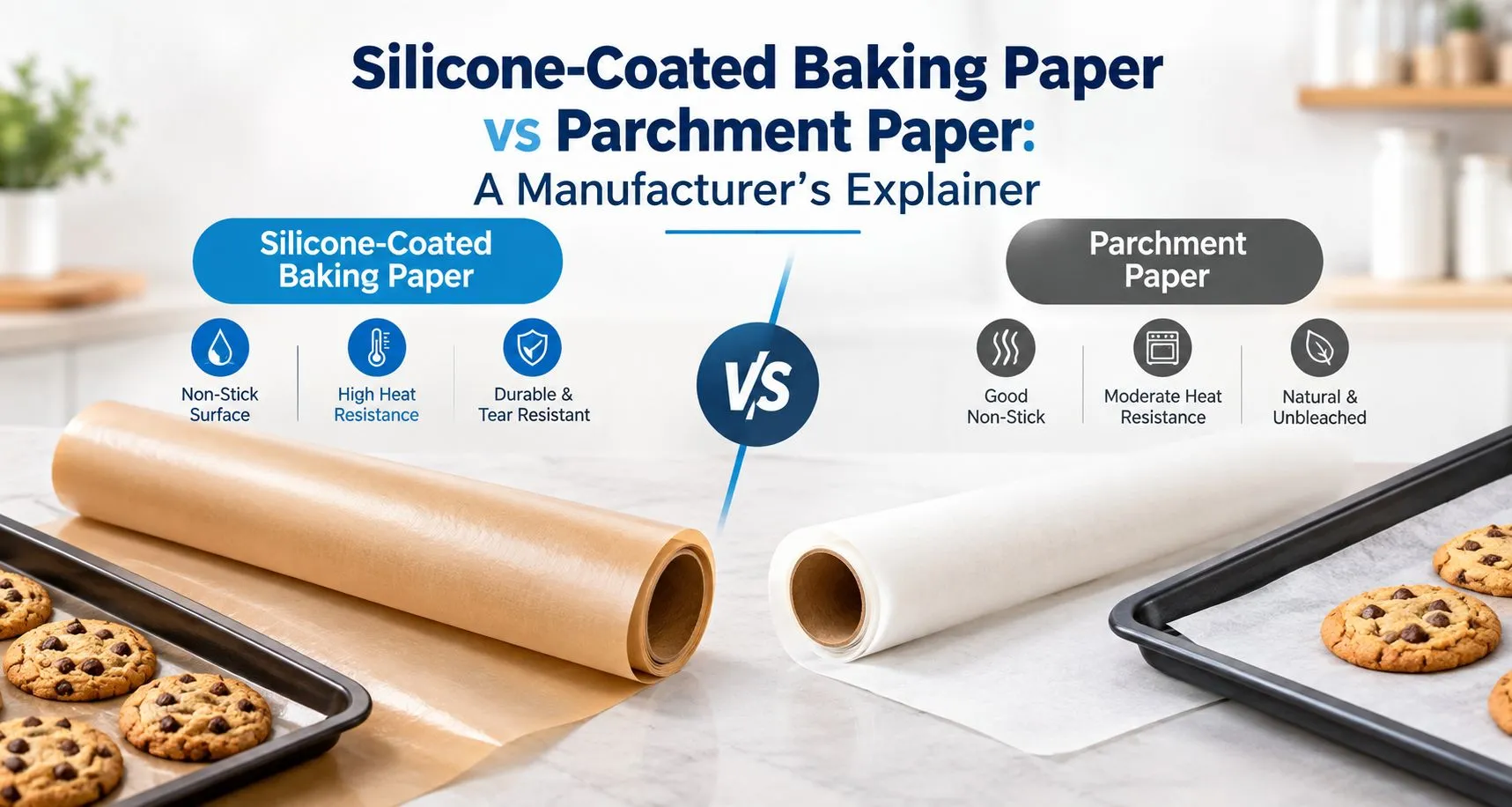
A bakery orders a container of baking sheets. The paper looks fine on day one. Two weeks later, cookies stick, and edges scorch, and the quality team wants answers. This traces back to one rushed choice: picking the wrong liner without understanding the real difference between the two products on the market.
That is the heart of the silicone-coated baking paper vs. parchment paper debate, and it is not just a kitchen question. Bakeries, food packaging converters, private-label brands, and foodservice distributors across the USA, Canada, Mexico, the Caribbean, and China all face this decision every time they place a bulk order. Get it right, and your ovens run clean and your product releases every time. Get it wrong, and you deal with scorched batches and a reorder headache during your busiest season.
This guide breaks down silicone-coated baking paper vs parchment paper in plain terms, straight from a manufacturer that makes both product types in-house. We will cover what each paper is made from, how they perform under heat, which certifications actually matter, and how to choose the right one for your product line before you commit to a bulk order. If you searched for the best silicone paper vs parchment paper, hoping for a straight answer instead of marketing fluff, this is built for you.
By the end, you will know exactly what separates silicone-coated baking paper vs parchment paper, why FormersPaper builds both to the same high standard, and how to walk into your next supplier conversation asking the right questions instead of guessing.
Silicone-coated baking paper starts as a base sheet of cellulose fiber, usually unbleached or lightly bleached wood pulp. A thin layer of food-grade silicone gets applied to one or both sides during the coating process. That silicone layer gives the paper its signature non-stick surface and higher heat tolerance than plain paper.
The coating does two jobs at once. It prevents dough, batter, and sticky fillings from bonding to the fibres underneath and helps the sheet hold its shape at higher oven temperatures without curling. That is why silicone-coated baking paper shows up everywhere from commercial bakeries to packaged snack lines, where consistent release matters on every batch.
GSM, or grams per square metre, decides how thick and sturdy the paper feels. Lighter grades save on freight, while heavier grades hold up better on high-speed lines running trays all day. A dependable manufacturer walks a buyer through this trade-off instead of shipping whatever grade sits in the warehouse.
Silicone-coated baking paper commonly ships as jumbo reels for converters who cut and package their own sizes or as finished, pre-cut sheets ready to load straight onto a tray. Either way, the coating quality has to stay consistent from the first roll to the thousandth, which is exactly where a vertically integrated manufacturer has the advantage over a reseller repackaging someone else's stock.
Parchment paper takes a different manufacturing route. The base cellulose sheet gets passed through a bath of sulphuric acid, a process called parchmentizing. This treatment partially dissolves the surface fibres and then fuses them back together into a denser, greaseproof layer. The result is a paper that resists moisture and grease naturally, without needing a silicone coating at all.
Because parchment paper relies on chemical treatment rather than a coating, it has a slightly lower heat ceiling than silicone-coated stock. It holds up well for everyday baking, roasting, and lining pans but darkens and turns brittle faster past its rated limit. For most kitchens, that is not an issue, since most recipes never approach those extremes.
Parchment paper still earns its place in commercial settings. It works well for lining cake pans, wrapping delicate pastries, and cooking en papillote, where a smooth, tear-resistant release matters more than extreme heat tolerance. Bakeries needing a dependable everyday liner without paying for unused heat resistance often reach for parchment first.
Both products start from the same raw material family, which is why so many buyers assume they are interchangeable. They are not, and understanding that gap is the whole point of comparing silicone-coated baking paper vs parchment paper before you sign off on a bulk purchase order.
Here is where the Silicone-Coated Baking Paper vs Parchment Paper comparison gets practical. Both papers look similar on a shelf. Their performance under heat, their release properties, and their cost at scale tell a very different story.
Base Material
Heat Resistance
Non-Stick Performance
Reusability
Best For
Bulk Order Fit
Many procurement teams comparing Silicone-Coated Baking Paper vs Parchment Paper side by side start with this table, then dig deeper into how each paper behaves inside their own ovens. Reading a spec sheet only tells half the story, which is why testing on real equipment always beats trusting numbers alone.
Heat resistance is usually the deciding factor for a commercial buyer. Silicone-coated baking paper generally handles a wider working range before it scorches, which matters on lines running hot ovens back to back all shift long. Parchment paper performs well within its own rated range, but pushing past that limit brings browning, brittleness, and a smoky smell nobody wants near packaged food.
Non-stick performance plays out differently too. The silicone layer gives a very even, predictable release across the sheet. Parchment releases well thanks to its acid-treated surface, though buyers running extremely sticky formulations sometimes prefer the coated option for extra safety margin.
Cost at scale is where procurement teams get surprised. A cheaper roll that jams a machine or tears mid-run costs more in the long run than a slightly pricier roll that performs consistently. This is why so many buyers researching best silicone-coated baking paper vs parchment paper options ask suppliers for real GSM specs and heat data instead of trusting a spec sheet alone.
A home baker who picks the wrong liner ruins one tray of cookies. A commercial bakery or brand that picks wrong ruins a production run or a client relationship. That difference in stakes is why B2B buyers cannot treat this decision the way a home cook does.
Consistency across every shipment matters more than almost anything else. When your facility runs the same paper across multiple production lines, or across multiple factories in different countries, you need every roll to behave the same way. A batch of wholesale baking paper that performs differently from the last one throws off bake times, changes browning results, and forces your quality team to troubleshoot a problem that should never have happened.
Regional compliance adds another layer most home-baking guides never mention. Buyers in the USA, Canada, Mexico, and the Caribbean each work within their own food-contact regulations, and China's manufacturing base must meet the same expectations before goods leave the factory. A supplier who understands these requirements saves a buyer from a compliance headache after the product has already shipped.
Private-label brands face a sharper version of this risk. If your packaging promises "premium parchment" and the product underneath does not deliver, your brand takes the hit, not your supplier. That is why private-label buyers treat commercial baking liners sourcing as a long-term partnership rather than a one-time purchase based on the lowest quote.
Buyers who search for best silicone paper vs parchment paper while comparing suppliers are usually trying to solve exactly this problem: finding a manufacturer who can prove consistency in writing, not just promise it on a sales call.
Procurement teams stocking wholesale baking paper for multiple facilities often standardize on one supplier for exactly this reason. Standardizing your commercial baking liners across every location removes the guesswork that comes from juggling different vendors with different specifications. It also simplifies training, since staff only ever handle one type of heat resistant baking liners regardless of which plant they work in. Facilities that standardize on certified heat resistant baking liners across every plant also simplify staff training and reduce onboarding time for new hires.
Any supplier can claim their paper is safe and food-grade. A named certification is different, because an outside body actually audited the claim in person.
FormersPaper holds ISO 9001:2015 for quality management, meaning every batch gets tracked against the same documented standard, not just whatever sample a buyer approved first. ISO 14001:2015 covers environmental management. ISO/IEC 27001 protects information security, which matters for B2B buyers managing sensitive order data.
OHSAS 18001 confirms workplace safety standards inside every facility. RoHS restricts certain hazardous substances, important for buyers needing proof their supply chain avoids harmful materials. FSC certification confirms the wood pulp behind FormersPaper's cellulose base comes from responsibly managed forests, giving buyers a verifiable answer when customers ask about sourcing.
These certifications matter just as much for heat resistant baking liners as they do for any other paper product FormersPaper manufactures, since food-contact safety and environmental responsibility apply across every product line the company produces. A buyer sourcing bulk baking paper should always ask for certificate numbers directly, then verify them with the issuing body rather than trusting a logo on a website.
Ask any potential supplier for real production data before committing to a bulk order: GSM specs in writing, heat tolerance figures, and certificate documentation that can be checked independently. A genuine manufacturer hands this over without hesitation. A reseller repackaging someone else's stock usually stalls or changes the subject.
Buyers importing commercial baking liners into Canada, Mexico, or the Caribbean should confirm which certifications travel with the customs paperwork, since a supplier who cannot produce them is rarely the best silicone paper vs parchment paper partner for a long-term contract.
Comparing spec sheets only gets a buyer halfway to the right decision. These checks turn a shortlist into a confident bulk order.
1. Match the paper to your actual bake temperatures
Pull your real oven settings before comparing suppliers. Hot, fast lines usually justify silicone-coated stock. Moderate ranges often make parchment the more cost-effective fit.
2. Confirm GSM and coating consistency in writing
Ask for exact GSM figures for every batch, not just the first sample approved. A supplier offering genuine wholesale baking paper should hand over this data without pushback.
3. Test samples on your actual equipment
A sheet that performs beautifully in a demo can behave differently at your real oven temperature and line speed. Always test before signing off on a container-load order.
4. Verify certifications by name and number
Look for ISO 9001:2015, ISO 14001:2015, ISO/IEC 27001, OHSAS 18001, RoHS, and FSC. Ask for the certificate files and confirm them with the issuing body directly.
5. Ask about production capacity and lead times
Your busiest season is the worst time to discover a supplier cannot keep up. Confirm minimum order quantities and realistic lead times before depending on a new source during peak demand.
6. Weigh converter formats against finished sheets
Converters need jumbo reels sized to their equipment, while foodservice and retail buyers usually need finished, pre-cut sheets. Confirm which format your operation actually needs before requesting quotes.
7. Consider multi-region supply
Chains and private-label brands operating across the USA, Canada, Mexico, and the Caribbean benefit from one supplier who keeps specifications identical everywhere, instead of managing separate vendors with separate standards. This matters just as much for commercial baking liners as for finished retail packaging.
8. Compare pricing across formats and grades
Buyers evaluating best silicone-coated baking paper vs parchment paper pricing should compare cost per finished sheet, not just cost per roll, since GSM and format both affect real yield per case of wholesale baking paper.
Buyers who work through this checklist before placing a bulk order consistently land on the best silicone-coated baking paper vs parchment paper fit for their exact production needs, instead of settling for whatever a broker happens to have sitting in a warehouse.
Placing a bulk order for silicone-coated baking paper vs. parchment paper looks simple on paper, but volume changes the calculation. Buyers stocking wholesale baking paper for a single facility have different needs than a multi-plant operation managing commercial baking liners across several countries.
Minimum order quantities, container sizes, and lead times all shift depending on the grade a buyer needs. A supplier offering the best silicone-coated baking paper vs parchment paper combination for one client might not be the best fit for another, since bake temperatures and volume change the right answer.
Buyers who lock in a standing order for heat resistant baking liners early in the season typically avoid the scramble that hits procurement teams every holiday and back-to-school rush. Planning ahead with a factory-direct supplier protects both price and supply.
Even the best paper on the market will not perform if it gets stored badly before it reaches the oven. These habits protect quality across any stockroom, warehouse, or production floor:
A premium roll of either product can perform reliably for a long shelf life when stored correctly. Paper left on a hot loading dock, however, will not hold up no matter how good the factory behind it was. This same discipline protects heat resistant baking liners just as much as it protects standard parchment stock, since heat and humidity degrade both product types when storage habits slip.
Plenty of companies sell baking paper. Far fewer companies actually manufacture it from raw material to finished roll. FormersPaper falls firmly into that second group, which is exactly why it can speak with authority on the Silicone-Coated Baking Paper vs Parchment Paper question instead of repeating a reseller's marketing copy.
FormersPaper runs a fully vertically integrated production model covering coating, laminating, printing, and converting in-house. The company operates five manufacturing factories with more than 600 pieces of advanced equipment, spread across roughly 3 million square feet of workshops and warehouses in China, the UK, and Indonesia. An in-house R&D team holding more than 100 patents keeps custom specs solvable rather than shelved.
That scale means FormersPaper controls coating quality on every run of silicone-coated baking paper, and controls the parchmentizing process on every run of parchment paper, instead of outsourcing either process to an unnamed third party. Buyers comparing best silicone paper vs parchment paper suppliers get a rare advantage here: one factory-direct source for both product types, with consistent GSM grades and verified certifications behind every shipment.
FormersPaper already supplies clients across retail, hospitality, healthcare, and finance, with dedicated supply lines reaching the USA, Canada, Mexico, and the Caribbean, alongside its manufacturing base in China. Whether a buyer needs jumbo reels or finished, cut-to-size sheets, FormersPaper builds both to the same certified standard.
This is what separates a genuine manufacturer of commercial baking liners from a trader repackaging stock it never touched. A true factory can adjust a spec quickly, fix a quality issue at the source, and scale production the moment demand spikes, instead of forwarding a complaint and hoping for a fast reply.
Buyers who compare FormersPaper directly against other suppliers of best silicone-coated baking paper vs parchment paper consistently find the same pattern: named certifications, real GSM data, and a factory willing to prove its numbers instead of just stating them. That same standard applies to every roll of wholesale baking paper and every case of commercial baking liners the company ships, regardless of destination.
Every buyer researching best silicone paper vs parchment paper wants the same four things: proof of quality, fair pricing, flexible formats, and supply they can count on across every region they serve. FormersPaper delivers on all four for both product lines, which is why it consistently ranks as the best silicone paper vs parchment paper source for private-label brands, converters, and foodservice distributors comparing wholesale baking paper suppliers side by side.
The company controls coating and parchmentizing from raw pulp to finished roll, across five factories and more than 600 pieces of equipment. Its heat resistant baking liners ship as jumbo reels or finished, cut-to-size sheets, with consistent GSM grades and named certifications behind every shipment. Few suppliers of commercial baking liners can back up their claims with real factories and real certificates the way FormersPaper can.
What sets FormersPaper apart for buyers weighing best silicone-coated baking paper vs parchment paper decisions is reach. With supply lines already serving the USA, Canada, Mexico, and the Caribbean, plus factories in China, the UK, and Indonesia, FormersPaper supports a brand that expands across borders without a new supplier search every time it enters a new market.
Choosing between Silicone-Coated Baking Paper vs Parchment Paper is not about picking whichever roll looks cheapest on a spec sheet. It is about matching the right product to your actual production temperatures, your actual volume, and your actual compliance needs across every market you serve.
Request samples of both product types, test them on your real equipment, and check the certifications behind whichever supplier you choose. A supplier who manufactures both silicone-coated baking paper and parchment paper in-house, under the same certified standards, removes the guesswork of juggling two separate vendors with two separate quality systems.
Contact FormersPaper for samples, GSM specs, and a factory-direct quote on either product, and compare the answers directly against whatever supplier you are currently using. Ready to see the difference real manufacturing makes on your next bulk order of heat resistant baking liners? The comparison starts with a simple test on your own trays. Whether your next order is for silicone-coated stock or standard parchment, insist on the same proof you would expect from any supplier of heat resistant baking liners: real specs, real certificates, and a factory that stands behind both.
Silicone-coated baking paper gets its non-stick surface and heat tolerance from a silicone layer over a cellulose base. Parchment paper gets its properties from an acid treatment that fuses the fibers into a denser, naturally greaseproof sheet. Both work well, but they are made differently and perform differently under heat.
Silicone-coated baking paper generally tolerates a wider heat range, making it a common choice for high-volume lines running hot ovens for extended periods.
Both products can be perfectly safe when manufactured to proper food-grade standards and backed by real certifications. Always ask a supplier for documentation such as ISO 9001:2015, RoHS compliance, and FSC certification rather than assuming safety based on marketing language alone.
Some heavier-grade silicone-coated sheets tolerate light reuse depending on the application, though most commercial and food-safety programs treat both products as single-use to maintain consistent hygiene and performance standards.
Ask for GSM specifications, heat tolerance data, and certificate numbers in writing before ordering wholesale baking paper in bulk. A genuine manufacturer provides this information immediately, while a reseller often stalls or cannot answer at all.
Yes. FormersPaper produces both product types in-house across its certified facilities, giving buyers a single, factory-direct source instead of managing two separate vendors for two separate paper types.
Converters who cut and package their own stock typically need jumbo reels sized to their equipment, while private-label brands and foodservice buyers usually need finished, pre-cut sheets ready to package under their own labeling.
Keep rolls sealed in original packaging, stored in a cool and dry area away from direct heat and humidity, and rotate older stock first. Proper storage protects both silicone-coated baking paper and parchment paper equally well.
Yes. FormersPaper maintains dedicated supply lines into the USA, Canada, Mexico, and the Caribbean, alongside manufacturing facilities in China, the UK, and Indonesia, which helps multi-region buyers keep specifications identical no matter where a shipment lands.
Not always. The best silicone paper vs parchment paper choice depends on your actual bake temperature and product type. High-heat, high-volume lines usually favor silicone-coated stock, but plenty of moderate-temperature applications still get excellent results from standard parchment paper, especially when cost per sheet matters more than maximum heat tolerance.
The best silicone-coated baking paper vs parchment paper supplier controls its own coating and treatment process, proves its GSM and heat data in writing, and holds certifications a buyer can verify independently. FormersPaper meets all three conditions across both product lines.
Look for ISO 9001:2015, ISO 14001:2015, ISO/IEC 27001, OHSAS 18001, RoHS, and FSC certification at minimum. FormersPaper holds all six across its manufacturing facilities, verifiable directly with each issuing body.


Formers Paper is a leading manufacturer for a comprehensive range of sustainable paper & packaging products serving customers globally.
Shenzhen Formers Paper Co. Ltd, No.92 Zhugushi Road, Wulian community, Longgang District, Shenzhen, China