We wish you Happy Holidays & a joyful New Year!

Top 10 boarding pass manufacturers airlines trust, ranked on GSM, printer compatibility, certifications, and security features.
September 15, 2026
John Doe
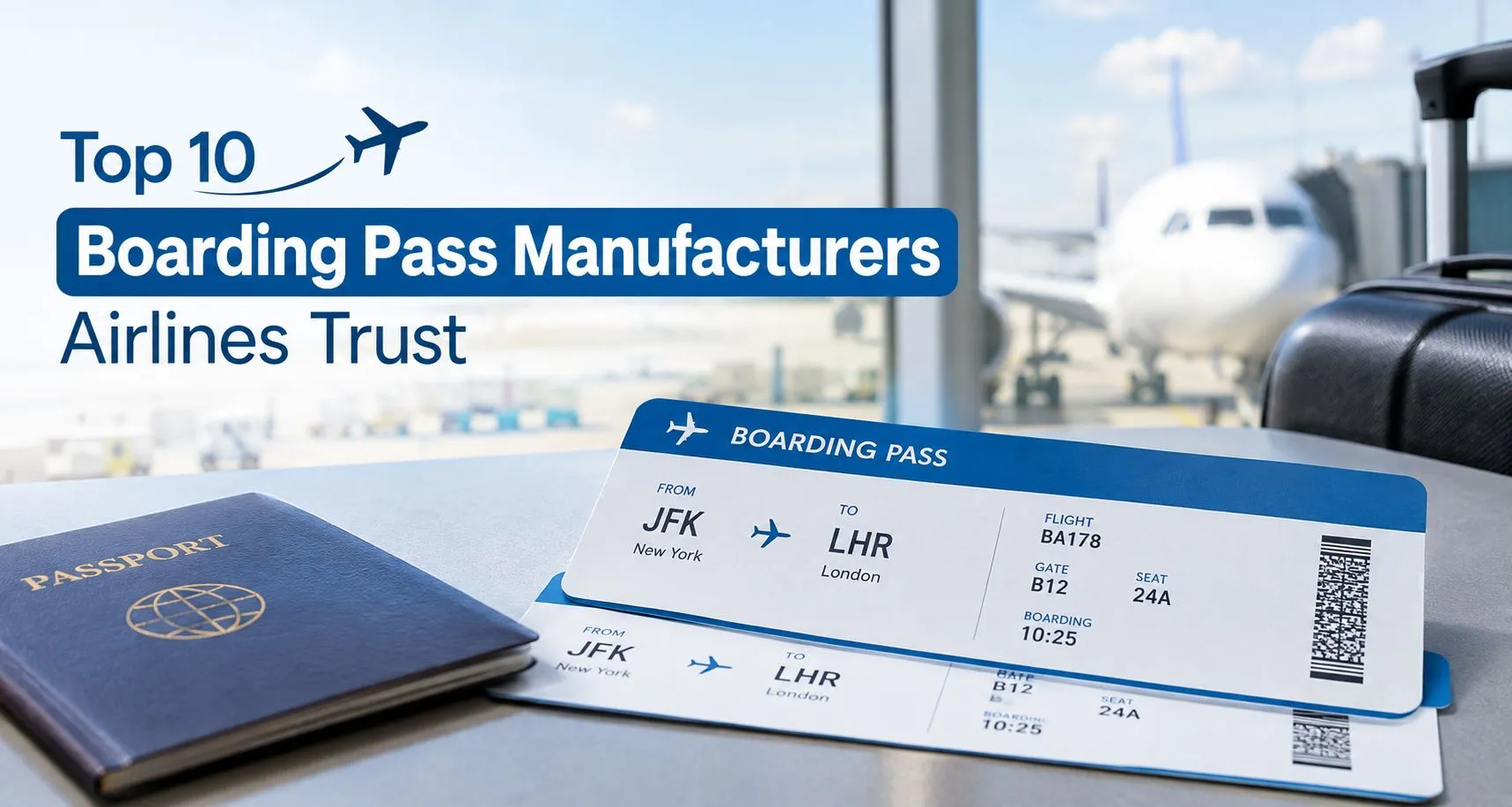
Every flight starts with a small piece of paper. It carries your name, your seat, and a barcode that decides if you get to board. That little slip matters more than it looks. If it jams the printer or the barcode won't scan, the whole check-in line stops moving. This is why picking the right boarding pass manufacturer matters more than most people realise.
We built this list to help airlines, airports, and travel companies compare their options. We looked at paper weight, printer compatibility, security features, and certifications. Some names below run large global factories. Others focus on one region. All ten show up when buyers search for reliable boarding pass manufacturers.
FormersPaper makes this list too, and we'll explain why later on. First, let's cover what actually separates a strong supplier from a weak one.
Not every paper company can produce a working boarding pass. The paper has to survive fast printers, tight schedules, and rough handling at the counter. Here's what to check before you sign a contract with a boarding pass manufacturer.
Boarding passes usually run between 126 and 175 GSM. Paper that's too thin slips inside the printer roller. Paper that's too thick can bend and jam the machine. A strong supplier keeps this weight steady across every batch.
Airport printers move fast, so the heat only touches the paper for a split second. The paper needs to react to that heat right away. Weak paper prints a grey, blurry image that a barcode scanner can't read.
Airports run printers from brands like Epson, Fujitsu, IER, Unimark, and VidTroniX. Each brand has its own speed, size, and resolution needs. A good factory tests its paper against these machines instead of guessing.
A clean cut lets the pass tear off without leftover dust or torn edges. A sloppy cut leaves debris inside the printer, and that debris causes jams down the line.
Airlines want to stop counterfeit passes. Features like sequential numbering, holograms, watermarks, and special inks help with that. A trustworthy company offers at least a few of these options.
Real certificates prove a factory follows real standards. Check for quality management and environmental certifications you can verify with the issuing body. Plenty of companies claim to be a top airline boarding pass manufacturer in China or elsewhere. Fewer can actually prove it on paper.
Most airport printers expect boarding passes cut to a few standard sizes. This matters because a boarding pass manufacturer can only guarantee a smooth print if the paper fits the machine correctly. Common widths include 187.3mm x 82mm, 203.2mm x 82mm, 187.3mm x 79mm, and 203.2mm x 79mm. Overall pass width usually falls between 54mm and 83mm, depending on the printer brand.
DPI, or dots per inch, is another number worth knowing. Most boarding pass printers run at 203 DPI. That's lower than some other thermal printers, but it's a deliberate trade-off. A higher DPI slows down print speed, and airport check-in counters can't afford to slow down. At 203 DPI, printers move fast while still producing a barcode sharp enough to scan on the first try.
Print speed matters just as much as size. Airport printers commonly print between 76mm and 254mm per second, depending on the brand and model. Epson, Fujitsu, IER, Unimark, and VidTroniX all build machines around this range, and each one expects paper that can keep up without smearing or fading.
This is where paper weight comes back into the picture. A boarding pass that runs too thin can slip inside the roller during fast printing. One that runs too thick forces the roller to push harder, which can cause the paper to bend and jam the machine. That's why the 126 to 175 GSM range shows up again and again across this list. A careful boarding pass manufacturer in China or anywhere else keeps that number steady from batch to batch.
Clean die cuts matter more at higher speeds too. A precise cut lets the pass tear off in one motion, without leaving dust or ragged edges behind. Dust buildup on a printer roller might sound minor, but over thousands of prints a day, it adds up fast. That buildup slows the roller down, throws off paper alignment, and leads to jams that stop the check-in line cold.
None of these numbers is complicated on their own. But together, they explain why some suppliers consistently print clean, scannable passes while others struggle with jams and blurry barcodes.
A lot of buyers start this search by looking at China first, and it's easy to see why. China has deep supply chains for paper coating, printing, and converting, often all under one roof. That's why so many procurement teams search for an airline boarding pass manufacturer in China before they look anywhere else. Still, not every factory that shows up in that search can back its claims with real paperwork. The checklist above matters no matter where a supplier is based, and it matters even more once you start comparing factories on price alone.
Below, we curated a top 10 boarding pass manufacturers list to help you find reliable suppliers offering durable and secure printing solutions.
FormersPaper is a vertically integrated boarding pass manufacturer with more than 30+ years in the paper trade. We coat, print, and convert our own paper instead of buying finished stock from someone else and relabelling it. We run five factories across China, the UK, and Indonesia. Together they cover roughly 3 million square feet of production and warehouse space. We also run over 600 pieces of production equipment.
Our facilities hold ISO 9001:2015, ISO 14001:2015, ISO/IEC 27001, OHSAS 18001, FSC, and RoHS certifications. That gives airlines proof instead of just a promise. Our in-house R&D team also holds more than 100 patents, which helps us keep improving paper performance for high-speed printing.
As an airline boarding pass manufacturer in China, we build our thermal boarding pass paper for barcode clarity and printer compatibility. We add sequential numbering, custom branding, and other security features to match an airline's exact needs. Since our factories sit across three continents, we can supply airlines in North America, Europe, the Middle East, Africa, and Asia without long shipping delays.
Telepaper is a Malaysia-based paper company with over 30 years of experience in thermal paper. It produces boarding passes between 126 and 175 GSM, with options for top-coated or non-top-coated paper. Telepaper also builds passes with a wallet, a magnetic strip, or neither, depending on what an airline needs.
Telepaper leans hard on printer testing, checking its paper against brands like Epson, Fujitsu Frontech, and IER. The company ships mostly to airlines across Asia and Oceania, including Thailand, the Philippines, Indonesia, Vietnam, Australia, and New Zealand.
Toppan is a large Japanese printing company with decades of experience in secure printing. It has long served industries that need tamper-resistant documents, including transport and travel paper products. Toppan's scale and security-printing background make it a name that comes up often in this space. Some airlines still list Toppan as a backup boarding pass manufacturer for print runs that need extra anti-counterfeit work. Boarding passes aren't the company's main product line, but the security-printing skill carries over.
Hansol Paper is a South Korean company known for producing thermal paper used in receipts, labels, and ticketing products. It has invested in eco-friendly thermal coatings over the years, which appeals to airlines with sustainability goals of their own. A handful of regional carriers in Asia list Hansol as a secondary boarding pass manufacturer. They turn to Hansol when order volumes spike during holiday travel.
Mitsubishi Paper Mills is a long-established Japanese paper company with a strong thermal paper division. It has decades of experience producing coated paper for point-of-sale and ticketing uses across the Asia-Pacific region.
Jujo Thermal is a Finland-based specialty paper company that focuses on thermal coatings for tickets, labels, and receipts. It serves clients across Europe and beyond, which makes it a name worth researching for airlines based closer to the EU. European carriers that want a boarding pass manufacturer within a shorter shipping distance often start their comparison with Jujo Thermal.
Oji Holdings is one of the largest paper manufacturers in the world. Its Kanzaki Specialty Papers division focuses on thermal and coated paper products. The company removed Bisphenol A from its thermal grades years ago as part of a broader push toward safer paper chemistry.
Appvion is a United States-based thermal paper producer with a long track record in the North American market. It supplies thermal paper for receipts, tickets, and other point-of-sale uses, and airlines based in North America often compare it against overseas suppliers. Shorter shipping times can make a domestic boarding pass manufacturer worth the extra look, even when overseas pricing looks better on paper.
Domtar's Iconex division supplies point-of-sale and thermal paper products across North America. The company grew its thermal paper business through acquisitions in recent years, expanding its footprint in the ticketing and receipt paper space.
Beyond the larger names above, China is home to many smaller converters that cut and finish ticket-grade thermal paper for regional airlines. These converters usually work with paper coated by someone else rather than coating it themselves. A boarding pass manufactuer in China at this smaller scale can work for lower order volumes, though they rarely match the certifications or output of a vertically integrated factory.
Certifications are not just stickers on a brochure. They prove that outside auditors checked the factory and confirmed it meets a real standard. When you compare an airline boarding pass manufacturer in China against one somewhere else, ask for certificate numbers and check them with the issuing body.
FormersPaper holds six certifications. ISO 9001:2015 covers quality management. ISO 14001:2015 covers environmental management. ISO/IEC 27001 covers information security. OHSAS 18001 covers workplace safety. FSC covers responsible sourcing. RoHS covers restricted hazardous materials. These certifications cover the full picture: quality, safety, environment, and security. A supplier that holds this full set has spent real time and money proving its process works. Ask for the certificate numbers directly. Check them against the issuing body's public database before you sign anything. A real boarding pass manufacturer will never hesitate to share that paperwork.
Picking a boarding pass manufacturer is not just about price. Here's a short checklist to run through before you commit to an order.
If a supplier hesitates on any of these points, take note. The right partner answers clearly and backs it up with paperwork. This matters even more with a smaller boarding pass manufactuer in China. Factory size and equipment can vary a lot from one converter to the next.
Out of the ten boarding pass manufacturers on this list, FormersPaper offers something a lot of buyers struggle to find in one place: full control over the entire process. We coat our own thermal paper, print it, and convert it into finished boarding passes, all inside our own factories. We don't outsource coating to a third party and then relabel the result.
We are an airline boarding pass manufacturer in China. We also run facilities in the UK and Indonesia. That spread lets us serve airlines across multiple continents without adding a middleman to the supply chain. Our certifications back up our claims instead of just repeating them. Does your airline need a boarding pass manufacturer in China with proven paperwork and global reach? We built our business for exactly that job.
Choosing a boarding pass manufacturer is a bigger decision than it looks. The paper you pick affects your check-in speed, your barcode scan rate, and how often your printers jam. Whether your airline flies out of North America, Europe, Asia, or anywhere in between, the right supplier should offer proof, not just promises.
FormersPaper has spent over 30+ years building the kind of vertically integrated production that airlines can rely on. Do you want a boarding pass manufacturer in China with real certifications and global factories? Reach out to our team for samples and a quote.
Most boarding passes run between 126 and 175 GSM. Many buyers find 130 to 170 GSM works best for fast, high-volume printers.
Most support Epson, Fujitsu Frontech, IER, Unimark, and VidTroniX, since these are common printer brands used at airport check-in counters.
No. Features like sequential numbering, holograms, and watermarks vary by supplier. Always ask before you order.
China has a large base of paper mills, coating facilities, and converters, which makes it easier to find an airline boarding pass manufacturer in China at competitive pricing with strong production scale.
A manufacturer usually coats and produces the base paper itself. A converter buys finished paper and cuts or prints it. A vertically integrated boarding pass manufacturer, like FormersPaper, does both under one roof.
Check their certifications, ask for a sample print run, and confirm their paper works with your printer brand before placing a large order.
Some airlines split large orders between two boarding pass manufacturers to protect their supply chain in case one factory runs into delays. This is common practice for bigger carriers with multiple hubs.


Formers Paper is a leading manufacturer for a comprehensive range of sustainable paper & packaging products serving customers globally.
Shenzhen Formers Paper Co. Ltd, No.92 Zhugushi Road, Wulian community, Longgang District, Shenzhen, China