We wish you Happy Holidays & a joyful New Year!

FormersPaper helps airlines and airports choose the right boarding pass manufacturer—focus on quality, security, durability, and reliable supply.
July 28, 2026
John Doe
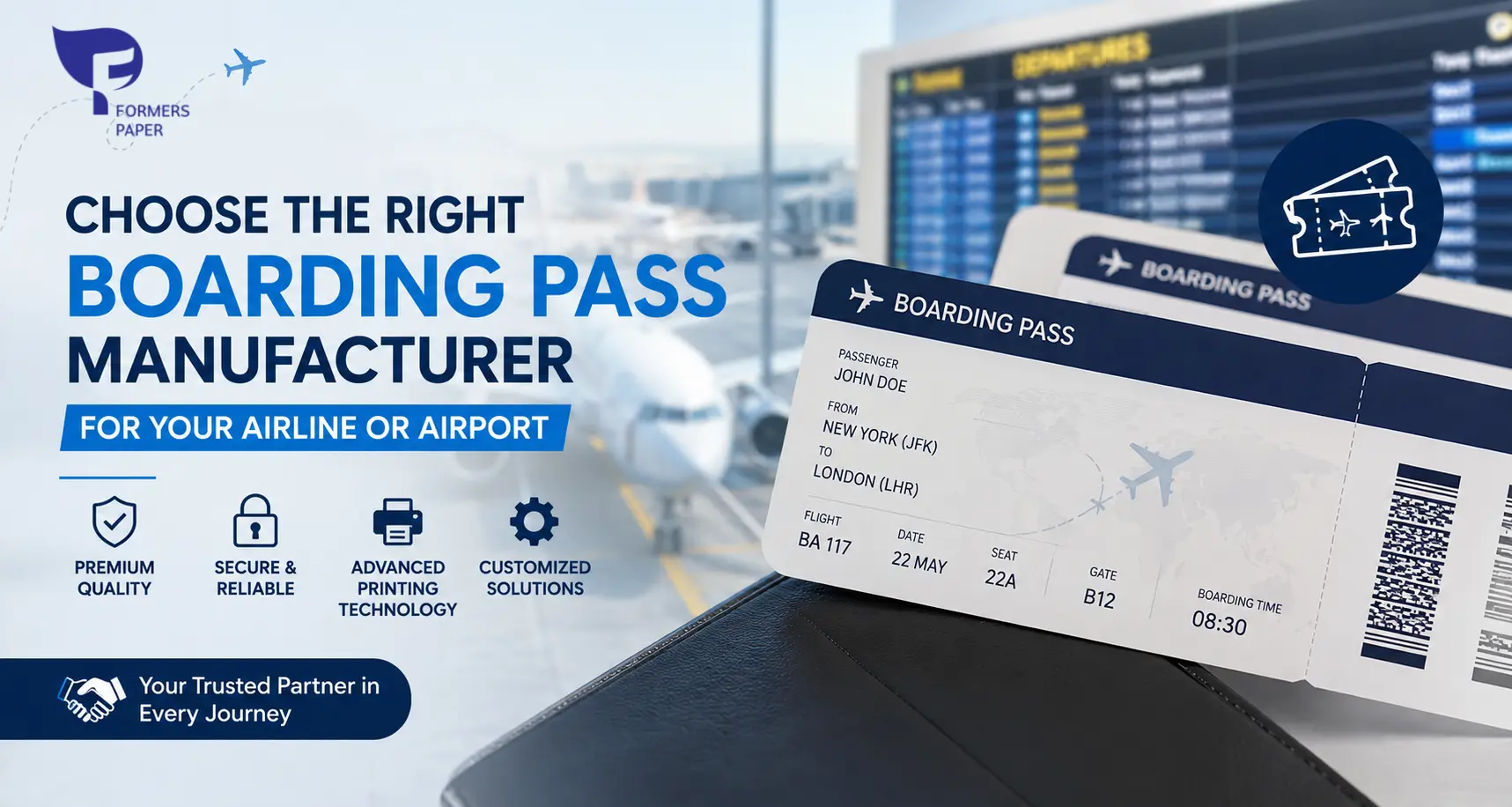
Every flight begins with a simple but essential document: the boarding pass.
It may look like just a small piece of paper, but it plays a critical role in the airport experience. It confirms passenger information, displays seat and flight details, carries a scannable barcode, and helps passengers move smoothly from check-in to the boarding gate.
Behind every reliable boarding pass is a professional boarding pass manufacturer with the technology, experience, and production capabilities to deliver consistent quality at scale.
For airlines and airports, choosing the right supplier is an important operational decision. A poorly manufactured boarding pass can cause printer jams, unclear barcodes, paper dust, scanning issues, and unnecessary delays at check-in counters and boarding gates. A reliable supplier, on the other hand, helps keep airport operations efficient and passengers moving.
This is why airlines and airports need to carefully evaluate their options before choosing an airline boarding pass manufacturer. In this guide, we explain what a boarding pass manufacturer does, what makes a high-quality boarding pass, what to look for in a supplier, and why FormersPaper is a trusted manufacturing partner for airlines and transportation businesses worldwide.
A boarding pass manufacturer produces the specialized paper materials and finished products used for airline boarding passes. This includes the paper stock, thermal coating, printing, lamination, die-cutting, folding, and other finishing processes required to create a boarding pass that performs reliably in airport environments.
While the final product may look simple, manufacturing a reliable boarding pass requires careful attention to detail.
The paper must:
Airports and airlines often use high-volume printers that produce hundreds or thousands of boarding passes every day. If the paper is too thick, too thin, poorly cut, or not properly coated, it can lead to jams and operational problems.
That is why choosing an experienced airline boarding pass manufacturer is about much more than purchasing paper. It is about selecting a manufacturing partner that understands airport operations, printing technology, product security, and the importance of consistent supply.
Modern airlines use several different boarding pass formats. A reliable boarding pass manufacturer should understand the requirements of each format and support the operational needs of different airlines and airports.
Traditional paper boarding passes remain widely used around the world.
They are typically printed at airport check-in counters, self-service kiosks, or airline service desks. The boarding pass usually includes important passenger and flight information, along with a barcode that can be scanned at security checkpoints and boarding gates.
Paper boarding passes can also provide valuable branding and marketing space. Airlines can use the reverse side to promote:
This makes a boarding pass more than an operational document. It can also become a valuable touchpoint between the airline and its passengers.
Mobile boarding passes have become increasingly popular as more passengers check in using smartphones.
Passengers can receive their boarding passes through an airline app, email, or mobile message. The digital pass contains a scannable barcode that can be read directly from a phone screen.
Mobile boarding passes help airlines reduce paper usage and improve the digital check-in experience. However, paper boarding passes remain essential for many passengers and airport operations, which is why high-quality physical boarding pass materials continue to play an important role in the aviation industry.
Print-at-home boarding passes allow passengers to receive their boarding pass digitally and print it before arriving at the airport.
This can help reduce waiting times at check-in counters and make the airport experience more convenient. It also reduces the pressure on airport printing infrastructure.
Whether an airline uses traditional counter printing, self-service kiosks, mobile boarding passes, or print-at-home options, the right boarding pass manufacturer can help support the physical printing requirements of the entire passenger journey.
Not every boarding pass is manufactured to the same standard. For airlines and airports, product quality directly affects operational efficiency.
Here are some of the most important factors to consider when choosing a boarding pass manufacturer.
Paper weight, commonly measured in GSM, plays an important role in printer performance.
Paper that is too thin may not feed correctly through the printer. Paper that is too thick may create unnecessary friction and increase the risk of jams.
The correct paper weight ensures that the boarding pass moves smoothly through the printing system while maintaining the right level of durability.
Many boarding passes need specialized thermal card stock that comes with a high-performance top coating. Boarding passes undergo rigorous handling, they are held in hands, stuffed into pockets, exposed to rain/spills, rubbed against luggage, or stuck with adhesive baggage/security tape.
A high-quality top coat ensures that the thermal paper becomes:
Historically, many oil- and water-resistant coatings relied on PFAS (Per- and Polyfluoroalkyl Substances) or "forever chemicals." Modern international airport standards and environmental regulations increasingly mandate 100% PFAS-Free boarding passes.
Leading boarding pass manufacturers utilize advanced PFAS-Free top-coating formulations. This guarantees full water, oil, friction, and tape resistance while keeping the products non-toxic, recyclable, and compliant with global environmental laws (such as EU REACH, U.S. State PFAS bans, and IATA environmental guidelines).
Many airport boarding pass printers use thermal printing technology.
Instead of using traditional ink, thermal printers use heat to create the printed image. The thermal coating on the paper must react quickly and consistently to produce clear text, graphics, and barcodes.
High-quality thermal paper helps ensure:
Poor-quality thermal paper may produce faded or unclear printing, which can affect barcode scanning and create delays at airport checkpoints.
Boarding passes must be cut and finished accurately to match the requirements of the printer and the final format.
Poorly cut paper can create:
Over time, paper dust and debris can affect printer rollers and printheads. Precise die-cutting helps maintain cleaner equipment and more reliable printing performance.
Barcode performance is one of the most important aspects of a boarding pass.
A boarding pass may have excellent paper quality, but if the barcode cannot be scanned quickly and accurately, it can still create problems at security checkpoints and boarding gates.
The printing process must deliver:
A professional boarding pass manufacturer understands that barcode quality is not an optional feature. It is essential to the passenger journey.
Airports use different types of printers and printing systems.
Before selecting a supplier, airlines should confirm that the boarding pass material is compatible with their existing equipment. A reliable manufacturer should be able to provide samples for testing and help ensure that the final product performs correctly with the customer's specific printing system.
Many international airlines and airport suppliers work with an airline boarding pass manufacturer in China because of the country's strong manufacturing infrastructure and large-scale production capabilities.
A professional manufacturer in China can offer several advantages, including:
Airlines may require significant quantities of boarding passes throughout the year. Large-scale factories can support high-volume production while maintaining consistent quality.
Large manufacturing facilities can often achieve greater production efficiency through:
For airlines ordering large quantities, even small savings per unit can create significant annual cost benefits.
Experienced manufacturers serving international customers often have established export and logistics systems. This helps support regular supply programs for airlines, airports, and transportation companies in different regions.
However, price should never be the only consideration when choosing a boarding pass manufacturer in China.
Airlines should also evaluate:
The right supplier should offer a combination of quality, scale, consistency, and long-term reliability.
FormersPaper is a professional boarding pass manufacturer serving airlines, airports, and transportation businesses around the world.
With vertically integrated manufacturing capabilities, FormersPaper manages key processes including PFAS-Free barrier coating, protective top coating, laminating, printing, and converting across its manufacturing facilities in China, the UK, and Indonesia.
This level of production control helps reduce unnecessary supplier handoffs and supports greater consistency throughout the manufacturing process.
For airlines and airports, this means a reliable manufacturing partner capable of supporting both product quality and large-scale supply requirements.
FormersPaper boarding passes are manufactured with a focus on durability, print quality, and operational performance.
Depending on customer requirements, boarding passes can be customized according to:
This allows airlines to select a boarding pass solution that matches their existing airport equipment and operational processes.
Boarding passes carry sensitive passenger and travel information, which makes product security and manufacturing quality extremely important.
FormersPaper has obtained a range of international certifications and compliance standards, including:
These certifications reflect FormersPaper's commitment to quality management, responsible production, information security, workplace standards, and environmental responsibility.
FormersPaper operates five manufacturing facilities supported by more than 600 pieces of advanced production equipment.
The company also has an in-house R&D team with more than 100 patents, supporting continuous product development and manufacturing innovation.
With more than 15 years of experience in the paper manufacturing industry, FormersPaper has developed the production knowledge and infrastructure needed to serve both regional airlines and large international transportation businesses.
FormersPaper's capabilities extend beyond airline boarding passes.
The company also manufactures a wide range of specialized paper and ticketing products, including:
For airlines and airport operators, working with a supplier that can provide multiple products can simplify procurement and reduce the need to manage several different manufacturing partners.
A boarding pass is an operational document, but it can also be an important branding opportunity.
With the right customization options, airlines can use boarding passes to create a stronger connection with passengers.
Customization may include:
For example, an airline may use the back of a boarding pass to promote a new destination, encourage loyalty program registrations, or introduce passengers to additional travel services.
FormersPaper can support customized boarding pass formats and designs based on an airline's specific requirements.
Whether a carrier needs a compact regional boarding pass or a larger format for international travel and connecting flight information, the right manufacturing partner should be able to provide a flexible solution.
Before signing a contract with a boarding pass manufacturer, airlines and airports should carefully evaluate the supplier.
Here are some of the most important questions to ask.
Product Quality: Request product samples and test them with your own printing equipment before placing a large order.
Printer Compatibility: Confirm that the paper and boarding pass format are compatible with your specific printer models and airport systems.
Customization Capabilities: Check whether the supplier can support your required size, design, branding, folding, and finishing specifications.
Security Features: Because boarding passes contain passenger and travel information, security and tamper resistance should be carefully considered.
Production Capacity: Make sure the supplier can support your regular requirements as well as peak travel periods and unexpected demand increases.
Certifications: Ask for documentation related to quality, environmental, information security, and material compliance certifications.
Delivery Reliability: Consistent supply is essential for airlines. Ask about standard lead times, production planning, shipping capabilities, and how the supplier handles urgent requirements.
The best boarding pass manufacturer is not necessarily the one offering the lowest price. It is the one that can provide the right balance of quality, reliability, customization, capacity, and long-term support.
Airlines and airports need boarding passes that perform reliably every day.
A quality boarding pass should feed smoothly through printers, produce clear and scannable information, withstand normal passenger handling, and arrive consistently when it is needed.
FormersPaper combines:
Whether you are a regional airline, an international carrier, an airport operator, or a transportation service provider, FormersPaper can provide reliable boarding pass solutions designed around your operational needs.
Choosing the right boarding pass manufacturer is an important decision for every airline and airport.
The right supplier can help reduce printer problems, improve barcode reliability, maintain consistent product quality, and support smooth passenger movement from check-in to boarding.
While many airlines choose to work with an airline boarding pass manufacturer in China because of the country's manufacturing scale and competitive production capabilities, the most important factor is finding a supplier that combines cost efficiency with dependable quality.
FormersPaper brings together advanced manufacturing, international certifications, extensive production capabilities, and more than 15+ years of industry experience to support airlines and transportation businesses around the world.
From boarding passes and luggage tags to other specialized ticketing products, FormersPaper provides reliable manufacturing solutions designed for the demands of modern transportation.
Looking for a trusted boarding pass manufacturer for your airline or airport? Contact FormersPaper today to request product samples, discuss your requirements, or request a customized quotation.
A boarding pass manufacturer produces the paper materials and finished boarding pass products used by airlines and airports. This may include thermal paper, printing, laminating, die-cutting, folding, and customized finishing.
Building and managing an in-house manufacturing facility requires significant investment in equipment, raw materials, labor, and quality control. Working with an experienced manufacturer allows airlines to access specialized production capabilities without managing the entire manufacturing process themselves.
Many boarding passes use thermal paper because thermal printers can produce clear text, graphics, and barcodes quickly without traditional ink. The paper must also be designed to feed smoothly through high-speed airport printing equipment.
PFAS ("forever chemicals") are increasingly regulated globally due to health and environmental concerns. Opting for PFAS-Free top-coated boarding passes ensures that airlines achieve full water, oil, and tape resistance while staying eco-friendly and fully compliant with international trade and environmental laws.
Yes. An experienced boarding pass manufacturer in China can offer large-scale production capacity, competitive pricing, advanced manufacturing capabilities, and international supply support. Airlines should carefully evaluate quality certifications, production standards, and manufacturing experience before selecting a supplier.
Yes. Boarding passes can often be customized with different sizes, formats, folding styles, branding elements, logos, colors, promotional content, and other design requirements.
Airlines should look for relevant quality, environmental, information security, and material compliance certifications. Examples include ISO 9001, ISO 14001, ISO/IEC 27001, RoHS compliance, and FSC certification, depending on the manufacturer's products and operations.
Ask about the supplier's manufacturing facilities, production equipment, workforce, previous international orders, quality control systems, and ability to manage peak-season demand. A manufacturer with multiple facilities and significant production capacity is generally better positioned to support large and recurring airline orders.


Formers Paper is a leading manufacturer for a comprehensive range of sustainable paper & packaging products serving customers globally.
Shenzhen Formers Paper Co. Ltd, No.92 Zhugushi Road, Wulian community, Longgang District, Shenzhen, China