We wish you Happy Holidays & a joyful New Year!

Thick thermal paper for ticket applications: 100-180 GSM, top-coated or non-topcoated, built to stop jams and keep barcodes crisp. Request Quote.
October 14, 2026
John Doe
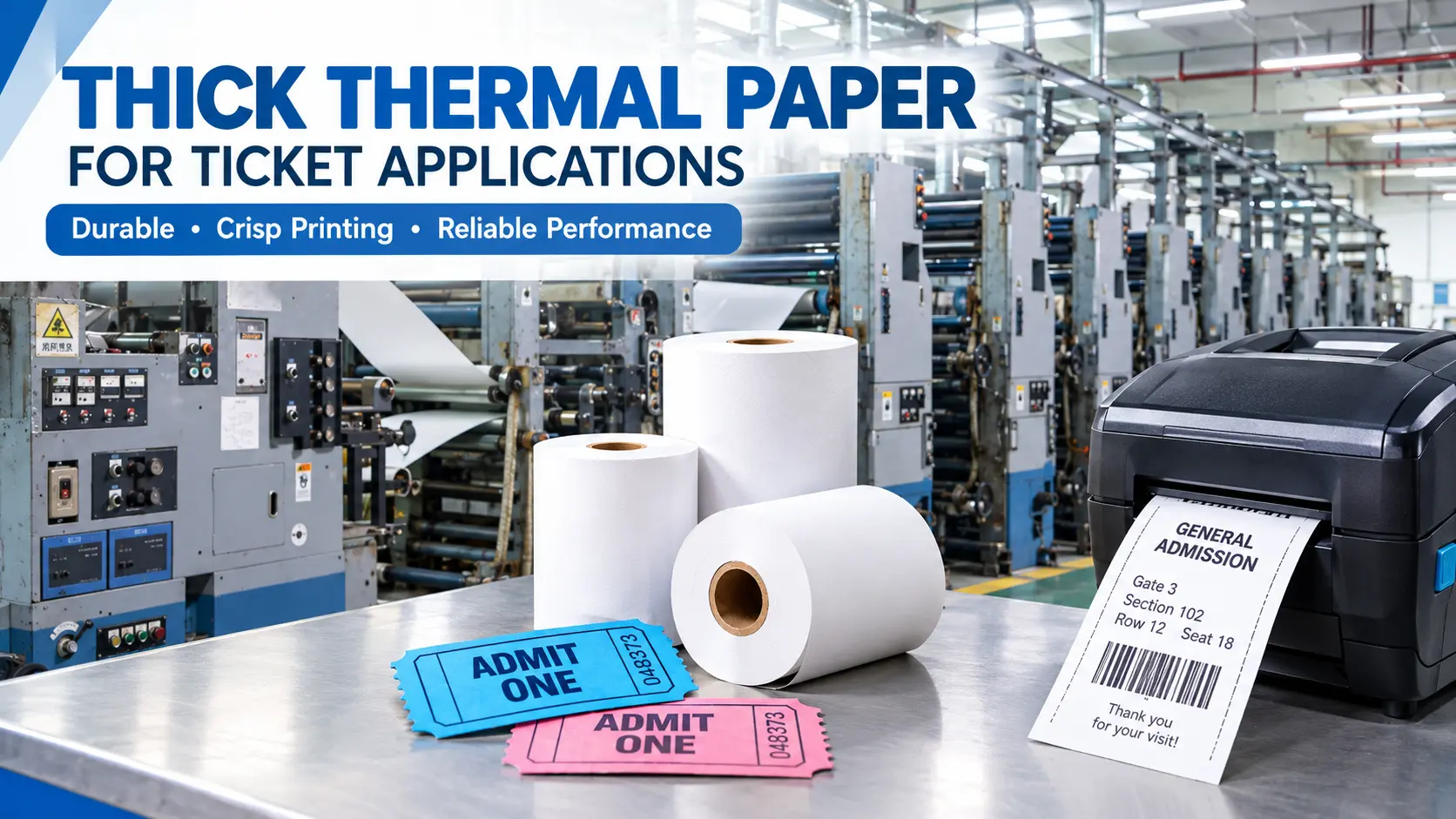
Every ticket tells a small story. It gets handed over at a gate, tucked into a pocket, folded in a bag, or squeezed in a crowded queue. If it tears, fades, or smudges along the way, the experience suffers, and so does your brand.
That’s why choosing the right paper matters. Thick thermal paper for ticket applications is built to handle exactly this kind of daily wear. It’s sturdier than standard receipt paper, feels more professional in the hand, and holds up well through scanning, bending, and handling. Whether you run a cinema, a transport service, a parking lot, an event venue, or an amusement park, thick thermal tickets help keep every print crisp and every barcode readable.
The best part? Thermal printing needs no ink or ribbons, so it’s faster, cleaner, and more cost-effective over time.
In this guide, you’ll learn what makes thick thermal paper different, where it works best, and how to pick the right thickness, coating, and quality for your ticket printing needs. If you want durable, high-quality ticket printing that looks good and lasts, you’re in the right place.
Thick thermal papers for ticket applications are heat-sensitive papers with extra weight and stiffness. A coating on the surface turns dark under the printer's hot head, so you need no ink, toner, or ribbon. The extra thickness helps tickets feed straight, survive rough handling, and keep barcodes easy to scan.
Numbers make the gap clear. Makers measure paper weight in GSM, which means grams per square meter. FormersPaper's standard receipt grades run about 48 to 55 GSM, and its high-sensitivity grades run about 55 to 65 GSM. Many thick ticket grades run from about 100 to 180 GSM. That is much heavier.
Thickness counts too. Makers measure it in micrometers. One human hair is roughly 70 micrometers wide, and many thick ticket grades run about 100 to 195 micrometers. Exact numbers change from grade to grade.
Using specialized thermal ticket paper offers distinct operational advantages over standard receipt paper:
Heavy weight and thick construction prevent tickets from tearing or fraying, even when exposed to moisture, friction, or rough handling by customers. Premium thick thermal paper for tickets ensures that passes maintain their shape throughout their lifecycle.
High-grade thermal coatings ensure crisp text, high-contrast barcodes, and sharp serial numbers that scan effortlessly on first pass. Investing in high-quality thermal paper eliminates barcode misreads and speeds up customer processing times at kiosks.
Thicker paper feeds smoothly through automated gates, ticket slots, and cutters without curling or causing frustrating machine jams.
From short-term event passes to long-lasting transit tickets, specialized thermal paper can be tailored with protective coatings to meet specific environmental demands.
A ticket gets handled far more than a receipt. Customers bend it, staff tear it, and machines pull it through slots, cutters, and gates. Thick thermal papers resist tearing and hold their shape. That makes durable thermal paper rolls more dependable where one jam stops a whole line.
Think about a toll booth at 8 a.m. Tickets pass from machine to hand to machine all morning. One weak batch can jam a printer, and the whole lane waits. The drivers in back cannot see the cause. They only see a stopped line. That is the job of thick thermal paper for ticket applications, to keep the line moving.
Thickness helps in three ways:
The paper feeds straighter through the printer path.
It resists tearing when people pull on it.
It curls less, so the scanner reads the barcode more easily.
Thick paper has one trade-off. A roll of the same size holds fewer meters of thicker paper, so you may change rolls more often. Most buyers accept that deal, because ticket applications thermal paper trades length for strength. Plan your roll changes before you order.
Learn how thick thermal paper for ticket applications provides durable, fade-resistant stock that prevents jams and keeps printing clear.
Paper Weight (GSM): Standard thermal paper runs lighter at 48 GSM - 65 GSM, while thick thermal ticket paper is much heavier at 100 GSM - 180 GSM.
Primary Applications: Standard paper is used for retail or ATM receipts, thick paper is built for parking passes, transit tickets, events, and gaming TITO.
Durability & Strength: Standard paper tears and curls easily under rough handling, whereas thick paper offers high tear resistance and maintains its shape.
Protective Coatings: Standard paper is rarely top-coated, while thick ticket stock frequently features top-coating to block water, oil, and sun exposure.
Roll Capacity: Standard paper rolls carry more total paper meters per diameter, while thicker rolls hold fewer meters due to increased paper density.
Thermal paper for tickets has layers. A base sheet gives strength. A pre-coat smooths the surface. The thermal coat makes the image. Some grades add a top-coat for protection and a back-coat for smoother feeding. Each layer changes how the ticket prints and how long the print lasts.
The thermal coat does the real work. It holds three parts: a color former, an acceptor, and a sensitizer. When the print head heats a tiny dot, these parts react and the dot turns dark. The top-coat works like a raincoat for the print. The back-coat cuts static and friction in fast printers.
Thick thermal paper for ticket applications uses these same layers. Here is the catch. Each maker builds its thermal paper grades with different coatings, so two rolls with the same weight can act very differently. Weight never tells the full story.
Pick top-coated thick thermal paper when tickets face water, oil, sunlight, or rough handling. Pick non-topcoated thick thermal paper when tickets stay indoors and live a short life. Both work well. They just solve different problems, and neither one wins every time.
Top-coated thick thermal paper has a thin protective film over the heat-sensitive layer. That film blocks things that ruin plain thermal paper: water, cooking oil, hand lotion, and plasticizers. Plasticizers are chemicals that keep plastic soft. They hide in some wallets, card sleeves, and clear tape. A top-coated thick thermal paper handles that contact better.
Non-topcoated thick thermal paper skips the film. It suits tickets that start and finish their life in one dry place, like an event hall. Real jobs use both types of thick thermal paper for tickets.
FormersPaper's car park tickets use thermal top-coated and non-top-coated grades that follow OEM specifications. OEM means the maker of the printer or gate. When you choose thermal paper for tickets, use this quick rule:
Will the ticket sit in a hot car or ride in a damp pocket? Choose top-coated thick thermal paper.
Will it end its life at the end of the night? Non-topcoated thick thermal paper may do the job.
If you feel unsure, test both on your own printer.
Selecting the right grade requires matching your operational environment with technical specs:
Check Paper GSM and Thickness- Ensure the GSM (100-180 GSM) matches your durability requirement without exceeding your printer’s maximum paper slot capability.
Consider Thermal Sensitivity and Print Quality- Evaluate dynamic sensitivity (print speed) versus static sensitivity (heat resistance in hot environments).
Check Printer Compatibility- Verify that roll dimensions, core sizes, and sensor mark locations align with your hardware.
Evaluate Paper Strength and Durability- Determine if your application requires top-coated stock to protect against water, oils, and physical abrasion.
Every spec sheet lists a few key numbers: weight, thickness, sensitivity, image density, and image stability. Learn what each one means, and you can compare thermal paper grades from any supplier in minutes. Ask for all of them in writing before you order thick thermal papers for ticket applications.
Weight (GSM): This tells you how heavy and stiff the paper feels.
Thickness: This tells you whether the paper fits your printer's slot and cutter.
Dynamic sensitivity: This tells you how dark the print looks at full printing speed. Higher sensitivity gives darker prints with less heat.
Static sensitivity: This tells you how hot the paper must get before it starts to darken. Highly sensitive paper can darken early in a hot warehouse.
Maximum density: This tells you how dark the darkest print can look. Dark prints help barcodes scan the first time.
Image stability: This tells you how long the print lasts under heat, light, and humidity. Ask what test conditions the supplier used.
With thick thermal papers, check weight and thickness first, because they decide whether the paper fits your printer. Notice the tension between two other numbers. Higher sensitivity prints darker, but it also reacts sooner to heat. Your climate decides which one matters more.
Thick thermal papers suit any ticket that needs strength and a clean print. Parking, toll, event, airline, gaming, and lottery tickets all fit. FormersPaper's Tickets page lists car park tickets, gaming TITO tickets, lottery tickets, boarding passes, event tickets, toll tickets, and airport luggage tags.
Gates run all day, and tickets often sit on hot dashboards. These jobs often call for top-coated thick thermal paper that follows the OEM specs for the gate printer. FormersPaper lists airports, shopping malls, and public car parks among its uses.
TITO means ticket in, ticket out. One machine prints the ticket, and another machine reads it later. FormersPaper's gaming tickets have IGT approval for EZ-Pay systems, and they work with TransAct, FutureLogic, and Nanoptix printers.
Lottery tickets carry money, so they need extra protection. FormersPaper lists sequential numbering, perforation lines, hot stamping foil, anti-counterfeit technology, and hologram labels for these tickets.
FormersPaper describes its boarding passes as tamper-proof. Its event tickets come in a standard 5.5 inch by 2 inch size, with optional perforations, sequential numbering, and barcodes.
Across all these jobs, thick thermal papers do the same basic work. They hold a sharp print while people and machines handle them. Good ticket applications thermal paper makes that look easy.
Bulk buyers across several sectors benefit from sourcing Durable Thermal Paper Rolls:
Ticket Printing Companies: Converters requiring dependable raw thermal stock for customization.
Thermal Paper Distributors and Wholesalers: Suppliers seeking consistent inventory and fast turnaround.
Transportation and Parking Service Providers: Operators managing transit gates, toll booths, and parking facilities.
Event Management Companies: Organizers needing reliable passes for sports, concerts, and expos.
Weather changes how thermal paper for tickets ages. Heat and sun can darken or fade the coating, while cold and condensation hurt handling and print quality. Buyers in the Caribbean, Mexico, Canada, the USA, and China face different risks, so match thick thermal papers for ticket applications to your climate, not only your printer.
The Caribbean: High heat, humidity, and strong sunlight hit tickets on docks and delivery trucks. Top-coated grades often earn their place here.
Mexico and the southern USA: Hot warehouses and loading areas raise the risk of fading.
Canada and the northern USA: Freezing temperatures and condensation cause trouble. A cold box that moves into a warm room can collect moisture.
China export shipments: Tickets may spend weeks inside shipping containers, so durability matters from day one.
Storage matters just as much for thick thermal papers. FormersPaper's own guidance says to keep rolls sealed in their original wrap and store them between roughly 68°F and 77°F (20°C and 25°C). Keep them away from radiators, printers, and sunny windows.
Heat-sensitive coatings on thick thermal paper for ticket applications need a developer chemical, and some developers contain BPA, short for bisphenol A. Bisphenol-free thermal paper avoids that chemical. Non-phenol thermal papers avoid phenol-based developers altogether. Staff touch ticket applications with thermal paper all day, so many buyers now ask for one of these options.
Start with one simple question: is this bisphenol-free thermal paper, and which developer does it use? Then ask for a written declaration. Some regions limit certain coating chemicals, so check the rules where you sell.
FormersPaper makes BPA-free formulations and offers written phenol-free declarations on request. Its Enviroprint thermal paper uses a zero-phenol formula that the team lab-tests. Ask the team which of these options, including non-phenol thermal papers, come in the ticket thickness you need. You can also read the guide to BPA-free thermal paper suppliers.
Non-phenol thermal papers and bisphenol-free thermal paper do not mean exactly the same thing. Ask for the exact wording, then compare it to the paperwork.
Good thermal paper for tickets does more than print black on white. Thick thermal papers can carry pre-printed artwork, serial numbers, barcodes, perforations, and anti-counterfeit marks. Tell your supplier early which features you need, because they change the paper, the ink, and the press.
Printers often add artwork with UV-flexo or UV-offset presses before the thermal print happens, so ask which inks suit your grade. Many also use black sensor marks on the back, so the machine knows where to cut. Sequential numbering gives you an audit trail, and barcodes let a gate or kiosk read the ticket in a blink.
Strong features still need good paper underneath. Even a perfect hologram cannot save a ticket that fades before the customer reaches the gate. That is why thick thermal papers for ticket applications come first, and the extras come second.
Before you order thermal paper for tickets, write down five facts: your printer model, ticket size, ticket life, weather, and extra features. Share them with your supplier. That short list helps a manufacturer recommend the right grade.
Printer or kiosk model: The paper must match your printer's slot, cutter, and sensors.
Size and format: Give your ticket size, roll width, core size, and roll length.
Ticket life and place: Name how long the ticket lasts, where you use it, and how it ships.
Coating type: Decide between top-coated and non-topcoated.
Developer: Ask for bisphenol-free thermal paper or non-phenol thermal papers if your staff or local rules call for it.
Extras and paperwork: List numbering, barcodes, perforation, and security marks, and ask for certificates that match your order.
Then do the test most buyers skip. Test thick thermal papers for ticket applications on your real printer. Print real tickets and scan them. Leave a few in a hot car and a few in a cold room. A sample costs little, and a failed bulk order costs a lot. Buyers also pick on price alone, skip the sample, and forget storage. Ticket applications thermal paper rewards the buyer who tests first.
Partnering with an experienced Thermal Paper Manufacturer guarantees that every roll meets strict international manufacturing standards. A direct manufacturer that coats its own paper offers full control over quality and formulation:
Consistent Paper Quality: Automated coating lines maintain precise GSM and micrometer standards across every production batch.
Custom Paper Specifications: Ability to order tailored roll widths, core sizes, black sensor marks, and security features.
Reliable Bulk Supply: High production capacity ensures long-term contract fulfillment without sudden stockouts.
Competitive Pricing and Technical Support: Buying factory-direct reduces intermediary markups while giving you access to technical support for printer compatibility.
FormersPaper delivers quality, consistency, and manufacturing expertise you can trust.
With over 30+ years of industry experience, FormersPaper offers vertically integrated manufacturing, managing coating, laminating, printing, and converting in-house. This ensures greater production control and consistent product quality for demanding ticket applications.
With five factories across China, the UK, and Indonesia, over 600 machines, and an R&D team holding more than 100 patents, we have the capabilities to support diverse business requirements.
Our ISO certifications, FSC certification, and RoHS compliance further demonstrate our commitment to quality, responsible sourcing, and industry standards.
Whether you serve customers in the USA, Canada, Mexico, the Caribbean, or other markets, we help you find the right thermal paper solution for your needs.
Ready to upgrade your ticket printing? Share your ticket dimensions, printer model, and application with FormersPaper. Request samples and discover the right thick thermal paper for your business
Good tickets start with good paper. Sourcing High-Quality Thermal Paper prevents machinery jams, speeds up entry lanes, and protects your brand image. If you want to see how Thermal Ticket Paper performs on your own gate, kiosk, or printer, request a quote from FormersPaper. Share your specs for your ticket applications thermal paper order, and the team will help you pick a grade and send samples to test.
For heavy-duty tickets, 100 to 180 GSM is ideal. This weight gives thermal ticket paper extra stiffness to feed smoothly through gates and avoid printer jams.
Yes. Heavy stock resists tearing, folding, and moisture better than receipt paper. FormersPaper produces durable grades that keep barcodes crisp and readable for fast gate scanning.
No. Regular desktop POS units handle up to 80 GSM stock. Heavy durable thermal paper rolls require industrial kiosk printers with stronger cutters and wider feed slots.
Thick stock offers 100-180 GSM weight, higher tear strength, and protective top-coatings against heat, oil, and water, whereas regular receipt paper is much thinner and un-coated.
Select a direct factory maker with certified eco-friendly coatings. FormersPaper supplies lab-tested, phenol-free paper with custom specs and sample rolls to verify performance on your hardware.


Formers Paper is a leading manufacturer for a comprehensive range of sustainable paper & packaging products serving customers globally.
Shenzhen Formers Paper Co. Ltd, No.92 Zhugushi Road, Wulian community, Longgang District, Shenzhen, China