We wish you Happy Holidays & a joyful New Year!

Parking & transit ticket printing: compare formats, certifications, and manufacturers to choose the right B2B supplier for your next order.
September 15, 2026
John Doe
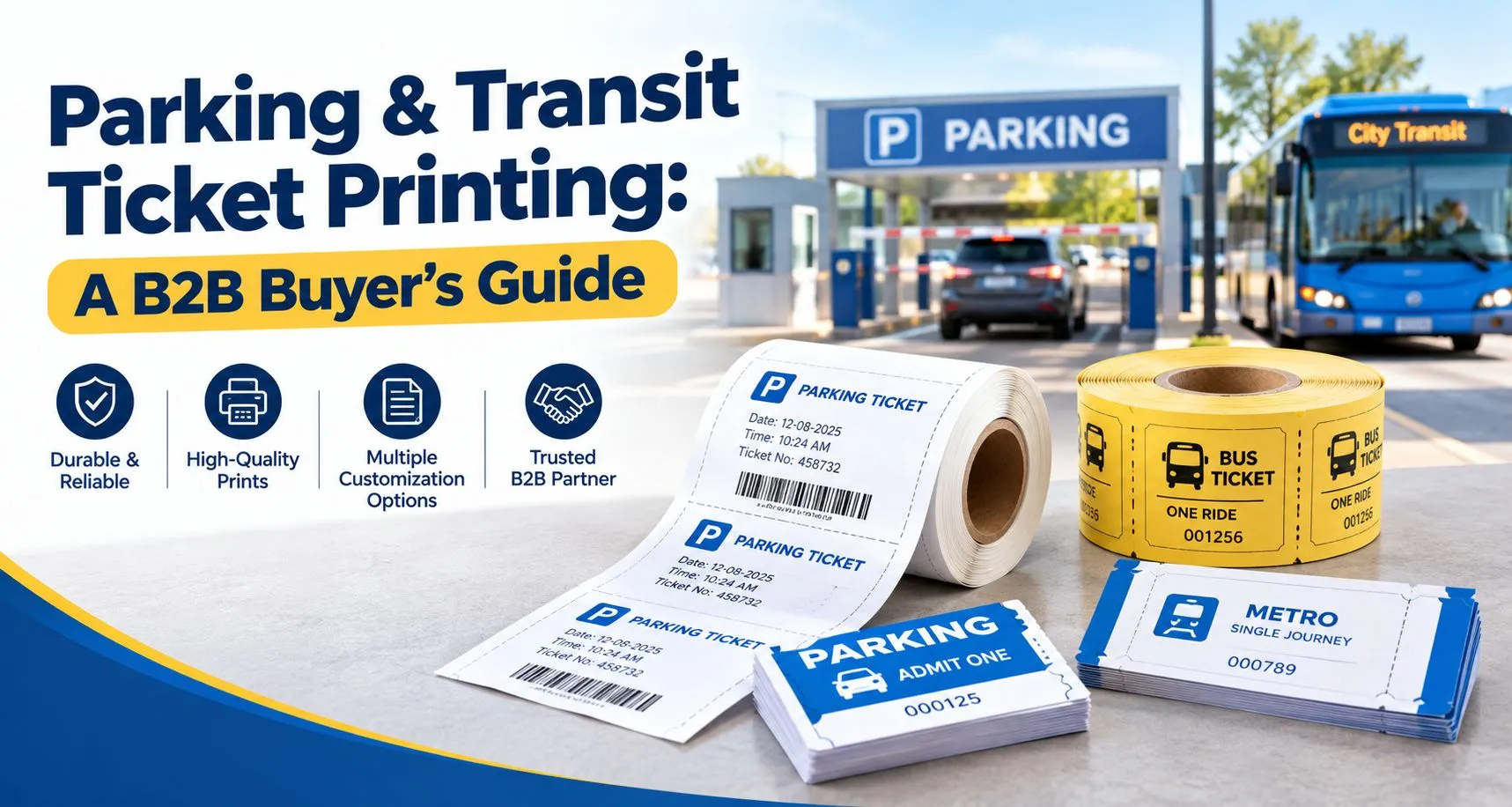
A parking gate that will not print. A transit kiosk that jams during the morning rush. A faded ticket is one a rider cannot scan at the platform. These small failures cause big problems for the businesses and agencies that run parking lots, garages, and transit systems every single day. That is why choosing the right parking ticket manufacturer matters as much as any other equipment decision you will make this year.
This guide breaks down everything a B2B buyer needs to know about parking & transit ticket printing, from the paper and printing technology behind every ticket to the certifications that separate a real manufacturer from a reseller. You will learn what printed parking tickets are made of, how transit ticket printing works at scale, and what questions to ask before you sign with any parking ticket supplier. We built this guide for procurement teams, facility managers, and transit operators across the United States, Canada, Mexico, the Caribbean, and China who need a dependable transit ticket printing supplier they can trust order after order. Along the way, you will see how FormersPaper operates as both a vertically integrated parking ticket manufacturer and a certified transit ticket printing manufacturer, not a company that simply resells someone else's stock.
Parking & transit ticket printing covers every physical ticket a business or agency issues to record a parking transaction or a transit fare. That includes entry tickets dispensed at garage gates, valet claim checks, bus and train fare tickets, event parking passes, and permit tickets used at gated lots. Each ticket type does a slightly different job, but they all share the same basic requirements: the print has to stay legible, the ticket has to survive handling, and the format has to work with the equipment that reads it.
For a B2B buyer, choosing a parking ticket manufacturer is not just a design decision. It is a manufacturing decision. The paper stock, the ink or thermal coating, and the press behind the job all work together to decide how the finished ticket performs once it leaves the factory and reaches your gate, your kiosk, or your driver's hand. A parking garage needs tickets that scan cleanly the first time. A transit agency needs printed parking tickets and fare tickets that hold up through thousands of daily taps and swipes. Getting this right starts with understanding the formats and the technology behind them, which is exactly what the next section covers.
The key points below outline essential ticket formats, manufacturer standards, quality certifications, and operational insights for B2B buyers:
Most parking ticket manufacturers today rely on one of three formats: direct thermal rolls, multi-part carbonless stock, or standard printed card stock for permits and passes. Knowing the difference helps you order the right stock the first time.
Direct thermal tickets use a heat-sensitive coating that reacts to a heated printhead, producing text and barcodes without ink or ribbons. This format dominates the output of most car parking ticket manufacturers because it is fast, requires no consumables beyond the paper roll, and works well in unattended kiosks running around the clock. The tradeoff is sensitivity to heat and sunlight, so a dashboard-exposed ticket can fade faster than one kept in a wallet. BPA-free thermal paper is worth specifying here, since some regions restrict standard thermal coatings and your staff may be handling these printed parking tickets throughout the day.
Multi-part carbonless tickets produce two or three simultaneous copies from a single entry, which is why valet operators and enforcement teams use them so often. One copy goes to the driver, and one stays on file. This format does not rely on heat, so it holds up better outdoors and over longer periods of storage.
Barcode and QR code tickets speed up exit and fare processing dramatically. A scanner that reads a code in under a second lets the gate open automatically, which matters most at busy transit stations, airports, and event lots where hundreds of people move through in a short window. Sequential numbering adds an audit trail, and security features such as void pantographs and serialised stock reduce the risk of counterfeiting.
A dependable transit ticket printing manufacturer will walk you through which format fits your equipment instead of pushing whatever stock happens to be sitting in the warehouse. Compatibility matters just as much as quality. If your gate hardware, kiosk printers, or turnstiles expect a specific paper width or barcode symbology, the wrong stock can cause read errors right at the point of entry.
Here is a scenario every procurement team has faced. Two suppliers quote nearly the same price for the same order. Six months later, one supplier's tickets still print dark and scan clean. The other supplier's stock has started jamming gates and fading in the sun. The paper looked identical on day one. The factory behind it was not.
This is the real difference between working with a genuine parking ticket manufacturer and working with a reseller. A vertically integrated parking ticket manufacturer controls its own coating, printing, and converting lines from raw material to finished roll. A reseller, by contrast, buys finished stock from someone else, adds a markup, and hopes the batch-to-batch quality holds. When something goes wrong, a reseller usually cannot tell you why, because it never touched the production process in the first place.
For B2B buyers ordering at volume, this distinction matters even more. A single bad batch from one of the many car parking ticket manufacturers competing for your business can multiply into a chain-wide problem the moment it reaches fifty gates, a hundred kiosks, or an entire transit line. Working with a manufacturer that owns its full production process, rather than one of the smaller car parking ticket manufacturers that simply broker stock, gives you a documented, testable process behind every roll and every carton that ships.
FormersPaper runs its production this way. As a parking ticket manufacturer with a fully vertically integrated model, FormersPaper controls coating, laminating, printing, and converting in-house across five factories, giving procurement teams a single accountable source instead of a chain of subcontractors.
Anyone can claim premium quality on a website. A certification means an outside body checked that claim and signed off on it. Before you commit to a parking ticket supplier, ask for the specific certificate names, not a vague "fully certified" answer.
Here is what to look for, and what FormersPaper's manufacturing facilities hold:
A real transit ticket printing supplier will hand over these documents without hesitation. A trader repackaging someone else's stock tends to change the subject or offer only general assurances. For B2B buyers sourcing parking ticket printing and transit ticket printing at scale, these named certifications are the difference between a documented, auditable supply chain and a guess.
Search online for parking ticket vendors, and you will find hundreds of results. Most sound similar on the surface. Few can actually prove production scale, and even fewer can serve B2B buyers with facilities spread across multiple countries.
Not every name that appears in a search for car parking ticket manufacturers runs its own factory. Some are traders who never touch a roll of paper before it ships. Others are genuine parking ticket manufacturers with certified facilities, documented production capacity, and a real research and development team behind every custom request. That gap between marketing claims and real production capacity is exactly why so many B2B buyers now vet suppliers by asking to see the factory, not just the certificate page.
FormersPaper falls firmly into the second group. As a parking ticket manufacturer with five factories and more than 600 pieces of production equipment, the company can support both standard orders and highly specialized custom requests without missing a delivery date. That structure is what lets FormersPaper act as a single, accountable manufacturer instead of a chain of subcontracted vendors. That combination of scale and accountability is exactly what separates a dependable long-term partner from a name you found on page three of a search result.
Printed parking tickets and transit fare tickets show up across a wide range of industries, and each one leans on a slightly different strength of the format.
Cities and transit agencies rely on parking and transit ticket printing for everything from metered lot tickets to bus and rail fares. Consistency across every station and every gate matters here, since a fare ticket that fails to scan in one location creates the same complaint everywhere else in the system.
Airport parking facilities move enormous volumes of vehicles in short windows, especially around holidays. Fast, reliable transit ticket printing and output from parking ticket manufacturers keeps exit lanes moving and reduces the customer service burden on staff.
Campuses and medical centers often run gated lots with permit-based access. Durable printed parking tickets that survive a full semester or a long hospital stay in a glove compartment reduce the number of replacement requests staff have to process.
Hotels, stadiums, and event venues use valet tickets, multi-part claim checks, and timed parking passes. Custom branding on these tickets reinforces the venue's identity while still functioning as a secure, numbered record.
Distribution centers and logistics yards use permit-style parking tickets to track vehicle access for drivers and visiting fleets, an application that overlaps with the same barcode and sequential numbering features used in retail and warehouse labeling.
Across every one of these industries, the underlying question is the same. Does the ticket simply need to record an entry, or does it also need to represent your brand, resist tampering, and hold up under real-world conditions? That answer decides which format and which parking ticket manufacturer is the right fit.
A comparison chart only gets a buyer halfway, since many parking ticket manufacturers list the same generic promises. Use this checklist before you commit to any parking ticket printing supplier.
Buyers who work through this checklist consistently end up with a transit ticket printing supplier that performs the same way on order one hundred as it did on order one.
Even the best press cannot save a ticket that is stored badly before use. A few habits protect printed parking tickets and transit stock from the moment they leave the factory:
A well-made ticket from a trusted manufacturer can hold its print quality for months or years when stored correctly. A ticket left in a hot loading dock or a sunny storage closet cannot perform well, no matter how strong the original print quality was.
Parking & transit ticket printing technology has changed a great deal over the past decade, moving toward better substrates, tighter color controls, and more secure formats. FormersPaper has built its production around this shift, running a fully vertically integrated model that covers coating, laminating, printing, and converting in-house.
This matters because parking ticket printing is only as reliable as the factory behind it. A press capable of sharp barcode detail means little if the substrate underneath it is inconsistent or if the facility cannot hold the same specification across a large order. FormersPaper runs five manufacturing factories with over 600 pieces of advanced production equipment, spread across roughly 3 million square feet of workshops and warehouses in China, the UK, and Indonesia. That scale gives FormersPaper, as a transit ticket printing manufacturer, the capacity to support both standard runs and highly customized orders without sacrificing consistency.
An in-house research and development team backs this production model, holding more than 100 patents that help solve custom requests instead of turning them away. For a B2B buyer, this means working with FormersPaper as your transit ticket printing manufacturer is not limited to a narrow catalogue of pre-approved templates. Non-standard sizes, specialty coatings, and application-specific finishes can be engineered to match the exact operational needs your parking facility or transit system brings to the table.
Businesses shopping among parking ticket manufacturers usually want the same four things: real production control, proof of certification, flexible specifications, and supply they can count on across every region they operate in. Many suppliers can promise one of these things. Very few can prove all four with certificates, equipment counts, and a multi-country supply chain.
FormersPaper delivers on all four. As a parking ticket manufacturer, the company controls its own coating, printing, and converting process across five factories and more than 600 pieces of production equipment. Certifications including ISO 9001:2015, ISO 14001:2015, ISO/IEC 27001, OHSAS 18001, FSC, RoHS, and BPI back every claim with a real, checkable document, setting FormersPaper apart from car parking ticket manufacturers that cannot produce the same paperwork.
What sets FormersPaper apart from other car parking ticket manufacturers and transit ticket printing manufacturers is reach combined with control. With manufacturing facilities across China, the UK, and Indonesia and direct supply lines into the USA, Canada, Mexico, and the Caribbean, FormersPaper supports B2B buyers who need the same parking ticket printing specification to show up correctly no matter which country receives the shipment. Few transit ticket printing suppliers can offer that same combination of scale, certification, and regional reach.
Ready to compare FormersPaper's parking ticket printing and transit ticket printing against your current supplier? Contact FormersPaper for samples, specifications, and a factory-direct quote on custom tickets.
Choosing the right parking ticket manufacturer is not about picking the biggest name on a search results page. It is about matching the format, the certifications, and the production model to what your parking facility or transit system actually needs. A gated employee lot does not need the same features as a high-volume transit station moving thousands of riders a day.
What does not change, regardless of which supplier a business chooses, is the importance of working with a manufacturer that controls its own production, holds real certifications, and can prove consistency across every batch. Reliable parking and transit ticket printing protects your bottom line just as much as it protects the driver or rider standing at your gate.
Before your next bulk order, run your shortlist of suppliers through the checklist covered in this guide. Ask for real samples, real certificate names, and real answers about who actually manufactures the parking ticket printing your operation depends on. Not every name among the many parking ticket manufacturers competing for your business will meet that bar, but the right parking ticket manufacturer will make it easy to verify from the very first conversation.
A parking ticket manufacturer produces the physical tickets used at parking garages, gated lots, and transit stations, including thermal rolls, multi-part carbonless tickets, valet claim checks, and permit-style passes. A genuine parking ticket manufacturer controls the coating, printing, and converting process in-house rather than reselling stock made elsewhere.
Thermal tickets use a heat-sensitive coating and a heated printhead to produce text without ink, which suits high-speed, unattended machine issuance. Carbonless tickets use pressure-sensitive layers to create simultaneous copies, which suit valet and enforcement workflows that need a customer copy and a retained copy.
Look for ISO 9001:2015 for quality management, ISO 14001:2015 for environmental management, RoHS for hazardous substance restrictions, and FSC for responsible sourcing. FormersPaper holds all of these, along with ISO/IEC 27001, OHSAS 18001, and BPI certification.
Yes. FormersPaper maintains manufacturing facilities and supply lines that serve the USA, Canada, Mexico, and the Caribbean directly, helping multi-country buyers keep ticket specifications consistent no matter where a shipment is headed.
Yes, though availability varies by supplier. Ask any parking ticket manufacturer you are considering for BPA-free documentation in writing rather than assuming it based on marketing claims.
Ask specific questions about their coating line, batch sizes, and production process. A genuine transit ticket printing manufacturer answers in detail and can walk you through its factory process. A reseller tends to grow vague quickly.
Municipal transit authorities, airports, hospitals, universities, hotels, stadiums, and logistics facilities all rely on this category, though each industry prioritizes different features such as durability, barcode accuracy, or branding.
Genuine car parking ticket manufacturers own their coating, printing, and converting equipment, which is why their pricing and lead times stay consistent order after order. A reseller buys finished stock from other manufacturers and adds a markup, which often means longer lead times and less control over quality when something goes wrong.
Bulk ordering from a single, certified parking ticket manufacturer reduces cost per ticket, keeps specifications consistent across every location, and simplifies reorders since the manufacturer retains your artwork and specifications on file.


Formers Paper is a leading manufacturer for a comprehensive range of sustainable paper & packaging products serving customers globally.
Shenzhen Formers Paper Co. Ltd, No.92 Zhugushi Road, Wulian community, Longgang District, Shenzhen, China