We wish you Happy Holidays & a joyful New Year!

How water-soluble labels work on reusable bottles, their benefits, industrial applications, and key specifications businesses should check before purchasing.
November 2, 2026
John Doe
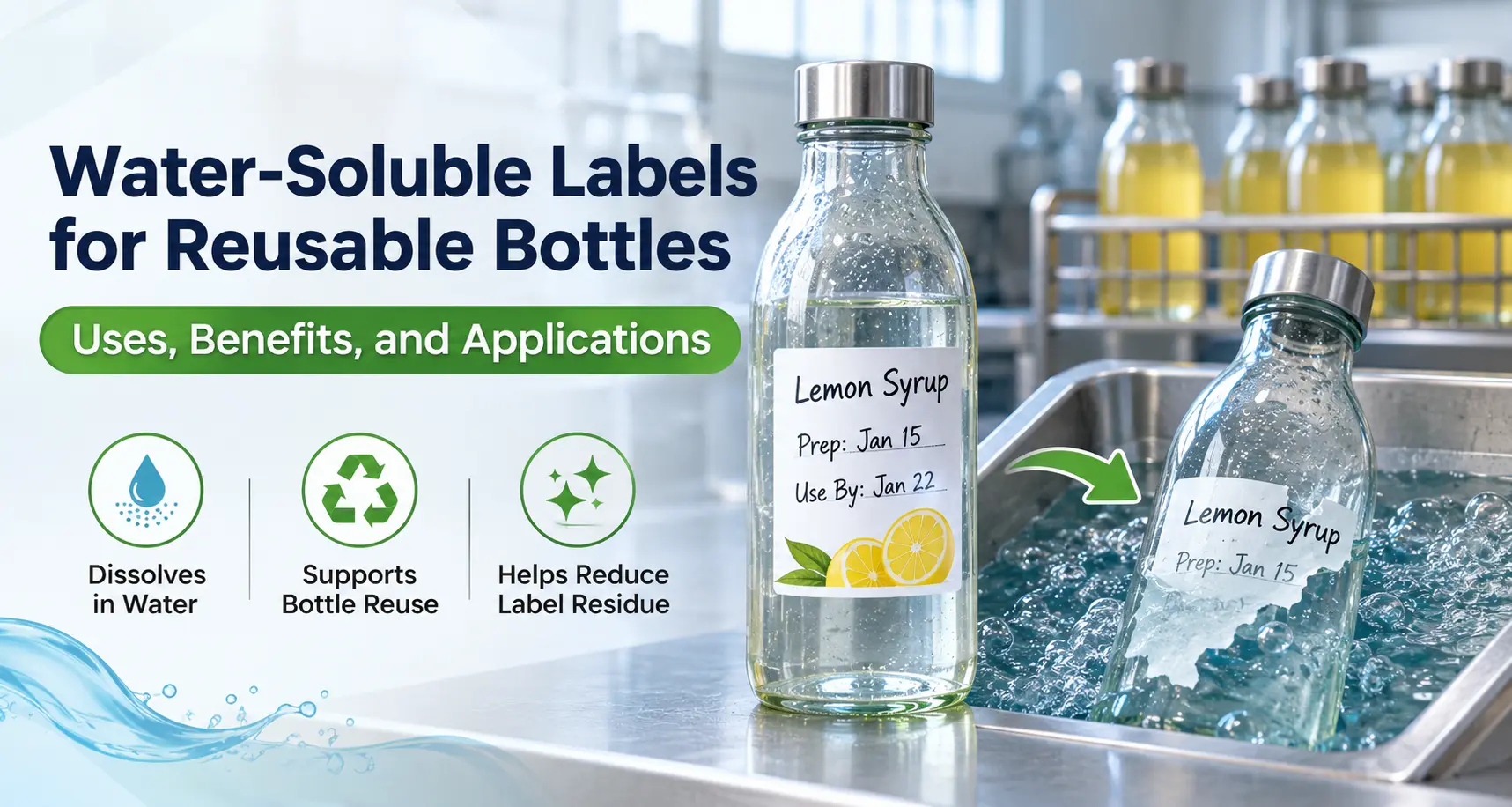
For beverage manufacturers, food processing companies, hospitality businesses, and packaging suppliers, cleaning and preparing reusable bottles is a regular part of daily operations. However, traditional labels and their adhesive residue can make this process more time-consuming than expected.
For beverage manufacturers, food processing companies, hospitality businesses, and packaging suppliers, cleaning and preparing reusable bottles is a regular part of daily operations. However, traditional labels and their adhesive residue can make this process more time-consuming than expected.
When bottles are reused several times, removing old labels often requires additional labour, scraping, soaking, or specialised cleaning. This can increase operating costs and delay the next production or filling cycle.
This is where water-soluble labels for reusable bottles offer a practical alternative.
Designed to dissolve when exposed to suitable water conditions, these labels can simplify bottle cleaning and reduce the effort involved in removing temporary product information. Depending on their material and adhesive composition, they can be useful for reusable glass bottles, food containers, kitchen storage bottles, and other applications where labels need to be removed regularly.
However, not every water-soluble label performs in the same way. Businesses must consider factors such as bottle material, moisture exposure, washing temperature, adhesive properties, and storage conditions before selecting a product.
In this guide, we explore how water-soluble labels work, their advantages, common industrial applications, and the technical specifications procurement teams should evaluate before placing bulk orders.
Whether you are a beverage manufacturer, food packaging company, hospitality supplier, or packaging distributor, understanding these factors can help you choose the right labeling solution for your operations.
Water-soluble labels are specially designed labels that break down or dissolve when exposed to suitable water conditions. Depending on the product construction, the label paper, adhesive, or both may dissolve during washing.
Unlike conventional pressure-sensitive labels, which are designed to remain attached to a surface, water-soluble labels are intended for applications where the label needs to be removed easily after use.
They are particularly useful for businesses that frequently reuse bottles and containers and need to replace temporary information such as preparation dates, batch numbers, product names, or contents.
A typical pressure-sensitive label consists of three main components:
For a fully water-soluble label, the facestock and adhesive are designed to break down in water. However, some products only have water-soluble adhesive, while their label material remains intact.
This distinction is important when selecting labels for industrial washing and reusable packaging applications.
Water-soluble labels are designed to remain attached under their intended dry-use conditions and dissolve or break down when exposed to suitable washing conditions.
When water comes into contact with the label, the facestock absorbs moisture and begins to soften. The adhesive also loses its bonding strength, allowing the label construction to break down.
The time required depends on several factors:
Warm water and sufficient agitation may help speed up the process. However, the actual performance should always be checked using product-specific test data.
These three label types are often confused, but they serve different purposes.
Water-soluble labels- The label material and adhesive are designed to dissolve or break down in water.
Wash-off labels- These are designed to release from the bottle during a specified washing process. The label face generally remains intact and can be separated through filtration.
Traditional permanent labels- These are designed to remain attached during normal use. Removing them may require soaking, scraping, or specialised cleaning.
For procurement teams, understanding this difference is essential. A label that releases from a bottle is not necessarily a label that dissolves completely.
Businesses should confirm exactly how the label behaves during washing before selecting a product.
Reusable packaging is widely used across beverage production, food preparation, hospitality, and industrial operations. While reusing bottles can reduce the need for single-use containers, it also creates a practical labeling challenge.
Old labels must be removed before bottles can be cleaned, refilled, or assigned new product information.
Traditional labels can leave adhesive residue behind, requiring additional cleaning and handling. Water-soluble labels provide an alternative for applications where temporary labeling and straightforward removal are important.
More businesses are exploring reusable packaging systems to improve material efficiency and reduce unnecessary packaging waste.
However, successful reuse depends on more than the bottle itself. Labels, adhesives, printing materials, and cleaning processes must also work together.
Selecting a suitable removable or water-soluble labeling solution can help businesses manage repeated bottle use more efficiently.
Permanent labels are not always suitable for containers that need frequent relabeling.
Adhesive residue can affect bottle appearance, increase cleaning time, and create difficulties during subsequent labeling.
Water-soluble labels can help reduce these challenges when the bottle's operating conditions match the label's intended performance.
A well-selected label makes it easier to manage temporary product information without creating unnecessary work during bottle preparation.
For businesses handling large numbers of reusable containers, even small improvements in label removal time can make daily operations more manageable.
Choosing the right label can make a difference in everyday packaging and cleaning operations. Here are some of the main advantages businesses may achieve with suitable water-soluble labels.
One of the main reasons businesses consider water-soluble labels is their removal performance.
Under suitable washing conditions, the label breaks down without requiring the same manual scraping associated with many permanent labels.
This can be particularly helpful in commercial kitchens, food preparation facilities, and other operations where containers are reused frequently.
Adhesive residue can create additional work during bottle cleaning.
Water-soluble adhesive labels are designed to break down under specified water conditions, helping reduce the possibility of leftover adhesive on the bottle surface.
Actual residue performance depends on the adhesive formulation and washing process, so businesses should verify it through sample testing.
Removing labels is an important step before reusable bottles can be cleaned and prepared for their next use.
When a suitable label dissolves during washing, staff may spend less time handling stubborn labels and cleaning adhesive residue.
This can help streamline bottle preparation, particularly in operations that process containers in large quantities.
Manual label removal can become a time-consuming task when hundreds or thousands of containers are processed regularly.
Using labels designed for easier removal may reduce the need for scraping and additional handling.
For businesses with high-volume bottle reuse operations, this can contribute to better labour allocation.
Scrapers and abrasive cleaning tools can leave marks on delicate glass and plastic containers.
Water-soluble labels may reduce the need for aggressive manual removal methods, helping businesses maintain the appearance of reusable bottles.
Labels are an important part of reusable packaging management. They carry temporary product details, identification information, and preparation dates.
A suitable water-soluble label can make it easier to replace this information during repeated reuse cycles.
However, businesses should evaluate the complete label construction and washing process before making sustainability claims.
Water-soluble labels are useful in industries where containers are frequently washed and relabeled. Their suitability depends on the container material, moisture exposure, and required label life.
Some common B2B applications include the following.
Beverage manufacturers and refill businesses often handle reusable bottles that need to be cleaned before refilling.
Water-soluble labels may be suitable for temporary identification, batch information, and internal handling requirements where the bottles remain dry during storage and use.
For chilled beverage bottles exposed to condensation or ice, businesses should consider alternative wash-off label constructions.
Glass bottles and jars are commonly used in food processing, hospitality, beverage packaging, and refill systems.
Water-soluble labels can be considered for temporary product identification and applications where containers are washed regularly.
A smooth, clean, and dry glass surface generally provides a suitable starting point for label application.
Commercial kitchens regularly use reusable squeeze bottles and storage containers for sauces, dressings, oils, and prepared ingredients.
Water-soluble labels can help kitchen teams display information such as:
After the container is emptied and cleaned, a suitable dissolvable label can be removed before the next preparation cycle.
For food-related applications, the label materials, printing inks, and adhesive must be assessed against applicable food-contact requirements.
Hotels, restaurants, bars, and catering companies often prepare syrups, juices, sauces, and other ingredients in reusable containers.
Temporary labels help staff identify contents and manage preparation schedules.
Water-soluble labels can be considered where containers are cleaned regularly and are not exposed to moisture beyond the product's performance limits.
Laboratories and healthcare facilities use reusable containers for certain internal storage, sample handling, and identification processes.
Dissolvable labels may be useful when temporary identification needs to be removed after a container has completed its intended use.
However, any laboratory or pharmaceutical application must meet its specific traceability, chemical compatibility, and regulatory requirements. A water-soluble label should not be used where permanent identification is required.
Reusable plastic bottles and containers made from materials such as PET and HDPE may also be considered for water-soluble labeling.
The results depend on the surface finish, bottle shape, adhesive compatibility, and cleaning conditions.
Businesses should test each plastic type separately rather than assuming that a label suitable for glass will perform equally well on plastic.
Bottle washing conditions play an important role in determining whether a water-soluble label is suitable for a particular operation.
A label that performs well during manual washing may behave differently in an industrial bottle-washing system.
Water temperature can influence how quickly a water-soluble label breaks down.
In many cases, warmer water helps accelerate the process. However, there is no single dissolution time that applies to every label.
Procurement teams should request test results showing the time required for dissolution at specific water temperatures.
Water movement can affect how quickly the label material softens and separates.
Manual rinsing, commercial dishwashers, and industrial washing systems all create different conditions.
Testing should reflect the actual washing equipment used at the facility.
Water composition, detergent concentration, and other cleaning chemicals can influence label performance.
This is especially important in industrial washing operations that use specialised cleaning solutions.
A label designed for plain-water removal should not automatically be assumed to perform in a hot caustic bottle-washing system.
Commercial returnable-bottle washing systems may use hot alkaline solutions and mechanical filtration to remove detached labels.
Wash-off labels are often developed specifically for these conditions.
Water-soluble labels may behave differently because their construction is designed to dissolve or break down rather than simply detach as an intact label.
Before introducing a new label into a production line, conduct a controlled washing trial using the actual equipment and cleaning conditions.
Water-soluble labels offer useful benefits, but they are not suitable for every packaging environment.
Understanding their limitations helps businesses avoid unnecessary material waste and production interruptions.
Water-soluble labels are designed to react to water. As a result, excessive moisture can affect their performance before the bottle reaches the washing stage.
Applications involving frequent splashing, condensation, or wet storage may require a different label construction.
Cold bottles often develop condensation when moved between refrigerated and warmer environments.
This moisture can affect the label's adhesive bond and may cause premature deterioration.
For beverage products stored in refrigerators or ice buckets, businesses should evaluate specialised wash-off or moisture-resistant labels.
Water-soluble label stock needs appropriate storage conditions.
High humidity and direct exposure to moisture can affect the paper and adhesive before application.
Keep label rolls sealed in suitable packaging and follow the manufacturer's recommended temperature, humidity, and shelf-life guidelines.
An important point for businesses is that water-soluble and biodegradable are not interchangeable terms.
Some water-soluble materials use synthetic polymers, including polyvinyl alcohol (PVA). Their environmental breakdown depends on the formulation and wastewater treatment conditions.
Other constructions may use cellulose-based or plant-derived materials.
If environmental performance is important to your purchasing decision, request material specifications and relevant independent test reports instead of relying only on the term water-soluble.
Selecting the right label depends on how your bottles are stored, used, cleaned, and reused.
The following comparison highlights the main differences.
1. Removal Method
2. Label Material
3. Adhesive Behaviour
4. Moisture Resistance
5. Adhesive Residue
6. Washing Requirements
7. Common Applications
When Should You Choose Water-Soluble Labels?
Consider water-soluble labels when-
Consider wash-off labels when-
Traditional labels are more suitable when-
The best choice is the one that matches your actual production and cleaning requirements, not simply the lowest price per roll.
Before purchasing water-soluble labels in bulk, procurement teams should evaluate more than just label price and appearance.
The following factors can help you select a suitable product.
The facestock determines how the label looks, prints, and behaves when exposed to water.
Ask the supplier about the paper composition, GSM, thickness, and dissolution characteristics.
The adhesive must provide sufficient bonding during the intended period of use while allowing the label to dissolve or release under the required washing conditions.
Request information about adhesive composition and performance on your specific bottle material.
Do not rely on general claims such as fast-dissolving or completely water-soluble.
Ask for test results showing:
Labels may behave differently on glass, PET, HDPE, and stainless steel.
Surface texture, curvature, cleanliness, and moisture can all affect adhesion.
Test samples on the actual containers used in your production process.
Labels must display information clearly throughout their intended service life.
Discuss suitable printing methods, ink compatibility, print durability, and barcode readability with your supplier.
Ask how the label rolls should be stored and how long they can remain in inventory without affecting performance.
This is particularly important for businesses purchasing labels in large quantities.
Selecting the right labeling material requires a clear understanding of your production process.
A product that works well for a restaurant kitchen may not be suitable for a high-volume beverage manufacturing facility.
Use the following steps before finalising your purchase.
Determine whether bottles are washed manually, in commercial dishwashers, or through industrial bottle-washing systems.
Record the water temperature, cleaning chemicals, washing duration, and agitation conditions.
Identify whether your containers are made from glass, PET, HDPE, or stainless steel.
Also consider bottle curvature, surface texture, and the condition of the container before label application.
Consider whether labeled bottles will be refrigerated, stored in humid environments, exposed to condensation, or handled with wet hands.
This will help determine whether water-soluble labels are appropriate or whether a moisture-resistant alternative is needed.
Ask your manufacturer for technical information covering the label paper, adhesive, thickness, GSM, and dissolution behaviour.
Do not finalise a purchase based only on product descriptions.
Test samples under real operating conditions before placing a large order.
Evaluate label adhesion, print quality, removal time, residue, and bottle cleanliness.
Compare the complete cost of using each label type, including:
This provides a better picture of long-term value than comparing the price per roll alone.
For B2B buyers, technical specifications are essential when comparing suppliers and preparing purchase orders.
Ask your manufacturer to provide the following details.
Before placing a bulk order, businesses should confirm the following specifications with their label manufacturer-
1. Label Size
2. Facestock Material
3. GSM (Grammage)
4. Adhesive Type
5. Dissolution Time
6. Water Temperature
7. Core Size
8. Roll Length
9. Printing Options
10. Die-Cutting
11. Minimum Order Quantity (MOQ)
12. Production Lead Time
13. Shelf Life
14. Packaging
For water-soluble adhesive labels, also request information about bonding strength, compatibility with the bottle surface, and performance under expected storage conditions.
A reliable supplier should be able to explain the technical characteristics of the product and provide relevant testing information.
For businesses supplying food, beverages, and food preparation facilities, label material selection requires additional attention.
The facestock, adhesive, and printing inks should be evaluated according to the intended application and relevant food-contact regulations.
For example, in the United States, FDA regulation 21 CFR 175.105 addresses certain adhesives used in food packaging applications. However, compliance depends on the specific formulation and conditions of use.
Businesses should request the appropriate documentation from their supplier, including:
Regional labeling requirements should also be considered when products are distributed internationally.
For example, Canadian prepackaged food labeling requirements include applicable English and French language provisions. Mexico's NOM-051 covers labeling requirements for prepackaged foods and non-alcoholic beverages.
The specific requirements depend on the product, packaging, and destination market. Buyers should verify the applicable rules before approving label artwork.
Water-soluble labels can support certain reusable packaging operations by simplifying label removal. However, this alone does not establish that the entire product is biodegradable, compostable, or environmentally harmless.
Businesses should evaluate the complete label construction, including paper, adhesive, ink, and any other materials.
Request relevant test reports and supporting documentation before making environmental claims in product specifications or marketing materials.
A sample test is one of the most practical ways to determine whether a label is suitable for your production line.
Instead of relying only on a technical brochure, conduct a small trial using your actual bottles and washing process.
Here is a suggested testing procedure:
For food-related applications, ensure that containers meet the required cleaning and hygiene standards before refilling.
Choosing a labeling supplier is an important decision for businesses that depend on consistent material quality, reliable production, and customised specifications.
FormersPaper is a B2B manufacturer of paper and packaging products, serving businesses across different industries and international markets.
With five manufacturing facilities across China, the UK, and Indonesia, the company offers capabilities in coating, laminating, printing, and converting.
Its manufacturing operations include more than 600 production machines across its facilities, supported by an R&D division with over 100 industry patents.
For businesses looking for specialised labeling solutions, FormersPaper offers water-soluble labels for food applications, along with custom flexographic printing and precision die-cutting services.
FormersPaper's in-house capabilities allow businesses to discuss material requirements, printing, and converting specifications with one manufacturing partner.
Customisation options can be discussed based on:
FormersPaper lists ISO 9001:2015 quality management and ISO 14001:2015 environmental management certifications, along with FSC and RoHS-related compliance credentials.
Buyers should request the relevant certificates and product-specific documentation when evaluating a particular label construction.
For distributors, packaging suppliers, manufacturers, and wholesale buyers, supplier communication and production capabilities are important considerations.
FormersPaper works with international customers and offers regional sales support for North American and Asian markets.
If you are evaluating water-soluble labels for reusable bottles or other food labeling applications, the team can discuss your requirements and help identify suitable samples for testing.
Explore the Labels & Stickers product range or the Food Labeling System.
For product enquiries, custom specifications, or quotation requests, contact FormersPaper.
Water-soluble labels can be a useful option for businesses that regularly reuse bottles and containers and need an easier way to remove temporary labeling.
From commercial kitchens and food preparation facilities to refill operations and reusable packaging systems, the right label construction can help simplify cleaning and reduce the effort involved in manual label removal.
However, choosing the correct product requires careful consideration of moisture exposure, bottle material, adhesive performance, washing temperature, and storage conditions.
If your containers remain dry during normal use and are washed under conditions suitable for the label, water-soluble labels are worth evaluating.
For chilled bottles, condensation-prone environments, or industrial washing lines, specialised wash-off labels may be a better fit.
Looking for a suitable labeling solution for your business? Contact FormersPaper to discuss your bottle material, washing process, label dimensions, and monthly requirements. The team can help you explore suitable options and arrange product samples for evaluation.
Water-soluble labels generally use specially formulated paper or other water-responsive facestock materials combined with a water-soluble adhesive. Depending on the product, some constructions may contain cellulose, plant-derived materials, or synthetic polymers such as polyvinyl alcohol (PVA). Always check the manufacturer's material specifications.
Dissolution time depends on the label material, adhesive formulation, water temperature, and agitation. Some products may dissolve within a short period under suitable conditions, but there is no universal time. Request product-specific test data from your supplier.
Yes, they can be suitable for reusable glass bottles when the bottle surface is clean and dry and the label is compatible with the intended application. Always test adhesion and removal performance before bulk purchasing.
They may be suitable for certain PET and HDPE bottles. However, plastic surface characteristics and bottle geometry can affect adhesion. Test the label on the actual container before selecting it for production.
They are designed to dissolve or break down under suitable conditions, which can help minimise adhesive residue. However, the final result depends on the adhesive formulation and washing process. A sample test is recommended.
It depends on the washing system and label construction. Industrial bottle washers may use high temperatures, alkaline cleaning solutions, and mechanical filtration. A water-soluble label designed for plain-water removal may not be suitable for these conditions.
Generally, they require careful evaluation for chilled applications because condensation can expose the label to moisture before washing. Specialised wash-off or moisture-resistant labels may be more appropriate.
Water-soluble labels are designed to dissolve or break down in water, while wash-off labels are designed to detach from a container during a specified washing process. Wash-off label facestock generally remains intact after removal.
Not necessarily. Water solubility does not automatically mean biodegradability or compostability. Check the label's material composition and request independent environmental test reports before making sustainability claims.


Formers Paper is a leading manufacturer for a comprehensive range of sustainable paper & packaging products serving customers globally.
Shenzhen Formers Paper Co. Ltd, No.92 Zhugushi Road, Wulian community, Longgang District, Shenzhen, China