We wish you Happy Holidays & a joyful New Year!

Compare water dissolvable labels vs. traditional labels, including their benefits, durability, costs, and applications, to find the right solution for your business.
October 23, 2026
John Doe
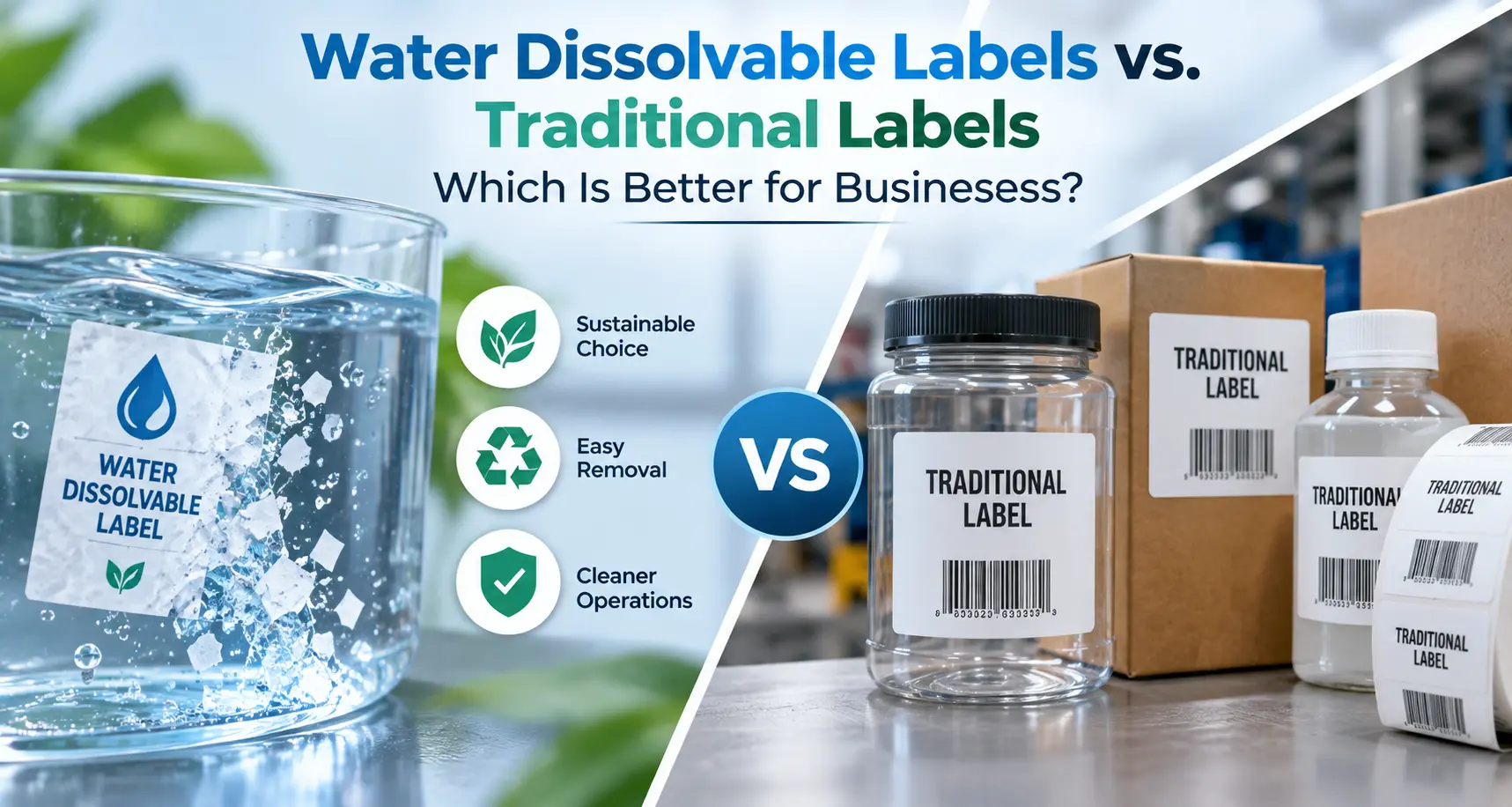
A label may be small, but the time and cost involved in removing it can add up across hundreds of containers, production batches, and daily operations.
For food manufacturers, commercial kitchens, packaging companies, and industrial businesses, choosing the right labeling solution is about more than product identification. It also affects cleaning processes, employee productivity, packaging costs, and day-to-day operations.
Traditional labels are widely used because of their reliable adhesion and versatility. However, when businesses need to reuse containers, trays, or storage boxes, removing these labels can become an additional task. Adhesive residue, manual scraping, and repeated cleaning can increase labour requirements and slow down container reuse.
This is where water dissolvable labels offer an alternative. Designed to break down when exposed to water under suitable conditions, they make label removal easier and help reduce the need for manual cleaning. They are particularly useful for businesses that regularly wash and reuse containers as part of their operations.
But does that mean water dissolvable labels are always a better choice than traditional labels? Not necessarily. While dissolvable labels offer advantages in temporary labeling applications, traditional labels remain suitable for packaging, shipping, product identification, and applications requiring long-lasting adhesion.
In this guide, we compare water dissolvable labels vs. traditional labels based on material composition, adhesive performance, durability, removal process, cost, and industry applications. We'll also discuss the factors businesses should consider before selecting a labeling solution for their specific requirements.
Before comparing their performance, it is important to understand how these two labeling solutions work and where businesses commonly use them.
Water dissolvable labels are specially designed labels that break down or disperse when exposed to water under suitable conditions. Depending on their construction, both the label material and adhesive may dissolve during washing, helping remove the label without the usual peeling and scraping process.
These labels are commonly used in commercial kitchens, food preparation facilities, laboratories, and selected manufacturing operations where containers are cleaned and reused regularly.
For example, a commercial kitchen may use dissolvable labels to identify food containers with preparation dates, use-by dates, and storage information. Once the container is ready for cleaning, the label can be removed through the recommended washing process.
One important consideration is that not all water-soluble labels work in exactly the same way. Their removal performance depends on the facestock, adhesive formulation, water temperature, and washing conditions.
Businesses should therefore check the product specifications and test samples before placing a bulk order.
Traditional labels are widely used across commercial and industrial applications for product identification, packaging, branding, inventory management, and shipping.
They are generally manufactured using paper or synthetic materials, such as polypropylene or polyester, with permanent or removable pressure-sensitive adhesives.
Permanent adhesive labels are designed to remain attached to a surface for an extended period. Removable labels, on the other hand, are developed for applications where labels need to be peeled away when required.
Common business applications include:
Unlike water dissolvable labels, traditional labels are not designed to disappear when exposed to water. Depending on the adhesive, their removal may require peeling, soaking, or additional cleaning.
These terms are sometimes used interchangeably, but they describe different label behaviours.
Understanding these differences is important for procurement teams because the wrong product can create additional work during cleaning or packaging operations.
Both labeling options serve different purposes. The following comparison highlights the factors businesses should consider before selecting a suitable product.
Let's examine the main differences in more detail.
The material and adhesive determine how a label performs during application, handling, storage, and removal.
Water dissolvable labels use specially formulated materials that break down when exposed to suitable washing conditions. Their adhesive is also designed to support removal through water exposure.
Traditional labels use paper or synthetic facestocks with permanent or removable adhesives. Their adhesive strength varies depending on the intended application, surface type, and environmental conditions.
For businesses, the right choice depends on whether the priority is easy removal or long-lasting adhesion.
Removing traditional labels from reusable containers can require additional labour, particularly when the adhesive leaves behind sticky residue.
Water dissolvable labels are designed to simplify this process. When used under the recommended conditions, they break down during washing and help reduce the need for manual peeling and scraping.
This can be particularly useful for food processing facilities, commercial kitchens, and manufacturing units that clean and reuse containers throughout the day.
Durability is another important consideration when comparing dissolvable labels vs. standard labels.
Traditional labels are available in different materials and adhesive formulations that can withstand moisture, handling, temperature changes, and other environmental conditions.
Water dissolvable labels, on the other hand, are designed to respond to water. This makes them suitable for temporary identification but less appropriate for applications where labels must remain intact during prolonged water exposure.
Businesses should consider storage temperatures, humidity, condensation, and handling conditions before choosing either option.
Sustainability is becoming an important purchasing consideration for manufacturers and packaging businesses.
Water dissolvable labels can help reduce the need to manually peel and collect old labels during container cleaning. Depending on their construction, they may also simplify waste handling.
However, water dissolvable does not automatically mean biodegradable, compostable, or environmentally harmless.
Businesses should review the material composition, adhesive, ink, and relevant environmental certifications before classifying a product as one of their eco-friendly labels.
Traditional labels are available for a wide range of surfaces, including cardboard, plastic, glass, metal, and other packaging materials.
Water dissolvable labels are also suitable for selected surfaces, particularly clean and dry containers used in repeat-wash applications.
However, their adhesion and removal performance can vary across different materials. Before placing a bulk order, test the labels on the actual surfaces used in your facility.
Water dissolvable labels can offer several operational advantages, particularly for businesses that regularly wash and reuse containers.
One of the main benefits of water dissolvable labels is the simplified removal process.
Traditional labels can leave sticky marks on containers, requiring employees to spend additional time peeling and cleaning them. Water dissolvable labels are designed to break down during suitable washing conditions, helping keep reusable containers clean.
This can reduce manual cleaning work in commercial kitchens, food processing facilities, and other high-volume operations.
Businesses that reuse plastic containers, stainless steel trays, storage bins, and other equipment need an efficient cleaning process.
When labels are difficult to remove, containers may require additional cleaning before they can be used again.
Water dissolvable labels help simplify this process by reducing the need for manual label removal. This can support faster container turnover and more efficient cleaning routines.
Removing traditional labels often creates additional waste in the form of paper, plastic facestock, and adhesive residue.
Water dissolvable labels offer an alternative for applications where labels need to be removed during washing.
Depending on their material composition and disposal requirements, they may help businesses simplify label waste management.
In facilities where hundreds of containers are cleaned daily, even a small reduction in cleaning time can make a noticeable difference.
Consider a commercial kitchen that cleans 200 labeled containers every day. If employees spend an additional two minutes removing each traditional label, that adds up to 400 minutes of labour.
That is more than six hours of additional work each day.
A suitable water dissolvable labeling solution can help reduce this manual effort, allowing employees to focus on other operational tasks.
Water dissolvable labels are useful in applications where temporary identification is required and containers are regularly cleaned.
Common examples include:
The actual suitability depends on the label's material, adhesive, and application requirements.
Although water dissolvable labels offer advantages in repeat-wash environments, traditional labels remain an important part of commercial and industrial operations.
Traditional labels are available with permanent adhesives that provide reliable attachment to different surfaces.
They are suitable for product packaging, shipping labels, inventory identification, and applications where information must remain visible throughout storage, transportation, or handling.
Businesses working with refrigerated products, outdoor equipment, and moisture-sensitive packaging often require labels that remain attached under challenging conditions.
Traditional labels made with suitable synthetic materials and adhesives can offer better resistance to water, humidity, and handling than water dissolvable alternatives.
Traditional labels play an important role in product presentation and identification.
Manufacturers and retailers use them to display product names, barcodes, ingredients, instructions, branding elements, and other important information.
They are available in different sizes, materials, finishes, and printing options to meet specific packaging requirements.
Traditional labels offer flexibility in terms of material selection, adhesive strength, printing methods, and finishes.
Businesses can select labels based on their packaging material, product requirements, and operating environment.
This makes them suitable for a wide range of B2B applications, from retail packaging to industrial product identification.
Every labeling solution has limitations. Understanding these factors can help businesses avoid purchasing products that do not match their operational requirements.
Water dissolvable labels are not suitable for every application.
Some important considerations include:
Traditional labels also have certain limitations, particularly in reusable-container applications.
The best option depends on how your business uses, stores, and handles labeled products.
If your operation involves frequent washing and reuse, water dissolvable labels may offer better convenience.
If your labels need to withstand moisture, refrigeration, transportation, or long-term storage, traditional labels may be more suitable.
For businesses with multiple labeling requirements, using both types in different departments may be the most practical approach.
Different industries have different labeling requirements. A solution that works well in a commercial kitchen may not be suitable for a warehouse or outdoor manufacturing environment.
Here is how both options fit into common business applications.
Food manufacturers use labels to identify ingredients, production batches, preparation dates, and storage information.
Water dissolvable labels can be useful on reusable containers, trays, and processing equipment that undergo regular washing.
Traditional labels are generally more suitable for product packaging, cartons, and containers that require information to remain visible throughout distribution.
Healthcare facilities and laboratories often use reusable trays, containers, and equipment that require regular cleaning.
Water dissolvable labels may be suitable for temporary identification where their removal properties match the cleaning process.
Traditional labels may be preferable for long-term identification, asset tracking, and applications where labels must remain readable.
Any label used in regulated healthcare or pharmaceutical processes should meet the relevant industry and facility requirements.
Manufacturing facilities use labels for temporary production identification, inventory tracking, and equipment management.
Water dissolvable labels may help identify reusable production containers and bins that are cleaned between operations.
Traditional labels are generally better suited to permanent product identification, chemical information, and labels that need to withstand industrial conditions.
Businesses that reuse packaging containers need a labeling solution that does not make cleaning unnecessarily difficult.
Water dissolvable labels can help simplify the removal of temporary identification labels from reusable boxes, bins, and containers.
Traditional labels remain useful for packaging that needs permanent branding, product information, or shipping details.
Hotels, restaurants, catering companies, and commercial kitchens frequently label food containers to manage preparation dates, storage information, and inventory.
Water dissolvable labels can make container cleaning easier by reducing the need to manually remove old labels.
FormersPaper offers a Food Labeling System for businesses looking to improve kitchen labeling and food identification processes.
You can also explore our hospitality industry solutions for additional commercial labeling and paper product requirements.
When purchasing labels in bulk, the initial price per roll should not be the only deciding factor.
Businesses should consider the total cost of using a label throughout its lifecycle. This includes purchasing, application, removal, cleaning, storage, and waste management.
Traditional labels may have a lower purchase price, depending on their material, adhesive, and printing specifications.
Water dissolvable labels may have a higher initial cost due to their specialised material and adhesive requirements.
However, a lower purchase price does not necessarily mean a lower overall operating cost.
Removing traditional labels from reusable containers can require additional employee time.
In high-volume operations, these repeated tasks can increase labour costs.
Water dissolvable labels may reduce the time spent on manual removal, helping businesses improve cleaning efficiency.
Businesses should also consider the waste generated during label removal.
Traditional labels may require separate collection and disposal, depending on their construction and the facility's waste management process.
Water dissolvable labels may simplify removal, but businesses should confirm that their material and adhesive are compatible with local wastewater and disposal requirements.
To understand which option offers better value, compare the following costs:
For businesses that wash and reuse containers regularly, water dissolvable labels may offer long-term operational savings.
For businesses that need durable product identification, traditional labels may provide better value.
The best purchasing decision should be based on actual usage data rather than the price of a single label roll.
For B2B buyers, understanding product specifications is essential before selecting a labeling solution. A label may perform well in one application but fail in another because of differences in material, adhesive, surface, or washing conditions.
Before finalising your purchase, review these technical factors with your supplier.
The facestock is the top material of the label that carries printed or handwritten information.
Ask about the material composition, thickness, and suitability for your application. These properties influence label handling, print quality, adhesion, and removal behaviour.
The adhesive determines how well the label attaches to a container or surface.
Check whether the adhesive is water-soluble, removable, or designed for a specific wash-off process. Also confirm how it performs during normal handling before the label is removed.
Dissolution performance depends on the label construction and washing conditions.
Ask your supplier for test results covering:
Avoid relying on a general dissolving-time claim without checking the technical data for the exact product.
Labels used in commercial kitchens and manufacturing facilities often need handwritten dates, batch numbers, or printed identification.
Check whether the label supports your preferred printing method, marker type, barcode requirements, and ink compatibility.
Water-sensitive label materials generally require more careful storage than conventional label stock.
Ask about recommended temperature, humidity, packaging, and shelf life to prevent premature deterioration before use.
Selecting the right label requires a clear understanding of your application and operational requirements.
Before placing a bulk order, consider these factors.
Start by identifying where the labels will be used.
Are they intended for reusable food containers, industrial bins, product packaging, or shipping cartons?
Water dissolvable labels are generally more suitable for temporary identification in repeat-wash applications, while traditional labels are better suited to applications requiring longer-lasting adhesion.
Check how strongly the label needs to stick to the surface and how it should be removed.
For reusable containers, easy removal may be a priority. For product packaging and inventory identification, reliable adhesion may matter more.
The same label may perform differently on plastic, glass, stainless steel, and other surfaces.
Consider exposure to moisture, temperature changes, oil, cleaning agents, and handling conditions.
Request samples and test them on the actual surfaces used in your facility.
If sustainability is part of your procurement strategy, ask suppliers for information about the label's materials, adhesive, ink, and environmental certifications.
For food-related applications, check whether the product documentation supports its intended use and complies with applicable food-contact or food-safety requirements.
A reliable supplier should be able to explain the product specifications, adhesive performance, material composition, and storage requirements.
Businesses should also compare production capacity, quality control, lead times, customisation options, and documentation before finalising a supplier.
Food labeling is an important part of managing commercial kitchen operations.
Restaurants, catering companies, and food processing facilities need clear labels to identify food items, monitor preparation dates, and manage storage.
Food safety labels help employees identify important information, including:
A reliable food labeling process can help reduce confusion, improve food rotation, and support consistent kitchen procedures.
Water dissolvable labels can support these workflows by making it easier to remove temporary labels from reusable food containers during cleaning.
However, businesses should not assume that every dissolvable label is automatically food-safe. The material, ink, and adhesive must be evaluated for the intended application.
Before purchasing food safety labels, ask your supplier for relevant technical specifications and supporting test documentation.
FormersPaper provides a Food Labeling System designed to support commercial kitchen labeling requirements, including clear food identification and more organised labeling processes.
You can also read our guide on Food-Safe Dissolvable Labels to understand the important factors involved in sourcing labels for food-related applications.
Sustainability is an important consideration for businesses looking to improve their packaging and labeling practices.
However, selecting eco-friendly labels requires more than choosing a product described as water soluble or dissolvable.
It is important to understand the difference between three commonly used terms:
These terms are not interchangeable.
Before selecting an environmentally preferable labeling solution, ask your supplier:
FormersPaper lists FSC and ISO 14001:2015 among its company credentials. However, buyers should request documentation applicable to the specific product they intend to purchase.
A responsible purchasing decision considers the complete product lifecycle, including raw materials, manufacturing, transportation, use, and disposal.
Ordering labels in large quantities without testing them can lead to unnecessary expenses and operational problems.
A sample evaluation helps procurement teams understand how each product performs under actual working conditions.
Follow these steps before confirming your order:
This process will help your procurement team select a label based on actual performance rather than supplier claims alone.
Choosing the right supplier is just as important as selecting the right label.
Working directly with a manufacturer can give businesses better visibility into product specifications, material selection, production capabilities, and customisation options.
FormersPaper operates as a vertically integrated manufacturer, with in-house coating, laminating, printing, and converting capabilities.
The company operates five manufacturing facilities across China, the UK, and Indonesia, with more than 600 pieces of production equipment. Its in-house R&D department also supports product development and manufacturing innovation.
FormersPaper lists ISO 9001, ISO 14001, FSC, and RoHS among its company credentials and certifications.
Businesses can explore the FormersPaper Labels & Stickers range for different labeling requirements, including thermal, barcode, security, and linerless labels.
For kitchen and food-related labeling needs, its Food Labeling System range is another option to consider.
If your business also requires paper rolls, you can explore the Paper Rolls product range.
Before finalising a supplier, discuss your application, required label specifications, order volume, and testing requirements.
There is no single labeling solution that works best for every business. The right choice depends on your products, working environment, cleaning process, and long-term operational requirements.
Water dissolvable labels are a practical option for businesses that frequently wash and reuse containers. They can help simplify label removal, reduce manual cleaning work, and improve container turnaround.
Traditional labels remain a reliable choice for product packaging, shipping, branding, inventory identification, and applications that require long-lasting adhesion or resistance to moisture.
For businesses with different labeling requirements, using both options across different operations may deliver the best results.
Before placing your next bulk order, compare the material, adhesive performance, removal process, and total operating cost. A well-informed purchasing decision can help your business select a labeling solution that supports daily operations while delivering better long-term value.
Looking for the right labeling solution for your business?
Explore FormersPaper's labeling products or contact the FormersPaper team to discuss your application, product specifications, and bulk order requirements.
The main difference is how they respond to water and how they are removed. Water dissolvable labels are designed to break down during suitable washing conditions, while traditional labels generally need to be peeled or removed through a separate cleaning process.
Water dissolvable labels may have a higher initial purchase price because of their specialised materials and adhesive formulations. However, businesses that frequently wash and reuse containers may save on labour and cleaning costs. The actual cost advantage depends on usage volume and operating conditions.
The dissolving time depends on the label material, adhesive formulation, water temperature, and washing conditions. Businesses should request technical specifications from the supplier and test samples under their actual operating conditions.
They can be suitable for certain food-related applications, such as temporary identification of reusable food containers. However, suitability depends on the materials, ink, adhesive, and intended use. Always request relevant food-safety documentation before purchasing.
They are designed to break down during suitable washing conditions and minimise adhesive residue. However, actual results depend on the product formulation, surface, and washing process. Testing is recommended before bulk purchasing.
Not automatically. Water dissolvability does not necessarily mean a product is biodegradable or compostable. Businesses should review material specifications, environmental certifications, and disposal requirements before making sustainability claims.
Yes. Traditional removable labels can be used on reusable containers when their adhesive and removal properties are suitable. However, some products may leave adhesive residue or require additional cleaning.
Industries that frequently wash and reuse containers can benefit from water dissolvable labels. Common applications include commercial kitchens, food processing, hospitality, healthcare, laboratories, and selected manufacturing operations.
Businesses should consider their application, surface material, environmental conditions, adhesive requirements, and removal process. If easy removal during washing is the priority, water dissolvable labels may be a suitable option. If long-term adhesion and durability matter more, traditional labels may be the better choice.
Before placing a bulk order, businesses should check the material composition, adhesive performance, dissolution conditions, printing compatibility, storage requirements, and relevant compliance documentation.


Formers Paper is a leading manufacturer for a comprehensive range of sustainable paper & packaging products serving customers globally.
Shenzhen Formers Paper Co. Ltd, No.92 Zhugushi Road, Wulian community, Longgang District, Shenzhen, China