We wish you Happy Holidays & a joyful New Year!

Choose the right label adhesive for plastic, glass, metal, and cardboard surfaces. Explore adhesive types, bonding strength, and industrial applications.
November 20, 2026
Jane Smith
A label can have perfect printing, the right material, and an attractive design. But what happens when it starts peeling off just days after application?
For manufacturers, packaging companies, and label converters, a small adhesive failure can create much bigger problems. Labels may curl at the edges, fall off during transportation, leave sticky residue, or fail to remain attached in cold storage.
These issues can lead to product relabelling, production delays, additional labour costs, and unhappy customers.
The problem is not always the label material or printing quality. In many cases, the real issue is choosing the wrong label adhesive for the product surface and working conditions.
Different surfaces require different bonding properties. An adhesive that works well on a glass bottle may not perform equally well on an HDPE container or a corrugated shipping box. Similarly, labels used in freezer storage need different adhesive properties from those used on products stored at room temperature.
So, how do you choose the right label adhesive for your business?
In this guide, we will explain the different types of label adhesives, their applications, and the factors B2B buyers should consider before placing a bulk order. We will also discuss how FormersPaper helps businesses find suitable self-adhesive label solutions for different materials and industrial requirements.
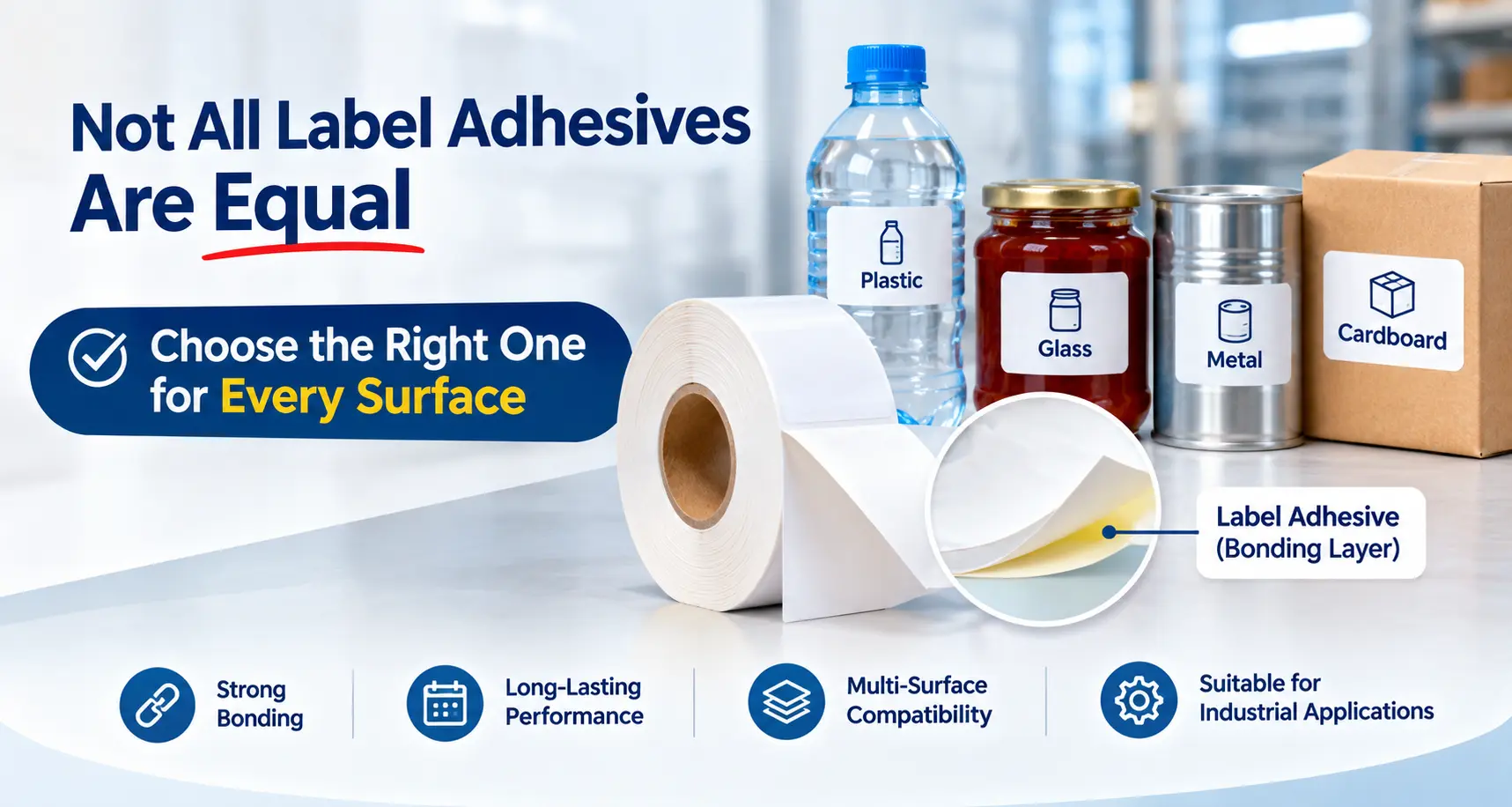
A label adhesive is the bonding layer that attaches a label to a product, package, container, or other surface.
Although it is usually a thin layer, it plays an important role in the overall performance of a self-adhesive label. It helps the label stay in place during application, storage, transportation, and everyday handling.
A typical self-adhesive label consists of three main components:
For manufacturers and packaging companies, adhesive selection is not just a technical decision. It directly affects production efficiency, product presentation, and packaging reliability.
For example, a shipping label that falls off during transportation can create tracking problems. A product label that loses its grip on a plastic bottle can affect brand presentation. Similarly, a barcode label that does not stay attached may create scanning difficulties in warehouses.
This is why businesses should consider adhesive performance as an important part of their label specifications.
Before selecting an adhesive, it is important to understand the main adhesive technologies and their performance characteristics.
The most commonly used adhesive technologies include acrylic, rubber-based, and UV-cured adhesives. Each has different strengths and is suitable for different applications.
Acrylic adhesives are widely used in applications that require long-term bonding and resistance to environmental conditions.
They generally offer good resistance to sunlight, heat, ageing, and temperature changes. Their bonding strength may develop gradually after application, making them suitable for labels that need to remain attached for extended periods.
Common applications include:
Acrylic adhesives are a suitable option when businesses need consistent performance over a longer period.
Rubber-based adhesives are known for their strong initial tack and quick bonding ability.
They can provide good adhesion to different materials, including certain rough surfaces and packaging substrates. They are also available in formulations designed for specific applications, including cold-temperature labelling.
Common applications include:
However, standard rubber-based adhesives may have limitations under prolonged exposure to high temperatures and sunlight. The exact performance depends on the adhesive formulation.
Hot melt adhesives are applied in a molten state during manufacturing and form a bond as they cool.
They are commonly used in pressure-sensitive label applications where strong initial tack and quick adhesion are important.
Common applications include:
The right hot melt formulation should be selected according to the surface material, application temperature, and required bonding performance.
UV-cured adhesives are hardened using ultraviolet light during the manufacturing process.
Depending on the formulation, they can offer useful resistance to heat and certain chemicals. They are generally selected for specialised industrial applications where specific performance requirements must be met.
Common applications include:
The best adhesive technology depends on the actual application. A higher price or stronger initial tack does not automatically mean better performance for every product.
Apart from their chemical composition, label adhesives can also be classified according to their intended use.
For B2B buyers, understanding these adhesive grades helps match the label to its actual application.
Permanent adhesives are designed to keep labels attached to the product for an extended period.
They are commonly used when labels should not be removed during normal product handling or transportation.
Applications-
Removable adhesives allow labels to be removed without leaving significant adhesive residue under suitable conditions.
They are useful for products where labels may need to be replaced or removed after a certain period.
Applications-
Repositionable adhesives allow users to lift and adjust a label during application before it becomes firmly attached.
They are useful when accurate label placement is important.
Applications-
High-tack adhesives provide strong initial bonding when a label comes into contact with a surface.
They can be useful for rough, curved, or difficult-to-bond materials, depending on the formulation.
Applications-
Freezer-grade adhesives are developed for labelling applications involving low temperatures.
They are particularly useful in cold storage, frozen food packaging, and cold-chain logistics.
Applications-
Tamper-evident adhesives are used in security applications where removing a label should leave visible evidence of interference.
Applications-
The important point is that stronger adhesion is not always the best choice. A removable label may be more suitable for reusable packaging, while a permanent adhesive may be necessary for product identification.
One of the most important factors in adhesive selection is the material onto which the label will be applied.
Different materials have different surface properties. Some allow adhesives to spread and bond easily, while others require specially formulated adhesives.
Here is how businesses can select suitable label adhesives for common industrial surfaces.
Plastic packaging is widely used in food, beverage, pharmaceutical, chemical, and personal care industries.
However, not all plastics have the same surface properties.
For example, PET generally offers better adhesive compatibility than certain low-surface-energy plastics such as HDPE and polypropylene.
Important considerations:
For HDPE and polypropylene containers, high-tack adhesives specifically formulated for low-surface-energy materials may provide better results than general-purpose adhesives.
Glass is commonly used in beverage bottles, food jars, cosmetic containers, and pharmaceutical packaging.
Its smooth surface generally allows good adhesive contact when properly cleaned.
However, moisture, condensation, dust, and temperature changes can affect bonding performance.
Important considerations:
For reusable glass containers, removable adhesives may be more appropriate. Permanent adhesives are generally preferred when the label needs to remain attached throughout the product's lifecycle.
Metal containers and equipment often require labels that can withstand handling, temperature changes, and industrial environments.
Metal surfaces may include stainless steel, aluminium, and coated metal.
Before choosing an adhesive, consider whether the surface is smooth, painted, textured, or coated.
Important considerations:
A suitable acrylic or specialised industrial adhesive may be appropriate depending on the application requirements.
Paper and cardboard are commonly used for product packaging, shipping cartons, and retail boxes.
Although these materials are generally easier to label, their surface texture and absorbency can affect bonding performance.
Corrugated cardboard can be particularly challenging because of its rough texture and loose surface fibres.
Important considerations:
High-tack adhesives may be useful for corrugated packaging because they can provide stronger initial contact with uneven surfaces.
Corrugated boxes are widely used in warehousing, e-commerce, manufacturing, and logistics.
Shipping labels, barcodes, and tracking labels must remain attached throughout handling and transportation.
A suitable adhesive should provide reliable bonding to the actual carton surface.
Businesses should consider the carton coating, recycled content, surface dust, and storage conditions before selecting an adhesive.
Labels applied to curved surfaces often face a problem known as edge lifting.
This happens when the label tries to return to its original flat shape after application.
The problem can become more noticeable on small-diameter bottles, tubes, and cylindrical containers.
To reduce this problem:
Choosing the right adhesive and label construction together is important for reliable performance.
Choosing an adhesive based only on how sticky it feels is not enough for industrial applications.
B2B buyers should evaluate several technical and operational factors before finalising their label specifications.
Surface energy affects how well an adhesive can spread across a material and establish contact.
High-surface-energy materials, such as clean glass and many metals, generally allow easier adhesive wetting.
Low-surface-energy plastics, including HDPE and polypropylene, are more difficult to bond and may require specially formulated adhesives.
Always identify the exact substrate before selecting an adhesive.
Temperature plays an important role in adhesive performance.
Some adhesives can soften under high heat, while others may become less flexible in extremely cold conditions.
Businesses should check two temperatures:
These temperatures can be very different.
For example, a label may be applied at room temperature but later stored in a freezer. In such cases, the adhesive must be suitable for the complete temperature range.
Products stored in refrigerators, cold rooms, or humid warehouses may experience condensation and moisture exposure.
Water can affect the bond, especially when it reaches the label edges.
Choose an adhesive formulation designed for the expected moisture conditions.
Initial tack refers to how quickly an adhesive grips a surface when first applied.
Long-term adhesion describes how well it maintains its bond over time.
Both properties are important, but their importance depends on the application.
For example, high-speed packaging operations may require good initial tack, while long-term product identification labels need reliable holding power throughout their service life.
The label adhesive should also match your production process.
Consider whether labels are applied manually or through an automatic labelling machine.
High-speed production lines require consistent label dispensing, reliable adhesion, and suitable release properties.
Businesses should also check compatibility with their printing and converting requirements.
Adhesive performance can change when label rolls are stored under unsuitable conditions.
High temperatures, humidity, and improper storage may affect the adhesive layer before the labels are used.
FormersPaper recommends storing label materials in a cool, dry environment, generally around 16°C to 25°C and approximately 50% relative humidity, subject to the specific product's storage guidance.
Rubber-based and acrylic-based adhesives are two important options for pressure-sensitive label applications.
However, they offer different performance characteristics.
Acrylic Adhesive-
Rubber-Based Adhesive-
When Should You Choose Acrylic Adhesives?
Acrylic adhesives are worth considering when your business requires:
Rubber-based adhesives may be more suitable when your application requires:
Which one should you select?
There is no universal winner. The right option depends on your substrate, application process, environmental conditions, and expected label lifespan.
Different industries have different labelling requirements. A standard adhesive may work for one application but fail in another.
Here are some common B2B applications where adhesive selection matters.
Food and beverage manufacturers use labels on bottles, jars, cartons, cans, and flexible packaging.
These labels may face refrigeration, moisture, condensation, and handling.
The adhesive should be selected according to the packaging material and storage environment.
Pharmaceutical packaging requires reliable product identification and readable information.
Labels may be used on medicine bottles, cartons, medical containers, and other healthcare packaging.
Adhesive selection should consider the container material, storage conditions, and applicable regulatory requirements.
Industrial and automotive applications often require labels that can withstand demanding working environments.
These may include equipment identification, component tracking, warning labels, and product information labels.
Depending on the application, resistance to heat, moisture, chemicals, and handling may be important.
Cleaning products, chemical containers, and household products may expose labels to moisture, oils, and different chemicals.
Businesses should select label materials and adhesives according to the specific exposure conditions.
Shipping and warehouse labels must remain readable and attached during transportation and handling.
Barcode labels, tracking labels, and carton identification labels require dependable adhesion to different packaging materials.
Even when businesses select good-quality label materials, incorrect adhesive selection or application conditions can create problems.
Here are some common issues and ways to reduce them.
Label edges may start peeling because of:
How to prevent it: Clean the surface properly, select a suitable adhesive grade, and test the label on the actual container.
Adhesive oozing occurs when the adhesive spreads beyond the label edges.
It can make rolls sticky, create dispensing issues, and affect printing operations.
Possible causes include excessive adhesive coating, high storage temperatures, and pressure from heavy stacking.
How to prevent it: Work with a manufacturer that maintains consistent adhesive coating and quality control during production. Follow the recommended storage and handling instructions.
Some plastics are difficult to bond because of their low surface energy.
Using a general-purpose adhesive may result in weak bonding or edge lifting.
How to prevent it: Identify the plastic type and select an adhesive specifically designed for that substrate.
Some labels leave sticky residue when removed.
This can happen when a permanent adhesive is used for an application that requires clean removal.
How to prevent it: Select a removable adhesive designed for the surface and intended removal period. Test the label before production.
Standard adhesives may lose bonding performance when applied to very cold surfaces or exposed to freezing conditions.
How to prevent it: Choose a suitable freezer-grade adhesive and confirm both application and storage temperature requirements.
Before placing a large order, businesses should test adhesive samples on their actual products.
A small sample test can help identify potential problems before they affect an entire production batch.
Here are some useful testing methods.
Check how quickly the label grips the surface immediately after application.
This is particularly important for high-speed labelling operations.
This test measures the force required to remove a label from a surface.
Professional laboratories may use recognised testing methods, including FINAT FTM 1 for 180-degree peel testing and ASTM D6252 for 90-degree peel testing.
Shear testing evaluates how well an adhesive resists movement under a sustained load.
It can help assess performance in applications where labels experience continuous stress.
Expose sample labels to the expected temperature and humidity conditions.
Check whether the adhesive maintains its bond without edge lifting or other visible problems.
Apply sample labels using your normal production process.
Test them on actual packaging materials, containers, and products rather than relying only on laboratory samples.
A simple five-step sample testing process:
Remember that practical testing does not replace professional laboratory testing. However, it can help businesses compare adhesive options before committing to bulk production.
Selecting the right adhesive is important, but choosing the right manufacturing partner is equally valuable.
For B2B buyers, a reliable supplier should understand the technical requirements of your application and provide consistent product quality.
Here are some points to consider.
Look for a manufacturer with suitable adhesive coating, laminating, printing, and converting capabilities.
Integrated manufacturing can help maintain better control over different production stages.
Not every business uses the same packaging material or operating conditions.
A good manufacturer should be able to discuss suitable adhesive options based on your substrate, temperature range, and application requirements.
Check the manufacturer's quality management systems and relevant certifications.
Also, verify any specific product compliance requirements applicable to your industry and target market.
For large-volume orders, manufacturing capacity and production consistency matter.
Ask about production capabilities, minimum order quantities, lead times, and quality checks.
Always request samples and test them on your actual products.
This helps your procurement and quality teams make a more informed decision.
Finding the right label adhesive requires more than choosing a product from a catalogue. Businesses need a manufacturing partner that understands different materials, production requirements, and application challenges.
FormersPaper provides self-adhesive label solutions for businesses looking for reliable materials and manufacturing support.
With five dedicated factories and more than 600 specialised machines, FormersPaper manages key manufacturing processes, including adhesive coating, laminating, printing, and converting in-house.
Its product range includes:
FormersPaper works with different adhesive technologies, including acrylic, high-tack hot melt, and specialised UV-cured options, depending on product requirements.
We also hold ISO 9001:2015 and ISO 14001:2015 certifications for its quality and environmental management systems.
Every labelling project has different requirements.
A packaging manufacturer may need strong adhesion for corrugated cartons, while a beverage company may require labels for glass bottles or PET containers.
Similarly, businesses operating in cold-chain logistics may need freezer-grade adhesives that perform under low-temperature conditions.
FormersPaper works with customers to identify suitable label constructions and adhesive options based on their application requirements.
FormersPaper serves business customers in markets including China, the USA, Canada, Mexico, and the Caribbean.
Whether you are a label converter, packaging manufacturer, distributor, or product manufacturer, choosing the right label material and adhesive can help improve the reliability of your labelling operations.
Contact FormersPaper to discuss your label specifications, request samples, and explore suitable solutions for your next production order.
Choosing the right label adhesive is an important decision for manufacturers, packaging companies, and label converters.
The wrong adhesive can lead to peeling labels, adhesive residue, production interruptions, and additional operating costs. On the other hand, selecting the right adhesive for your surface and working conditions can improve label performance and reduce avoidable problems.
Before placing your next bulk order, consider the material, surface energy, application temperature, storage conditions, moisture exposure, and required bonding strength.
Also, compare different label adhesive types, test samples on actual products, and work with a manufacturer that understands your requirements.
Looking for reliable self-adhesive label solutions for your business?
Connect with FormersPaper to discuss your application requirements, explore suitable adhesive options, and request samples for your next project.
The best adhesive depends on the type of plastic. PET generally supports good adhesive bonding, while HDPE and polypropylene may require specially formulated high-tack adhesives designed for low-surface-energy materials.
There is no single strongest adhesive for every industrial application. High-tack rubber-based, acrylic, and specialised adhesives can offer different bonding properties. The right option depends on the surface, temperature, and application requirements.
Acrylic adhesives are generally preferred for long-term performance, sunlight resistance, and ageing stability. Rubber-based adhesives are often selected for strong initial tack and quick bonding. The best choice depends on the intended use.
Businesses should select an adhesive compatible with the packaging material, clean the surface before application, use suitable application pressure, and test samples under actual storage and transportation conditions.
Freezer-grade adhesives are designed for low-temperature labelling applications. However, businesses should confirm both the application temperature and the minimum storage temperature before selecting a product.
Some general-purpose adhesives can work on multiple materials, but their performance may vary. Difficult surfaces such as HDPE, polypropylene, and rough corrugated cardboard may require specialised adhesive formulations.
Many pressure-sensitive adhesives continue building adhesion after application. Some may reach their intended bonding performance within approximately 24 hours, but the exact time depends on the formulation, surface, and environmental conditions.
Permanent adhesives are designed for long-term attachment, while removable adhesives are developed to allow label removal under suitable conditions with minimal residue. The right choice depends on the product and its intended use.
Buyers should provide:
Providing these details helps the manufacturer recommend a more suitable label solution.
Yes. FormersPaper manufactures different self-adhesive label products, including thermal, barcode, weigh-scale, security, linerless, and deep-freezer labels. Businesses can discuss their material, adhesive, and production requirements with the team to explore suitable options.


Formers Paper is a leading manufacturer for a comprehensive range of sustainable paper & packaging products serving customers globally.
Shenzhen Formers Paper Co. Ltd, No.92 Zhugushi Road, Wulian community, Longgang District, Shenzhen, China