We wish you Happy Holidays & a joyful New Year!

Explore detailed guidance on medical thermal paper, including uses, quality factors, and buying tips for healthcare buyers to make informed decisions.
June 29, 2026
John Doe
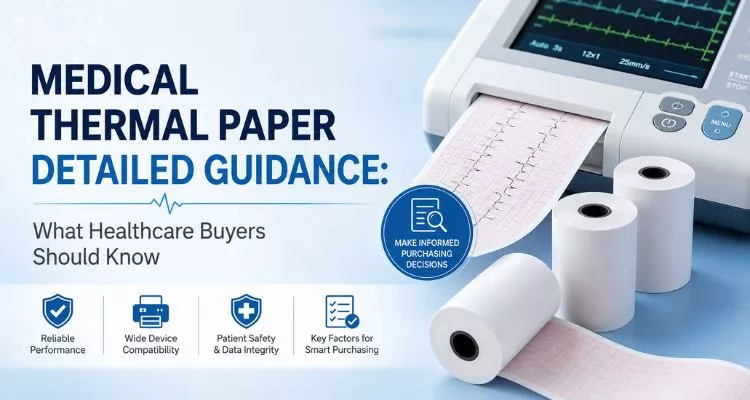
Every hospital, clinic, and diagnostic centre depends on one thing that rarely gets a second thought until it fails: the paper running through their medical devices. ECG machines, patient monitors, ultrasound systems, and fetal monitoring units all need medical thermal paper that prints clearly, holds up under storage, and meets the strict quality requirements healthcare environments demand. Get the paper wrong, and you get smudged ECG tracings, faded patient records, or paper that jams at the worst possible moment.
This blog cuts through the noise. We will explain what medical thermal paper is, how it works in medical devices, which specifications matter, and what to look for in a supplier. If you are sourcing medical-grade thermal paper for a hospital group, a diagnostics distributor, or a procurement team, this is where to start.
Medical thermal paper is a specially coated paper used in heat-based printing systems inside clinical devices. Unlike standard office thermal paper, medical thermal paper is engineered to meet the specific demands of healthcare documentation: sharper image clarity, longer archival stability, consistent sensitivity across the roll, and compatibility with a wide range of medical-grade thermal printer systems.
The core technology is simple. A base layer of paper is coated with a heat-sensitive chemical layer. When the thermal printhead applies heat at precise points, that coating reacts and darkens to form text, lines, or waveforms. No ink. No ribbons. No consumable cartridges. Just heat, paper, and chemistry.
What separates medical thermal paper from retail or POS thermal paper is the precision of that chemistry. In a medical setting, a faint line or a smudged waveform on an ECG tracing is not just inconvenient. It can affect clinical interpretation. A patient wristband that fades before discharge creates an identification risk. A foetal monitoring strip that loses clarity mid-labour is a documentation and safety problem. Medical grade thermal paper is manufactured to tighter specifications precisely because the stakes are higher.
Understanding the print mechanism helps you choose the right medical thermal paper roll for each application.
A thermal printhead contains a row of tiny heating elements. As the paper feeds through, those elements activate in precise patterns, applying heat to specific points on the coated surface. The heat triggers a chemical reaction in the coating, producing a darkened area on the paper. The image, whether it is a grid for ECG readings, a waveform for fetal monitoring, or a text label, builds up point by point as the paper advances.
Three things determine print quality in this system. First, the sensitivity of the coating: how much heat it takes to produce a readable mark. Second, the consistency of the coating across the roll: uneven coating produces variable density across a single printout. Third, the flatness and dimensional stability of the paper: a roll that has absorbed moisture or been stored in poor conditions can cause feed problems, paper jams, and uneven prints.
This is why medical thermal printer paper is not simply commodity paper with a heat-sensitive coat. It is a precision product where the base paper, the coating chemistry, the coating weight, the topcoat (if any), and the manufacturing consistency all contribute to the final clinical result.
Medical thermal paper serves a wider range of clinical applications than most procurement teams realise. Understanding each use case helps you specify the right product for each device.
The most common application for thermal paper in hospital settings. ECG machines print the electrical activity of the heart as waveforms on a grid. The paper must carry precise grid lines, usually printed in red or blue, against a white background, and the thermal waveform printing must be sharp enough for cardiologists to read interval measurements accurately. Medical thermal paper for ECG applications comes in standard widths and roll formats matched to specific machine models, and getting the wrong size or sensitivity grade can cause misaligned grids or unreadable tracings.
Cardiotocography machines record fetal heart rate and uterine contractions during pregnancy and labour. The paper strips produced are part of the official clinical record and may be reviewed in litigation years after the birth. This demands medical thermal paper roll stock with excellent archival stability. Fetal monitoring paper must resist fading under normal storage conditions for the period required by local medical records legislation, which in many jurisdictions runs to years rather than months.
Bedside monitors, ICU equipment, and anaesthesia systems print vital sign records using medical thermal printer paper. These printouts document patient status at critical moments. The paper needs to feed reliably through automated systems, print clearly under high-speed conditions, and remain legible for as long as required by hospital records policies.
Ultrasound systems use medical thermal paper to print diagnostic images. The grey-scale density range and image resolution of medical thermal paper used in this application is higher than in standard text printing. The paper must be able to render the subtle gradations that allow radiologists and sonographers to read organ structures, foetal anatomy, and vascular flow patterns.
Self-adhesive medical grade thermal paper is used for patient wristbands, medication labels, specimen tube labels, and equipment tracking tags. These labels must remain legible through exposure to moisture, disinfectants, and handling by gloved hands. They also need adhesives rated for skin contact in the case of wristbands and for laboratory environments in the case of sample labelling.
Thermal printing is widely used in pharmacy dispensing systems. Medical thermal paper in this context must produce text sharp enough for pharmacist and patient verification and must remain readable for the duration of any legal record-keeping requirement.
This is the question most procurement teams ask once, get a vague answer to, and then never ask again. The answer matters because standard thermal paper sold for POS systems is not the same product as medical thermal paper, and using the wrong one in clinical settings creates real problems.
Coating sensitivity and uniformity
Medical devices operate at specific heat settings tuned to their paper specifications. Standard POS thermal paper may have different sensitivity thresholds, producing images that are too light, too dark, or uneven when used in a device calibrated for medical grade stock.
Image permanence
Medical records must remain legible for years, sometimes decades, depending on the jurisdiction and the type of record. Standard thermal paper can fade significantly within months when exposed to light, heat, or humidity. Medical thermal paper is formulated with coating chemistry and, in many cases, a protective topcoat that extends image life substantially.
Chemical safety
Standard thermal paper has historically used bisphenol A (BPA) as a developer chemical in the heat-sensitive coating. The EU restricted BPA in thermal paper from January 2020. Many jurisdictions are moving toward BPA-free and phenol-free requirements for medical applications specifically. Medical grade thermal paper from responsible manufacturers is BPA-free and, increasingly, phenol-free, using alternative developer chemistry that meets current and emerging regulatory requirements.
Dimensional stability
Medical devices have tight paper feed tolerances. Paper that absorbs moisture, stretches, or curls will jam, misfeed, or produce misaligned prints. Medical thermal paper is manufactured and tested for dimensional stability across a range of storage and use conditions.
Grid and pre-print accuracy
Many medical thermal paper rolls carry pre-printed grids, time markers, or reference lines that must align precisely with the thermal printing from the device. These pre-prints are part of the clinical measurement system. A grid that is slightly off-pitch from the specification will produce measurements that appear correct but are not.
When specifying or sourcing medical thermal paper rolls, these are the parameters that matter.
Width and diameter: Medical devices are designed for specific paper widths. Common widths in medical applications include 50mm, 57mm, 63mm, 80mm, 110mm, and wider formats for chart recorders and fetal monitors. Roll outer diameter and core diameter must match the device's paper compartment. Always confirm device specifications before ordering.
Paper weight (GSM): Medical thermal paper typically runs between 48 GSM and 65 GSM. Lighter weights (48-55 GSM) are used in portable and high-volume devices where roll length matters. Heavier weights (55-65 GSM) are used in applications requiring dimensional stability or where the printout will be handled repeatedly. Formers Paper offers medical thermal printer paper in 48 GSM, 55 GSM, and 65 GSM weights to match the full range of clinical applications.
Thermal sensitivity grade: Sensitivity determines how much heat is required to produce a given image density. Using paper with the wrong sensitivity for a device can produce prints that are too light to read or so dark that fine waveform detail is lost. Always match sensitivity to device specifications.
Topcoat: A topcoat layer applied over the thermal coating protects the image from moisture, abrasion, and light exposure. Medical thermal paper used in applications requiring archival stability, such as fetal monitoring and long-term patient records, should carry a protective topcoat.
Core diameter: Most medical device paper compartments accommodate either a 12mm or 25mm core. Confirm the core diameter before ordering, as using the wrong core in a device designed for a different size will prevent the roll from seating correctly.
BPA/phenol-free certification: For medical applications, always specify BPA-free stock and request written documentation confirming compliance. If your organisation operates in the EU or California, or supplies to healthcare systems in those markets, phenol-free stock is increasingly the required standard.
The top-ranking articles on medical thermal paper share a common weakness: they treat the subject as though all thermal paper is essentially the same product with slight variations, and they provide no meaningful guidance on matching paper to clinical applications, verifying supplier claims, or understanding the regulatory landscape.
Device Compatibility
Generic articles talk about thermal paper in general terms. In medical settings, the paper is part of the clinical system. A 110mm fetal monitoring roll for one manufacturer's CTG machine will not necessarily work in another manufacturer's unit, even at the same width, because sensitivity, core size, and roll length may differ. Procurement teams need supplier partners who understand device-specific requirements, not just paper specifications in the abstract.
Image Durability
Most articles mention that thermal paper can fade but fail to address what this means for healthcare documentation specifically. Depending on the country and the type of record, medical documents must be retained for between 5 and 30 years. Not all medical thermal paper meets the same archival standard. Procurement teams should ask for specific archival performance data, not just a general claim that the paper is "medical grade."
Chemical Safety (BPA-Free)
Articles that mention BPA often treat it as a solved problem. It is not. The regulatory landscape for bisphenols in thermal paper continues to evolve. The EU's 2024/3190 regulation extended restrictions to food-contact materials and introduced mandatory Declarations of compliance. Several US states have passed or are passing BPA restriction laws for thermal paper, with phase-out deadlines running through 2026 and beyond. Healthcare procurement teams need suppliers who track these changes and provide current, written compliance documentation, not suppliers who point to a certification that was issued years ago.
Vertical Integration
Articles typically offer a list of things to look for in a supplier without explaining why certain supplier capabilities matter. For medical thermal paper specifically, vertical integration, meaning the supplier controls the full process from raw material through coating, converting, and quality testing, is a significant quality assurance advantage. When one team controls every step, they can trace and resolve quality variation at the source. When a supplier buys coated jumbo rolls from one party and converts them with another, quality consistency depends on how well those external parties perform, and any problem is harder to investigate and fix.
Sustainability Credentials
Healthcare organisations face growing pressure to reduce their environmental footprint. Medical thermal paper from suppliers with FSC certification (ensuring responsibly sourced wood pulp), ISO 14001 environmental management certification, and a commitment to BPA-free and phenol-free chemistry addresses both clinical quality and sustainability requirements simultaneously.
The difference between a reliable medical thermal paper supplier and an unreliable one often isn't visible in a product catalogue. Here is how to evaluate suppliers before you commit.
Ask for certifications, not just claims: A credible supplier will hold ISO 9001:2015 (quality management), ISO 14001:2015 (environmental management), and be able to provide product-specific compliance documents for BPA/phenol-free claims. Ask for the documents. If a supplier describes their quality system verbally but cannot produce paperwork, treat that as a warning sign.
Request samples matched to your devices: Test medical thermal paper roll samples in the actual devices your organisation uses before placing a bulk order. Check print density, image uniformity across the full roll width, dimensional stability, and feed reliability. Paper that performs well in a test printer may behave differently in a medical device calibrated to specific paper properties.
Understand the supply chain: Find out whether your supplier manufactures the paper themselves or sources it from elsewhere. A supplier with their own coating and converting facilities has much greater control over consistency than one assembling orders from third-party stock. Ask about their production process and quality testing procedures.
Evaluate responsiveness and technical knowledge: A good medical thermal paper supplier can answer specific questions about sensitivity grades, archival performance, device compatibility, and regulatory compliance without hesitation. If a supplier's responses are vague or generic, that reflects their actual level of knowledge and support.
Check manufacturing certifications at the facility level: ISO certifications should be held by the manufacturing facility that produces the paper, not just the sales entity. Ask which facilities hold which certifications and request the certificate documents.
Before placing any order for medical thermal paper, run through these questions with your supplier.
Even the best medical grade thermal paper performs below specification if it is stored or handled incorrectly. A few straightforward guidelines protect your investment and your print quality.
Store medical thermal paper rolls away from direct sunlight and heat sources. Thermal coatings are heat-sensitive by design, and prolonged exposure to elevated temperatures can cause background darkening or coating degradation before the paper ever reaches a printer.
Keep rolls in their original packaging until use. The packaging protects the coating from light exposure, humidity, and physical contact with surfaces that could trigger the coating.
Store rolls horizontally in a cool, dry environment. Ideal storage conditions are typically 15 to 25 degrees Celsius at 40 to 65 percent relative humidity. Exposure to high humidity can cause the paper to absorb moisture, affecting its dimensional stability and feed performance.
Do not stack heavy items on stored paper rolls. Compression can deform the roll, leading to feed problems and uneven print contact with the thermal printhead.
Rotate stock on a first-in, first-out basis. Medical thermal paper has a usable shelf life that varies by product. Using older stock first ensures you are always working with paper within its optimal performance window.
FormersPaper manufactures and supplies medical thermal paper, medical thermal paper rolls, and medical grade thermal paper to healthcare organisations and distributors globally. Our BPA-free and phenol-free medical thermal printer paper is available in 48 GSM, 55 GSM, and 65 GSM weights, manufactured in ISO 9001:2015 and ISO 14001:2015 certified facilities.
We serve customers across North America, Europe, the Middle East, Africa, and Asia from our manufacturing and distribution network spanning China, the UK, and Indonesia. Whether you need standard medical thermal paper rolls for a hospital network, custom pre-printed medical forms, or jumbo reel raw materials for converting operations, our vertically integrated supply chain has the capacity and the quality systems to deliver.
Get in touch with our healthcare team:
Or visit formerspaper.com to download our product catalogue and request a quote.
At FormersPaper, we are a vertically integrated manufacturer of paper and packaging products with over 15 years of experience in the paper industry. Our manufacturing facilities span China, the UK, and Indonesia, covering over 3 million square feet of production and warehousing space and operating more than 600 pieces of advanced production equipment.
Our medical thermal paper is manufactured in ISO 9001:2015 certified facilities, ensuring consistent quality management across every production run. Our operations also hold ISO 14001:2015 certification for environmental management and ISO/IEC 27001 for information security. Our facilities are additionally RoHS compliant and FSC certified, confirming that our paper products come from responsibly managed forest sources.
For healthcare customers in the US and Canada, our Indonesian facility provides a strategic low-tariff manufacturing solution. We produce premium BPA-free and phenol-free medical thermal paper in 48 GSM, 55 GSM, and 65 GSM weights, backed by official Indonesia Certificate of Origin documentation for every order.
Our in-house R&D department holds over 100 patents and is continuously developing improvements to our thermal paper formulations, including ultra-thin 35 GSM and 40 GSM options for portable medical devices and environmentally conscious procurement programmes. We have also developed physical thermal technology, an eco-friendly printing method that produces high-contrast medical records without relying on chemical developers, eliminating phenols entirely while delivering superior archival stability for critical clinical documentation.
We supply medical thermal paper rolls, medical thermal printer paper, and medical grade thermal paper to healthcare facilities, medical device distributors, and procurement organisations globally, from North America and Europe to the Middle East, Africa, and Asia. Our fully integrated supply chain means we can deliver at scale, on time, with no surprises.
Medical grade thermal paper is manufactured to tighter specifications than standard retail or POS thermal paper. It delivers higher image consistency, longer archival stability, precise dimensional stability for medical device feed systems, and typically BPA-free or phenol-free chemical formulations to meet healthcare regulatory requirements. Standard thermal paper is optimised for short-term receipt printing, not clinical documentation.
It is increasingly the required standard in many markets. The EU restricted BPA in thermal paper from January 2020. Several US states have legislated BPA restrictions for thermal paper, with enforcement deadlines running through 2026. Healthcare procurement teams sourcing medical thermal paper should specify BPA-free stock and request written compliance documentation from their supplier.
Common widths for medical applications include 50mm, 57mm, 63mm, 80mm, and 110mm, though wider formats are used in chart recorders and some diagnostic imaging systems. Always confirm the width required by your specific device model before ordering.
Archival life varies significantly between products and storage conditions. Medical thermal paper with a protective topcoat, stored correctly away from light, heat, and humidity, can maintain legibility for 5 to 10 years or more. Standard thermal paper without a topcoat may fade noticeably within 1 to 2 years. For clinical applications with long record retention requirements, always specify archival-grade medical thermal paper and ask your supplier for specific performance data.
No. Medical devices are calibrated to work with paper of specific sensitivity, width, core size, and roll diameter. Using paper outside those specifications can produce poor print quality, cause device jams, or, in some cases, affect the accuracy of recorded measurements. Always source medical thermal paper rolls matched to your device manufacturer's specifications.
Most clinical applications use 55 GSM as a standard weight, offering a good balance of image stability and roll capacity. Portable and high-volume applications may use 48 GSM to maximise roll length. Applications requiring maximum dimensional stability or producing documents that will be handled repeatedly may use 65 GSM. Confirm your device's recommended paper weight before ordering.
Phenol-free medical grade thermal paper is increasingly the required standard for EU-facing supply chains following the 2024/3190 regulation's extension of bisphenol restrictions to food-contact materials. For healthcare applications, phenol-free stock is the most future-proof choice and eliminates the risk of compliance gaps as regulations continue to tighten.


Formers Paper is a leading manufacturer for a comprehensive range of sustainable paper & packaging products serving customers globally.
Shenzhen Formers Paper Co. Ltd, No.92 Zhugushi Road, Wulian community, Longgang District, Shenzhen, China