We wish you Happy Holidays & a joyful New Year!

Not all baking paper is compostable. See how silicone coatings affect biodegradability and which certifications B2B buyers should verify before sourcing.
October 15, 2026
John Doe
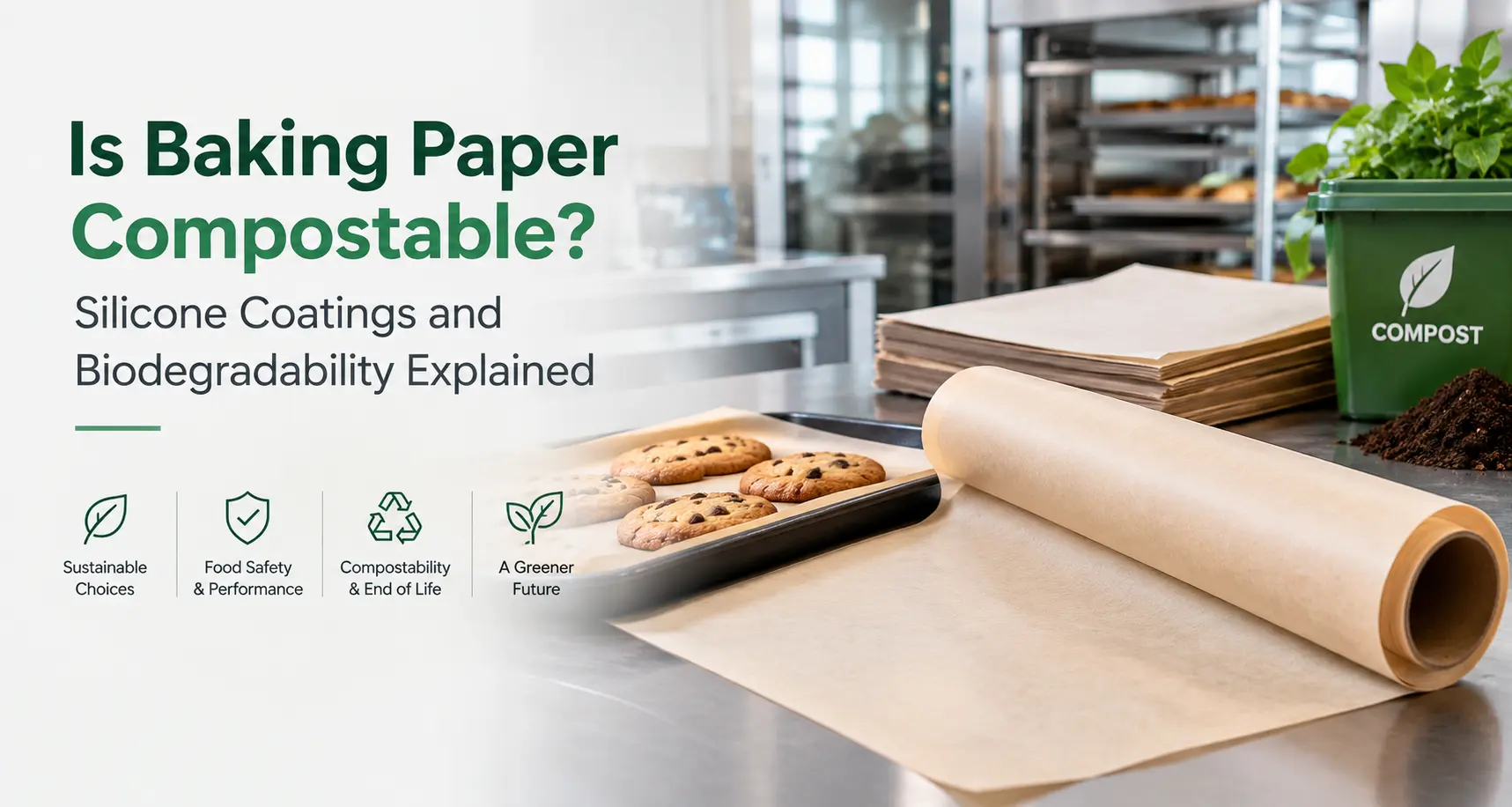
Baking paper is an essential material for commercial bakeries, food manufacturers, catering companies, and food packaging businesses. It helps prevent food from sticking to baking trays, supports consistent baking results, and makes cleaning easier. However, as businesses pay more attention to sustainable packaging and waste management, one question is becoming increasingly important, Is baking paper compostable?
The answer depends on the materials used to manufacture the paper, the type of coating applied, and whether the finished product has been tested and certified for compostability.
For procurement managers, wholesale buyers, and packaging distributors, understanding these details is important before placing a bulk order. A baking paper product may offer excellent heat resistance and non-stick performance, but that does not automatically mean it is suitable for composting or recycling.
Silicone coatings, in particular, can make a difference when evaluating the environmental properties of baking paper. Businesses also need to consider food-contact safety, paper thickness, coating quality, product certifications, and the waste management facilities available in their operating regions.
In this guide, we explain how baking paper is manufactured, how silicone coatings affect biodegradability, what compostability certifications mean, and which product specifications businesses should review before choosing a supplier. Whether you operate a commercial bakery, manufacture packaged food, distribute food-grade paper, or purchase baking paper in bulk, this guide will help you make a more informed sourcing decision.
Before evaluating whether baking paper is compostable, it is important to understand what goes into its manufacturing.
Commercial baking paper generally consists of a paper base made from cellulose fibres, along with surface treatments or coatings that provide specific performance properties.
These materials determine how the paper performs during baking and how it behaves after disposal.
Most baking paper starts with wood pulp, which is processed into a thin, heat-resistant paper sheet.
Depending on the intended application, manufacturers may use different paper grades, fibre compositions, and surface treatments.
The main components include:
The final construction depends on the intended application, such as commercial baking, food processing, catering, or food packaging.
Silicone coatings are widely used in commercial baking paper because of their non-stick properties and ability to withstand high temperatures.
For bakeries and food manufacturers, these properties offer several practical advantages:
Manufacturers can apply silicone to one or both sides of the paper, depending on the required performance.
However, silicone also affects how the finished paper behaves during disposal. While the paper fibres can break down under suitable conditions, the coating may not decompose in the same way.
This is why businesses should evaluate the complete product rather than considering the paper base alone.
Baking paper, parchment paper, and greaseproof paper are often used interchangeably, but their manufacturing processes and performance characteristics can differ.
- Baking Paper
- Parchment Paper
- Greaseproof Paper
For B2B buyers, understanding these differences helps when comparing product specifications and selecting the right material for a particular application.
The simple answer is, Not all baking paper is compostable.
Compostability depends on the paper composition, coating materials, manufacturing process, and independent testing of the finished product.
Uncoated paper made from cellulose fibres may break down under suitable composting conditions. However, conventional silicone-coated baking paper should not automatically be considered compostable.
The presence of a paper base does not guarantee that the complete product meets compostability requirements.
Silicone-coated baking paper is designed to remain stable during high-temperature baking and repeated exposure to grease and moisture.
These properties make it suitable for demanding commercial applications, but they can also affect its breakdown during composting.
The paper fibres may decompose under appropriate conditions, while the silicone coating may behave differently.
For this reason, businesses should not assume that standard silicone-coated baking paper can be added to an industrial or home composting system.
If a supplier claims that a silicone-coated product is compostable, request independent certification for the exact paper grade and coating combination.
Several factors determine whether a baking paper product can meet compostability requirements.
1. Paper composition
The type of fibre used in the paper base affects its ability to break down during composting.
2. Coating formulation
Silicone and other surface treatments can influence how the finished product behaves during decomposition.
3. Manufacturing process
Additional treatments, inks, adhesives, and other components may affect the overall compostability of the finished product.
4. Independent testing
A product must meet the relevant compostability requirements for its intended disposal environment.
5. Local waste management facilities
Even certified compostable products may not be accepted by every commercial composting facility.
Businesses should understand the difference between home and industrial composting before selecting products based on environmental claims.
Home Composting
- Industrial Composting
A product certified for industrial composting is not automatically suitable for home composting.
For businesses operating multiple locations, this distinction is especially important because waste management systems can vary between cities and countries.
Silicone plays an important role in the performance of modern baking paper. However, its properties also raise questions about biodegradability and end-of-life disposal.
Understanding the coating is essential for businesses that want to balance product performance with sustainability requirements.
Silicone is a synthetic material commonly used in baking paper to create a smooth, non-stick surface.
Manufacturers apply a controlled layer to the paper and cure it through a heat-based process.
This coating helps baking paper perform reliably in commercial environments where resistance to heat, grease, and moisture is important.
For bakery owners and food manufacturers, silicone-coated paper can help improve operational efficiency by reducing food sticking and simplifying tray cleaning.
Silicone does not behave like ordinary paper fibres during natural decomposition.
While cellulose-based paper can break down through biological processes under suitable conditions, conventional silicone coatings may remain intact for much longer.
This difference is important when evaluating the environmental performance of the finished product.
A paper sheet should not be labelled biodegradable or compostable simply because its main structure is made from natural fibres.
Businesses should request product-specific test reports rather than relying on general material descriptions.
The silicone layer changes the surface properties of the paper and can influence how the complete sheet behaves during composting.
The main considerations include:
For procurement teams, this means that coating specifications should be included in the product evaluation process.
The right option depends on the application, performance requirements, and disposal infrastructure available to the business.
Compostable and biodegradable are two terms that frequently appear in sustainable packaging discussions.
Although they are related, they do not mean the same thing.
Understanding the difference helps procurement managers and packaging distributors evaluate supplier claims more carefully.
Biodegradable materials are materials that can be broken down by microorganisms under suitable environmental conditions. However, the term does not always specify how quickly the material breaks down or what conditions are required.
Compostable materials must meet defined requirements for decomposition, disintegration, and environmental safety within a specified composting environment.
In simple terms, compostability is a more specific claim than biodegradability.
For B2B buyers, this distinction matters when purchasing paper products for customers who have sustainability requirements or operate certified waste management systems.
Product certifications help businesses distinguish between verified environmental claims and general marketing statements.
Depending on the market and product construction, buyers may come across standards and certification schemes such as:
Not every certification applies to every type of paper product.
Therefore, buyers should confirm that the certification covers the complete finished baking paper, including its coating, inks, and other components.
When evaluating eco-friendly baking paper, do not focus only on terms such as natural, green, biodegradable, or sustainable.
Instead, review the product documentation.
Look for:
This information provides a more reliable basis for comparing suppliers.
The environmental impact of baking paper depends on more than its ability to decompose.
Raw material sourcing, manufacturing processes, product durability, transportation, and disposal all contribute to its overall environmental footprint.
For businesses purchasing baking paper in large quantities, these factors should form part of the supplier evaluation process.
Silicone-coated baking paper offers practical advantages in commercial kitchens because of its non-stick performance and resistance to heat and grease.
However, these performance benefits do not automatically make the product environmentally friendly or compostable.
Businesses should evaluate the complete product lifecycle, including:
A reliable supplier should be able to provide relevant product and manufacturing documentation to support its environmental claims.
Silicone-coated paper can be difficult to recycle through conventional paper recycling systems because the coating needs to be separated from the paper fibres.
Food contamination creates another challenge.
Used baking paper containing grease, food particles, or other residues may not be accepted by standard paper recycling facilities.
For commercial buyers, it is important to establish a clear waste management process based on the product specification and local recycling guidelines.
Businesses looking to reduce their environmental impact can consider several approaches.
1. Certified compostable baking paper
Where suitable products and commercial composting facilities are available, certified compostable baking paper may support a more organised organic waste management system.
2. Uncoated paper products
For applications that do not require silicone-based non-stick performance, suitable uncoated paper grades may be worth evaluating.
3. Reusable baking liners
Certain commercial baking operations may benefit from reusable liners where food safety, cleaning procedures, and operational requirements allow their use.
4. Better material utilisation
Selecting appropriate roll widths, sheet sizes, and paper thicknesses can help reduce unnecessary material consumption.
The best choice depends on the specific application rather than a single sustainability claim.
Sustainability is becoming an important consideration across food manufacturing, hospitality, commercial baking, and food packaging.
Customers increasingly ask suppliers about material sourcing, product safety, and waste management. As a result, procurement decisions now involve more than comparing prices and product specifications.
For B2B businesses, understanding the compostability of baking paper can help reduce confusion, support customer requirements, and improve purchasing decisions.
Food manufacturers, retail brands, hospitality groups, and packaging distributors are paying closer attention to the environmental properties of the materials they purchase.
This has increased the importance of transparent product information and independently supported sustainability claims.
Businesses sourcing baking paper should work with manufacturers that can provide clear documentation about paper composition, coating materials, certifications, and manufacturing practices.
Choosing the right baking paper can support several business requirements.
Sustainability is not only about choosing products labelled compostable.
Businesses should also consider how efficiently a material performs during its intended use. For example, a paper grade that provides the required performance with less material waste may be a practical option for a high-volume bakery. Similarly, selecting appropriate jumbo reel widths or pre-cut sheet sizes can help reduce unnecessary offcuts during production and food preparation.
The objective should be to choose materials that meet operational requirements while supporting measurable improvements in resource utilisation and waste management.
Before placing a bulk order, procurement teams should evaluate the following factors:
Evaluating these factors before purchasing helps reduce sourcing risks and makes supplier comparisons more meaningful.
Different commercial operations have different baking paper requirements.
A large bakery may prioritise non-stick performance and consistent roll supply, while a food manufacturer may require specific GSM, coating, and food-contact specifications.
Therefore, the right baking paper should match the actual requirements of the application.
Commercial baking paper must withstand the temperatures used in the intended baking process.
Before purchasing, confirm:
Food-contact documentation should be requested from the supplier and reviewed according to the regulations of the destination market.
Coating quality plays an important role in the overall performance of baking paper.
An appropriate coating helps food release easily and reduces sticking during baking.
When comparing suppliers, ask about:
A sample evaluation under actual production conditions can help buyers identify the most suitable grade.
Paper thickness is generally measured in GSM (grams per square metre).
Different GSM grades are suitable for different operational requirements.
A lighter paper grade may work well for standard baking applications, while heavier grades may be preferred for demanding commercial operations.
However, higher GSM does not automatically mean better performance. Buyers should consider paper strength, coating quality, heat resistance, and application requirements together.
If compostability is a purchasing requirement, ask the manufacturer for documentation covering the exact product being supplied.
A complete supplier documentation package may include:
Do not assume that certification for one paper grade applies to every product manufactured by the same supplier.
B2B businesses supplying international markets must understand that waste management requirements vary by country and region.
A baking paper product accepted in one market may not be suitable for disposal through another market's waste management system.
Businesses sourcing baking paper for the US market should review the relevant compostability certification requirements and local composting facility acceptance policies.
Some commercial facilities require specific certification marks, while others maintain their own approved product lists.
Brands should also ensure that environmental claims are supported by appropriate evidence and meet applicable advertising requirements.
Composting and waste collection programmes vary across provinces and municipalities.
Distributors and food manufacturers should confirm whether local facilities accept coated paper products and whether additional certification is required.
Businesses should also ensure that environmental marketing claims are properly supported.
Industrial composting availability and waste management infrastructure can vary considerably by location.
Before sourcing products based on compostability, buyers should check the facilities available in their distribution or operational areas.
Businesses operating in Caribbean markets may face limitations in commercial composting infrastructure.
In such situations, reducing unnecessary paper consumption, selecting suitable product sizes, and improving material utilisation can be practical steps towards reducing waste.
Businesses sourcing or manufacturing baking paper for the Chinese market should review the applicable product requirements and local waste sorting regulations.
Packaging distributors and private-label brands should ensure that product descriptions and environmental claims are consistent with the relevant market requirements.
Important for international buyers: Always evaluate compostability certifications alongside local waste management infrastructure. A certified product does not guarantee that a suitable composting facility is available in every market.
Waste management should be part of the product selection process, not something businesses consider only after purchasing.
The correct disposal method depends on the paper composition, coating, food contamination, certification, and local waste collection guidelines.
For commercial kitchens and food manufacturing facilities, a clear disposal procedure can help reduce waste sorting errors.
Used baking paper is generally not accepted in conventional paper recycling streams because of its coating and food contamination.
Grease and food residues can affect the quality of recycled paper pulp.
Businesses should check with their local recycling provider before including any baking paper in a paper recycling collection.
Only dispose of baking paper through a composting programme if the product is certified for the relevant composting environment and the local facility accepts it.
Standard silicone-coated baking paper should not be assumed to be compostable.
Commercial kitchens and food production facilities can follow these steps:
A well-defined process helps businesses manage waste more consistently across their operations.
Choosing eco-friendly baking paper involves more than finding a product with a sustainable-looking label.
Businesses should consider the complete product specification, the manufacturer's production practices, and the material's performance throughout its intended use.
Here are some important factors to consider when comparing suppliers.
Ask suppliers about the origin of their paper fibres and whether they hold recognised forest certification.
FSC certification, for example, can help buyers evaluate responsible sourcing claims when the specific product and supply chain are covered by the certification.
PFAS and silicone are different groups of materials and should not be confused.
PFAS-related concerns have encouraged many food packaging businesses to review the chemical composition of their paper products.
If PFAS-free baking paper is a purchasing requirement, request a supplier declaration and relevant supporting test documentation.
However, PFAS-free does not automatically mean biodegradable or compostable.
Selecting the right GSM can help businesses balance paper consumption, strength, and performance.
Consider the type of food being baked, the operating temperature, the baking process, and the required durability.
Ordering the right paper format can help reduce material waste during commercial operations.
For example:
These options can be particularly useful for large bakeries, paper converters, and packaging distributors.
A supplier's manufacturing capabilities also matter.
Look for manufacturers that maintain documented quality management systems, consistent production processes, and relevant environmental management certifications.
For example, ISO 9001 relates to quality management systems, while ISO 14001 relates to environmental management systems.
These certifications can provide useful information about the manufacturer's management practices, although they do not independently certify a specific baking paper product as compostable.
For businesses purchasing baking paper in bulk, choosing the right manufacturing partner is just as important as selecting the right paper grade.
FormersPaper manufactures silicone-coated baking paper for commercial and industrial applications, offering different product specifications to meet the requirements of bakeries, food manufacturers, distributors, and paper converters.
Its focus is on product performance, coating quality, manufacturing consistency, and flexible supply options.
FormersPaper's operates five manufacturing facilities with more than 600 machines across China, the UK, and Indonesia.
With over 30+ years of industry experience, the company manages several manufacturing processes in-house, including coating, laminating, printing, and converting.
Its manufacturing sites hold ISO 9001:2015 and ISO 14001:2015 certifications, alongside FSC and RoHS approvals as stated in its company documentation.
This manufacturing setup supports different product requirements and bulk supply needs.
FormersPaper offers silicone-coated baking paper with a PFAS-free, food-grade coating.
The product range is designed to withstand temperatures up to 230°C, subject to the applicable product specification and recommended usage conditions.
Available coating options include:
These options allow buyers to select products according to their application and performance requirements.
Different commercial baking operations require different paper thicknesses.
FormersPaper offers the following GSM options:
35-40 GSM: Suitable for light-duty baking applications.
40-42 GSM: Ideal for standard commercial baking.
45-60 GSM: Suitable for heavy-duty baking requirements.
The most suitable grade depends on the application, equipment, and required paper performance.
Buyers are encouraged to test samples before confirming large-volume orders.
For paper converters, wholesalers, and large-scale manufacturers, FormersPaper also offers jumbo reels and baking base paper.
Businesses can explore suitable product formats based on their converting equipment, production requirements, and customer specifications.
You can explore the complete range of jumbo reels and raw materials, commercial baking paper, and eco-friendly packaging products.
When evaluating whether baking paper is compostable, buyers should ask for clear information about the exact product grade and its coating.
FormersPaper encourages buyers to discuss their technical requirements before placing an order.
If your business requires compostability certification, request the available documentation for the specific product under consideration. Do not assume that standard silicone-coated grades are compostable without appropriate product-specific evidence.
For commercial buyers looking for reliable baking paper manufacturing and bulk supply, contact FormersPaper to discuss product specifications, request samples, and receive a factory quotation.
So, is baking paper compostable?
The answer depends on the paper composition, coating formulation, and certification of the finished product.
Uncoated cellulose-based paper may break down under suitable composting conditions, while conventional silicone-coated baking paper should not automatically be considered compostable or biodegradable.
For procurement managers, bakery owners, food manufacturers, and packaging distributors, the important thing is to look beyond general environmental claims.
Before placing a bulk order, review the paper grade, GSM, coating specifications, food-contact compliance, environmental certifications, and supplier manufacturing capabilities.
It is equally important to understand the waste management facilities available in your operating market.
A reliable baking paper supplier should provide transparent product information, consistent quality, and the documentation needed to support informed purchasing decisions.
Looking for commercial baking paper for your business? Explore FormersPaper's baking paper range or contact the team to discuss your bulk requirements, technical specifications, and customised supply options.
Not all baking paper is compostable. Uncoated cellulose-based paper may be compostable under suitable conditions, while standard silicone-coated baking paper requires product-specific testing and certification before it can be considered compostable.
The paper fibres may break down under suitable conditions, but silicone coatings do not behave like ordinary paper fibres. Buyers should review independent testing of the complete product before accepting biodegradability claims.
Do not assume that silicone-coated parchment paper is compostable. It should only enter a composting system if the exact product has the appropriate certification and is accepted by the local facility.
Biodegradable describes a material's ability to break down through biological processes under suitable conditions. Compostable products must meet additional requirements relating to decomposition, disintegration, and environmental safety within a defined composting system.
No. PFAS-free refers to the absence of PFAS according to the applicable testing or declaration criteria. Compostability is a separate property that requires independent verification.
Standard silicone-coated baking paper is generally not accepted in conventional paper recycling systems. Food contamination can also affect recycling. Businesses should confirm acceptance with their local recycling provider.
Depending on the destination market and product construction, buyers may encounter EN 13432, relevant ASTM standards, TÜV Austria OK compost certifications, and BPI certification. Always confirm that the certification applies to the exact finished product.
The appropriate GSM depends on the baking application, required durability, and operating conditions. Common commercial options include 35-40 GSM, 40-42 GSM, and 45-60 GSM. Buyers should test samples to identify the most suitable grade.
Procurement managers should review paper composition, GSM, coating type, heat resistance, food-contact compliance, environmental certifications, product consistency, manufacturing capacity, customisation options, and delivery requirements.
Businesses can select appropriate sheet sizes, use suitable jumbo reel widths, reduce unnecessary cutting waste, and reuse baking paper only where the manufacturer's recommendations and food safety requirements permit it.
Not necessarily. Brown colour does not automatically indicate compostability, responsible fibre sourcing, or chemical safety. Buyers should check the paper composition, sourcing certifications, coating details, and environmental test reports.
Look for manufacturers with established production capabilities, documented quality management systems, consistent product specifications, relevant food-contact documentation, and the ability to support bulk orders. Request samples and technical data sheets before confirming a long-term supply agreement.


Formers Paper is a leading manufacturer for a comprehensive range of sustainable paper & packaging products serving customers globally.
Shenzhen Formers Paper Co. Ltd, No.92 Zhugushi Road, Wulian community, Longgang District, Shenzhen, China