We wish you Happy Holidays & a joyful New Year!

How carbonless paper works, understand CB, CFB, and CF paper types, and learn how to choose the right NCR paper for your business.
October 27, 2026
John Doe
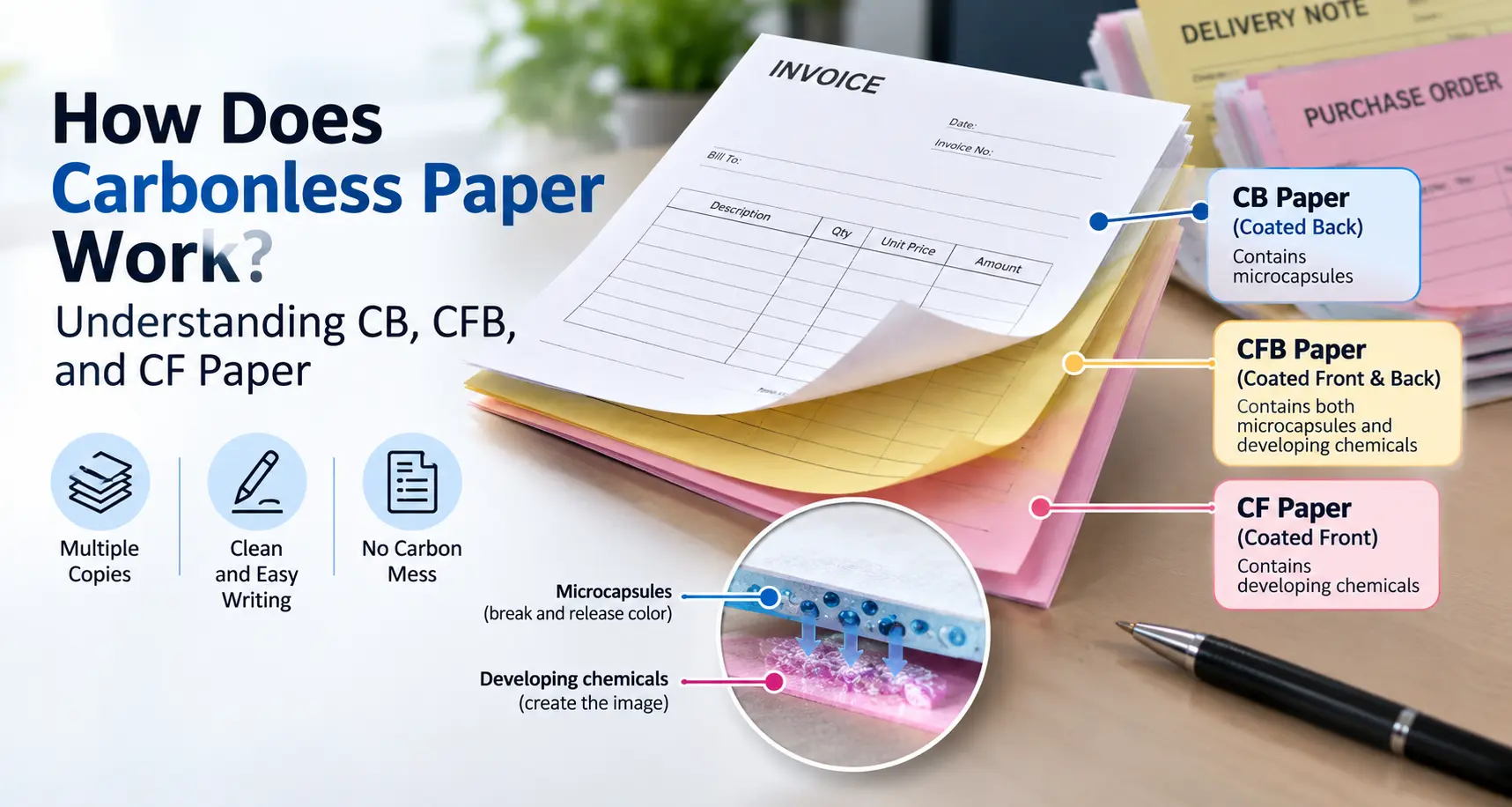
Businesses across industries regularly handle invoices, purchase orders, delivery notes, receipts, and other documents that require multiple copies. For printing companies, paper converters, distributors, and manufacturers, producing these documents efficiently requires paper that delivers consistent image transfer and reliable performance.
This is where carbonless paper plays an important role.
Carbonless paper, also known as NCR (No Carbon Required) paper, allows businesses to create multiple copies of a document through writing or printing pressure without using a separate carbon sheet. It uses specially developed chemical coatings that transfer information from one sheet to another, making it a practical solution for multi-part business forms.
But how does carbonless paper work? What makes CB, CFB, and CF paper different? And why is selecting the right paper combination important for businesses involved in printing and converting?
The answer lies in its pressure-sensitive coating technology. Each paper grade has a specific function, and when arranged correctly, these sheets work together to produce clear copies from a single writing operation.
In this guide, FormersPaper explains the working principle of carbonless paper, the roles of CB, CFB, and CF sheets, their stacking combinations, manufacturing considerations, and important factors B2B buyers should evaluate before purchasing carbonless paper in bulk.
Carbonless paper is a specially coated paper that produces duplicate or multiple copies when pressure is applied to its surface. Unlike traditional carbon paper, it does not require an additional ink-coated sheet between pages.
Instead, it uses a chemical coating system consisting of microscopic capsules containing colour-forming chemicals and a developer coating. When pressure is applied, the capsules release their contents, which react with the developer coating on the next sheet to create a visible image.
Carbonless paper is widely used for manufacturing:
For businesses that process a large number of transactions, preparing separate documents for different departments or customers can take additional time and resources.
Carbonless paper simplifies this process by allowing the same information to appear on multiple sheets simultaneously.
Some of its key advantages include:
For printing businesses and paper converters, choosing the right carbonless paper is essential for maintaining consistent copy quality and meeting customer requirements.
Carbonless paper works through a pressure-sensitive chemical reaction involving two main components: microencapsulated colour-forming chemicals and a developer coating.
These coatings are applied to specific surfaces of the paper. Under normal conditions, they remain separate. However, when someone writes on the top sheet or uses a compatible impact-printing process, the applied pressure ruptures the microscopic capsules and releases the colour-forming solution.
When this solution comes into contact with the developer coating on the next sheet, a chemical reaction takes place and produces a visible image.
The microcapsule coating contains microscopic capsules filled with a colourless dye solution.
These capsules are designed to remain intact during normal handling and storage. When sufficient pressure is applied, they rupture and release the colour-forming solution.
The released solution then transfers to the developer-coated surface of the sheet underneath.
The developer coating is applied to the front surface of the receiving paper.
It generally contains materials such as acidic clay, phenolic resin, or other suitable developer compounds. When the colour-forming chemicals come into contact with this coating, they react to produce a visible image.
Depending on the formulation, the resulting image may appear blue or black.
The process can be explained in four stages:
Step 1- Pressure Application
A pen tip, typewriter, or suitable impact printer applies pressure to the top sheet.
Step 2- Microcapsule Rupture
The pressure breaks the microscopic capsules present on the coated back of the sheet, releasing the colour-forming solution.
Step 3- Chemical Reaction
The released dye comes into contact with the developer coating on the front of the next sheet.
Step 4- Image Formation
A chemical reaction takes place, creating a visible copy of the original writing or printed information.
The same process continues through the remaining sheets in a multi-part form, allowing businesses to produce several copies in a single operation.
Carbonless paper is available in three primary grades: CB, CFB, and CF. These grades are classified according to the location of their functional coatings.
Each type performs a different role in transferring and receiving information. Understanding their construction is important for printing companies, converters, and businesses purchasing carbonless paper in bulk.
CB stands for Coated Back. It is generally used as the top sheet in a carbonless paper form.
The back surface of CB paper is coated with microcapsules containing a colourless dye solution. When someone writes or prints on the sheet with sufficient pressure, these capsules rupture and release the dye.
The released dye transfers to the developer coating on the front of the next sheet, producing the first duplicate copy.
Main Features of CB Paper-
Common Applications-
CF stands for Coated Front. It is generally used as the bottom sheet in a carbonless paper set.
The front surface of CF paper contains a developer coating, which reacts with the colour-forming chemicals released from the microcapsules on the sheet above.
This reaction creates the final copy of the original writing or printed information.
Unlike CB and CFB paper, CF paper does not require a microcapsule coating because it does not transfer an image to another sheet underneath.
Main Features of CF Paper-
Common Applications-
CFB stands for Coated Front and Back. It is used as the middle sheet in multi-part carbonless forms.
Both sides of CFB paper have functional coatings:
This dual-coating arrangement allows CFB paper to perform two functions simultaneously. It receives an image from the previous sheet and transfers another image to the sheet below.
Main Features of CFB Paper-
Common Applications-
For carbonless paper manufacturers and converters, CFB paper requires particular attention because the performance of both coatings influences the quality of the complete document set.
Although all three grades are part of the same carbonless paper system, their coating structures and functions are different.
1. CB Paper (Coated Back)
2. CFB Paper (Coated Front and Back)
3. CF Paper (Coated Front)
In simple terms-
The correct combination of these three grades ensures that information transfers properly throughout a multi-part form.
The arrangement of carbonless paper follows a back-to-front coating principle.
The microcapsule-coated back of one sheet must be positioned against the developer-coated front of the next sheet. This allows the colour-forming chemicals to react correctly when pressure is applied.
Depending on the number of copies required, businesses use different combinations of CB, CFB, and CF paper.
Paper Arrangement- CB → CF
A two-part form consists of one CB sheet at the top and one CF sheet at the bottom.
When pressure is applied to the CB sheet, its microcapsules rupture and release the colour-forming solution. The solution reacts with the developer coating on the CF sheet, producing a duplicate.
Result: One original and one duplicate copy.
Paper Arrangement: CB → CFB → CF
A three-part form contains one CB sheet, one CFB sheet, and one CF sheet.
When pressure is applied-
Result: One original and two duplicate copies.
For four-part or larger forms, additional CFB sheets are placed between the top CB sheet and bottom CF sheet.
Common arrangements include-
Each middle CFB sheet receives an image from above and transfers an image to the next sheet below.
The basic arrangement remains the same regardless of the number of parts: one CB sheet at the top, one CF sheet at the bottom, and CFB sheets in between.
For businesses purchasing carbonless paper, the number of required copies should be confirmed before selecting the paper combination.
For printing companies and paper converters, consistent image transfer is one of the most important quality requirements.
Several factors influence the performance of carbonless paper.
The coating must be applied consistently across the paper surface. Uneven coating distribution may lead to differences in image density and copy clarity.
The microcapsules should have suitable characteristics to remain stable during normal handling while releasing their contents under the required pressure.
The developer coating must react effectively with the colour-forming chemicals to produce clear and readable images.
GSM and paper thickness influence the physical characteristics of the sheet and the pressure transferred through a multi-part form. The paper combination should be selected according to the required number of copies.
Excessive heat, humidity, friction, and pressure during storage can affect the coating system and lead to unwanted marks or reduced performance.
For bulk buyers, evaluating these factors through product samples and technical specifications helps reduce quality issues during converting and printing.
Carbonless paper manufacturing requires specialised coating technology and controlled processing to achieve consistent image-transfer performance.
The process involves preparing the coating materials, applying the appropriate formulations to the base paper, drying, finishing, and inspecting the finished product.
The manufacturing process begins with selecting suitable base paper according to the required GSM, thickness, surface characteristics, and intended application.
The colour-forming solution is enclosed in microscopic capsules. Their properties must be suitable for the required pressure-sensitive application.
The coatings are applied according to the specific paper grade:
After coating, the paper passes through controlled drying and finishing processes to prepare it for further converting.
The finished paper is inspected for relevant specifications such as GSM, coating consistency, image development, surface quality, and overall performance.
For converters and distributors, working with a manufacturer that maintains consistent coating and quality-control processes is important for dependable supply.
Carbonless paper is used across industries where multiple parties or departments require a physical copy of the same transaction.
Businesses use multi-part carbonless forms to provide copies to customers, accounting departments, and internal records teams.
Delivery notes, goods receipts, and dispatch documents require copies for drivers, warehouses, and receiving customers.
Retail stores, restaurants, and hotels use carbonless paper for receipts, order forms, and guest checks.
Manufacturers use carbonless forms for material requests, inventory records, production documentation, and dispatch reports.
Certain financial and administrative transactions require multiple copies for customers and internal records.
Medical facilities use carbonless forms for selected administrative records, service documentation, and other paperwork requiring duplicate copies.
These applications make carbonless paper an important material for businesses involved in printing, stationery production, and document management.
Selecting carbonless paper for commercial use requires careful consideration of paper specifications, coating performance, and the intended application.
For procurement managers, paper converters, and wholesale distributors, the following factors should be evaluated before placing a bulk order.
Identify whether your application requires CB, CFB, or CF paper. The number of copies required determines the combination of paper grades.
Paper weight affects handling, thickness, and the suitability of the paper for different multi-part forms.
FormersPaper offers carbonless paper in a listed range of 45–80 GSM. Buyers should confirm the availability of specific grades and combinations according to their requirements.
Check whether the required image colour is available and ensure that the paper produces clear, consistent copies across all layers.
Coating uniformity is important for reliable image transfer. Ask suppliers about their coating processes and quality-control procedures.
Depending on the production requirement, carbonless paper may be purchased in jumbo reels, rolls, or sheets.
Share your required dimensions, GSM, roll width, core size, and converting specifications with the supplier.
For wholesale and industrial buyers, minimum order quantities and production lead times are important purchasing considerations.
Confirm these details before finalising a bulk order.
Before committing to a large order, evaluate samples using your actual printing or converting setup.
Also request relevant technical specifications, quality certificates, and compliance documents according to your business requirements.
For businesses involved in paper converting, printing, and wholesale distribution, choosing the right manufacturing partner is important for maintaining product quality and a dependable supply chain.
FormersPaper supports B2B customers looking for carbonless copy paper and other specialty paper solutions for commercial and industrial applications.
With manufacturing facilities and in-house capabilities across coating, laminating, printing, and converting, FormersPaper provides paper solutions for different business requirements.
FormersPaper's carbonless paper range includes:
Additional product specifications include:
FormersPaper also reports dedicated coating lines and in-house R&D capabilities to support its specialty paper manufacturing operations.
Whether you manufacture business forms, supply stationery products, or convert jumbo reels into finished paper products, selecting the right paper specifications is essential.
FormersPaper works with B2B customers across different markets, supporting enquiries related to product grades, GSM requirements, paper formats, and bulk purchasing.
If you are looking for a carbonless paper manufacturer or supplier, contact FormersPaper to discuss your requirements and request product information.
Carbonless paper is an important material for businesses that require multiple copies of the same document without using traditional carbon sheets. Its performance depends on the interaction between three essential paper grades: CB, CFB, and CF.
While CB paper initiates the image-transfer process, CFB paper carries it through the middle layers, and CF paper receives the final copy. Understanding how these grades work together helps printing companies, paper converters, and wholesale buyers select the right combination for their production requirements.
However, choosing the right carbonless paper involves more than understanding its coating structure. GSM, coating consistency, image clarity, paper format, and supplier reliability also influence the final product.
At FormersPaper, we support B2B customers looking for carbonless paper solutions for printing, converting, and commercial applications.
Looking for a reliable carbonless paper manufacturer or supplier? Contact FormersPaper to discuss your CB, CFB, and CF paper requirements and explore suitable options for your business.
Carbonless paper uses microcapsules containing colour-forming chemicals and a developer coating. When pressure is applied, the capsules rupture and release the dye, which reacts with the developer coating to produce a visible copy.
CB paper has a microcapsule coating on its back, CFB paper has a developer coating on its front and a microcapsule coating on its back, and CF paper has a developer coating on its front. Each grade performs a different function in multi-part forms.
The standard arrangement is CB at the top, CFB in the middle, and CF at the bottom. The number of CFB sheets depends on how many copies are required.
Carbonless paper is commonly used in two-part, three-part, four-part, and five-part forms. Some applications require additional sheets. The achievable copy quality depends on the paper combination, coating performance, and applied pressure.
Carbonless paper generally uses microencapsulated colour-forming chemicals and a developer coating. Depending on the formulation, the developer may contain acidic clay, phenolic resin, or other suitable materials.
Traditional carbon paper uses a separate ink-coated sheet placed between two pages. NCR paper has specially developed coatings built into the paper itself, allowing multiple copies to be produced without a separate carbon insert.
The suitable GSM depends on the application, paper grade, and number of copies required. FormersPaper lists carbonless paper options ranging from 45 to 80 GSM. Contact the team to confirm available specifications.
Carbonless paper is commonly used for invoices, purchase orders, delivery notes, receipts, restaurant guest checks, warehouse records, and other multi-part business documents.
Yes, carbonless paper can be used with suitable printing methods, including offset and impact printing. Digital printing compatibility depends on the specific paper grade and equipment. Always check the manufacturer's recommendations before production.
Carbonless paper should be kept in its original packaging in a cool, dry environment. Avoid excessive heat, direct sunlight, moisture, friction, and unnecessary pressure to help maintain coating performance.


Formers Paper is a leading manufacturer for a comprehensive range of sustainable paper & packaging products serving customers globally.
Shenzhen Formers Paper Co. Ltd, No.92 Zhugushi Road, Wulian community, Longgang District, Shenzhen, China