We wish you Happy Holidays & a joyful New Year!

Choose the right material, adhesive and print finish for custom adhesive safety stickers. A practical guide for manufacturers planning bulk orders.
November 17, 2026
John Doe
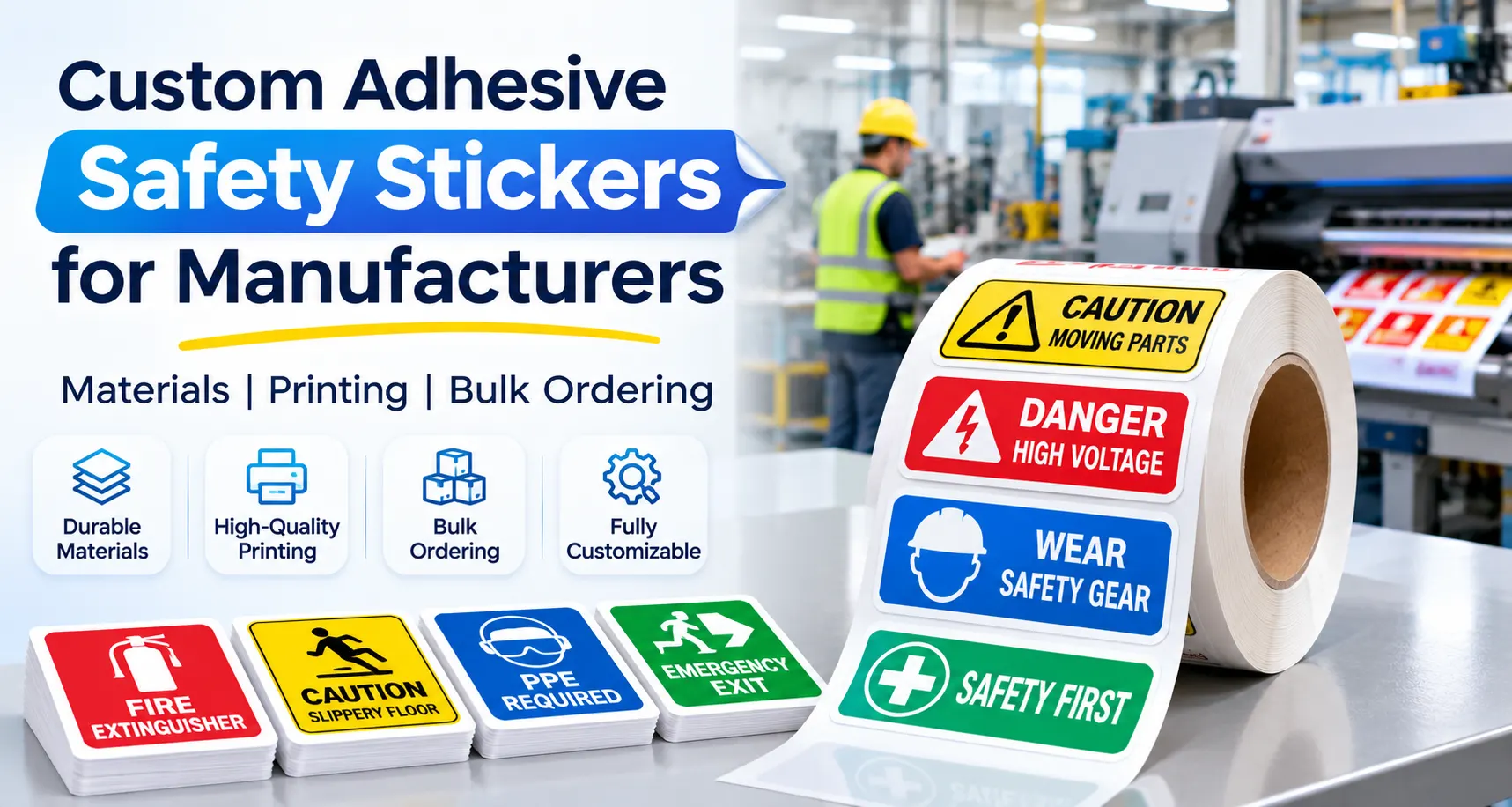
A safety warning is only useful when employees can see it, read it, and understand it at the right moment. On a busy manufacturing floor, even a small label can help prevent equipment damage, workplace injuries, and unnecessary operational risks.
Think about a machine operating at high temperatures or an electrical control panel carrying a high-voltage warning. Employees may not have time to consult a manual every time they work with equipment. They need clear safety instructions directly on the machine, panel, or working surface.
This is where custom adhesive safety stickers become important for manufacturers. Unlike standard off-the-shelf labels, custom safety stickers can be designed around specific equipment, workplace hazards, surface conditions, and operational requirements.
However, choosing the right sticker involves more than selecting a warning symbol and printing it. Material quality, adhesive performance, printing technology, environmental resistance, and durability all influence how well a safety label performs over time.
For manufacturers, distributors, equipment suppliers, and procurement professionals, selecting the right supplier is equally important.
At FormersPaper, we understand the importance of matching label materials and adhesives to their intended applications. In this guide, we'll explore the different types of industrial safety stickers, available materials, adhesive options, printing considerations, and important factors to review before placing a bulk order.
Custom adhesive safety stickers are pressure-sensitive labels designed to communicate warnings, safety instructions, restrictions, and important operational information.
They are manufactured according to specific requirements, including size, shape, material, adhesive type, colour, printing design, and language.
Unlike generic safety labels, custom stickers allow manufacturers to display information that relates directly to their machinery, products, workplace conditions, and safety procedures.
For example, a manufacturer operating industrial ovens may require heat-resistant warning stickers, while an electrical equipment manufacturer may need high-visibility voltage warning labels.
The design and material requirements can differ significantly between these applications.
Depending on the application, custom industrial safety stickers can offer:
These features help businesses select labels that suit their working environments rather than relying on a one-size-fits-all solution.
Manufacturing facilities use different types of machinery, electrical systems, chemicals, and industrial equipment. Each application can present its own safety concerns.
Standard labels may not always provide the correct dimensions, wording, language, or material performance required for these environments.
Custom safety stickers help manufacturers address these requirements more effectively.
Here are some important reasons businesses invest in custom-printed safety labels:
Equipment manufacturers can also use custom labels to maintain consistent branding and safety instructions across different product models.
For procurement teams, working with experienced custom adhesive safety sticker manufacturers helps simplify repeat orders and maintain consistency across production batches.
It is important to remember that safety stickers support workplace safety procedures but do not replace machine guards, employee training, risk assessments, or other required protective measures.
Different workplace hazards require different warning messages. Selecting the correct label category helps employees understand the potential risk and the action they need to take.
Here are some common types of industrial safety stickers used across manufacturing and commercial environments.
Warning stickers communicate potential hazards associated with machinery, equipment, and workplace activities.
They are commonly used around moving components, hot surfaces, hazardous substances, and restricted operational areas.
Danger and caution labels help communicate the severity of a potential hazard.
Their wording, symbols, and colours should follow the applicable safety signage standards and approved artwork.
Manufacturers commonly use these labels on machinery, industrial panels, production equipment, and maintenance areas.
These labels provide important information about machine operation and potential hazards.
Common examples include:
Chemical safety labels communicate information about hazardous substances, handling precautions, and potential exposure risks.
For relevant chemical applications, labels may need to follow the Globally Harmonized System (GHS) requirements.
Electrical safety labels identify voltage risks, electrical hazards, and restricted access areas.
Fire safety stickers are used to identify fire extinguishers, emergency equipment, fire exits, and related safety instructions.
Manufacturing facilities also use adhesive labels to identify storage areas, restricted zones, pedestrian routes, and equipment locations.
These labels help employees and visitors understand workplace layouts and follow established safety procedures.
Safety labels must communicate information accurately. Depending on the application and destination market, manufacturers may need to follow specific safety signage and labelling standards.
Some commonly referenced standards include:
Exporters should also consider local regulations. For example, Mexico has NOM-026-STPS requirements relating to safety colours and signs in workplaces.
The applicable requirements depend on the product, workplace, industry, and country.
Incorrect warning messages, symbols, or colours can create confusion and may result in compliance issues.
Before sending artwork for production, manufacturers should:
At FormersPaper, custom safety stickers can be manufactured according to customer-provided designs and specifications. Buyers should ensure that their approved artwork meets the requirements of the intended application.
The material used to manufacture a safety sticker directly affects its durability, appearance, and performance.
A label placed on an indoor control panel may have different requirements from one exposed to outdoor sunlight, machine oil, or regular chemical cleaning.
For this reason, material selection should be based on the actual working environment.
FormersPaper works with three main facestock options for custom adhesive safety stickers.
Polypropylene is a practical option for many general-purpose labelling applications.
Its useful characteristics include:
PP can be considered for industrial applications where the environmental conditions do not require the additional performance characteristics of specialised materials.
Polyethylene is softer and more flexible than many other label materials.
It can be suitable for applications involving curved surfaces, flexible packaging, or surfaces that require a more adaptable label.
Manufacturers should evaluate the specific PE grade and adhesive combination before selecting it for demanding industrial environments.
Polyester is a strong and dimensionally stable material used in applications where labels need additional durability.
Depending on the selected grade and construction, PET labels can offer better resistance to heat, scratches, and certain chemicals than standard PP or PE options.
They are worth considering for industrial equipment, machinery panels, and applications where label longevity is important.
- PP (Polypropylene): Offers good moisture resistance and versatility, making it suitable for general industrial labelling applications.
- PE (Polyethylene): Soft and flexible, making it a suitable choice for curved surfaces and flexible materials.
- PET (Polyester): Provides strength and dimensional stability, making it ideal for machinery labels and demanding industrial applications.
The final choice should consider the complete label construction, including adhesive, coating, printing method, and environmental exposure.
The printed surface also needs protection, particularly when labels are exposed to regular cleaning or handling.
FormersPaper offers protective coating options designed for different application requirements, including:
The required temperature range and chemical exposure should always be confirmed before production.
Even a well-printed safety label will not perform properly if it cannot stay attached to the intended surface.
Adhesive selection is therefore just as important as choosing the facestock.
Before selecting an adhesive, manufacturers should consider the surface material, texture, cleanliness, temperature, and application conditions.
Three properties are particularly important when evaluating adhesive performance.
Tack: Describes how quickly an adhesive bonds to a surface when pressure is applied.
Peel Adhesion: Measures the force required to remove an adhesive label from a surface under specified test conditions.
Shear Resistance: Describes how well an adhesive resists movement or sliding under sustained force.
Understanding these properties helps procurement teams compare adhesive options more accurately.
Acrylic Adhesive
Acrylic adhesives are commonly selected for applications requiring long-term bonding and good ageing performance. Depending on the formulation, they can provide resistance to light and temperature exposure.
Hot Melt Adhesive
Hot melt adhesives offer quick initial bonding and are commonly used in applications involving packaging and certain industrial surfaces.
UV Adhesive
Specialised UV adhesive options may be suitable for specific applications. Their performance depends on the adhesive formulation and intended use.
FormersPaper offers acrylic, hot melt, and UV adhesive options for different sticker requirements.
Permanent adhesives are generally selected when labels are expected to remain attached for extended periods.
Removable adhesives are more appropriate for temporary identification, notices, and applications where clean removal is important.
The right option depends on the label's purpose and the surface involved.
For industrial safety stickers, buyers should also consider the challenges associated with powder-coated surfaces, textured materials, oily equipment, and low-surface-energy plastics.
No single adhesive works equally well on every surface. Testing the proposed combination before bulk production is the safest approach.
Printing quality plays an important role in how easily employees recognise and understand safety instructions.
A warning label should communicate its message quickly. Small text, poor contrast, unclear symbols, or inconsistent colours can make important information difficult to read.
FormersPaper offers custom printing and finishing options to meet different industrial labelling requirements.
Manufacturers can customise their safety stickers according to their branding and application needs.
Available options include:
The company supports printing in one to ten colours, depending on the project requirements.
When preparing artwork for industrial safety stickers, keep the following points in mind:
The supply format is another important consideration, particularly for manufacturers using automated labelling equipment.
Roll labels may require specific roll direction, core size, and spacing between individual stickers.
Sheet formats may be more suitable for manual application or smaller labelling requirements.
Discuss these specifications with your supplier before approving the production order.
Before beginning a full production run, request a final artwork proof.
Your procurement and safety teams should verify the following:
This simple review helps reduce printing errors and unnecessary production costs.
Custom safety stickers are used across a wide range of industries. Their specifications vary depending on the equipment, workplace conditions, and safety requirements.
Some common applications include:
Manufacturing plants use warning labels on production machinery, moving equipment, electrical panels, and maintenance areas.
Automotive and engineering companies use safety labels to identify equipment hazards, operating instructions, and restricted areas.
Construction businesses use safety stickers for equipment identification, hazard communication, electrical warnings, and workplace instructions.
Warehouses use identification and safety labels on storage racks, handling equipment, pallets, and restricted access areas.
These industries require labels that communicate chemical hazards, handling instructions, and relevant safety information.
Material and adhesive selection should account for the specific chemicals and cleaning processes involved.
Electrical equipment manufacturers use labels to communicate voltage information, electrical hazards, and operating precautions.
Ordering thousands of labels without checking their performance can lead to unnecessary costs and production delays.
A sample evaluation gives manufacturers an opportunity to verify whether the selected material and adhesive are suitable for their actual equipment.
Here is a practical testing process:
For formal adhesion evaluation, buyers can discuss recognised test methods such as FINAT FTM 1 for 180-degree peel adhesion and ASTM D6252 for 90-degree peel adhesion.
Testing conditions should be documented so different suppliers and material combinations can be compared fairly.
Experienced custom adhesive safety sticker manufacturers should be able to discuss sample testing before a large production order.
For manufacturers with multiple production lines or facilities, bulk ordering can simplify purchasing and help maintain consistent labelling across equipment.
However, ordering in large quantities also makes it important to finalise every specification before production begins.
A clear purchase requirement helps suppliers understand the project and provide an accurate quotation.
Before requesting a quotation from a manufacturer, prepare the following specifications:
Providing these details upfront can help reduce back-and-forth communication and speed up the quotation process.
The cost of custom industrial safety stickers depends on several factors.
Material Selection: Different facestocks have different costs and performance characteristics.
Adhesive Type: Specialised adhesive requirements can influence the final product price.
Sticker Dimensions: Larger labels generally require more material.
Printing Requirements: Colour count, artwork complexity, and printing specifications can affect production costs.
Order Quantity: Production volume and job setup requirements influence unit pricing.
Finishing Options: Protective coatings, lamination, and die-cutting can affect overall manufacturing costs.
Minimum order quantities (MOQs) and production timelines depend on the material, dimensions, printing requirements, finishing process, and order volume.
FormersPaper does not publish a single fixed MOQ or lead time for all safety sticker projects. Its sales team confirms these details after reviewing the order specifications.
For accurate planning, buyers should request confirmation of:
Businesses can make bulk purchasing more efficient by following a few practical steps:
For export orders, FormersPaper can also provide a Certificate of Origin. Buyers should confirm documentation requirements before dispatch.
Selecting a supplier is an important part of the purchasing process. A low quotation may look attractive, but material quality, production consistency, and technical support also influence the long-term value of an order.
When comparing custom adhesive safety sticker manufacturers, consider the following factors.
Choose a manufacturer that can discuss different facestocks and adhesive options based on your application requirements.
Check whether the supplier can handle your required colours, dimensions, artwork, shapes, coatings, and supply formats.
For recurring or high-volume requirements, understand the supplier's production capabilities and ability to maintain consistency across batches.
Ask about quality control procedures, material checks, production inspections, and relevant management system certifications.
A supplier that supports sample evaluation helps buyers assess material suitability before committing to larger quantities.
International buyers should also consider packaging, shipping arrangements, export documentation, and communication during the order process.
A reliable safety labels and stickers manufacturer should be transparent about product specifications, production capabilities, and order requirements.
When purchasing industrial safety labels in bulk, working directly with a manufacturer can make communication and production coordination easier.
FormersPaper provides custom adhesive safety sticker manufacturing solutions for B2B buyers looking for different materials, adhesives, printing specifications, and finishing options.
Here are some of the company's manufacturing capabilities.
FormersPaper handles coating, laminating, printing, and converting in its own manufacturing facilities.
This integrated approach allows the company to manage different stages of label production under its manufacturing operations.
The company offers PP, PE, and PET facestocks, along with acrylic, hot melt, and UV adhesive options.
These choices help buyers specify labels according to their intended application.
FormersPaper supports one-to-ten-colour printing, custom shapes, die-cut designs, and different protective coating options.
The company operates five factories across China, the UK, and Indonesia, with more than 600 pieces of equipment and over 100 patents, according to its company information.
This manufacturing infrastructure supports its broader label and adhesive product operations.
FormersPaper lists the following management system certifications:
These certifications relate to the company's management systems. They should not be confused with product-specific safety label approvals or certification of customer artwork.
FormersPaper serves customers in China, the United States, Canada, Mexico, and the Caribbean.
Its international supply experience supports businesses looking for custom label manufacturing and export arrangements.
For procurement teams, the next step is to share the intended application, artwork, material preferences, and order quantity to discuss a suitable specification.
Custom adhesive safety stickers play an important role in communicating workplace hazards, equipment instructions, and operational precautions.
However, the right sticker is not simply the one with the best-looking design. It must also have the appropriate material, adhesive, printing quality, and protective finish for its intended environment.
For manufacturers, the most important step is to understand where the label will be applied and what conditions it will face during everyday operations.
Whether you need PET safety labels for industrial equipment, flexible PE stickers, moisture-resistant PP labels, or customised adhesive solutions for large production requirements, selecting the right manufacturing partner can make the purchasing process easier.
FormersPaper offers custom adhesive safety sticker manufacturing solutions for B2B buyers, with multiple material choices, adhesive options, printing capabilities, and integrated production facilities.
Planning your next bulk safety sticker order? Share your artwork, required dimensions, application surface, material preferences, and estimated quantity with FormersPaper to discuss your requirements, request sample information, and get a quotation.
Custom adhesive safety stickers communicate workplace hazards, operating instructions, equipment warnings, and safety precautions. They are commonly applied to industrial machinery, electrical panels, chemical containers, storage areas, and manufacturing equipment.
The best material depends on the intended application. PP is suitable for many general labelling requirements, PE offers flexibility for curved or flexible surfaces, and PET provides additional strength and dimensional stability for demanding applications.
Yes. FormersPaper offers protective coating options designed for different environmental requirements, including water, machine oil, chemicals, alcohol, scratches, and UV exposure. The appropriate construction should be confirmed based on actual operating conditions.
Yes. Manufacturers can discuss bulk production according to their required quantities, dimensions, materials, printing specifications, and finishing requirements. MOQ and production timelines should be confirmed with the supplier for each project.
You should provide approved artwork, sticker dimensions, material preferences, adhesive requirements, order quantity, printing specifications, supply format, application surface, and delivery destination.
Yes. Custom designs can include company branding, approved safety symbols, specific warning messages, and multiple languages according to the project requirements.
Consider the application surface, surface texture, temperature, moisture, chemical exposure, and expected service life. Discuss these conditions with your supplier and test a sample before approving bulk production.
Permanent adhesive labels are designed for long-term attachment, while removable adhesive labels are intended for applications where clean removal is important. The final choice depends on the surface and application requirements.
Yes. FormersPaper offers custom adhesive sticker manufacturing with PP, PE, and PET materials, different adhesive options, custom printing, coatings, and finishing capabilities for B2B requirements.
FormersPaper serves customers in several international markets, including China, the United States, Canada, Mexico, and the Caribbean. Buyers can contact its team to discuss order quantities, shipping arrangements, and export documentation.


Formers Paper is a leading manufacturer for a comprehensive range of sustainable paper & packaging products serving customers globally.
Shenzhen Formers Paper Co. Ltd, No.92 Zhugushi Road, Wulian community, Longgang District, Shenzhen, China