We wish you Happy Holidays & a joyful New Year!

Carbonless business forms vs. Carbon paper: see which one keeps your records clean, legible, and ready when a dispute or audit hits.
September 11, 2026
John Doe
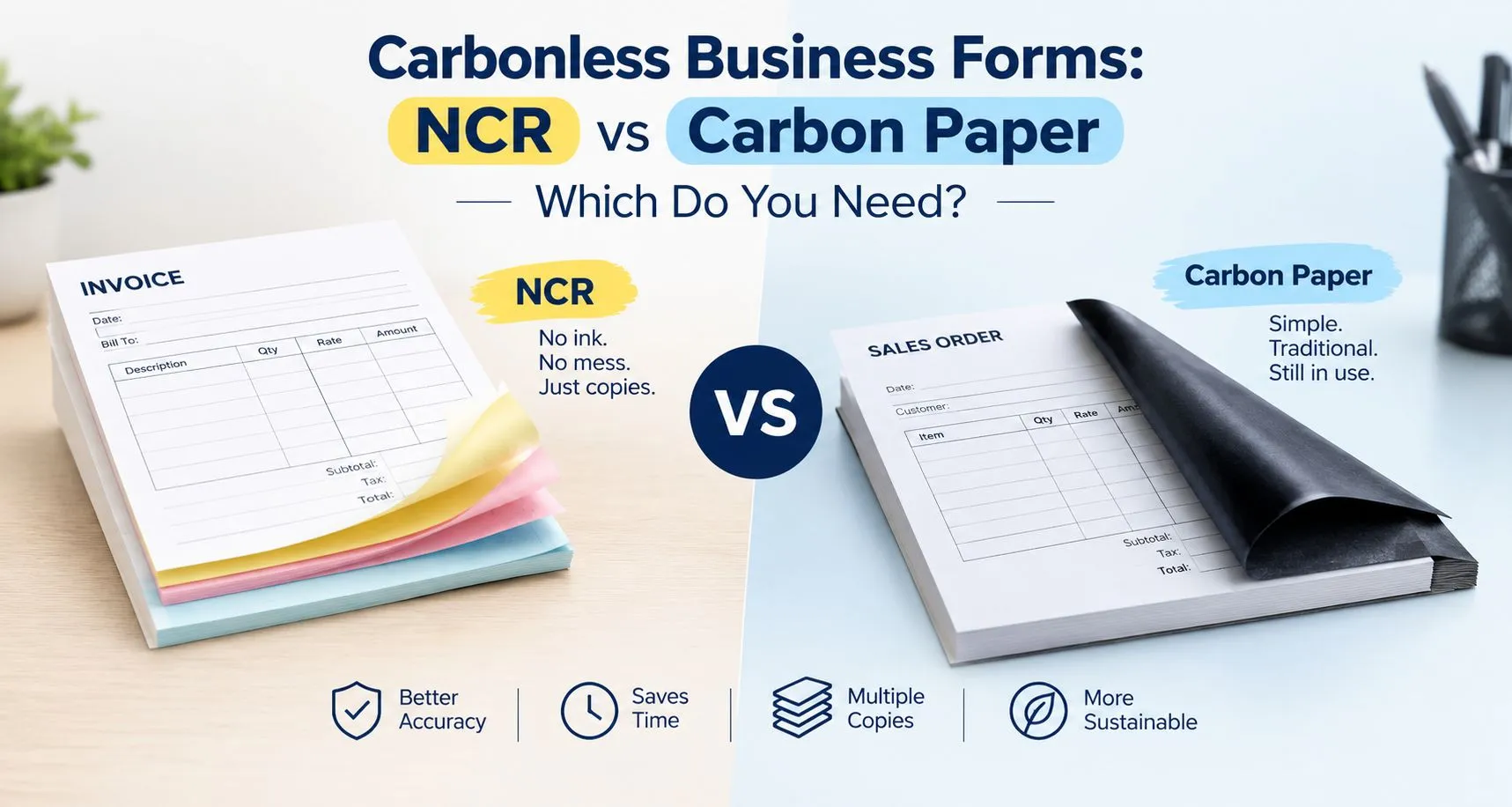
Your delivery driver hands over a copy that already looks faded before the customer even signs it. Now you have a dispute on your hands, and no readable proof to settle it. This happens more often than most businesses admit, and it is exactly why so many companies are moving away from old carbon paper and switching to carbonless paper instead.
This guide breaks down NCR vs carbon paper in plain language so you know exactly which one your business needs. You will learn what carbonless forms actually are, how they stack up against old-style carbon paper, and how to choose the right custom carbonless business forms for your industry. FormersPaper manufactures NCR carbonless business forms in-house and ships business forms to companies across the USA, Canada, Mexico, the Caribbean, and China every week, so this comparison comes from real production experience, not a guess pulled off a search results page.
Picking the right option is not just a paperwork decision. It affects how fast your staff can process a sale, how clean your records stay, and how confident you feel handing a customer their copy. Get it wrong, and you end up with smudged, unreadable carbon copies nobody can read six months later. Get it right, and every copy of your paperwork stays crisp and easy to file.
Carbon paper is the old-school method for making copies of a document. A thin sheet coated with a wax-based ink sits between two sheets of paper. When someone writes or types on the top sheet, the pressure pushes ink from the carbon sheet onto the page below it, creating a copy.
It works, but it comes with real headaches. The carbon sheet smudges hands, desks, and shirt sleeves. It has to be removed and repositioned for every new set. It can slip out of place mid-write, which means your second or third copy comes out blank or badly aligned. Businesses that still rely on plain carbon paper for daily paperwork often deal with messy desks and copies that fade within days.
NCR stands for "No Carbon Required". The name traces back to the National Cash Register Company, the business that first developed this coating technology decades ago. NCR carbonless paper removes the loose carbon sheet entirely and replaces it with a chemical coating built directly into the sheet itself.
Here is how it works. The back of the top sheet carries a layer of micro-encapsulated dye. The front of the sheet beneath it carries a reactive clay coating. When pressure is applied, whether from a pen, a typewriter, or an impact printer, the tiny capsules of dye burst open and react with the clay layer below. That reaction creates an instant, legible copy, with no loose carbon sheet involved at all.
Paper professionals describe this using three coating types: CB (coated back), CF (coated front), and CFB (coated front and back). The top sheet in a multi-part set is CB only. Middle sheets are CFB, since they need to both receive the copy from above and pass it down to the sheet below. The final sheet is CF only, since nothing needs to be passed further. Understanding this layering helps if you are ordering custom carbonless NCR forms and want to confirm your supplier is using the right coating on each sheet in the set.
When you compare the two side by side, the practical differences show up fast. Here is a straightforward breakdown that business buyers use when weighing NCR carbonless business forms against traditional carbon paper.
Laid out this way, the choice becomes much easier. Carbon paper still has a place in very low-volume, informal settings. For nearly everything else, carbonless forms give a business cleaner copies, faster processing, and far less mess at the front counter or back office.
Every year, more companies retire their old carbon paper and move to NCR carbonless business forms instead. A few reasons keep coming up in conversations with procurement teams.
These forms show up across nearly every industry that needs a reliable paper trail. Seeing where your own business fits usually settles the question on its own.
Seeing your own operation somewhere on this list is usually the fastest way to confirm that carbonless paper, not plain carbon paper, is the right fit for your daily paperwork.
Businesses operating across borders face an added wrinkle here. A restaurant chain with locations in the USA and Mexico, or a logistics company moving freight between Canada and the Caribbean, needs every branch working from the same set format, the same color coding, and the same paper weight. Sourcing from a single manufacturer that already understands multi-country supply keeps that consistency intact, rather than leaving each branch to order slightly different stock from whichever local supplier happens to be closest.
Plenty of businesses now run most of their paperwork through software, so it is fair to ask whether printed sets still have a place. The honest answer is yes, especially in a few common situations.
Job sites, delivery routes, and warehouses do not always have reliable internet access. A driver standing in a loading dock cannot always pull up an app to confirm a signature, but a printed set works every time, with no signal required and no battery to charge. Contracts and agreements that need a wet-ink signature also still lean on physical paperwork, since some clients and some legal processes simply expect a signed copy in hand.
There is also the audit angle. A physical, dated, signed set of records gives compliance teams something concrete to point to during a review, without depending on a server staying online or a file staying backed up correctly. Many companies now run a mixed approach, keeping digital systems for day-to-day tracking while still relying on printed sets at the point of transaction, where a signature or a handoff needs to happen in person. That mixed approach is exactly where a dependable paper supplier earns its keep.
A side-by-side comparison only gets you halfway. These checks help you land on the exact paper setup your operation actually needs.
Most businesses choose 2-part or 3-part sets. A 2-part set typically gives one copy to the customer and keeps one for your files. A 3-part set adds a copy for accounting or inventory. Some industries, like transport and logistics, use 4-part or even 5-part custom carbonless business forms so every stop along the supply chain gets its own copy.
Standard colors for carbonless forms are white, yellow, pink, green, and blue. Assign each color to a specific purpose, for example white for the customer, yellow for the department, and pink for the office, so your staff never has to guess which copy goes where.
NCR carbonless business forms come glued into pads, bound into books with a taped spine, or supplied as loose sets. Pads suit counters and desks. Books suit drivers and field staff who need a tidier, more durable format. Loose sets suit businesses that prefer to file each form individually.
Not every carbonless paper works with every printer. If your business runs impact or dot-matrix printers, confirm your custom carbonless NCR forms are rated for that pressure-based printing. If you plan to overprint using a laser printer, ask specifically for laser-compatible NCR carbonless paper, since standard stock is not always rated for laser heat.
Sequential numbering on business forms helps with document control and makes it far easier to track a missing set. Perforation lets a top sheet or coupon tear away cleanly, which matters for tickets, vouchers, or detachable receipts built into your custom carbonless business forms.
Not all carbonless stock performs the same. Lightweight stock may feel flimsy in daily use, while heavier stock holds up better to repeated handling in a busy office or warehouse. Coating quality also affects how sharp each copy looks, since a thin or inconsistent coating can leave the bottom sheet in a set noticeably fainter than the top. A dependable manufacturer will confirm the weight and coating quality of your order before it ships, not after a complaint comes in, and should be able to share this information in writing rather than a vague assurance over the phone.
If your business needs this paper every month, confirm your supplier can support recurring bulk orders without delay. This matters even more for companies operating across several countries, since a supply gap in one location can slow down operations everywhere else.
Here is something many buyers overlook: the paper type is only half the decision. Who actually manufactures your business forms is the other half, and it is the half that protects your daily operations.
Founded in 1995 by Ms. Wei Ren in Shenzhen, FormersPaper has spent three decades building a fully vertically integrated production process. Coating, laminating, printing, and converting all happen in-house, which means the company controls the entire process behind every batch of NCR carbonless business forms it ships, instead of outsourcing pieces of production to outside vendors.
FormersPaper runs five manufacturing factories with more than 600 pieces of advanced production equipment, spread across roughly 3 million square feet of workshops and warehouses in China, the UK, and Indonesia. An in-house research and development team holds more than 100 patents, which means custom requests get engineered and solved rather than pushed aside.
Certifications matter just as much as equipment when you are sourcing this paper for a growing operation. FormersPaper holds ISO 9001:2015 for quality management, ISO 14001:2015 for environmental management, ISO/IEC 27001 for information security, OHSAS 18001 for workplace health and safety, RoHS compliance for restricted hazardous substances, and FSC certification confirming that fiber comes from responsibly managed forests. These are not vague homepage claims. They are documented standards that procurement and compliance teams can verify before signing a supply agreement.
For a retail chain, hospital network, finance office, or logistics company comparing suppliers, this scale and documentation translate into something simple: consistent coating quality, batch after batch, and a supplier that can keep up with your order volume as your business grows.
This matters even more once you factor in geography. A company running stores or branches across several countries cannot afford coating quality that shifts from one shipment to the next, or a supplier that treats one region as a priority and leaves another waiting. Working with a single, vertically integrated manufacturer that already ships to multiple regions removes that risk, since every batch comes off the same production lines under the same quality checks, no matter which country places the order.
Even the best carbonless paper will not perform well if it is stored the wrong way. Follow these habits to keep every batch of business forms in good condition until the day they are used.
A little care in storage goes a long way toward making sure every copy in your custom carbonless business forms stays legible from the day it is printed to the day it is filed.
Businesses sourcing this type of paper across North America, the Caribbean, and China all face a similar challenge: finding one supplier who can deliver consistent quality without routing every order through several middlemen first.
FormersPaper's product range covers far more than a single paper type. Alongside NCR carbonless business forms, the catalog includes docket books, thermal paper rolls, jumbo reels and raw materials for converters, tickets, labels and stickers, baking paper, and eco-friendly packaging. That range matters if your order today turns into a broader paper or packaging need down the road, since working with one certified manufacturer for multiple categories keeps procurement simple.
Whether your business needs finished, ready-to-use custom carbonless NCR forms or bulk raw material for your own converting line, FormersPaper's in-house production covers both without handing your order to a third-party coater along the way. Ready to compare FormersPaper against your current supplier? Reach out for samples, specifications, and a factory-direct quote built for your exact workflow.
There is no universal winner between the two. The right choice depends on your volume, your printer hardware, and how long you need each copy to stay legible. Use these questions to land on the right answer for your business.
Answering these questions turns an abstract comparison into a straightforward purchasing decision your whole team can agree on.
Choosing between the two comes down to matching the paper to your volume, your equipment, and how professional you need each copy to look. Carbon paper still has a small place in very low-volume settings, but for nearly every modern business, carbonless paper delivers cleaner copies, faster processing, and a more professional customer experience.
What does not change is the importance of your supplier. A manufacturer with in-house production, real certifications, and the capacity to scale with your order volume protects you from mismatched batches and missed deadlines. FormersPaper manufactures custom carbonless business forms in-house, backed by ISO 9001:2015, ISO 14001:2015, ISO/IEC 27001, OHSAS 18001, RoHS, and FSC certifications, and ships business forms to companies across the USA, Canada, Mexico, the Caribbean, and China. If you are ready to lock in a reliable paper supply for your operation, contact FormersPaper today for samples, specifications, and a factory-direct quote.
NCR stands for "No Carbon Required." The term comes from the National Cash Register Company, which developed the original carbonless coating technology used in carbonless forms today.
Carbon paper uses a loose, ink-coated sheet placed between pages to create a copy. NCR carbonless paper uses a built-in chemical coating that reacts under pressure, so there is no separate sheet to handle or misplace.
Standard carbonless paper is designed for pressure-based printing, like handwriting or impact printers. If you need to overprint using a laser printer, ask your supplier for laser-compatible NCR carbonless paper, since heat-sensitive coatings behave differently under a laser printer's heat.
Most custom carbonless business forms come in 2-part, 3-part, or 4-part sets. Some industries, like transport and logistics, use 5-part custom carbonless NCR forms so every party involved receives an identical copy.
Carbonless paper often costs slightly more upfront than plain carbon paper, but businesses save on cleanup time, reduced errors, and fewer replaced carbon sheets. Over time, many companies find custom carbonless business forms more cost-effective for daily use.
Retail, hospitality, healthcare, finance, transport, logistics, and manufacturing all rely heavily on carbonless paper for receipts, work orders, delivery slips, and compliance paperwork.
Store business forms flat, away from heat, humidity, and direct sunlight. Keep sets wrapped until use and rotate older stock first to avoid faded or prematurely triggered coatings.
Yes. FormersPaper manufactures custom carbonless NCR forms, docket books, thermal paper rolls, labels, tickets, and eco-friendly packaging in-house, allowing B2B buyers to consolidate multiple paper categories with a single certified supplier.
It depends on the manufacturer's sourcing and certifications. Look for FSC-certified fiber and RoHS-compliant coatings, both of which FormersPaper holds across its facilities.


Formers Paper is a leading manufacturer for a comprehensive range of sustainable paper & packaging products serving customers globally.
Shenzhen Formers Paper Co. Ltd, No.92 Zhugushi Road, Wulian community, Longgang District, Shenzhen, China